The best car seat gap fillers
It is the cheapest problem on this site to solve and one of the most annoying to live with. The complication is that the seat moves and most fillers do not.
By Sawyer V. · Published · How we research
We have not tested any of this. Everything below is compiled from published manufacturer specifications, and the arithmetic is printed so you can check it. This page carries affiliate links: if you buy through one we earn a commission at no extra cost to you, and it does not change the order of the picks. Full disclosure.
The short answer
Buy the Drop Stop. It works because of one design decision: the seat belt catch passes through a slot in the filler, so it is anchored to the belt stalk and travels with the seat. Every filler that simply wedges into the gap eventually works loose, because the gap is not a fixed width — it changes every time the seat slides. Do not use anything that blocks a seat belt buckle, a seat rail or an airbag sensor connector.
| # | Pick | Install | Score | Price |
|---|---|---|---|---|
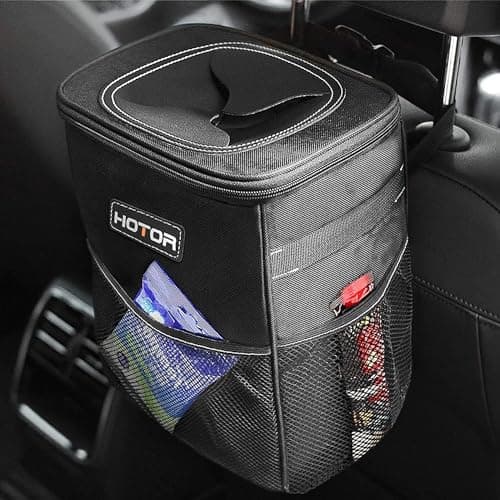
| 1 | HOTOR Car Trash Can (2 gallon) The cheapest fix for a permanently messy car | Drops in | 9.7/10 | $9.98 - view on Amazon |
| 2 | Drop Stop Seat Gap Filler Never fishing a phone out of the seat rail again | Drops in | 9.2/10 | $24.99 - view on Amazon |
| 3 | Auto Drive Hard-Sided Trunk Organizer When the load rating is the thing you care about | Drops in | 8.8/10 | Check price on Amazon |
Prices last verified October 20, 2026. They move constantly; the figure on Amazon when you click is the real one.
Why the gap exists and why it is the worst place in the car
The gap between the seat and the center console exists because the seat has to slide. It needs clearance to move fore and aft through its full travel, and that clearance is a slot running the length of the seat, positioned directly below where your hand naturally rests.
Everything that falls into it goes somewhere genuinely awkward: down among the seat rails, the motors, the wiring loom and the airbag connectors. Retrieving a phone from there means moving the seat to its extreme, reaching under, and often not finding it until you next vacuum properly.
There is also a distraction argument. A phone that drops into the gap while you are driving creates exactly the impulse you do not want — reaching down into a footwell at speed. The filler is arguably a safety accessory as much as a convenience one.
The anchoring problem, which is the whole engineering challenge
A wedge-shaped foam filler dropped into the gap works perfectly for about a week. Then the seat gets adjusted, the gap changes shape, and the filler shifts. After a month it is either pushed down out of sight or sitting proud where it catches your leg.
The Drop Stop's solution is to stop treating the gap as a fixed slot. The seat belt catch — the buckle stalk that comes up out of the seat itself — passes through a slot in the filler. Because that stalk is part of the seat, it moves when the seat moves, and the filler moves with it. The gap can change width all it likes.
What you must never block
This is a cheap accessory going into a part of the car that contains safety systems, so it is worth being specific about the exclusions.
- The seat belt buckle itself. The buckle has to be reachable and the release has to be pressable with one hand in the dark. A filler that sits over it is unacceptable
- The seat rails and travel. Nothing rigid should sit where the seat needs to move. If the seat's travel is reduced or it binds at either end, remove the filler
- Wiring and connectors under the seat. Occupant classification sensors, seat position sensors and side airbag wiring live down there. A filler resting on a connector can work it loose, and a disconnected occupant sensor typically lights a warning and can change how the airbag deploys
- The side airbag deployment path. Side airbags fire from the outer bolster of the seat, not the console side — but nothing should be wedged into the seat structure anywhere. This is the same caution that governs seat covers, covered in best car seat covers
None of that makes gap fillers dangerous. It makes the difference between a filler that sits in the gap and one that is jammed into the seat structure, which is a distinction worth making when you fit it.
Buy the pair
The console side is the gap people notice, because it is the one your hand is over. The door side has exactly the same gap, and it is worse in one respect: things that fall down there end up against the door sill where they get stepped on.
Gap fillers are normally sold in pairs for this reason. Fitting only one leaves half the problem, and the second one costs nothing extra.
The cheaper and the more thorough answers
The free version is a rolled towel, and it genuinely works — for a while. It compresses, it migrates, and it looks like a rolled towel. As a temporary fix before a long drive it is entirely reasonable.
The more thorough version is admitting that the gap is a symptom. Things fall into it because there is nowhere else to put them, which is a storage problem rather than a gap problem. A console organizer, a bin and a place for a phone address the cause — small fixes that declutter a car makes that case at length, and a phone in a mount is a phone that cannot fall anywhere at all.
For the wider organization question — footwells, back seat, trunk — start at how to organize your car.
While you are down there
Fitting a gap filler is the one time you will have clear access to the space beside the seat, and it is worth spending ten minutes with a vacuum before you close it off permanently. Whatever is down there now is what will be down there in five years.
A crevice tool or a narrow attachment is what this needs — the full method is in how to clean your car interior, and the machine choices are in best car vacuums.
Every pick, with the working
Each entry lists the specifications the maker publishes, the axis scores those specifications produce, and what you give up. Rows that read “Not published” are not omissions on our side: they are things the maker will not commit to in writing, and they cost the product points on the transparency axis. Specifications compiled September 4, 2026.
Our pickThe cheapest fix for a permanently messy car
HOTOR Car Trash Can (2 gallon)
Two gallons, 7.9 by 5.5 by 10.2 inches, Oxford cloth over a waterproof PEVA lining, with four magnetic snaps holding the bag open and a strap that fastens it to a headrest or the console. A car gets cluttered because there is nowhere to put rubbish, and this is thirteen dollars of nowhere-to-put-rubbish solved.
- Capacity
- 2 gallons (3-gallon version also sold)
- Dimensions
- 7.9 x 5.5 x 10.2 in
- Weight
- 1.0 lb
- Outer material
- Oxford cloth
- Lining
- Waterproof PEVA
- Bag retention
- 4 magnetic snaps, 2 spare bags included
- Pockets
- 3 mesh
- Mounting
- Adjustable strap with quick-release buckle
- Warranty
- Not published
List price $12.99 per Walmart listing, 2-gallon, captured on the compile date below. Not a live price and not what you will pay — the button is where the real number is.
What it gets right
- Published dimensions and capacity, so you can check it against the space beside your seat
- PEVA waterproof lining — the difference between a bin and a stain when someone puts a coffee cup in it
- Four magnetic snaps hold a liner bag open, which is the detail that makes it usable one-handed while driving
- Strap and quick-release buckle, so it attaches to something rather than sliding around the footwell
Flaws
- Two gallons is small if you carry passengers who eat in the car; the 3-gallon version exists for that
- Soft-sided, so it needs to be strapped to something or it tips
- It only works if you empty it, which is the same problem as every bin ever made
The working behind the 9.7
- Heat headroom: not scored (weight 22%)
- The maker publishes no operating-temperature ceiling, so this axis is dropped and the other weights are re-normalized.
- Install effort: 10.0 (weight 24%)
- Drops in and sits there. No fixing of any kind, and it comes out again when you sell the car.
- Price against the ceiling: 10.0 (weight 24%)
- Listed at $12.99 on the compile date. This site's buyer has a practical ceiling around $150 for a single upgrade, so the scale rewards everything under $100 and falls away sharply past $150. The live price is very often different, and that is what the button is for.
- Written commitment: not scored (weight 15%)
- No warranty term published, so this axis is dropped and the other weights are re-normalized.
- Spec transparency: 8.9 (weight 15%)
- 8 of the 9 specifications we went looking for are published by the maker (89%). A blank row is never a guess here: it prints “Not published” and it costs the product points, because a figure nobody will commit to in writing is a figure you cannot check.
Axes with no published input are dropped and the remaining weights re-normalized, so a product is not punished for a category where an axis does not apply. Specifications compiled September 4, 2026 from the HOTOR 2-gallon listing — HOTOR's own product page publishes none of these figures.
2Never fishing a phone out of the seat rail again
Drop Stop Seat Gap Filler
A neoprene wedge that fills the gap between the seat and the center console, with a slot the seatbelt catch passes through. That slot is the patent and it is the reason this one stays put where generic wedges migrate. It is more expensive than it has any right to be, and it solves a problem that genuinely happens while you are driving.
- Material
- Neoprene
- Quantity
- 2 per pack, driver and passenger
- Fit method
- Expands and contracts to the gap; seatbelt slot anchors it
- Cleaning
- Liquid and stain resistant, wipe clean
- Dimensions
- Not published
- Warranty
- Not published
List price $24.99 per Walmart listing, two-pack, captured on the compile date below. Not a live price and not what you will pay — the button is where the real number is.
What it gets right
- The seatbelt slot means it is anchored rather than wedged, which is the difference from every generic copy
- Neoprene expands and contracts to fit whatever gap your car has, so 'universal' is closer to true than usual
- Liquid and stain resistant, and it wipes clean
- Sold as a pair, so both front seats are covered
Flaws
- $25 to $40 for two pieces of shaped neoprene, depending entirely on where you buy
- It fills the gap, which also means the gap is no longer available for anything you wanted to put there
- Cars with an unusually wide gap or a console that flares will still see items get past the ends
The working behind the 9.2
- Heat headroom: not scored (weight 22%)
- The maker publishes no operating-temperature ceiling, so this axis is dropped and the other weights are re-normalized.
- Install effort: 10.0 (weight 24%)
- Drops in and sits there. No fixing of any kind, and it comes out again when you sell the car.
- Price against the ceiling: 10.0 (weight 24%)
- Listed at $24.99 on the compile date. This site's buyer has a practical ceiling around $150 for a single upgrade, so the scale rewards everything under $100 and falls away sharply past $150. The live price is very often different, and that is what the button is for.
- Written commitment: not scored (weight 15%)
- No warranty term published, so this axis is dropped and the other weights are re-normalized.
- Spec transparency: 6.7 (weight 15%)
- 4 of the 6 specifications we went looking for are published by the maker (67%). A blank row is never a guess here: it prints “Not published” and it costs the product points, because a figure nobody will commit to in writing is a figure you cannot check.
Axes with no published input are dropped and the remaining weights re-normalized, so a product is not punished for a category where an axis does not apply. Specifications compiled September 4, 2026 from Drop Stop published product description and materials.
3When the load rating is the thing you care about
Auto Drive Hard-Sided Trunk Organizer
Skip this one. A rigid organizer is the wrong shape for this job entirely. The gap changes width as the seat slides, and anything rigid either jams the seat travel or falls through. It is a good console organizer and a bad gap filler, and the two get sold to the same people.
18.5 by 16.54 by 9.96 inches with a published maximum load of 5 kilograms, which is the only organizer here that publishes a load rating at all. Hard sides mean it stands up empty, which is the opposite trade from the collapsible one: it holds its shape always and it takes its space always.
- Dimensions
- 18.5 x 16.54 x 9.96 in
- Maximum load
- 5 kg (about 11 lb)
- Construction
- Hard sided, collapsible
- Compartments
- Not published
- Securing
- Not published
- Warranty
- Not published
List price $17.82 per Walmart listing, captured on the compile date below. Not a live price and not what you will pay — the button is where the real number is.
What it gets right
- Publishes a maximum load, which nobody else in this category does
- Hard sides hold shape whether it is full or empty
- Collapses flat when you genuinely need the whole trunk
- Cheap
Flaws
- 5 kg is about eleven pounds, which is one bag of shopping and not two
- Smaller than the DRIVE Auto in every dimension
- Hard sides mean it takes its footprint even when it holds one thing
The working behind the 8.8
- Heat headroom: not scored (weight 22%)
- The maker publishes no operating-temperature ceiling, so this axis is dropped and the other weights are re-normalized.
- Install effort: 10.0 (weight 24%)
- Drops in and sits there. No fixing of any kind, and it comes out again when you sell the car.
- Price against the ceiling: 10.0 (weight 24%)
- Listed at $17.82 on the compile date. This site's buyer has a practical ceiling around $150 for a single upgrade, so the scale rewards everything under $100 and falls away sharply past $150. The live price is very often different, and that is what the button is for.
- Written commitment: not scored (weight 15%)
- No warranty term published, so this axis is dropped and the other weights are re-normalized.
- Spec transparency: 5.0 (weight 15%)
- 3 of the 6 specifications we went looking for are published by the maker (50%). A blank row is never a guess here: it prints “Not published” and it costs the product points, because a figure nobody will commit to in writing is a figure you cannot check.
Axes with no published input are dropped and the remaining weights re-normalized, so a product is not punished for a category where an axis does not apply. Specifications compiled September 4, 2026 from Auto Drive hard-sided trunk organizer listing.
Prices last verified October 20, 2026. They move constantly; the figure on Amazon when you click is the real one.
Questions people actually ask
Will a gap filler stop my seat from sliding?
A correctly fitted soft filler should not. If your seat binds or its travel is reduced after fitting one, take it out — the filler has been pushed into the rail area, which is not where it belongs.
Do gap fillers work on every car?
The belt-anchored design needs a buckle stalk that comes up out of the seat. Cars that mount the buckle on the console or floor have nothing to anchor to. Check yours before buying.
Can I put one on the door side too?
Yes, and you should — they are normally sold in pairs. The door-side gap is the same problem and the things that fall into it end up underfoot.
Is there anything I should not put a filler near?
Keep it clear of the seat belt buckle, the seat rails and any wiring or connectors under the seat. Occupant sensors and side airbag wiring live there, and a filler resting on a connector can disturb it.