The best car armrest cushions
A cheap fix for a console that sits too low — and a symptom of a seating position that is probably worth checking first.
By Sawyer V. · Published · How we research
We have not tested any of this. Everything below is compiled from published manufacturer specifications, and the arithmetic is printed so you can check it. This page carries affiliate links: if you buy through one we earn a commission at no extra cost to you, and it does not change the order of the picks. Full disclosure.
The short answer
Thickness is the specification, and it is the only one published. Pads typically run 12.6 to 13.8 inches long and 1.5 to 3 inches thick, and it is the thickness that determines how much higher your elbow sits. Nothing in the category publishes a foam density, which is what decides whether it stays that thick under your arm or compresses flat within a month.
| # | Pick | Install | Score | Price |
|---|---|---|---|---|
| 1 | Everlasting Comfort Lumbar Support Pillow Filling the gap your seat leaves | Drops in | 9.5/10 | $39.99 - view on Amazon |
| 2 | ComfiLife Gel Enhanced Seat Cushion The standard answer for a long drive | Drops in | 9.3/10 | $41.36 - view on Amazon |
| 3 | Memory Foam Center Console Armrest Cushion Raising a console that sits too low | Drops in | 8.3/10 | $17.99 - view on Amazon |
Prices last verified October 26, 2026. They move constantly; the figure on Amazon when you click is the real one.
Measure three things before buying
Universal fit in this category means one fixed size with elastic straps, so fitment is on you.
- Console lid length and width. Published pads cluster around 12.6-13.8 inches long by 7-8 inches wide. Much shorter than your lid and it slides; much longer and it overhangs into the cupholders
- The gap you are trying to close. Sit normally, rest your arm where it wants to be, and measure down to the lid. That is the thickness you need, and it is usually less than people assume
- Clearance above the lid. A 3 inch pad on a sliding console lid can foul the lid's travel, and on some cars it can interfere with the gear selector or the parking brake
The reason your elbow does not reach
This is the part of the page that might save you the purchase.
A console armrest is at a fixed height. If your elbow does not reach it comfortably, either the console is genuinely low for your build, or you are sitting lower or further back than you should be.
The second is common and it has knock-on effects. A seat set too low means you are also looking through less windshield, reaching further for the wheel, and holding your arms up rather than resting them — which is shoulder and neck fatigue on a long drive rather than an elbow problem.
Work through the sequence before buying anything: seat height, seat base tilt, backrest angle, then wheel reach and rake. Most drivers have never touched three of those — how to set up your driving position.
If you are at one end of the height range, the fit problems are specific and so are the fixes — best car accessories for tall and short drivers.
What a pad genuinely fixes
Three real cases where the seat is set correctly and the pad is the right answer.
| Complaint | Cushion? | Better answer |
|---|---|---|
| Console lid is hard plastic | Yes | — |
| Console sits an inch too low for you | Yes | — |
| Lid surface is scratched or worn | Yes | — |
| Shoulder aches on long drives | No | Seat height and backrest angle |
| Reaching for the wheel | No | Wheel reach adjustment |
| Lower back aches | No | Lumbar support |
| Thighs unsupported | No | Seat base tilt or a wedge cushion |
A hard plastic console lid against a bare elbow for an hour is genuinely uncomfortable and genuinely solved by a few dollars of foam. That is the honest case for the product and it is a decent one.
Fitting one that stays put
Every pad in this category attaches with elastic bands, hook-and-loop straps, or both around the console lid.
Neither is adhesive, which is correct — adhesive on a console lid is permanent, and a console lid usually opens, which means the adhesive is holding against a hinge action every time.
- Check the lid still opens with the pad fitted. On some consoles the straps cross the hinge line and bind
- Check the cover comes off. This is a surface your forearm rests on daily, and most versions have a removable washable cover — which is the difference between a two-year item and a six-month one
- Expect some sliding on leather. Elastic over a smooth leather lid grips less well than over fabric
The rest of the contact points
An armrest is one of five places your body touches the car, and it is the cheapest of them to fix. The others cost more and matter more on a long drive.
The seat base, where thigh support decides whether an hour is comfortable — best seat cushions for long drives. The lower back, where the fix is a shape change rather than padding — best lumbar supports, and which of the two you need is worked out in seat cushion vs lumbar support.
And the steering wheel, which is the contact point people notice least and hold longest — best steering wheel covers.
If the underlying complaint is tiredness rather than any single contact point, the cheapest intervention is not a product at all — how to reduce driver fatigue.
Every pick, with the working
Each entry lists the specifications the maker publishes, the axis scores those specifications produce, and what you give up. Rows that read “Not published” are not omissions on our side: they are things the maker will not commit to in writing, and they cost the product points on the transparency axis. Specifications compiled September 4, 2026.
Our pickFilling the gap your seat leaves
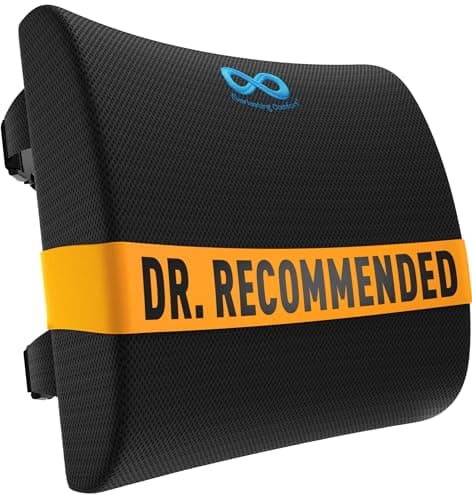
Everlasting Comfort Lumbar Support Pillow
High-density memory foam on a dual-strap harness, and the only support in this category to cite named third-party standards: Everlasting Comfort states the foam is CertiPUR-US certified and the covers are OEKO-TEX certified, under a published lifetime replacement-or-money-back guarantee. What it does not publish, anywhere on its own product page, is a single dimension — and depth is the one figure that decides whether a lumbar support fits you.
- Depth (the fit figure)
- 3.5 in per the listing; the maker publishes none
- Dimensions
- 13 x 3.5 in per the listing; its 0.1 in height is not credible
- Weight
- 1.5 lb per the listing; the maker publishes none
- Material
- High-density memory foam, CertiPUR-US certified
- Cover
- Removable and breathable; the maker does not name the material
- Attachment
- Dual adjustable straps with extension pieces, removable
- Fits seats up to
- 32 in wide, per the listing
- Certifications
- CertiPUR-US foam, OEKO-TEX covers
- Warranty
- Lifetime replacement or money back, published
- Foam density figure
- Not published
- Maker-published dimensions
- Not published
List price $39.99 per Everlasting Comfort's own store, sale price (regular $44.95), captured on the compile date below. Not a live price and not what you will pay — the button is where the real number is.
What it gets right
- CertiPUR-US certified foam and OEKO-TEX certified covers, both stated by the maker — named external standards are rare anywhere in car accessories
- Lifetime replacement-or-money-back guarantee published, plus a stated lifetime warranty against defects on non-electronic products
- Dual adjustable straps with extension pieces rather than one, which is what stops it walking down the seat back
- Removable, breathable cover, and the listing fits it to seats up to 32 in wide
Flaws
- Everlasting Comfort's own product page publishes no dimensions at all — not length, width, depth or weight
- The depth figure therefore comes from the retail listing, and the listing's own dimension set includes a 0.1 in height that cannot be right
- Marketed first as an office chair cushion; car use is one application among several and no car-specific testing is claimed
- No foam density figure published, so CertiPUR-US tells you what the foam is not made of rather than how firm it is
The working behind the 9.5
- Heat headroom: not scored (weight 22%)
- The maker publishes no operating-temperature ceiling, so this axis is dropped and the other weights are re-normalized.
- Install effort: 10.0 (weight 24%)
- Drops in and sits there. No fixing of any kind, and it comes out again when you sell the car.
- Price against the ceiling: 9.5 (weight 24%)
- Listed at $39.99 on the compile date. This site's buyer has a practical ceiling around $150 for a single upgrade, so the scale rewards everything under $100 and falls away sharply past $150. The live price is very often different, and that is what the button is for.
- Written commitment: 10.0 (weight 15%)
- 1200-month warranty. This is the only promise in the entire listing that a court would read, which is why it is scored and the marketing copy is not.
- Spec transparency: 8.2 (weight 15%)
- 9 of the 11 specifications we went looking for are published by the maker (82%). A blank row is never a guess here: it prints “Not published” and it costs the product points, because a figure nobody will commit to in writing is a figure you cannot check.
Axes with no published input are dropped and the remaining weights re-normalized, so a product is not punished for a category where an axis does not apply. Specifications compiled September 4, 2026 from the Everlasting Comfort retail listing (the maker's own page publishes no dimensions).
2The standard answer for a long drive
ComfiLife Gel Enhanced Seat Cushion
17.5 by 13.7 by 2.8 inches of high-density memory foam with a gel layer on top, a non-slip rubber base and a washable cover. The published geometry is what matters here: 2.8 inches is enough lift to change your hip angle and not so much that your head moves toward the headliner in a low car. Measure your seat-to-roof clearance before you buy.
- Dimensions
- 17.5 L x 13.7 W x 2.8 H in
- Weight
- 1.45 lb
- Core material
- High-density memory foam
- Top layer
- Cooling gel
- Base
- Non-slip rubber
- Cover
- Machine-washable zippered velour, OEKO-TEX certified
- Foam density figure
- Not published
- Warranty
- Lifetime money back or replacement, stated
List price $59.94 per ComfiLife's own store, captured on the compile date below. Not a live price and not what you will pay — the button is where the real number is.
What it gets right
- Published dimensions, which most cushions in this category do not give you
- 2.8 in of lift changes the hip angle without wrecking your seating position
- Non-slip rubber base, so it stays where you put it when you get in
- Cover comes off and goes in the machine, which after one summer matters
Flaws
- 2.8 in of lift is a real change to your relationship with the roof, the mirrors and the belt path
- ComfiLife does not publish a foam density figure, only the words high density
- $59.94 list is a lot for foam
The working behind the 9.3
- Heat headroom: not scored (weight 22%)
- The maker publishes no operating-temperature ceiling, so this axis is dropped and the other weights are re-normalized.
- Install effort: 10.0 (weight 24%)
- Drops in and sits there. No fixing of any kind, and it comes out again when you sell the car.
- Price against the ceiling: 9.0 (weight 24%)
- Listed at $59.94 on the compile date. This site's buyer has a practical ceiling around $150 for a single upgrade, so the scale rewards everything under $100 and falls away sharply past $150. The live price is very often different, and that is what the button is for.
- Written commitment: not scored (weight 15%)
- No warranty term published, so this axis is dropped and the other weights are re-normalized.
- Spec transparency: 8.8 (weight 15%)
- 7 of the 8 specifications we went looking for are published by the maker (88%). A blank row is never a guess here: it prints “Not published” and it costs the product points, because a figure nobody will commit to in writing is a figure you cannot check.
Axes with no published input are dropped and the remaining weights re-normalized, so a product is not punished for a category where an axis does not apply. Specifications compiled September 4, 2026 from ComfiLife's Gel Enhanced Seat Cushion page.
3Raising a console that sits too low
Memory Foam Center Console Armrest Cushion
Skip this one. Its own skip, for a specific reason. If your elbow does not reach the console comfortably, the cause is often that the seat is set too low or too far back rather than that the console is too low — and raising your arm support without fixing the seat locks in a posture that causes shoulder and neck ache on long drives. Set the seat properly first. If the gap is still there, then buy the pad.
A foam pad strapped over the center console lid, and the only specification worth reading is its thickness — because that is what changes where your elbow sits. Published dimensions around 12.6 to 13.8 inches long and 1.5 to 3 inches thick cover most of the category.
- Length
- Commonly 12.6-13.8 in
- Thickness
- Commonly 1.5-3 in
- Fitting
- Elastic bands and hook-and-loop
- Foam density
- Not published
- Cover
- Removable and washable on most versions
- Warranty
- Not published
- List price
- Not published
What it gets right
- Published dimensions on most listings, commonly around 12.6-13.8 in long by 7-8 in wide
- Published thickness, typically 1.5 to 3 in, which is the figure that determines the height change
- Elastic band and hook-and-loop fitting, so nothing adhesive touches the console lid
- Removable washable covers on most versions
Flaws
- Nothing in this category publishes a foam density, which is what determines whether it compresses flat under an elbow
- A thick pad can foul the console lid opening or the gear selector on some cars
- 'Universal fit' with a fixed size means it will overhang or underfill many consoles
- No warranty published anywhere in the category
The working behind the 8.3
- Heat headroom: not scored (weight 22%)
- The maker publishes no operating-temperature ceiling, so this axis is dropped and the other weights are re-normalized.
- Install effort: 10.0 (weight 24%)
- Drops in and sits there. No fixing of any kind, and it comes out again when you sell the car.
- Price against the ceiling: not scored (weight 24%)
- No published list price we could cite on the compile date, so this axis is dropped and the other weights are re-normalized.
- Written commitment: not scored (weight 15%)
- No warranty term published, so this axis is dropped and the other weights are re-normalized.
- Spec transparency: 5.7 (weight 15%)
- 4 of the 7 specifications we went looking for are published by the maker (57%). A blank row is never a guess here: it prints “Not published” and it costs the product points, because a figure nobody will commit to in writing is a figure you cannot check.
Axes with no published input are dropped and the remaining weights re-normalized, so a product is not punished for a category where an axis does not apply. Specifications compiled September 4, 2026 from Published dimensions, thickness and fitting method.
Prices last verified October 26, 2026. They move constantly; the figure on Amazon when you click is the real one.
Questions people actually ask
What thickness armrest cushion should I get?
Measure it. Sit normally, rest your arm where it naturally wants to sit, and measure down to the console lid. Published pads run 1.5 to 3 inches thick and the gap is usually smaller than people assume.
Do armrest cushions flatten out?
Some do, and nothing in the category publishes a foam density — which is the figure that would tell you. The practical test is whether you can compress it to nothing between finger and thumb.
Will an armrest cushion help shoulder pain?
Probably not, and it may lock in the cause. Shoulder ache while driving is usually seat height or backrest angle rather than arm support. Set the seat properly first and see whether the complaint survives.
Will it fit my console?
Measure the lid. Pads cluster around 12.6-13.8 in long by 7-8 in wide, attach with elastic and hook-and-loop, and a thick one can foul a sliding lid or the gear selector on some cars.