The best car neck pillows
Almost every neck pillow is designed for an aircraft seat, and a car headrest is a different shape entirely. The difference is the back of the pillow.
By Sawyer V. · Published · How we research
We have not tested any of this. Everything below is compiled from published manufacturer specifications, and the arithmetic is printed so you can check it. This page carries affiliate links: if you buy through one we earn a commission at no extra cost to you, and it does not change the order of the picks. Full disclosure.
The short answer
Buy the Cabeau Evolution S3, and only for passengers. The flat back is the entire reason: a conventional horseshoe pillow is round all the way around, so it wedges between your head and the headrest and pushes your head forward — the opposite of what you want. The S3's strap system also anchors it to the seat, which addresses head drop rather than neck support. Do not wear a neck pillow while driving. It restricts the shoulder check.
| # | Pick | Install | Score | Price |
|---|---|---|---|---|
| 1 | Everlasting Comfort Lumbar Support Pillow Filling the gap your seat leaves | Drops in | 9.5/10 | $39.99 - view on Amazon |
| 2 | ComfiLife Gel Enhanced Seat Cushion The standard answer for a long drive | Drops in | 9.3/10 | $41.36 - view on Amazon |
| 3 | Cabeau Evolution S3 Travel Pillow A passenger who actually sleeps | Drops in | 9.2/10 | $39.99 - view on Amazon |
Prices last verified October 20, 2026. They move constantly; the figure on Amazon when you click is the real one.
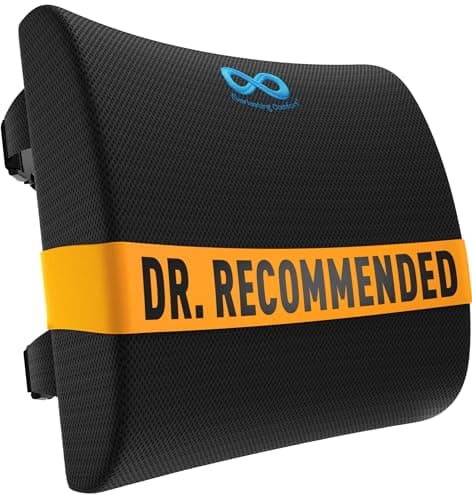
The flat back is the whole product
Most neck pillows are a closed horseshoe: the same thickness at the back of your neck as at the sides. On an aircraft that is tolerable because the seat back is soft and reclines. In a car it is actively counterproductive.
A car headrest sits forward of the seat back by design — it is positioned to catch your head in a rear impact, so it is already close to you. Add a couple of inches of foam behind your neck and your head is pushed forward of where it wants to sit, which is precisely the posture that produces neck strain in the first place.
A pillow with a flat, thin back fits into the gap that actually exists between your neck and the seat, and leaves your head resting where the headrest intended.
The real problem is head drop, not neck support
Ask someone what wakes them up in a car and it is rarely neck ache. It is the moment their head falls sideways or forward and jerks them awake. That happens because muscle tone drops as you fall asleep, and nothing is holding your head.
Side supports address the sideways version. Almost nothing addresses forward drop, which is the one that actually wakes people, because a pillow resting on your shoulders has no anchor — it falls forward with your head.
Cabeau's strap system is the exception: it connects the pillow to the seat back, so the pillow stays put and your head has something to fall against. Whether that matters depends entirely on whether you are trying to sleep or just to be comfortable.
Fit is a specification, and one of the few published
The Cabeau publishes a neck size range of 12 to 18 inches. That is genuinely useful and almost unique — most of this category publishes nothing but a color and a fill material.
Outside that range the front clasp is the limiting factor: too small and it will not close, too large and the pillow rotates around your neck rather than staying put. Measure before buying; a pillow that does not fit does nothing at all.
Memory foam, microbeads and inflatable
- Memory foam holds a shape and supports consistently. It is heavier, it does not pack down small unless the product is designed to compress, and it gets warm against your neck. The Cabeau is CertiPUR-US certified, which speaks to what is in the foam rather than how it performs
- Microbeads shift under load, so support is inconsistent and tends to migrate away from where you need it. They are cheap and they pack small
- Inflatable packs smallest by a wide margin and supports worst. Inflation pressure is a trade between too firm and too soft, and it changes with temperature
For a car — where packing size barely matters because it lives on the back seat — memory foam is the obvious choice. The reasoning flips entirely if you are buying for flights.
The thing nobody checks until it is too late
A neck pillow is in contact with skin and hair for hours at a time, in a car that gets hot. A removable, washable cover is not a luxury feature, and a pillow without one becomes unpleasant within a season.
Quick-dry fabric matters for the same reason: a cover that takes two days to dry is a cover that does not get washed. The Cabeau publishes both a removable washable cover and a quick-dry fabric, which between them are more useful than any comfort claim.
When a neck pillow is the wrong purchase
If the discomfort starts in your lower back and works upward, a neck pillow will not help. That pattern usually points at pelvic tilt from a seat base that slopes, and the fix is underneath you rather than behind your head — see best seat cushions for long drives and best lumbar supports.
If it is fatigue rather than pain, the answer is scheduling rather than equipment — how to reduce driver fatigue covers what actually works. And if you are buying for a child in a car seat, do not: aftermarket head supports that did not come with the seat are not part of its tested configuration.
We describe geometry, materials and what manufacturers publish. We do not diagnose anything and we make no medical claims — if you have persistent neck pain, that is a conversation for a clinician rather than a shopping decision.
Every pick, with the working
Each entry lists the specifications the maker publishes, the axis scores those specifications produce, and what you give up. Rows that read “Not published” are not omissions on our side: they are things the maker will not commit to in writing, and they cost the product points on the transparency axis. Specifications compiled September 4, 2026.
Our pickFilling the gap your seat leaves
Everlasting Comfort Lumbar Support Pillow
High-density memory foam on a dual-strap harness, and the only support in this category to cite named third-party standards: Everlasting Comfort states the foam is CertiPUR-US certified and the covers are OEKO-TEX certified, under a published lifetime replacement-or-money-back guarantee. What it does not publish, anywhere on its own product page, is a single dimension — and depth is the one figure that decides whether a lumbar support fits you.
- Depth (the fit figure)
- 3.5 in per the listing; the maker publishes none
- Dimensions
- 13 x 3.5 in per the listing; its 0.1 in height is not credible
- Weight
- 1.5 lb per the listing; the maker publishes none
- Material
- High-density memory foam, CertiPUR-US certified
- Cover
- Removable and breathable; the maker does not name the material
- Attachment
- Dual adjustable straps with extension pieces, removable
- Fits seats up to
- 32 in wide, per the listing
- Certifications
- CertiPUR-US foam, OEKO-TEX covers
- Warranty
- Lifetime replacement or money back, published
- Foam density figure
- Not published
- Maker-published dimensions
- Not published
List price $39.99 per Everlasting Comfort's own store, sale price (regular $44.95), captured on the compile date below. Not a live price and not what you will pay — the button is where the real number is.
What it gets right
- CertiPUR-US certified foam and OEKO-TEX certified covers, both stated by the maker — named external standards are rare anywhere in car accessories
- Lifetime replacement-or-money-back guarantee published, plus a stated lifetime warranty against defects on non-electronic products
- Dual adjustable straps with extension pieces rather than one, which is what stops it walking down the seat back
- Removable, breathable cover, and the listing fits it to seats up to 32 in wide
Flaws
- Everlasting Comfort's own product page publishes no dimensions at all — not length, width, depth or weight
- The depth figure therefore comes from the retail listing, and the listing's own dimension set includes a 0.1 in height that cannot be right
- Marketed first as an office chair cushion; car use is one application among several and no car-specific testing is claimed
- No foam density figure published, so CertiPUR-US tells you what the foam is not made of rather than how firm it is
The working behind the 9.5
- Heat headroom: not scored (weight 22%)
- The maker publishes no operating-temperature ceiling, so this axis is dropped and the other weights are re-normalized.
- Install effort: 10.0 (weight 24%)
- Drops in and sits there. No fixing of any kind, and it comes out again when you sell the car.
- Price against the ceiling: 9.5 (weight 24%)
- Listed at $39.99 on the compile date. This site's buyer has a practical ceiling around $150 for a single upgrade, so the scale rewards everything under $100 and falls away sharply past $150. The live price is very often different, and that is what the button is for.
- Written commitment: 10.0 (weight 15%)
- 1200-month warranty. This is the only promise in the entire listing that a court would read, which is why it is scored and the marketing copy is not.
- Spec transparency: 8.2 (weight 15%)
- 9 of the 11 specifications we went looking for are published by the maker (82%). A blank row is never a guess here: it prints “Not published” and it costs the product points, because a figure nobody will commit to in writing is a figure you cannot check.
Axes with no published input are dropped and the remaining weights re-normalized, so a product is not punished for a category where an axis does not apply. Specifications compiled September 4, 2026 from the Everlasting Comfort retail listing (the maker's own page publishes no dimensions).
2The standard answer for a long drive
ComfiLife Gel Enhanced Seat Cushion
Skip this one. It is in this list only to make a point about where discomfort on a long drive actually comes from. If your neck aches after three hours, the cause is very often the seat base tilting your pelvis, not the headrest — and a seat cushion addresses that where a neck pillow cannot.
17.5 by 13.7 by 2.8 inches of high-density memory foam with a gel layer on top, a non-slip rubber base and a washable cover. The published geometry is what matters here: 2.8 inches is enough lift to change your hip angle and not so much that your head moves toward the headliner in a low car. Measure your seat-to-roof clearance before you buy.
- Dimensions
- 17.5 L x 13.7 W x 2.8 H in
- Weight
- 1.45 lb
- Core material
- High-density memory foam
- Top layer
- Cooling gel
- Base
- Non-slip rubber
- Cover
- Machine-washable zippered velour, OEKO-TEX certified
- Foam density figure
- Not published
- Warranty
- Lifetime money back or replacement, stated
List price $59.94 per ComfiLife's own store, captured on the compile date below. Not a live price and not what you will pay — the button is where the real number is.
What it gets right
- Published dimensions, which most cushions in this category do not give you
- 2.8 in of lift changes the hip angle without wrecking your seating position
- Non-slip rubber base, so it stays where you put it when you get in
- Cover comes off and goes in the machine, which after one summer matters
Flaws
- 2.8 in of lift is a real change to your relationship with the roof, the mirrors and the belt path
- ComfiLife does not publish a foam density figure, only the words high density
- $59.94 list is a lot for foam
The working behind the 9.3
- Heat headroom: not scored (weight 22%)
- The maker publishes no operating-temperature ceiling, so this axis is dropped and the other weights are re-normalized.
- Install effort: 10.0 (weight 24%)
- Drops in and sits there. No fixing of any kind, and it comes out again when you sell the car.
- Price against the ceiling: 9.0 (weight 24%)
- Listed at $59.94 on the compile date. This site's buyer has a practical ceiling around $150 for a single upgrade, so the scale rewards everything under $100 and falls away sharply past $150. The live price is very often different, and that is what the button is for.
- Written commitment: not scored (weight 15%)
- No warranty term published, so this axis is dropped and the other weights are re-normalized.
- Spec transparency: 8.8 (weight 15%)
- 7 of the 8 specifications we went looking for are published by the maker (88%). A blank row is never a guess here: it prints “Not published” and it costs the product points, because a figure nobody will commit to in writing is a figure you cannot check.
Axes with no published input are dropped and the remaining weights re-normalized, so a product is not punished for a category where an axis does not apply. Specifications compiled September 4, 2026 from ComfiLife's Gel Enhanced Seat Cushion page.
3A passenger who actually sleeps
Cabeau Evolution S3 Travel Pillow
The only neck pillow here that solves the real problem, which is not neck support but head drop. A strap system anchors it to the seat back so your head cannot fall forward, and the flat back means it does not push your head off the headrest the way a horseshoe pillow does.
- Weight
- 11.6 oz
- Neck size range
- 12-18 in
- Fill
- CertiPUR-US certified memory foam
- Back profile
- Flat (patented thin flat back)
- Anchoring
- S3 seat strap system plus adjustable front clasp
- Cover
- Removable and washable, quick-dry fabric
- Packed size
- About one third of full size, in the included bag
- List price
- Not published
- Warranty
- Not published
What it gets right
- The flat back is the whole point — a round pillow wedges between your head and the headrest and pushes you forward
- Seat strap system anchors it to the seat so your head does not drop, which is what actually wakes you up
- CertiPUR-US certified memory foam and a removable, washable cover
- Packs to about a third of its size in the included bag
Flaws
- Passenger only. Do not wear a neck pillow while driving — it restricts your shoulder check
- Fits neck sizes 12-18 inches; outside that range the front clasp is the limit
- No published warranty term
The working behind the 9.2
- Heat headroom: not scored (weight 22%)
- The maker publishes no operating-temperature ceiling, so this axis is dropped and the other weights are re-normalized.
- Install effort: 10.0 (weight 24%)
- Drops in and sits there. No fixing of any kind, and it comes out again when you sell the car.
- Price against the ceiling: not scored (weight 24%)
- No published list price we could cite on the compile date, so this axis is dropped and the other weights are re-normalized.
- Written commitment: not scored (weight 15%)
- No warranty term published, so this axis is dropped and the other weights are re-normalized.
- Spec transparency: 7.8 (weight 15%)
- 7 of the 9 specifications we went looking for are published by the maker (78%). A blank row is never a guess here: it prints “Not published” and it costs the product points, because a figure nobody will commit to in writing is a figure you cannot check.
Axes with no published input are dropped and the remaining weights re-normalized, so a product is not punished for a category where an axis does not apply. Specifications compiled September 4, 2026 from Cabeau Evolution S3 published specifications.
Prices last verified October 20, 2026. They move constantly; the figure on Amazon when you click is the real one.
Questions people actually ask
Can I use a neck pillow while driving?
No. It restricts head rotation, and turning your head is how you check a blind spot. Use one as a passenger. If driving is uncomfortable, adjust the seat and headrest position instead.
Why does my neck pillow push my head forward?
Because it is a full horseshoe with foam behind your neck, and a car headrest already sits forward. A pillow with a flat, thin back fits the gap that actually exists rather than creating a new one.
Are memory foam neck pillows too hot for a car?
They are warmer than microbead or inflatable pillows, and a car is already warm. A quick-dry, breathable cover helps materially. If you drive somewhere genuinely hot, the bigger win is keeping the cabin cool in the first place.
Will a neck pillow help with car sickness?
Not directly. Motion sickness comes from a mismatch between what your eyes and inner ear report. Keeping your head still against a seat can reduce that mismatch slightly, which is a side effect rather than a design purpose, and we make no claim beyond that.