The best car accessories for long drives
A long drive is a different problem from a commute. Comfort compounds over hours instead of minutes, several people need power at once, and help is further away. Six picks ranked for that, not for the daily grind.
By Sawyer V. · Published · How we research
We have not tested any of this. Everything below is compiled from published manufacturer specifications, and the arithmetic is printed so you can check it. This page carries affiliate links: if you buy through one we earn a commission at no extra cost to you, and it does not change the order of the picks. Full disclosure.
The short answer
Comfort first, then power, then self-sufficiency. On a commute a bad seating position is twenty minutes of mild irritation; on a six-hour drive it is the entire experience, which is why a seat cushion moves from optional to first on this list. Then a three-port charger, because a long drive has several people and several devices in it. Then a jump starter and a tire inflator, because a problem two hundred miles from home is a different problem from the same one on your own driveway.
| # | Pick | Install | Score | Price |
|---|---|---|---|---|
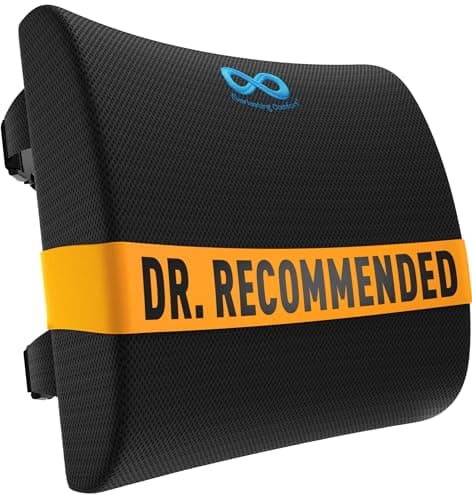
| 1 | Everlasting Comfort Lumbar Support Pillow Filling the gap your seat leaves | Drops in | 9.5/10 | $39.99 - view on Amazon |
| 2 | ComfiLife Gel Enhanced Seat Cushion The standard answer for a long drive | Drops in | 9.3/10 | $41.36 - view on Amazon |
| 3 | AstroAI Portable Tire Inflator (150 PSI) Topping up four tires in a driveway | Plugs in | 9.1/10 | $26.99 - view on Amazon |
| 4 | Anker 335 Car Charger (67W) Three devices, no arguments | Plugs in | 9.0/10 | $42.99 - view on Amazon |
| 5 | Kinder Fluff Windshield Sun Shade The only UV claim here with a certification behind it | Drops in | 9.0/10 | Check price on Amazon |
| 6 | NOCO Boost Plus GB40 Not needing anybody else's car | Plugs in | 8.0/10 | Check price on Amazon |
Prices last verified October 19, 2026. They move constantly; the figure on Amazon when you click is the real one.
Why this list is not the commuter list
The commuter list is ordered by how often you touch something, because a commute is short and repeated. A long drive inverts three things:
All of it assumes the car is yours. If you are flying somewhere and picking up a car you have never seen, the constraint changes completely — nothing permanent, nothing adhesive, everything in a carry-on. That is the rental car list.
- Comfort compounds. A seating position that is slightly wrong is unnoticeable for twenty minutes and dominant after four hours.
- Power demand multiplies. A commute is one phone. A road trip is a driver's phone on navigation, a passenger's phone, a tablet in the back, and possibly a laptop at a stop.
- Help gets further away. A flat tire on your own driveway is an inconvenience. The same tire two hundred miles from home, on a Sunday, is a different category of problem.
1. Comfort, and measure before you buy
A seat cushion raises the back of your hips relative to the front, tilting your pelvis slightly forward and taking weight off the tailbone. Over four hours that is the difference between arriving fine and arriving stiff.
Two numbers to check first, both of which take a tape measure: your seat-to-roof clearance, because a 2.8-inch cushion removes 2.8 inches from it; and the gap behind your lower back, because a lumbar support deeper than your gap pushes you forward rather than supporting you.
The cushion page ranks on published thickness and the lumbar page on published depth, for exactly this reason. And reset every mirror afterwards — any cushion moves your head.
2. A charger with three ports
This is the one place where a long drive genuinely needs more than a commute. A two-port charger is fine for one person; a car with a family in it runs out of ports before it runs out of battery.
What matters is the per-port ceiling rather than the total. A charger advertised at 67 W may cap each port at 35 W, which is fine because nothing with a phone battery draws more than that — but it is worth knowing which number you are reading. The head-to-head puts two published tables side by side, and the wattage page does the arithmetic.
One long-drive-specific point: bring cables that are long enough to reach the back seat. A three-port charger with three two-foot cables is a two-port charger.
3. The two things that matter when help is far away
A jump starter and a tire inflator. Neither is exciting, both live in the trunk and get forgotten, and both are worth many times their price on the day.
- The jump starter. 1,000 peak amps in a 2.4-pound pack. Check the published engine-size ceiling against your car — NOCO publishes gasoline to 6.0 liters and diesel to 3.0 for the GB40 — and charge it before the trip, because a lithium pack that has sat in a trunk all summer is not at the charge it reports. The jump starter page.
- The inflator. A socket-powered pump with a published duty cycle of 15 minutes on and 10 minutes cooling will top up four tires comfortably. It will not fill one from flat, and knowing which tool you have matters more at the roadside than in the driveway. The inflator page.
4. The shade, for the stops rather than the drive
On a road trip the car spends hours parked in unfamiliar places at the hottest part of the day — trailheads, lots, roadside stops — and getting back into a car that has been in full sun for three hours is genuinely unpleasant.
Under $25, and it protects the dashboard, the wheel and anything electronic you left in there. The keeping-cool guide covers the free tactics that go with it, including parking angle and cracking the windows.
The pre-trip checklist
| Check | Why | Time |
|---|---|---|
| Tire pressures, cold | They fall about a pound a month and more with temperature | 5 min |
| Jump starter charge | Lithium self-discharges; a summer in a trunk matters | 1 min |
| Windshield, inside | Plasticizer film is the main cause of night glare | 5 min |
| Washer fluid | The one you notice at the worst moment | 2 min |
| Dash cam card | Format it in the camera and confirm it records | 2 min |
Tire pressures should be checked cold, before driving — they rise several PSI once warm. Use the figure on the sticker in your door jamb, not the number on the tire sidewall, which is the tire's maximum rather than your car's recommendation.
What not to leave in the car at a stop
Anything with a lithium battery, which includes the jump starter you brought precisely so it would be there. Heat shortens its life, and a hot trunk on a summer road trip is the worst environment it will ever see. Also: aerosols, sunscreen, anything in a plastic bottle you intend to drink, and anything electronic you care about.
A dash cam is the exception, because it is designed for the environment — and the good ones publish a temperature ceiling to prove it, which is unusual enough that it has its own page.
Every pick, with the working
Each entry lists the specifications the maker publishes, the axis scores those specifications produce, and what you give up. Rows that read “Not published” are not omissions on our side: they are things the maker will not commit to in writing, and they cost the product points on the transparency axis. Specifications compiled September 4, 2026.
Our pickFilling the gap your seat leaves
Everlasting Comfort Lumbar Support Pillow
Skip this one. Excellent if your seat leaves a genuine gap behind your lower back. If it does not — and many seats with the lumbar adjustment wound out do not — a pillow around three and a half to four inches deep pushes you forward instead of supporting you, which is worse than nothing. Measure your gap before this one, not after.
High-density memory foam on a dual-strap harness, and the only support in this category to cite named third-party standards: Everlasting Comfort states the foam is CertiPUR-US certified and the covers are OEKO-TEX certified, under a published lifetime replacement-or-money-back guarantee. What it does not publish, anywhere on its own product page, is a single dimension — and depth is the one figure that decides whether a lumbar support fits you.
- Depth (the fit figure)
- 3.5 in per the listing; the maker publishes none
- Dimensions
- 13 x 3.5 in per the listing; its 0.1 in height is not credible
- Weight
- 1.5 lb per the listing; the maker publishes none
- Material
- High-density memory foam, CertiPUR-US certified
- Cover
- Removable and breathable; the maker does not name the material
- Attachment
- Dual adjustable straps with extension pieces, removable
- Fits seats up to
- 32 in wide, per the listing
- Certifications
- CertiPUR-US foam, OEKO-TEX covers
- Warranty
- Lifetime replacement or money back, published
- Foam density figure
- Not published
- Maker-published dimensions
- Not published
List price $39.99 per Everlasting Comfort's own store, sale price (regular $44.95), captured on the compile date below. Not a live price and not what you will pay — the button is where the real number is.
What it gets right
- CertiPUR-US certified foam and OEKO-TEX certified covers, both stated by the maker — named external standards are rare anywhere in car accessories
- Lifetime replacement-or-money-back guarantee published, plus a stated lifetime warranty against defects on non-electronic products
- Dual adjustable straps with extension pieces rather than one, which is what stops it walking down the seat back
- Removable, breathable cover, and the listing fits it to seats up to 32 in wide
Flaws
- Everlasting Comfort's own product page publishes no dimensions at all — not length, width, depth or weight
- The depth figure therefore comes from the retail listing, and the listing's own dimension set includes a 0.1 in height that cannot be right
- Marketed first as an office chair cushion; car use is one application among several and no car-specific testing is claimed
- No foam density figure published, so CertiPUR-US tells you what the foam is not made of rather than how firm it is
The working behind the 9.5
- Heat headroom: not scored (weight 22%)
- The maker publishes no operating-temperature ceiling, so this axis is dropped and the other weights are re-normalized.
- Install effort: 10.0 (weight 24%)
- Drops in and sits there. No fixing of any kind, and it comes out again when you sell the car.
- Price against the ceiling: 9.5 (weight 24%)
- Listed at $39.99 on the compile date. This site's buyer has a practical ceiling around $150 for a single upgrade, so the scale rewards everything under $100 and falls away sharply past $150. The live price is very often different, and that is what the button is for.
- Written commitment: 10.0 (weight 15%)
- 1200-month warranty. This is the only promise in the entire listing that a court would read, which is why it is scored and the marketing copy is not.
- Spec transparency: 8.2 (weight 15%)
- 9 of the 11 specifications we went looking for are published by the maker (82%). A blank row is never a guess here: it prints “Not published” and it costs the product points, because a figure nobody will commit to in writing is a figure you cannot check.
Axes with no published input are dropped and the remaining weights re-normalized, so a product is not punished for a category where an axis does not apply. Specifications compiled September 4, 2026 from the Everlasting Comfort retail listing (the maker's own page publishes no dimensions).
2The standard answer for a long drive
ComfiLife Gel Enhanced Seat Cushion
17.5 by 13.7 by 2.8 inches of high-density memory foam with a gel layer on top, a non-slip rubber base and a washable cover. The published geometry is what matters here: 2.8 inches is enough lift to change your hip angle and not so much that your head moves toward the headliner in a low car. Measure your seat-to-roof clearance before you buy.
- Dimensions
- 17.5 L x 13.7 W x 2.8 H in
- Weight
- 1.45 lb
- Core material
- High-density memory foam
- Top layer
- Cooling gel
- Base
- Non-slip rubber
- Cover
- Machine-washable zippered velour, OEKO-TEX certified
- Foam density figure
- Not published
- Warranty
- Lifetime money back or replacement, stated
List price $59.94 per ComfiLife's own store, captured on the compile date below. Not a live price and not what you will pay — the button is where the real number is.
What it gets right
- Published dimensions, which most cushions in this category do not give you
- 2.8 in of lift changes the hip angle without wrecking your seating position
- Non-slip rubber base, so it stays where you put it when you get in
- Cover comes off and goes in the machine, which after one summer matters
Flaws
- 2.8 in of lift is a real change to your relationship with the roof, the mirrors and the belt path
- ComfiLife does not publish a foam density figure, only the words high density
- $59.94 list is a lot for foam
The working behind the 9.3
- Heat headroom: not scored (weight 22%)
- The maker publishes no operating-temperature ceiling, so this axis is dropped and the other weights are re-normalized.
- Install effort: 10.0 (weight 24%)
- Drops in and sits there. No fixing of any kind, and it comes out again when you sell the car.
- Price against the ceiling: 9.0 (weight 24%)
- Listed at $59.94 on the compile date. This site's buyer has a practical ceiling around $150 for a single upgrade, so the scale rewards everything under $100 and falls away sharply past $150. The live price is very often different, and that is what the button is for.
- Written commitment: not scored (weight 15%)
- No warranty term published, so this axis is dropped and the other weights are re-normalized.
- Spec transparency: 8.8 (weight 15%)
- 7 of the 8 specifications we went looking for are published by the maker (88%). A blank row is never a guess here: it prints “Not published” and it costs the product points, because a figure nobody will commit to in writing is a figure you cannot check.
Axes with no published input are dropped and the remaining weights re-normalized, so a product is not punished for a category where an axis does not apply. Specifications compiled September 4, 2026 from ComfiLife's Gel Enhanced Seat Cushion page.
3Topping up four tires in a driveway
AstroAI Portable Tire Inflator (150 PSI)
150 PSI maximum, a digital gauge, and AstroAI's own published figure of a 195/65/R15 tire going 30 to 36 PSI in under a minute. It also publishes the duty cycle honestly: fifteen minutes of continuous use and then ten minutes of cooling. That duty cycle is the specification that separates a topping-up tool from a tire-filling one.
- Maximum pressure
- 150 PSI
- Power
- 12 V DC
- Duty cycle
- 15 minutes continuous, then 10 minutes cooling
- Published inflation rate
- 195/65/R15 from 30 to 36 PSI in under 1 minute
- Gauge
- Digital, automatic shutoff
- Warranty
- Not published
- Operating range
- Not published
List price $37.99 per AstroAI's own store, captured on the compile date below. Not a live price and not what you will pay — the button is where the real number is.
What it gets right
- Published inflation rate on a named tire size, which is the only useful way to state this figure
- Published duty cycle: 15 minutes on, 10 minutes cooling
- Digital gauge with automatic shutoff at the set pressure
- Around $32 to $38 depending on the model
Flaws
- 15 minutes of continuous running is four tires topped up, not one tire filled from flat
- 150 PSI is a headline number a passenger car will never approach
- 12V socket powered, so a car with the ignition off will run its battery down doing this
The working behind the 9.1
- Heat headroom: not scored (weight 22%)
- The maker publishes no operating-temperature ceiling, so this axis is dropped and the other weights are re-normalized.
- Install effort: 10.0 (weight 24%)
- Plugs into a 12V socket or a USB port. Nothing to mount, nothing to route, reversible in a second.
- Price against the ceiling: 9.5 (weight 24%)
- Listed at $37.99 on the compile date. This site's buyer has a practical ceiling around $150 for a single upgrade, so the scale rewards everything under $100 and falls away sharply past $150. The live price is very often different, and that is what the button is for.
- Written commitment: not scored (weight 15%)
- No warranty term published, so this axis is dropped and the other weights are re-normalized.
- Spec transparency: 7.1 (weight 15%)
- 5 of the 7 specifications we went looking for are published by the maker (71%). A blank row is never a guess here: it prints “Not published” and it costs the product points, because a figure nobody will commit to in writing is a figure you cannot check.
Axes with no published input are dropped and the remaining weights re-normalized, so a product is not punished for a category where an axis does not apply. Specifications compiled September 4, 2026 from AstroAI's 150 PSI tire inflator page.
4Three devices, no arguments
Anker 335 Car Charger (67W)
Two USB-C and one USB-A totaling 67W, with a per-port ceiling of 35W. That per-port number is the whole difference between this and the 535: 35W charges any phone at full speed and charges a laptop slowly. For a car with two phones and a tablet in it, this is the right one and it is the cheaper one.
- Ports
- 2 x USB-C, 1 x USB-A
- Total output
- 67 W
- Maximum per port
- 35 W
- Protocols
- USB Power Delivery and PPS
- Safety
- ActiveShield 2.0
- Model
- A2736H11-1
- Warranty
- 18 months
- Operating range
- Not published
List price $29.99 per Best Buy listing for A2736H11-1, captured on the compile date below. Not a live price and not what you will pay — the button is where the real number is.
What it gets right
- Three ports, so the passenger argument ends
- PD and PPS support, which is what Samsung phones need for their fastest charging
- 35W per port is more than any phone can take, so nothing is bottlenecked
- ActiveShield 2.0 thermal management, and an 18-month warranty
Flaws
- 35W per-port ceiling means a laptop charges slowly even though the unit says 67W
- Three ports in one 12V socket is a physically chunky thing in a tight console
- Anker does not publish an operating-temperature range
The working behind the 9.0
- Heat headroom: not scored (weight 22%)
- The maker publishes no operating-temperature ceiling, so this axis is dropped and the other weights are re-normalized.
- Install effort: 10.0 (weight 24%)
- Plugs into a 12V socket or a USB port. Nothing to mount, nothing to route, reversible in a second.
- Price against the ceiling: 9.5 (weight 24%)
- Listed at $29.99 on the compile date. This site's buyer has a practical ceiling around $150 for a single upgrade, so the scale rewards everything under $100 and falls away sharply past $150. The live price is very often different, and that is what the button is for.
- Written commitment: 7.0 (weight 15%)
- 18-month warranty. This is the only promise in the entire listing that a court would read, which is why it is scored and the marketing copy is not.
- Spec transparency: 8.8 (weight 15%)
- 7 of the 8 specifications we went looking for are published by the maker (88%). A blank row is never a guess here: it prints “Not published” and it costs the product points, because a figure nobody will commit to in writing is a figure you cannot check.
Axes with no published input are dropped and the remaining weights re-normalized, so a product is not punished for a category where an axis does not apply. Specifications compiled September 4, 2026 from Anker's 335 Car Charger product page.
5The only UV claim here with a certification behind it
Kinder Fluff Windshield Sun Shade
Reflective polyester in four published sizes, and the only shade in this ledger whose UV claim is stated as a certified test result rather than a round marketing number: 99.87% of UVB and 99.02% of UVA. Two decimal places is what a test report looks like; 99% is what a copywriter writes.
- Material
- Reflective polyester, 210T
- Certified UVB blocking
- 99.87%
- Certified UVA blocking
- 99.02%
- Sizes published
- 24x29 and 33x36 (two piece), 28x31, 64x36 (one piece)
- Cabin temperature claim
- Not published
- Frame
- Not published
- Warranty
- Not published
List price $20.90 per Kinder Fluff's own store, 64 x 36 in single piece, captured on the compile date below. Not a live price and not what you will pay — the button is where the real number is.
What it gets right
- Certified UV figures published to two decimal places, which is a testable claim rather than a slogan
- Four published sizes including a 64 x 36 in single piece and a 33 x 36 in two-piece
- Under $21 across the range
- Two-piece versions fold smaller, so they live behind a seat rather than in the trunk
Flaws
- Kinder Fluff publishes a UV figure and no cabin-temperature figure, so there is nothing to compare against EcoNour's claim
- Two-piece shades leave a seam down the middle of the windshield and a gap if you fit them carelessly
- 210T fabric rather than the 240T some competitors use, though neither publishes what that means in performance
The working behind the 9.0
- Heat headroom: not scored (weight 22%)
- The maker publishes no operating-temperature ceiling, so this axis is dropped and the other weights are re-normalized.
- Install effort: 10.0 (weight 24%)
- Drops in and sits there. No fixing of any kind, and it comes out again when you sell the car.
- Price against the ceiling: 10.0 (weight 24%)
- Listed at $20.9 on the compile date. This site's buyer has a practical ceiling around $150 for a single upgrade, so the scale rewards everything under $100 and falls away sharply past $150. The live price is very often different, and that is what the button is for.
- Written commitment: not scored (weight 15%)
- No warranty term published, so this axis is dropped and the other weights are re-normalized.
- Spec transparency: 5.7 (weight 15%)
- 4 of the 7 specifications we went looking for are published by the maker (57%). A blank row is never a guess here: it prints “Not published” and it costs the product points, because a figure nobody will commit to in writing is a figure you cannot check.
Axes with no published input are dropped and the remaining weights re-normalized, so a product is not punished for a category where an axis does not apply. Specifications compiled September 4, 2026 from Kinder Fluff's windshield sunshade product page.
6Not needing anybody else's car
NOCO Boost Plus GB40
1,000 peak amps out of a 24 watt-hour lithium pack that weighs 2.4 pounds, rated for gasoline engines to 6.0 liters and diesel to 3.0, with spark-proof clamps and reverse-polarity protection. It is the single accessory here that changes what happens on the worst morning of your year, and it fits in a glovebox.
- Peak amps
- 1,000 A
- Battery
- 24 Wh lithium-ion
- Engine ceiling
- Gasoline to 6.0 L, diesel to 3.0 L
- Starts per charge
- Up to 20
- Dimensions
- 7.7 x 3.2 x 1.7 in
- Weight
- 2.4 lb with clamps
- Light
- 100 lumens
- Safety
- Spark proof, reverse polarity protected
- Operating range
- Not published
List price $99.95 per NOCO's listed price, captured on the compile date below. Not a live price and not what you will pay — the button is where the real number is.
What it gets right
- 1,000 peak amps and up to 20 starts on one charge, both published
- Spark-proof and reverse-polarity protected, which matters when you are doing this in the dark
- 2.4 lb and 7.7 inches long — it genuinely lives in the car rather than the garage
- USB port and a 100-lumen light, so it is also the thing you reach for in a power cut
Flaws
- Lithium, so it self-discharges and needs topping up every few months or it is a brick when you need it
- 6.0 L gasoline and 3.0 L diesel is the published ceiling — a big diesel needs the bigger model
- $99.95 for something you hope never to use
The working behind the 8.0
- Heat headroom: not scored (weight 22%)
- The maker publishes no operating-temperature ceiling, so this axis is dropped and the other weights are re-normalized.
- Install effort: 10.0 (weight 24%)
- Plugs into a 12V socket or a USB port. Nothing to mount, nothing to route, reversible in a second.
- Price against the ceiling: 7.0 (weight 24%)
- Listed at $99.95 on the compile date. This site's buyer has a practical ceiling around $150 for a single upgrade, so the scale rewards everything under $100 and falls away sharply past $150. The live price is very often different, and that is what the button is for.
- Written commitment: 5.5 (weight 15%)
- 12-month warranty. This is the only promise in the entire listing that a court would read, which is why it is scored and the marketing copy is not.
- Spec transparency: 8.9 (weight 15%)
- 8 of the 9 specifications we went looking for are published by the maker (89%). A blank row is never a guess here: it prints “Not published” and it costs the product points, because a figure nobody will commit to in writing is a figure you cannot check.
Axes with no published input are dropped and the remaining weights re-normalized, so a product is not punished for a category where an axis does not apply. Specifications compiled September 4, 2026 from NOCO Boost Plus GB40 published specifications.
Prices last verified October 19, 2026. They move constantly; the figure on Amazon when you click is the real one.
Questions people actually ask
What is the most important thing for a long drive?
Comfort, because it compounds. A seating position slightly wrong is invisible for twenty minutes and dominant after four hours. Measure your seat-to-roof clearance and your lumbar gap before buying anything, because both products are geometry.
How many charger ports do I need for a road trip?
Three, if there is more than one person in the car. A two-port charger runs out of ports long before anything runs out of battery. Bring cables long enough to reach the back seat, or the third port is decorative.
Should I check tire pressures before a long drive?
Yes, cold, before driving. Tires lose about a pound a month and more as temperature drops, and underinflated tires at sustained highway speed are both a fuel cost and a heat problem. Use the door-jamb sticker figure.
Is a seat cushion worth it for a road trip?
For many people, yes — but check your headroom first, because the useful ones are close to three inches thick. And reset every mirror afterwards: any cushion raises your head and the mirrors were set for where it used to be.
Sources
- ComfiLife Gel Enhanced Seat Cushion published dimensions and materials
- Anker 335 Car Charger published specifications
- NOCO Boost Plus GB40 published peak amps and engine ceiling
- AstroAI 150 PSI tire inflator published duty cycle and inflation rate
- Kinder Fluff windshield sunshade published sizes and certified UV figures