The best windshield sun shades
Under $25 for the largest single change available to a parked car's interior temperature. Two shades ranked on published sizes and on whether their headline claims are testable numbers or round marketing figures.
By Sawyer V. · Published · How we research
We have not tested any of this. Everything below is compiled from published manufacturer specifications, and the arithmetic is printed so you can check it. This page carries affiliate links: if you buy through one we earn a commission at no extra cost to you, and it does not change the order of the picks. Full disclosure.
The short answer
Buy the Kinder Fluff, and buy it in a size you have measured. It is the only shade here whose headline claim is stated as a certified test result rather than a round number: 99.87% of UVB and 99.02% of UVA blocked. Two decimal places is what a test report looks like. Fit is the whole product — a shade two inches too small leaves the sun on exactly the part of the dashboard you bought it to protect — so measure your windshield corner to corner before ordering anything.
| # | Pick | Install | Score | Price |
|---|---|---|---|---|
| 1 | EcoNour Windshield Sun Shade The cheapest real temperature drop in the car | Drops in | 9.3/10 | $11.99 - view on Amazon |
| 2 | Kinder Fluff Windshield Sun Shade The only UV claim here with a certification behind it | Drops in | 9.0/10 | Check price on Amazon |
Prices last verified October 19, 2026. They move constantly; the figure on Amazon when you click is the real one.
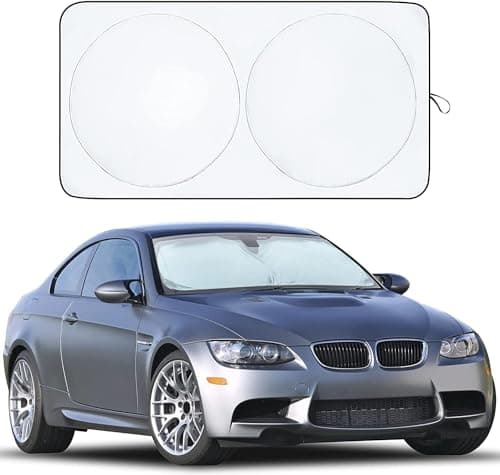
Why this is the best value in the whole car
The windshield is by far the largest aperture letting solar energy into a parked car: large, angled toward the sun for most of the day, and made of glass that passes visible light and traps the infrared that light becomes when it hits your dashboard. Block it and you have addressed the dominant heat path.
For under $25. Nothing else on this site changes the car by as much for as little, and it helps everything: the dashboard, the steering wheel, the adhesive holding your phone mount on, and the dash cam sitting behind the mirror in the hottest part of the glass.
Which claims you can actually check
This category is full of numbers, and they are not all the same kind of number.
| Shade | Headline claim | Form of the claim |
|---|---|---|
| Kinder Fluff | 99.87% UVB, 99.02% UVA blocked | Stated as certified test figures, to two decimals |
| EcoNour | Up to 40 F cooler, 99% heat and UV blocked | Maker's own claim, no test conditions stated |
A round 99% is a marketing figure. 99.87% is what comes off a test report: somebody measured something and reported what came out. And “up to 40 F cooler” has no stated conditions at all — cooler than what, in what car, at what ambient temperature, measured where in the cabin?
Neither maker is lying. The point is that one of them has given you something to check and the other has given you a number to trust, and this site prefers the first every time.
Fit is the entire product
A shade that does not fill your windshield does not do the job. Sun coming through a two-inch gap at the top lands on the dashboard and the whole thermal argument goes with it. There is no partial credit here.
Measure your windshield at its widest and at its tallest, then compare against published sizes:
- Kinder Fluff: 24 x 29 in and 33 x 36 in as two-piece sets, 28 x 31 in, and 64 x 36 in as a single piece.
- EcoNour: 53 x 30, 59 x 29, 64 x 32, 66 x 27 and 75 x 37 in — the wider range, which is a real advantage if your car is unusual.
Round up rather than down. A shade slightly too large can be tucked behind the visors; a shade too small can only be too small.
One piece or two
- One piece covers the whole windshield with no seam. It is the better block and it is bulkier folded — it lives in the trunk or across the back seat.
- Two piece folds much smaller, so it lives behind a seat where you will actually reach for it. It leaves a seam down the middle, and if you fit the halves carelessly there is a gap.
The honest answer is that the shade you will use every day beats the shade that blocks marginally better and lives in the trunk. If it takes effort to get out, it will not get used in July, which is the only month it matters.
Frame and fabric
EcoNour publishes reinforced steel rings, which is the part that decides whether a folding shade still holds its shape after two summers of being twisted back into a circle. Kinder Fluff does not publish a frame specification.
On fabric, EcoNour publishes 240T polyester with a reflective coating and Kinder Fluff publishes 210T reflective polyester. The T number is thread count per square inch. Higher is generally denser and more durable, and neither maker publishes what the difference means in performance — so it is a specification without an outcome attached, and this page does not weight it heavily.
What else actually cools a parked car
A shade is the largest single intervention and it is not the only one. Cracking the windows a few millimeters, parking so the windshield faces away from the afternoon sun, and a reflective cover for the steering wheel all help. The keeping-cool guide ranks the whole set by effort as well as effect, because effort is what decides which ones you actually do.
Every pick, with the working
Each entry lists the specifications the maker publishes, the axis scores those specifications produce, and what you give up. Rows that read “Not published” are not omissions on our side: they are things the maker will not commit to in writing, and they cost the product points on the transparency axis. Specifications compiled September 4, 2026.
Our pickThe cheapest real temperature drop in the car
EcoNour Windshield Sun Shade
Skip this one. Not a bad shade — it has more published sizes and reinforced steel rings. But its headline figure is a 40 F cabin reduction with no stated test conditions, which is a claim you cannot check. If the marketing number is what sold you, buy the one whose number reads like a test report instead.
240T polyester with a reflective coating and reinforced steel rings, in sizes from 53 by 30 up to 75 by 37 inches. EcoNour states its shades keep an interior up to 40 F cooler and block 99 percent of heat and UV. Those are the maker's own figures rather than an independent test, and even at half of them this is the best dollar-per-degree in the whole car.
- Material
- 240T polyester with reflective coating
- Frame
- Reinforced steel rings
- Sizes published
- 53x30, 59x29, 64x32, 66x27, 75x37 in
- Maker's temperature claim
- Up to 40 F cooler interior
- Maker's UV claim
- Blocks 99% of heat and UV
- Independent verification
- Not published
- Warranty
- Not published
List price $20.99 per EcoNour's own store, 53 x 30 in umbrella model, captured on the compile date below. Not a live price and not what you will pay — the button is where the real number is.
What it gets right
- Multiple published sizes, so you can actually match your windshield rather than fold a compromise
- Reinforced steel rings, which is what stops the frame collapsing after one summer
- Under $25 across most sizes
- Folds down small enough to live behind a seat rather than in the trunk
Flaws
- The 40 F figure is EcoNour's own claim, not an independent measurement, and the conditions behind it are not published
- You have to actually put it up every time, which is the real reason sun shades fail
- Sizing is on you: too small leaves a gap, too big will not sit flat
The working behind the 9.3
- Heat headroom: not scored (weight 22%)
- The maker publishes no operating-temperature ceiling, so this axis is dropped and the other weights are re-normalized.
- Install effort: 10.0 (weight 24%)
- Drops in and sits there. No fixing of any kind, and it comes out again when you sell the car.
- Price against the ceiling: 10.0 (weight 24%)
- Listed at $20.99 on the compile date. This site's buyer has a practical ceiling around $150 for a single upgrade, so the scale rewards everything under $100 and falls away sharply past $150. The live price is very often different, and that is what the button is for.
- Written commitment: not scored (weight 15%)
- No warranty term published, so this axis is dropped and the other weights are re-normalized.
- Spec transparency: 7.1 (weight 15%)
- 5 of the 7 specifications we went looking for are published by the maker (71%). A blank row is never a guess here: it prints “Not published” and it costs the product points, because a figure nobody will commit to in writing is a figure you cannot check.
Axes with no published input are dropped and the remaining weights re-normalized, so a product is not punished for a category where an axis does not apply. Specifications compiled September 4, 2026 from EcoNour's windshield sunshade range.
2The only UV claim here with a certification behind it
Kinder Fluff Windshield Sun Shade
Reflective polyester in four published sizes, and the only shade in this ledger whose UV claim is stated as a certified test result rather than a round marketing number: 99.87% of UVB and 99.02% of UVA. Two decimal places is what a test report looks like; 99% is what a copywriter writes.
- Material
- Reflective polyester, 210T
- Certified UVB blocking
- 99.87%
- Certified UVA blocking
- 99.02%
- Sizes published
- 24x29 and 33x36 (two piece), 28x31, 64x36 (one piece)
- Cabin temperature claim
- Not published
- Frame
- Not published
- Warranty
- Not published
List price $20.90 per Kinder Fluff's own store, 64 x 36 in single piece, captured on the compile date below. Not a live price and not what you will pay — the button is where the real number is.
What it gets right
- Certified UV figures published to two decimal places, which is a testable claim rather than a slogan
- Four published sizes including a 64 x 36 in single piece and a 33 x 36 in two-piece
- Under $21 across the range
- Two-piece versions fold smaller, so they live behind a seat rather than in the trunk
Flaws
- Kinder Fluff publishes a UV figure and no cabin-temperature figure, so there is nothing to compare against EcoNour's claim
- Two-piece shades leave a seam down the middle of the windshield and a gap if you fit them carelessly
- 210T fabric rather than the 240T some competitors use, though neither publishes what that means in performance
The working behind the 9.0
- Heat headroom: not scored (weight 22%)
- The maker publishes no operating-temperature ceiling, so this axis is dropped and the other weights are re-normalized.
- Install effort: 10.0 (weight 24%)
- Drops in and sits there. No fixing of any kind, and it comes out again when you sell the car.
- Price against the ceiling: 10.0 (weight 24%)
- Listed at $20.9 on the compile date. This site's buyer has a practical ceiling around $150 for a single upgrade, so the scale rewards everything under $100 and falls away sharply past $150. The live price is very often different, and that is what the button is for.
- Written commitment: not scored (weight 15%)
- No warranty term published, so this axis is dropped and the other weights are re-normalized.
- Spec transparency: 5.7 (weight 15%)
- 4 of the 7 specifications we went looking for are published by the maker (57%). A blank row is never a guess here: it prints “Not published” and it costs the product points, because a figure nobody will commit to in writing is a figure you cannot check.
Axes with no published input are dropped and the remaining weights re-normalized, so a product is not punished for a category where an axis does not apply. Specifications compiled September 4, 2026 from Kinder Fluff's windshield sunshade product page.
Prices last verified October 19, 2026. They move constantly; the figure on Amazon when you click is the real one.
Questions people actually ask
Do windshield sun shades actually work?
The physics is not in doubt: the windshield is the largest opening for sunlight into a parked car and blocking it reduces the heat that gets in. The size of the effect depends on the car, the glass, the parking angle and the day, and the specific numbers quoted are manufacturer claims rather than independent measurements.
What size sun shade do I need?
Measure your windshield at its widest and tallest and match against published sizes, rounding up. A shade slightly too big tucks behind the visors. A shade too small leaves sun on the dashboard, which is exactly what you were preventing.
One-piece or foldable two-piece?
One piece blocks better with no seam; two pieces fold much smaller and live behind a seat. Since the real failure mode is leaving it in the trunk, the more convenient one usually wins in practice.
Is 240T fabric better than 210T?
It is denser, and neither maker publishes what that means for heat or UV performance. It is a specification without a stated outcome, so it is not weighted heavily here.