The best leather cleaners and conditioners
Almost every modern car seat badged as leather has a urethane top coat. That single fact changes what conditioner does and what actually damages the seat.
By Sawyer V. · Published · How we research
We have not tested any of this. Everything below is compiled from published manufacturer specifications, and the arithmetic is printed so you can check it. This page carries affiliate links: if you buy through one we earn a commission at no extra cost to you, and it does not change the order of the picks. Full disclosure.
The short answer
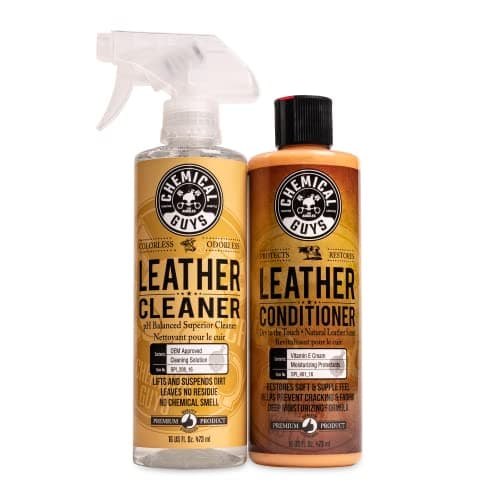
Buy a two-step kit and use both steps. Chemical Guys publishes pH-balanced and explicitly states it is safe on synthetic leather, which is what most cars badged as leather actually have. The reason two steps matter: an all-in-one seals dirt under the conditioner. And understand what you are treating — most modern car leather has a urethane top coat, so conditioner is largely maintaining that coating rather than feeding the hide beneath it.
| # | Pick | Install | Score | Price |
|---|---|---|---|---|
| 1 | Chemical Guys Leather Cleaner & Conditioner Kit Leather and leatherette that gets sat on daily | Drops in | 8.9/10 | $27.99 - view on Amazon |
| 2 | Meguiar's Ultimate Interior Detailer One bottle for the whole cabin | Drops in | 8.9/10 | $8.00 - view on Amazon |
| 3 | 303 Automotive Protectant A dashboard in permanent sunlight | Drops in | 8.7/10 | $16.98 - view on Amazon |
| 4 | Chemical Guys Easy All Interior Care Kit Doing it properly rather than quickly | Drops in | 7.7/10 | $39.99 - view on Amazon |
Prices last verified October 22, 2026. They move constantly; the figure on Amazon when you click is the real one.
What your seats actually are
This is the fact the whole category talks around. Almost all car upholstery sold as leather is finished or coated leather: a hide with a pigmented polyurethane layer on top. Plenty of it is not leather at all but leatherette — a polyurethane surface on a fabric backing.
Manufacturers do it for good reasons. A coated surface resists staining, dye transfer from clothing, UV, and abrasion far better than untreated hide, and a car interior is a much harsher environment than furniture.
The consequence for care is significant. When you apply conditioner to a coated seat, you are applying it to polyurethane, not to leather. Very little penetrates to the hide, because the coating is doing exactly the job it was designed for.
Why two steps and not one
A combined cleaner-conditioner has an inherent problem: it is trying to lift dirt and lay down a protective film in the same wipe. Whatever dirt it has loosened is still on the surface when the film goes down.
Two steps separates them. The cleaner emulsifies dirt, body oils and dye transfer, and you remove that with a cloth. Then the conditioner goes onto a clean surface, where it can actually sit on the coating rather than on a layer of grime.
The failure mode of one-step products on light-colored seats is visible: a gradual gray cast that gets slightly worse each time, because each application locks in a little more of what the previous one did not remove.
| Chemical Guys kit | 303 Protectant | Meguiar's Interior Detailer | |
|---|---|---|---|
| Steps | Two | One | One |
| pH | Stated balanced, no figure | Not published | Not published |
| Safe on synthetic leather | Stated explicitly | Yes, listed surface | Yes, all surfaces |
| UV figure | Not published | SPF 40 equivalent | Inhibitors, no figure |
| Finish | Not stated | Matte | Satin |
| Reapplication interval | Not published | 30-45 days | Weeks, no figure |
The pH question, honestly
Leather care marketing leans hard on pH balance, and the underlying point is real: strongly alkaline cleaners — the kind in general-purpose degreasers — can damage leather finishes and strip dye.
Chemical Guys states its products are pH-balanced and color-safe, and does not publish an actual pH number. That is a gap. “Balanced” is a claim; a figure would be a specification, and on this site the difference costs points on the transparency axis.
The practical version, which does not need a number: do not use household all-purpose cleaner, degreaser or dish soap on car seats. Those are alkaline by design and they will eventually dull and strip a finish. A product formulated for the job is worth the small premium purely for what it does not contain.
What actually destroys a leather seat
Not drying out, in the way the marketing suggests. Two things, in order:
- UV degradation of the coating. Sunlight breaks down polyurethane. The coating becomes brittle, then it cracks, and the crack is permanent — no conditioner reverses it. This is why driver's seat bolsters and the tops of rear seats fail first: they get the most sun
- Abrasion at the entry point. The outer bolster of the driver's seat takes the friction of every entry and exit, with jeans rivets and pocket contents. It is a mechanical wear point and no product prevents it
Both are arguments for UV protection rather than moisture. Chemical Guys states its conditioner includes UV protection but publishes no figure; 303 publishes an SPF 40 equivalent, which is a comparable number in a category of adjectives. The full comparison is in best dashboard protectants.
The cheapest UV intervention is not a product at all — it is a windshield shade, which stops the sun reaching the interior in the first place. See how to protect your car interior from sun.
The method
The mistakes here are all about liquid: too much of it, applied to the wrong thing, left to dry in place.
- Vacuum first, with a crevice tool into the seat crease and the perforation seams. Grit ground into a coating under a cloth is abrasion
- Apply cleaner to a brush or cloth, never to the seat. Spraying directly floods perforations and stitch holes, and liquid that gets behind the coating comes out later as a stain
- Agitate gently with a soft brush, particularly on grained surfaces where dirt sits in the texture
- Wipe away with a clean microfiber — this is the step that removes the dirt, and skipping it means redistributing it
- Conditioner thinly, on a cloth, buffed off. Excess conditioner left on a coated surface stays greasy and attracts dust
- Never on the steering wheel. Conditioner on a wheel is a slip hazard, and this is the one place people routinely get it wrong
Perforated seats need particular care: the holes are ventilation for heated and cooled seats, and product forced into them does not come back out. Work with a barely damp cloth over perforated areas.
How often
Clean when it looks like it needs it — dye transfer from dark jeans onto light seats is the usual prompt, and it is far easier to remove early than after a season.
Condition a few times a year rather than monthly. On a coated surface there is little benefit to more, and excess product builds a film that dulls the finish and attracts dust.
Two adjacent problems have their own pages: general interior cleaning method is in how to clean your car interior, and anything that has soaked into fabric rather than sitting on a coating is in how to remove stains from car seats.
Every pick, with the working
Each entry lists the specifications the maker publishes, the axis scores those specifications produce, and what you give up. Rows that read “Not published” are not omissions on our side: they are things the maker will not commit to in writing, and they cost the product points on the transparency axis. Specifications compiled September 4, 2026.
Our pickLeather and leatherette that gets sat on daily
Chemical Guys Leather Cleaner & Conditioner Kit
A two-step kit that separates cleaning from conditioning, which matters because a combined product does neither well. Stated pH-balanced and safe on natural, sealed and synthetic leather — the last one covers most modern car seats.
- Steps
- Two — cleaner then conditioner
- pH
- Stated pH-balanced (no figure published)
- Safe on
- Natural, sealed and synthetic leather
- Conditioner claims
- UV protection, prevents drying and cracking
- Size
- 2 x 16 fl oz
- Warranty
- Not published
- List price
- Not published
What it gets right
- Two separate steps: clean first, then condition. An all-in-one seals dirt under the conditioner
- Stated pH-balanced, so it does not strip dye or change the surface texture
- Explicitly safe on synthetic leather, which is what most cars badged as leather actually have
- Conditioner is stated to include UV protection, which is the mechanism that cracks a dashboard-adjacent seat
Flaws
- Chemical Guys does not publish an actual pH number, only that it is balanced
- Two products means two steps, and people skip the second one
- Most cars sold with leather have a sealed urethane top coat, so conditioner does far less than the marketing implies
The working behind the 8.9
- Heat headroom: not scored (weight 22%)
- The maker publishes no operating-temperature ceiling, so this axis is dropped and the other weights are re-normalized.
- Install effort: 10.0 (weight 24%)
- Drops in and sits there. No fixing of any kind, and it comes out again when you sell the car.
- Price against the ceiling: not scored (weight 24%)
- No published list price we could cite on the compile date, so this axis is dropped and the other weights are re-normalized.
- Written commitment: not scored (weight 15%)
- No warranty term published, so this axis is dropped and the other weights are re-normalized.
- Spec transparency: 7.1 (weight 15%)
- 5 of the 7 specifications we went looking for are published by the maker (71%). A blank row is never a guess here: it prints “Not published” and it costs the product points, because a figure nobody will commit to in writing is a figure you cannot check.
Axes with no published input are dropped and the remaining weights re-normalized, so a product is not punished for a category where an axis does not apply. Specifications compiled September 4, 2026 from Chemical Guys leather care published information.
2One bottle for the whole cabin
Meguiar's Ultimate Interior Detailer
Skip this one. It is a good one-step maintenance product and it is not leather care. A combined cleaner-protectant across all surfaces cannot do what a dedicated cleaner followed by a dedicated conditioner does. Buy it for the dash and screens; buy a two-step kit for seats you care about.
Cleans and protects in a single step across every interior surface including navigation screens, which is what makes it the practical choice for maintenance rather than restoration. It publishes no UV figure, which is where the 303 beats it.
- Size
- 15.2 fl oz
- Surfaces
- All interior including screens, dash, door panels, console
- Finish
- Non-greasy satin
- UV
- UV inhibitors stated, no figure published
- Duration
- Stated as weeks, no interval published
- Warranty
- Not published
- List price
- Not published
What it gets right
- Stated safe on all interior surfaces including stereo and navigation screens — most protectants are not
- One step rather than two, which means it actually gets used
- Non-greasy satin finish, so no glare off the dash
- Stated to contain UV inhibitors against fading, browning and cracking
Flaws
- No published UV figure of any kind — 'superior UV protection' is not a specification
- A combined cleaner-protectant is a compromise at both jobs compared with doing them separately
- 'Lasts for weeks' is not an interval you can plan around
The working behind the 8.9
- Heat headroom: not scored (weight 22%)
- The maker publishes no operating-temperature ceiling, so this axis is dropped and the other weights are re-normalized.
- Install effort: 10.0 (weight 24%)
- Drops in and sits there. No fixing of any kind, and it comes out again when you sell the car.
- Price against the ceiling: not scored (weight 24%)
- No published list price we could cite on the compile date, so this axis is dropped and the other weights are re-normalized.
- Written commitment: not scored (weight 15%)
- No warranty term published, so this axis is dropped and the other weights are re-normalized.
- Spec transparency: 7.1 (weight 15%)
- 5 of the 7 specifications we went looking for are published by the maker (71%). A blank row is never a guess here: it prints “Not published” and it costs the product points, because a figure nobody will commit to in writing is a figure you cannot check.
Axes with no published input are dropped and the remaining weights re-normalized, so a product is not punished for a category where an axis does not apply. Specifications compiled September 4, 2026 from Meguiar's Ultimate Interior Detailer published information.
3A dashboard in permanent sunlight
303 Automotive Protectant
The only interior protectant here that publishes a comparable UV figure — an SPF 40 equivalent — instead of saying 'UV protection' and stopping. It also dries matte, which matters because a shiny dashboard reflects into the windshield.
- UV rating
- SPF 40 equivalent
- Duration per application
- 30 to 45 days
- Finish
- Matte, non-greasy
- Surfaces
- Vinyl, rubber, plastic, leather
- Warranty
- Not published
- List price
- Not published
What it gets right
- Publishes an SPF 40 rating, a number you can compare, where the category publishes adjectives
- Dries to a matte finish — a glossy dash reflects sunlight straight into the windshield in your eyeline
- Stated 30 to 45 days per application, so you know the reapplication interval rather than guessing
- Works on vinyl, rubber, plastic and leather, so one bottle covers the cabin
Flaws
- 30 to 45 days means this is a recurring job, not a one-time treatment
- Any protectant on a steering wheel or pedals is a slip hazard — keep it off contact surfaces
- It slows UV damage; it does not reverse a dashboard that has already cracked
The working behind the 8.7
- Heat headroom: not scored (weight 22%)
- The maker publishes no operating-temperature ceiling, so this axis is dropped and the other weights are re-normalized.
- Install effort: 10.0 (weight 24%)
- Drops in and sits there. No fixing of any kind, and it comes out again when you sell the car.
- Price against the ceiling: not scored (weight 24%)
- No published list price we could cite on the compile date, so this axis is dropped and the other weights are re-normalized.
- Written commitment: not scored (weight 15%)
- No warranty term published, so this axis is dropped and the other weights are re-normalized.
- Spec transparency: 6.7 (weight 15%)
- 4 of the 6 specifications we went looking for are published by the maker (67%). A blank row is never a guess here: it prints “Not published” and it costs the product points, because a figure nobody will commit to in writing is a figure you cannot check.
Axes with no published input are dropped and the remaining weights re-normalized, so a product is not punished for a category where an axis does not apply. Specifications compiled September 4, 2026 from 303 Automotive Protectant published specifications.
4Doing it properly rather than quickly
Chemical Guys Easy All Interior Care Kit
Leather cleaner and conditioner, streak-free glass spray, microfiber towels and quick wipes, sold as a set. The glass spray is the item that earns the kit its place: the film on the inside of a windshield is the single biggest contributor to night glare, and almost nobody owns a cleaner that removes it without leaving a haze.
- Contents
- Leather cleaner and conditioner, glass spray, microfiber towels, quick wipes
- Interior type
- Leather-focused
- Bottle volumes
- Not published
- List price
- Not published
- Warranty
- Not published
What it gets right
- Includes a proper glass cleaner, which is the most-skipped and most-valuable interior job
- Leather cleaner and conditioner as separate steps rather than a single 'wipe' product
- Microfiber towels included, so the kit is genuinely complete
- Chemical Guys publishes what is in each kit, which lets you compare kits rather than trusting a photo
Flaws
- Leather products are wasted on a cloth interior — check which kit matches your seats
- More expensive than a supermarket bundle, and for a car you keep clean anyway that is hard to justify
- Chemical Guys publishes no bottle volumes on the kit page, so value per ounce is unknowable
The working behind the 7.7
- Heat headroom: not scored (weight 22%)
- The maker publishes no operating-temperature ceiling, so this axis is dropped and the other weights are re-normalized.
- Install effort: 10.0 (weight 24%)
- Drops in and sits there. No fixing of any kind, and it comes out again when you sell the car.
- Price against the ceiling: not scored (weight 24%)
- No published list price we could cite on the compile date, so this axis is dropped and the other weights are re-normalized.
- Written commitment: not scored (weight 15%)
- No warranty term published, so this axis is dropped and the other weights are re-normalized.
- Spec transparency: 4.0 (weight 15%)
- 2 of the 5 specifications we went looking for are published by the maker (40%). A blank row is never a guess here: it prints “Not published” and it costs the product points, because a figure nobody will commit to in writing is a figure you cannot check.
Axes with no published input are dropped and the remaining weights re-normalized, so a product is not punished for a category where an axis does not apply. Specifications compiled September 4, 2026 from Chemical Guys' Easy All Interior Care Kit page.
Prices last verified October 22, 2026. They move constantly; the figure on Amazon when you click is the real one.
Questions people actually ask
Do I need to condition modern car leather?
Less than the marketing suggests. Most car leather has a urethane coating, so conditioner maintains that coating rather than feeding the hide. Keeping it clean and UV-protected matters more than how often you condition.
Can I use leather products on leatherette?
Yes, if the product states it is safe on synthetic leather — Chemical Guys does. Since the surface of coated leather and leatherette is chemically similar, a product safe on one is generally safe on the other.
What causes leather seats to crack?
UV degradation of the coating, mostly, plus mechanical abrasion at the entry bolster. Once the coating cracks, no conditioner reverses it. Shade does more to prevent it than any bottle.
Can I use household cleaner on car seats?
No. All-purpose cleaners, degreasers and dish soap are alkaline by design and will dull and eventually strip a leather finish. Use something formulated for the job.