The best car trash cans
The highest-return thirteen dollars you can spend on a car interior, because a cluttered car is almost always a car with nowhere to put a wrapper. Ranked on the three specifications that decide whether it gets used.
By Sawyer V. · Published · How we research
We have not tested any of this. Everything below is compiled from published manufacturer specifications, and the arithmetic is printed so you can check it. This page carries affiliate links: if you buy through one we earn a commission at no extra cost to you, and it does not change the order of the picks. Full disclosure.
The short answer
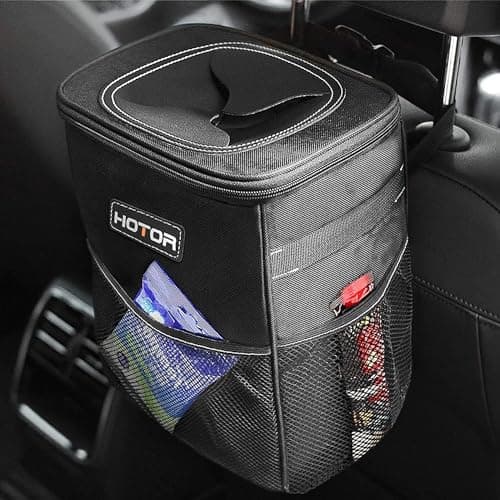
Buy the HOTOR 2-gallon. It publishes the three things that decide whether a car bin gets used: a waterproof PEVA lining (so a half-full coffee cup is a wipe rather than a stain), four magnetic snaps that hold a liner bag open (so you can drop something in one-handed while driving), and an adjustable strap with a quick-release buckle (so it fastens to a headrest or console instead of tipping over in the footwell). Published dimensions are 7.9 x 5.5 x 10.2 inches at about $13.
| # | Pick | Install | Score | Price |
|---|---|---|---|---|
| 1 | HOTOR Car Trash Can (2 gallon) The cheapest fix for a permanently messy car | Drops in | 9.7/10 | $9.98 - view on Amazon |
| 2 | DRIVE Auto Products Trunk Organizer A trunk that has groceries in it every week | Drops in | 9.2/10 | Check price on Amazon |
| 3 | Drop Stop Seat Gap Filler Never fishing a phone out of the seat rail again | Drops in | 9.2/10 | $24.99 - view on Amazon |
Prices last verified October 19, 2026. They move constantly; the figure on Amazon when you click is the real one.
The actual problem this solves
Cars do not get cluttered because their owners are careless. They get cluttered because a wrapper, a receipt or an empty cup has nowhere to go, so it goes in a door pocket or a cup holder and stays there.
Give it somewhere to go and the problem largely stops. That is why this is the highest return per dollar in the whole organization section — a trunk organizer manages what you carry, and this fixes what accumulates.
The three specifications that matter
- A waterproof lining. The single most important one, and the reason cheap fabric bins fail. Something wet goes in a car bin within the first week — a cup with an inch left, a wet wipe, a yogurt pot. HOTOR publishes a PEVA lining under Oxford cloth. Without one, the bin becomes the smell.
- Bag retention. A liner bag that collapses into the bin the first time you reach for it is a bin you stop using. Four magnetic snaps holding the bag mouth open is a small detail that decides daily usability.
- An attachment that suits your car. A bin in the footwell tips over and then rolls under the pedals, which is a genuine hazard rather than an inconvenience. It needs to strap to something.
Where to actually mount it
- Back of the center console. Best all-round position. Reachable from the driver's seat and from the back, out of every footwell.
- Front passenger headrest post. Ideal if the back seat is where the mess comes from — children can reach it without help.
- Passenger footwell, strapped. Fine if nobody sits there often. Strapped, not loose.
- Door pocket. Only for the very small bins, and it costs you the door pocket.
Two gallons or three
Two gallons is right for a commuter car carrying one or two people. It is small enough to fit beside a seat without intruding and large enough that you are emptying it weekly rather than daily.
Three gallons is for cars that carry children, do long trips, or belong to someone who eats in the car regularly. HOTOR publishes both. The trade is purely space — the larger one intrudes noticeably more if it is strapped where a passenger's legs go.
Liners, and the habit that makes it work
Use actual liner bags. HOTOR ships two spares and the bin takes standard small bags, and a bin used without a liner is a bin you have to wash.
The habit that makes the whole thing work is the same one on the organizing guide: empty it every time you buy fuel. You are already standing beside the car with two free minutes, there is a bin ten feet away, and it attaches the job to something you already do at a predictable interval. That is the entire system.
What nobody in this category publishes
Nothing about durability. Not a fabric weight, not a seam rating, not a warranty. The HOTOR listing carries dimensions, capacity, weight and materials — which is more than most — and stops there. HOTOR's own product page publishes none of it, which we worked through in the HOTOR car trash can review.
That is why this page ranks on lining, retention and attachment rather than on longevity: those three are published and checkable, and longevity in this category is not. A row that says “Not published” on the product below is a maker declining to commit, and it costs points on the transparency axis exactly as it should.
The rest of the cabin
A bin fixes accumulation. The other cabin problems have their own cheap fixes, and the small-fixes page covers all four honestly — including being direct about the two that mostly are not worth buying.
If the mess is in the trunk rather than the cabin, that is a different product entirely and the trunk organizer page is the right place.
Every pick, with the working
Each entry lists the specifications the maker publishes, the axis scores those specifications produce, and what you give up. Rows that read “Not published” are not omissions on our side: they are things the maker will not commit to in writing, and they cost the product points on the transparency axis. Specifications compiled September 4, 2026.
Our pickThe cheapest fix for a permanently messy car
HOTOR Car Trash Can (2 gallon)
Two gallons, 7.9 by 5.5 by 10.2 inches, Oxford cloth over a waterproof PEVA lining, with four magnetic snaps holding the bag open and a strap that fastens it to a headrest or the console. A car gets cluttered because there is nowhere to put rubbish, and this is thirteen dollars of nowhere-to-put-rubbish solved.
- Capacity
- 2 gallons (3-gallon version also sold)
- Dimensions
- 7.9 x 5.5 x 10.2 in
- Weight
- 1.0 lb
- Outer material
- Oxford cloth
- Lining
- Waterproof PEVA
- Bag retention
- 4 magnetic snaps, 2 spare bags included
- Pockets
- 3 mesh
- Mounting
- Adjustable strap with quick-release buckle
- Warranty
- Not published
List price $12.99 per Walmart listing, 2-gallon, captured on the compile date below. Not a live price and not what you will pay — the button is where the real number is.
What it gets right
- Published dimensions and capacity, so you can check it against the space beside your seat
- PEVA waterproof lining — the difference between a bin and a stain when someone puts a coffee cup in it
- Four magnetic snaps hold a liner bag open, which is the detail that makes it usable one-handed while driving
- Strap and quick-release buckle, so it attaches to something rather than sliding around the footwell
Flaws
- Two gallons is small if you carry passengers who eat in the car; the 3-gallon version exists for that
- Soft-sided, so it needs to be strapped to something or it tips
- It only works if you empty it, which is the same problem as every bin ever made
The working behind the 9.7
- Heat headroom: not scored (weight 22%)
- The maker publishes no operating-temperature ceiling, so this axis is dropped and the other weights are re-normalized.
- Install effort: 10.0 (weight 24%)
- Drops in and sits there. No fixing of any kind, and it comes out again when you sell the car.
- Price against the ceiling: 10.0 (weight 24%)
- Listed at $12.99 on the compile date. This site's buyer has a practical ceiling around $150 for a single upgrade, so the scale rewards everything under $100 and falls away sharply past $150. The live price is very often different, and that is what the button is for.
- Written commitment: not scored (weight 15%)
- No warranty term published, so this axis is dropped and the other weights are re-normalized.
- Spec transparency: 8.9 (weight 15%)
- 8 of the 9 specifications we went looking for are published by the maker (89%). A blank row is never a guess here: it prints “Not published” and it costs the product points, because a figure nobody will commit to in writing is a figure you cannot check.
Axes with no published input are dropped and the remaining weights re-normalized, so a product is not punished for a category where an axis does not apply. Specifications compiled September 4, 2026 from the HOTOR 2-gallon listing — HOTOR's own product page publishes none of these figures.
2A trunk that has groceries in it every week
DRIVE Auto Products Trunk Organizer
Skip this one. A trunk organizer solves the trunk and does nothing for the cabin, which is where rubbish actually accumulates. It is here because the two get bought together and people frequently buy only this one, then wonder why the front of the car is still a mess.
23 by 17 by 11 inches open, collapsing to 15 inches long when you only need half of it, with a tie-down strap system. The collapse is the feature: a trunk organizer that is always full size is a box that lives in your trunk, and one that folds down is storage you actually keep.
- Dimensions open
- 23 L x 17 W x 11 H in
- Dimensions collapsed
- 15 L x 17 W x 11 H in
- Compartments
- Multi-compartment with adjustable dividers
- Securing
- Tie-down strap system
- Load rating
- Not published
- Warranty
- Not published
List price $16.99 per Walmart listing, black, captured on the compile date below. Not a live price and not what you will pay — the button is where the real number is.
What it gets right
- Collapses from 23 in to 15 in long, so it takes the space it needs and no more
- Tie-down straps stop it sliding on the first roundabout, which is the entire failure mode
- Adjustable dividers, so a case of drinks and a bag of shopping can share it
- Under $20 at most listings
Flaws
- Soft-sided, so it holds its shape only when it is reasonably full
- The straps need somewhere to anchor, and not every trunk has a hook
- 11 in tall is short for tall bottles standing up
The working behind the 9.2
- Heat headroom: not scored (weight 22%)
- The maker publishes no operating-temperature ceiling, so this axis is dropped and the other weights are re-normalized.
- Install effort: 10.0 (weight 24%)
- Drops in and sits there. No fixing of any kind, and it comes out again when you sell the car.
- Price against the ceiling: 10.0 (weight 24%)
- Listed at $16.99 on the compile date. This site's buyer has a practical ceiling around $150 for a single upgrade, so the scale rewards everything under $100 and falls away sharply past $150. The live price is very often different, and that is what the button is for.
- Written commitment: not scored (weight 15%)
- No warranty term published, so this axis is dropped and the other weights are re-normalized.
- Spec transparency: 6.7 (weight 15%)
- 4 of the 6 specifications we went looking for are published by the maker (67%). A blank row is never a guess here: it prints “Not published” and it costs the product points, because a figure nobody will commit to in writing is a figure you cannot check.
Axes with no published input are dropped and the remaining weights re-normalized, so a product is not punished for a category where an axis does not apply. Specifications compiled September 4, 2026 from DRIVE Auto Products trunk organizer listing.
3Never fishing a phone out of the seat rail again
Drop Stop Seat Gap Filler
A neoprene wedge that fills the gap between the seat and the center console, with a slot the seatbelt catch passes through. That slot is the patent and it is the reason this one stays put where generic wedges migrate. It is more expensive than it has any right to be, and it solves a problem that genuinely happens while you are driving.
- Material
- Neoprene
- Quantity
- 2 per pack, driver and passenger
- Fit method
- Expands and contracts to the gap; seatbelt slot anchors it
- Cleaning
- Liquid and stain resistant, wipe clean
- Dimensions
- Not published
- Warranty
- Not published
List price $24.99 per Walmart listing, two-pack, captured on the compile date below. Not a live price and not what you will pay — the button is where the real number is.
What it gets right
- The seatbelt slot means it is anchored rather than wedged, which is the difference from every generic copy
- Neoprene expands and contracts to fit whatever gap your car has, so 'universal' is closer to true than usual
- Liquid and stain resistant, and it wipes clean
- Sold as a pair, so both front seats are covered
Flaws
- $25 to $40 for two pieces of shaped neoprene, depending entirely on where you buy
- It fills the gap, which also means the gap is no longer available for anything you wanted to put there
- Cars with an unusually wide gap or a console that flares will still see items get past the ends
The working behind the 9.2
- Heat headroom: not scored (weight 22%)
- The maker publishes no operating-temperature ceiling, so this axis is dropped and the other weights are re-normalized.
- Install effort: 10.0 (weight 24%)
- Drops in and sits there. No fixing of any kind, and it comes out again when you sell the car.
- Price against the ceiling: 10.0 (weight 24%)
- Listed at $24.99 on the compile date. This site's buyer has a practical ceiling around $150 for a single upgrade, so the scale rewards everything under $100 and falls away sharply past $150. The live price is very often different, and that is what the button is for.
- Written commitment: not scored (weight 15%)
- No warranty term published, so this axis is dropped and the other weights are re-normalized.
- Spec transparency: 6.7 (weight 15%)
- 4 of the 6 specifications we went looking for are published by the maker (67%). A blank row is never a guess here: it prints “Not published” and it costs the product points, because a figure nobody will commit to in writing is a figure you cannot check.
Axes with no published input are dropped and the remaining weights re-normalized, so a product is not punished for a category where an axis does not apply. Specifications compiled September 4, 2026 from Drop Stop published product description and materials.
Prices last verified October 19, 2026. They move constantly; the figure on Amazon when you click is the real one.
Questions people actually ask
What size car trash can do I need?
Two gallons for a commuter carrying one or two people — small enough not to intrude, large enough to empty weekly. Three gallons if you carry children or eat in the car regularly.
Where should I put a car trash can?
Strapped to the back of the center console is the best all-round spot — reachable from front and back and out of every footwell. Never loose in the driver's footwell, where it can end up under a pedal.
Do I need a waterproof one?
Yes. Something wet goes into a car bin within the first week, and a fabric bin without a waterproof lining absorbs it. That is how a bin becomes the smell you were trying to get rid of.
How often should I empty it?
Every time you fill up with fuel. You are already beside the car with two free minutes and a bin nearby, which is what makes it a habit rather than a chore you postpone.