The best roof cargo bags
A roof bag is the cheapest way to add a trunk's worth of space to a car that has no roof rack. It is also a parachute, and there is a weight limit you almost certainly have not looked up.
By Sawyer V. · Published · How we research
We have not tested any of this. Everything below is compiled from published manufacturer specifications, and the arithmetic is printed so you can check it. This page carries affiliate links: if you buy through one we earn a commission at no extra cost to you, and it does not change the order of the picks. Full disclosure.
The short answer
Buy the Rightline Gear Sport 2. 15 cubic feet, a waterproof zipper rather than a merely weatherproof one, and — the reason the category exists — car clips that let it attach to a car with no roof rack at all, by gripping the door frame weather molding. Rightline publishes a 12-month warranty brand-wide. Before you buy anything here, look up your vehicle's roof load limit; it is lower than people assume and it includes the bag.
| # | Pick | Install | Score | Price |
|---|---|---|---|---|
| 1 | Rightline Gear Bungee Cargo Net Stopping the trunk redistributing itself | Drops in | 8.6/10 | $46.70 - view on Amazon |
| 2 | Rightline Gear Sport 2 Car Top Carrier A car with no roof rack | Clips on | 7.6/10 | $65.99 - view on Amazon |
| 3 | Rightline Gear Range 2 Car Top Carrier Knowing exactly what will fit before you buy | Clips on | 7.5/10 | $99.99 - view on Amazon |
Prices last verified October 20, 2026. They move constantly; the figure on Amazon when you click is the real one.
The car-clip system is the point
Most rooftop cargo solutions assume you have crossbars. Plenty of cars do not, and fitting them costs more than the bag does.
Rightline's answer is a set of clips on the ends of the straps that hook into the door frame weather molding. You open the doors, hook the clips inside the frame, close the doors, and the straps are anchored to the car's structure rather than to a rack.
It works. The trade-off is one that nobody mentions in the listing: the straps now run through the door openings, so every time you open a door you are opening it past a strap, and on a four-door car that is four doors. For a road trip it is fine. For daily use it is an irritation that gets old quickly.
Waterproof and weatherproof are different words
This is the specification difference between the two Rightline bags and it is the reason for the ranking.
The Sport 2 is described as waterproof with a waterproof zipper. The Range 2 is described as weatherproof. In practice the difference shows up at the closure: a zipper is the obvious water path on any bag, and a bag that is sealed everywhere except its opening is a bag that leaks at its opening.
| Sport 2 | Range 2 | |
|---|---|---|
| Capacity | 15 cubic feet | 15 cubic feet |
| Water rating | Waterproof | Weatherproof |
| Zipper | Waterproof zipper | Not stated |
| External dimensions | Not published | 40 x 36 x 18 in |
| Attaches without a rack | Yes | Yes |
| Warranty | 12 months | 12 months |
| Load rating | Not published | Not published |
Neither publishes a load rating in pounds, only volume. That is a real gap on a product whose weight is the thing your roof cares about, and it means the constraining number has to come from your car's manual rather than from the bag.
The aerodynamic cost is real
A roof bag is a large, blunt object in the airflow above the most aerodynamically sensitive part of the car. Drag rises with the square of speed, so the penalty is modest around town and substantial at highway speed — which is exactly where road trips happen.
We are not going to invent a percentage, because it depends entirely on the vehicle, the bag and how fast you drive. What is worth planning for is that a long highway trip with a loaded roof bag will cost you noticeably more fuel than the same trip without one, and that driving a little slower recovers a disproportionate amount of it.
Two practical consequences: mount the bag as far forward as the roof allows so the windshield deflects air over it rather than into it, and take it off when you are not using it. A bag left on the roof between trips is a permanent fuel penalty for nothing.
Packing, which decides whether it survives
- Fill it completely. A partly-full bag flaps, and flapping is what destroys fabric and works straps loose. Pad out the space with soft items
- Soft things only. Bags, bedding, clothes. Anything with a hard corner works against the fabric from the inside for the whole journey
- Heavy at the bottom and centred. Weight high and to one side changes how the car handles more than people expect
- Protect the paint. A blanket or a mat under the bag stops grit trapped underneath from sanding the roof at every vibration
- Re-check the straps after twenty minutes of driving, and at every stop. Loads settle
Cheaper answers that are often better
A roof bag is the right answer when you genuinely need more volume than the car has. It is the wrong answer when the real problem is that the space you have is badly used. It is also the wrong answer when what you are carrying is bicycles, which belong on a trunk-mounted rack rather than stuffed into a bag.
Before adding 15 cubic feet to the roof, it is worth being honest about the trunk. A cargo net or a set of tie-downs stops things sliding and lets you stack properly rather than spreading out — see cargo nets and tie-downs. A trunk organizer does the same job with structure, covered in best trunk organizers.
And if the load is dirty or wet — camping gear, sports kit, garden waste — a cargo liner in the trunk may solve the problem you actually have, which is not space but mess. That is best cargo liners.
Every pick, with the working
Each entry lists the specifications the maker publishes, the axis scores those specifications produce, and what you give up. Rows that read “Not published” are not omissions on our side: they are things the maker will not commit to in writing, and they cost the product points on the transparency axis. Specifications compiled September 4, 2026.
Our pickStopping the trunk redistributing itself
Rightline Gear Bungee Cargo Net
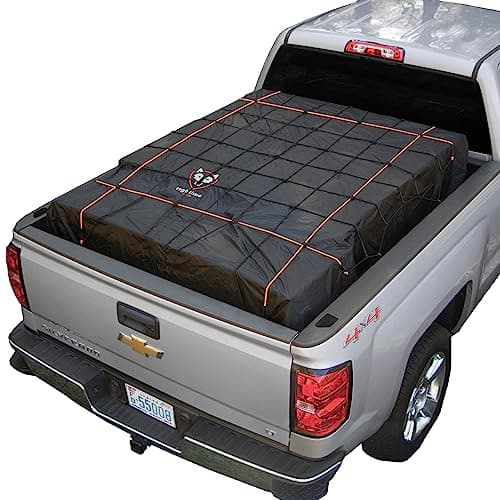
Five by six feet unstretched and nine by ten stretched, with twelve rigid hooks and a perimeter bungee that tightens the edges around whatever is under it. Rightline states the hooks are rigid specifically so they hold shape under load — which is the failure mode of every cheap net, where the hooks straighten and let go one at a time.
- Dimensions unstretched
- 5 ft x 6 ft
- Dimensions stretched
- 9 ft x 10 ft
- Hooks
- 12, rigid, relocatable
- Edge
- Adjustable perimeter bungee
- UV protection
- Stated, to preserve elasticity
- Load rating
- Not published
- List price
- Not published
- Warranty
- Not published
What it gets right
- Published stretched and unstretched dimensions, so you can work out whether it covers your load
- Rigid hooks stated not to bend or break, which is the whole difference between nets in this category
- Relocatable hooks and an adjustable perimeter bungee, so one net handles very different loads
- UV protected to keep elasticity, which is what stops it going brittle after two summers
Flaws
- It needs anchor points. Many hatchbacks and sedans have very few, and a net with nothing to hook to is useless
- Sized for a truck bed, so in a car trunk you will have a lot of net and not much load
- A net contains; it does not organize. For that you want a box
The working behind the 8.6
- Heat headroom: not scored (weight 22%)
- The maker publishes no operating-temperature ceiling, so this axis is dropped and the other weights are re-normalized.
- Install effort: 10.0 (weight 24%)
- Drops in and sits there. No fixing of any kind, and it comes out again when you sell the car.
- Price against the ceiling: not scored (weight 24%)
- No published list price we could cite on the compile date, so this axis is dropped and the other weights are re-normalized.
- Written commitment: not scored (weight 15%)
- No warranty term published, so this axis is dropped and the other weights are re-normalized.
- Spec transparency: 6.3 (weight 15%)
- 5 of the 8 specifications we went looking for are published by the maker (63%). A blank row is never a guess here: it prints “Not published” and it costs the product points, because a figure nobody will commit to in writing is a figure you cannot check.
Axes with no published input are dropped and the remaining weights re-normalized, so a product is not punished for a category where an axis does not apply. Specifications compiled September 4, 2026 from Rightline Gear bungee cargo net published specifications.
2A car with no roof rack
Rightline Gear Sport 2 Car Top Carrier
15 cubic feet that attaches with or without a roof rack, which is the whole reason to buy a bag instead of a box. The car-clip system straps to the door frame weather molding on a bare roof.
- Capacity
- 15 cubic feet
- Shell
- UV-protected PVC semi-coated mesh XT
- Closure
- Waterproof zipper
- Attachment
- Roof rack straps or included car clips (no rack needed)
- Included
- 4 straps, 4 car clips, stuff sack with sewn-in guide
- Warranty
- 12 months
- Load rating
- Not published
- List price
- Not published
What it gets right
- Attaches with OR without a roof rack — the included car clips grip the door frame molding
- Published 15 cubic feet capacity
- UV-protected PVC semi-coated mesh shell with a waterproof zipper, so the closure is not the weak point
- 1-year manufacturer warranty published brand-wide
Flaws
- On a bare roof the straps run through the door openings, so the doors have to open past the straps every time
- A roof bag is a parachute. Expect a real fuel economy penalty at highway speed
- No published load rating in pounds, only volume
The working behind the 7.6
- Heat headroom: not scored (weight 22%)
- The maker publishes no operating-temperature ceiling, so this axis is dropped and the other weights are re-normalized.
- Install effort: 9.0 (weight 24%)
- Clips onto a vent blade or a headrest post. Two minutes, no tools, no adhesive, no residue.
- Price against the ceiling: not scored (weight 24%)
- No published list price we could cite on the compile date, so this axis is dropped and the other weights are re-normalized.
- Written commitment: 5.5 (weight 15%)
- 12-month warranty. This is the only promise in the entire listing that a court would read, which is why it is scored and the marketing copy is not.
- Spec transparency: 7.5 (weight 15%)
- 6 of the 8 specifications we went looking for are published by the maker (75%). A blank row is never a guess here: it prints “Not published” and it costs the product points, because a figure nobody will commit to in writing is a figure you cannot check.
Axes with no published input are dropped and the remaining weights re-normalized, so a product is not punished for a category where an axis does not apply. Specifications compiled September 4, 2026 from Rightline Gear Sport 2 published specifications.
3Knowing exactly what will fit before you buy
Rightline Gear Range 2 Car Top Carrier
Skip this one. It publishes external dimensions, which the Sport 2 does not, and that is genuinely useful. But it is described as weatherproof rather than waterproof, and its zipper is not stated as waterproof either. On a bag that sits in the rain at highway speed, that distinction is worth more than knowing the dimensions in advance.
The same 15 cubic feet as the Sport 2 and the same no-rack-required attachment, but Rightline publishes actual external dimensions for this one — 40 x 36 x 18 inches — which is the only way to know whether it clears your roof before it arrives.
- Capacity
- 15 cubic feet
- External dimensions
- 40 x 36 x 18 in
- Weather rating
- Weatherproof (not stated as waterproof)
- Attachment
- Roof rack straps or car clips (no rack needed)
- Warranty
- 12 months
- Load rating
- Not published
- List price
- Not published
What it gets right
- Published external dimensions (40 x 36 x 18 in), which the Sport 2 does not state
- 15 cubic feet, same as the Sport 2
- Attaches with or without a roof rack
- 1-year manufacturer warranty
Flaws
- Described as weatherproof rather than waterproof — a meaningful difference in sustained rain
- Same aerodynamic penalty as any roof bag
- No published load rating
The working behind the 7.5
- Heat headroom: not scored (weight 22%)
- The maker publishes no operating-temperature ceiling, so this axis is dropped and the other weights are re-normalized.
- Install effort: 9.0 (weight 24%)
- Clips onto a vent blade or a headrest post. Two minutes, no tools, no adhesive, no residue.
- Price against the ceiling: not scored (weight 24%)
- No published list price we could cite on the compile date, so this axis is dropped and the other weights are re-normalized.
- Written commitment: 5.5 (weight 15%)
- 12-month warranty. This is the only promise in the entire listing that a court would read, which is why it is scored and the marketing copy is not.
- Spec transparency: 7.1 (weight 15%)
- 5 of the 7 specifications we went looking for are published by the maker (71%). A blank row is never a guess here: it prints “Not published” and it costs the product points, because a figure nobody will commit to in writing is a figure you cannot check.
Axes with no published input are dropped and the remaining weights re-normalized, so a product is not punished for a category where an axis does not apply. Specifications compiled September 4, 2026 from Rightline Gear Range 2 published specifications.
Prices last verified October 20, 2026. They move constantly; the figure on Amazon when you click is the real one.
Questions people actually ask
Can I use a roof bag on a car with no roof rack?
Yes, that is the main reason to buy one. Rightline's car clips hook into the door frame weather molding, anchoring the straps to the car's structure. The trade is that the straps then run through the door openings.
How much weight can I put on my roof?
Check your owner's manual — it is vehicle-specific and it is a dynamic limit that accounts for cornering and braking, not just static weight. The bag and straps count toward it. Neither bag here publishes its own load rating.
Can I go through a car wash with the bag on?
No. Automatic washes will catch and damage it, and the straps run through the door openings on a rack-free install. Remove the bag first.
Will a roof bag scratch my paint?
It can, if grit gets trapped underneath and the bag moves against it. A blanket or protective mat between bag and roof prevents almost all of this, and it costs nothing.