The best solar battery maintainers
The manufacturer publishes the limitation most of this category hides: this maintains a charge against natural drain. It does not recover a battery that is already flat.
By Sawyer V. · Published · How we research
We have not tested any of this. Everything below is compiled from published manufacturer specifications, and the arithmetic is printed so you can check it. This page carries affiliate links: if you buy through one we earn a commission at no extra cost to you, and it does not change the order of the picks. Full disclosure.
The short answer
It offsets natural drain. It does not charge a flat battery, and Sunway says so. Published output runs 1.5W (0.13A), 5W and 8W, and Sunway states it will not overcharge a battery of 20Ah or more. Two conditions have to hold for it to work: the car is parked where sun reaches it, and — if you connect via the 12V socket — that socket stays live with the ignition off.
| # | Pick | Install | Score | Price |
|---|---|---|---|---|
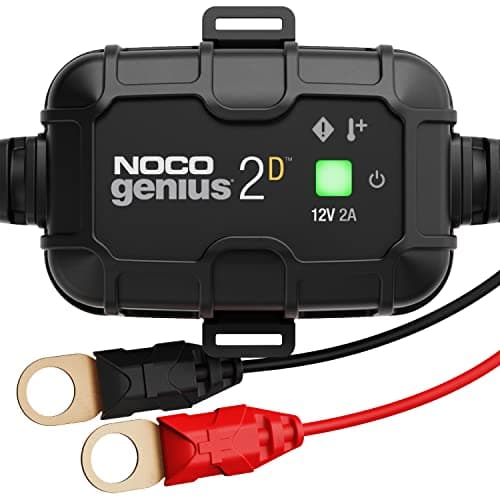
| 1 | NOCO GENIUS5 Battery Charger A car that sits, or a battery that keeps going flat | Plugs in | 9.2/10 | $39.95 - view on Amazon |
| 2 | ANCEL BA101 Battery Tester Knowing whether the battery or the alternator is at fault | Plugs in | 8.9/10 | $36.99 - view on Amazon |
| 3 | Sunway Solar Battery Trickle Charger Stating plainly what it cannot do | Plugs in | 8.9/10 | $39.99 - view on Amazon |
Prices last verified October 26, 2026. They move constantly; the figure on Amazon when you click is the real one.
What it is actually for
Every car battery self-discharges, and every modern car draws a small standing current with the ignition off — alarm, keyless entry receiver, clock, body control module. That combination is what flattens a battery in a car that sits for a month.
A solar maintainer offsets that standing draw. It supplies a trickle during daylight so the battery is not slowly losing ground.
Sunway states the boundary explicitly: it maintains charge against natural drainage, and is not designed to recharge a battery that has fully discharged. Publishing what a product cannot do is rare enough that it is the main reason this one is here.
Two conditions that have to hold
- Sun has to reach it. A car in a garage, under a carport, under a cover or in a parking garage gets nothing. This rules out a large share of the cars whose owners want one
- The connection has to stay live. Via the 12V socket it only works if that socket is powered with the ignition off, which varies by car. Battery clamps or a fused ring terminal bypass the issue entirely and are the better connection for long storage
Check the socket first — it takes thirty seconds with anything that lights up. If it dies with the ignition, use the clamps.
Solar against a mains maintainer
| Solar maintainer | Mains smart charger | |
|---|---|---|
| Recharges a flat battery | No — stated | Yes |
| Needs an outlet | No | Yes |
| Needs sun | Yes | No |
| Output | 1.5-8 W depending on panel | Amps, not watts — far more |
| Reconditioning modes | No | Published on better units |
| Works in a garage | No | Yes |
| Works in winter | Poorly | Yes |
The honest summary: if you have access to an outlet where the car is parked, a mains maintainer is better at everything. It recovers a discharged battery, holds one properly, and several publish desulfation or reconditioning modes — best car battery chargers.
Solar wins in exactly one situation and wins it decisively: a vehicle parked outdoors with no power available. A car at an airport for three weeks, a second car on a driveway, a caravan or a boat trailer.
When it is the wrong purchase entirely
Most people who buy one of these have a different problem, and a trickle of sunlight does not touch it.
- The battery is worn. Most starter batteries last three to five years. A battery that no longer holds charge will not be rescued by 1.5W — best car battery testers tells you which situation you are in
- The alternator is not charging. A charging-system fault presents as a flat battery and a new battery does not fix it
- There is a real parasitic drain. a door not fully shut, a trunk light, an aftermarket accessory wired to a permanent live. That is a fault to find, not a deficit to top up
- Short trips. Cranking takes a lot out and a ten-minute commute does not put it back. A mains charger overnight solves that properly
- A hardwired dash cam in parking mode. Published draw is roughly 0.25-0.35A — an order of magnitude more than a 1.5W panel supplies — does parking mode drain your battery
That last one is worth dwelling on. If a dash cam is the reason the battery keeps dying, the fix is the hardwire kit's low-voltage cutoff setting, not a solar panel trying to outrun it.
Which wattage
Sunway publishes 1.5W, 5W and 8W versions, and the choice is about how much sun you realistically get rather than how big the battery is.
- 1.5W for a car parked in reliable open sun, offsetting a normal key-off draw
- 5W for partial shade, shorter winter days, or a vehicle with a slightly higher standing draw
- 8W for a larger battery, a boat or RV, or genuinely poor light
Sunway states the maintainer will not overcharge a battery of 20Ah or greater, which covers every car battery and rules out using the larger panels unregulated on a small motorcycle battery.
Mount the panel where it gets light and does not block your view — a dashboard panel is in the windshield aperture, and anything in that aperture is subject to the same obstruction thinking as everything else on the glass — where to mount your phone in a car. If the car is parked long-term, on the rear parcel shelf is usually better and out of the way.
Every pick, with the working
Each entry lists the specifications the maker publishes, the axis scores those specifications produce, and what you give up. Rows that read “Not published” are not omissions on our side: they are things the maker will not commit to in writing, and they cost the product points on the transparency axis. Specifications compiled September 4, 2026.
Our pickA car that sits, or a battery that keeps going flat
NOCO GENIUS5 Battery Charger
Publishes what almost nothing in this category does: the chemistries it supports by name, the capacity ceiling, and the fact that it has a thermal sensor adjusting charge to ambient temperature. Seven modes including a repair mode and a force mode for a battery at 0 V.
- Output
- 5 A
- Voltages
- 6 V and 12 V
- Chemistries
- Wet, gel, MF, CA, EFB, AGM, lithium
- Capacity ceiling
- Up to 120 Ah
- Modes
- 7 — Standby, 12V, 12V AGM, 12V Lithium, 6V, Repair, Force
- Thermal compensation
- Integrated thermal sensor
- Minimum start voltage
- 1 V (0 V in Force mode)
- Warranty
- Not published
- List price
- Not published
What it gets right
- Publishes supported chemistries by name — wet, gel, MF, CA, EFB, AGM and lithium — rather than 'all battery types'
- Publishes a capacity ceiling of 120 Ah, so you can check it against your battery
- Integrated thermal sensor adjusts charging to ambient temperature, which prevents overcharging in heat
- Charges from as low as 1 V, with a force mode for a battery that has gone fully to 0 V
- 6 V and 12 V, which covers motorcycles and older vehicles as well as cars
Flaws
- 5 A is a maintainer and a slow charger, not a fast one. A deeply flat large battery takes many hours
- Force mode bypasses the safety detection that stops it charging a dead battery, and a battery that dead may be scrap
- It is a garage tool that needs mains power — it does nothing at the roadside
- No published warranty term
The working behind the 9.2
- Heat headroom: not scored (weight 22%)
- The maker publishes no operating-temperature ceiling, so this axis is dropped and the other weights are re-normalized.
- Install effort: 10.0 (weight 24%)
- Plugs into a 12V socket or a USB port. Nothing to mount, nothing to route, reversible in a second.
- Price against the ceiling: not scored (weight 24%)
- No published list price we could cite on the compile date, so this axis is dropped and the other weights are re-normalized.
- Written commitment: not scored (weight 15%)
- No warranty term published, so this axis is dropped and the other weights are re-normalized.
- Spec transparency: 7.8 (weight 15%)
- 7 of the 9 specifications we went looking for are published by the maker (78%). A blank row is never a guess here: it prints “Not published” and it costs the product points, because a figure nobody will commit to in writing is a figure you cannot check.
Axes with no published input are dropped and the remaining weights re-normalized, so a product is not punished for a category where an axis does not apply. Specifications compiled September 4, 2026 from NOCO GENIUS5 published specifications.
2Knowing whether the battery or the alternator is at fault
ANCEL BA101 Battery Tester
Publishes the three things that decide whether a battery tester is any use to you: the CCA range it measures, the battery chemistries it supports, and the voltage range it will operate across. It tests the charging system as well as the battery, which is what separates diagnosis from guessing.
- CCA measurement range
- 100-2000 CCA
- Battery types
- Flooded, AGM, GEL, EFB
- Minimum battery capacity
- Over 30Ah
- Operating voltage
- 8-30V DC
- Tests
- Battery, cranking, charging
- Warranty
- Not published
- List price
- Not published
What it gets right
- Publishes a measurement range of 100-2000 CCA, which covers every passenger car battery and most trucks
- Publishes supported chemistries: flooded, AGM, GEL and EFB — AGM in particular tests differently and cheap testers get it wrong
- Tests battery, cranking and charging systems separately, so a failing alternator does not read as a failing battery
- Published operating range of 8-30V DC, powered from the battery under test
Flaws
- Stated for batteries over 30Ah — it is not the tool for a motorcycle or lawn tractor battery below that
- Reads CCA against the rating you enter, so a wrong entry gives a confidently wrong result
- No printout and no logging; you read it and write it down
- No warranty published
The working behind the 8.9
- Heat headroom: not scored (weight 22%)
- The maker publishes no operating-temperature ceiling, so this axis is dropped and the other weights are re-normalized.
- Install effort: 10.0 (weight 24%)
- Plugs into a 12V socket or a USB port. Nothing to mount, nothing to route, reversible in a second.
- Price against the ceiling: not scored (weight 24%)
- No published list price we could cite on the compile date, so this axis is dropped and the other weights are re-normalized.
- Written commitment: not scored (weight 15%)
- No warranty term published, so this axis is dropped and the other weights are re-normalized.
- Spec transparency: 7.1 (weight 15%)
- 5 of the 7 specifications we went looking for are published by the maker (71%). A blank row is never a guess here: it prints “Not published” and it costs the product points, because a figure nobody will commit to in writing is a figure you cannot check.
Axes with no published input are dropped and the remaining weights re-normalized, so a product is not punished for a category where an axis does not apply. Specifications compiled September 4, 2026 from ANCEL BA101 published measurement range, chemistries and operating voltage.
3Stating plainly what it cannot do
Sunway Solar Battery Trickle Charger
Skip this one. The honest skip on its own page. If the car has a parasitic drain, or a battery that is already weak, or lives in a garage, a solar panel on the dashboard will not fix it — Sunway states plainly it maintains against natural drainage and will not recharge a fully discharged battery. Buy it for a car parked outdoors that sits for weeks. For everything else, a mains maintainer does more.
Publishes the limitation most of this category hides: it is a trickle charger for offsetting natural drain, not a charger for reviving a flat battery. It also states it will not overcharge a battery of 20Ah or more, which is the safety question people actually have.
- Output options
- 1.5 W (0.13 A), 5 W, 8 W
- Function
- Maintain against natural drain only
- Will recharge a flat battery
- No — stated
- Overcharge protection
- Stated safe on 20Ah and above
- Connection
- 12V socket or battery clamps
- Warranty
- Not published
- List price
- Not published
What it gets right
- States explicitly that it maintains charge against natural drainage and will not recharge a fully discharged battery
- States it will not overcharge or damage a battery of 20Ah or greater
- Published wattage options — 1.5 W (0.13 A), 5 W and 8 W — so you can match output to the drain
- Plugs into the 12V socket or clips to the terminals, with no installation
Flaws
- Needs sun. A car parked in a garage or under cover gets nothing from it
- 1.5 W at 0.13 A is a very small current — it offsets a parasitic drain, it does not fight one
- Via the 12V socket it only works if that socket is live with the ignition off, which varies by car
- No published warranty
The working behind the 8.9
- Heat headroom: not scored (weight 22%)
- The maker publishes no operating-temperature ceiling, so this axis is dropped and the other weights are re-normalized.
- Install effort: 10.0 (weight 24%)
- Plugs into a 12V socket or a USB port. Nothing to mount, nothing to route, reversible in a second.
- Price against the ceiling: not scored (weight 24%)
- No published list price we could cite on the compile date, so this axis is dropped and the other weights are re-normalized.
- Written commitment: not scored (weight 15%)
- No warranty term published, so this axis is dropped and the other weights are re-normalized.
- Spec transparency: 7.1 (weight 15%)
- 5 of the 7 specifications we went looking for are published by the maker (71%). A blank row is never a guess here: it prints “Not published” and it costs the product points, because a figure nobody will commit to in writing is a figure you cannot check.
Axes with no published input are dropped and the remaining weights re-normalized, so a product is not punished for a category where an axis does not apply. Specifications compiled September 4, 2026 from Sunway Solar published output, limitations and battery compatibility.
Prices last verified October 26, 2026. They move constantly; the figure on Amazon when you click is the real one.
Questions people actually ask
Can a solar charger recharge a dead car battery?
No, and Sunway states so. It maintains charge against natural drainage. A fully discharged battery needs a mains charger, and possibly a test to establish whether it is worth recovering.
Will a solar maintainer overcharge my battery?
Sunway states it will not overcharge or damage a battery of 20Ah or greater, which covers every car battery. Smaller motorcycle batteries are a different case and want a regulated unit.
Does it work through the cigarette lighter socket?
Only if that socket stays live with the ignition off, which varies by car. Check first — it takes thirty seconds. Battery clamps or a fused ring terminal bypass the question entirely and are better for long storage.
Solar or a plug-in battery maintainer?
A mains maintainer if you have an outlet where the car is parked — it recovers a flat battery, holds one properly and works in winter and in garages. Solar wins only where there is no power at all.