The best car battery chargers
A jump starter gets you moving once. A charger stops you needing one. People buy the wrong one constantly, and the difference is not subtle.
By Sawyer V. · Published · How we research
We have not tested any of this. Everything below is compiled from published manufacturer specifications, and the arithmetic is printed so you can check it. This page carries affiliate links: if you buy through one we earn a commission at no extra cost to you, and it does not change the order of the picks. Full disclosure.
The short answer
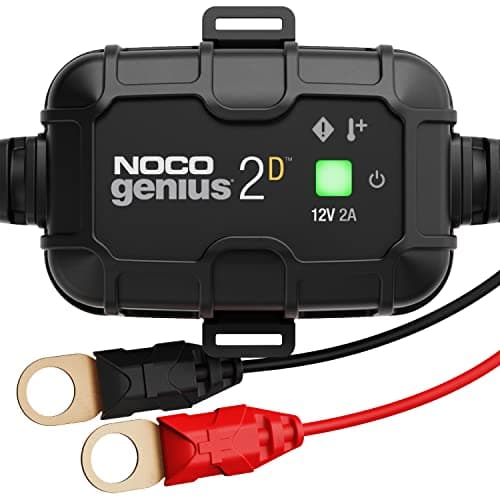
Buy the NOCO GENIUS5 if the car sits, or the battery keeps dying. It publishes the three figures that matter: the chemistries it supports by name — wet, gel, MF, CA, EFB, AGM and lithium — a capacity ceiling of 120 Ah, and an integrated thermal sensor that adjusts charge rate to ambient temperature. At 5 A it is a maintainer and a slow charger, not a fast one. A jump starter is a different product for a different problem.
| # | Pick | Install | Score | Price |
|---|---|---|---|---|
| 1 | NOCO GENIUS5 Battery Charger A car that sits, or a battery that keeps going flat | Plugs in | 9.2/10 | $39.95 - view on Amazon |
| 2 | BlueDriver Pro OBD2 Scanner Reading more than the engine light | Plugs in | 9.0/10 | $94.94 - view on Amazon |
| 3 | NOCO Boost Plus GB40 Not needing anybody else's car | Plugs in | 8.0/10 | $99.95 - view on Amazon |
Prices last verified October 24, 2026. They move constantly; the figure on Amazon when you click is the real one.
Two products, opposite jobs
This is the confusion that sends people home with the wrong box, and it is worth settling before anything else.
| Jump starter | Charger / maintainer | |
|---|---|---|
| Current | Hundreds of amps, for seconds | A few amps, for hours |
| Job | Start an engine now | Refill and hold a battery |
| Power source | Its own lithium pack | Mains |
| Where it works | Roadside | Where there is an outlet |
| Puts charge back | Essentially none | That is the whole function |
A jump start does not charge anything. The engine started on borrowed current and your battery is still flat — the alternator then has to refill it, which needs sustained driving. We set that out in how to jump start a car.
So if you jump the car twice in a month, the jump starter is not the answer. Either something is draining the battery, or the battery is at the end of its life, and a charger addresses the first while telling you about the second.
What we ranked on
- Published chemistry support. AGM and lithium need different charge profiles from flooded lead-acid. A charger that says “all battery types” has told you nothing
- Published capacity ceiling. In amp-hours, so you can check it against your battery rather than hoping
- Thermal compensation. Correct charging voltage varies with temperature. A charger without a thermal sensor is using one number year round
- Minimum start voltage. Most smart chargers refuse to start below a threshold, which is a safety feature and occasionally the thing standing between you and a recoverable battery
Why chemistry is the specification
Modern cars are increasingly not running the flooded lead-acid battery a generic charger assumes. Anything with stop-start is very likely AGM or EFB, and those want a higher absorption voltage than a flooded battery and are damaged by the wrong profile over time.
NOCO publishes the list by name — wet, gel, MF, CA, EFB, AGM and lithium — and gives AGM and lithium their own selectable modes rather than a single “smart” setting. That is the difference between a charger that has a profile for your battery and one that has an average.
The thermal sensor, which nobody mentions
Lead-acid chemistry is temperature dependent. The correct absorption voltage is higher when cold and lower when hot, and a charger holding one fixed voltage will undercharge in a cold garage in January and overcharge in a hot one in July.
Overcharging in heat is the one that does damage, because it drives off electrolyte in a battery that in most cars cannot be topped up. NOCO publishes an integrated thermal sensor that adjusts for ambient temperature, which is a real functional feature rather than a marketing line.
Five amps, and why more is not better
5 A sounds modest next to chargers advertising 10 or 15. For a car battery that is usually the right number rather than a compromise.
A typical car battery is around 45 to 70 Ah. Charging at 5 A puts a meaningful charge back over a working day and does it gently, and gentle is what a lead-acid battery wants — high-current charging heats the plates and shortens life. Fast charging exists for garages that need a car out of the door, not for a battery you would like to keep.
Where 5 A genuinely is not enough: a deeply discharged large truck or RV battery, which will take a very long time. Check the published 120 Ah ceiling against your battery before assuming.
Repair and Force modes, and when not to use them
Smart chargers refuse to start below a voltage threshold, because a battery that low may be internally shorted and charging it is genuinely unsafe. NOCO publishes charging from as low as 1 V, with a Force mode that overrides detection entirely down to 0 V.
That is a useful capability and it deliberately bypasses a safety check. A battery that has sat at zero volts has almost certainly sulfated beyond recovery, and forcing charge into a damaged battery is how they vent or worse. Try it once on a battery you were going to replace anyway; do not make it routine.
Repair mode attempts desulfation, which works on a battery that is merely tired and does nothing for one with a failed cell. Neither mode turns a scrap battery into a good one.
Before you buy: find out why it went flat
A healthy battery in a car driven regularly does not go flat. If yours does, a charger treats the symptom, and there are three usual causes worth checking first.
- Short journeys. Starting takes a lot out and a ten-minute drive does not put it back. This is the most common cause and a maintainer genuinely is the fix
- A parasitic draw. A vehicle's own standby load is normally 20 to 50 mA. Something staying awake pushes that up — the arithmetic is in does a car charger drain your battery
- An accessory left drawing. A dash cam in parking mode is a deliberate continuous load and needs a low-voltage cutoff — does parking mode drain your battery
A scanner will often surface a charging-system fault code that explains the whole thing — best OBD2 scanners. And a jump pack in the trunk is still worth having for the morning it happens anyway: best portable jump starters.
One thing a charger will not tell you: whether the battery is worth charging. A smart charger will happily keep reviving a battery that has lost half its capacity, and it will do it every few weeks without ever reporting the problem — best car battery testers covers the three tests that separate a worn battery from a failing alternator.
Where there is no outlet at all — a car parked outdoors for weeks — a solar maintainer is the alternative, with the limitation its own maker publishes: it offsets natural drain and will not recharge a flat battery — best solar battery maintainers.
Every pick, with the working
Each entry lists the specifications the maker publishes, the axis scores those specifications produce, and what you give up. Rows that read “Not published” are not omissions on our side: they are things the maker will not commit to in writing, and they cost the product points on the transparency axis. Specifications compiled September 4, 2026.
Our pickA car that sits, or a battery that keeps going flat
NOCO GENIUS5 Battery Charger
Publishes what almost nothing in this category does: the chemistries it supports by name, the capacity ceiling, and the fact that it has a thermal sensor adjusting charge to ambient temperature. Seven modes including a repair mode and a force mode for a battery at 0 V.
- Output
- 5 A
- Voltages
- 6 V and 12 V
- Chemistries
- Wet, gel, MF, CA, EFB, AGM, lithium
- Capacity ceiling
- Up to 120 Ah
- Modes
- 7 — Standby, 12V, 12V AGM, 12V Lithium, 6V, Repair, Force
- Thermal compensation
- Integrated thermal sensor
- Minimum start voltage
- 1 V (0 V in Force mode)
- Warranty
- Not published
- List price
- Not published
What it gets right
- Publishes supported chemistries by name — wet, gel, MF, CA, EFB, AGM and lithium — rather than 'all battery types'
- Publishes a capacity ceiling of 120 Ah, so you can check it against your battery
- Integrated thermal sensor adjusts charging to ambient temperature, which prevents overcharging in heat
- Charges from as low as 1 V, with a force mode for a battery that has gone fully to 0 V
- 6 V and 12 V, which covers motorcycles and older vehicles as well as cars
Flaws
- 5 A is a maintainer and a slow charger, not a fast one. A deeply flat large battery takes many hours
- Force mode bypasses the safety detection that stops it charging a dead battery, and a battery that dead may be scrap
- It is a garage tool that needs mains power — it does nothing at the roadside
- No published warranty term
The working behind the 9.2
- Heat headroom: not scored (weight 22%)
- The maker publishes no operating-temperature ceiling, so this axis is dropped and the other weights are re-normalized.
- Install effort: 10.0 (weight 24%)
- Plugs into a 12V socket or a USB port. Nothing to mount, nothing to route, reversible in a second.
- Price against the ceiling: not scored (weight 24%)
- No published list price we could cite on the compile date, so this axis is dropped and the other weights are re-normalized.
- Written commitment: not scored (weight 15%)
- No warranty term published, so this axis is dropped and the other weights are re-normalized.
- Spec transparency: 7.8 (weight 15%)
- 7 of the 9 specifications we went looking for are published by the maker (78%). A blank row is never a guess here: it prints “Not published” and it costs the product points, because a figure nobody will commit to in writing is a figure you cannot check.
Axes with no published input are dropped and the remaining weights re-normalized, so a product is not punished for a category where an axis does not apply. Specifications compiled September 4, 2026 from NOCO GENIUS5 published specifications.
2Reading more than the engine light
BlueDriver Pro OBD2 Scanner
Publishes its five supported protocols by name and states plainly that enhanced ABS, SRS and transmission diagnostics work on 13 named brands rather than implying they work everywhere. No subscription, which in this category is genuinely unusual.
- Protocols
- ISO15765-4 (CAN), ISO14230-4 (KWP2000), ISO9141-2, J1850 VPW, J1850 PWM
- Vehicle coverage
- 1996+ North American cars, SUVs and light trucks
- Enhanced diagnostics
- ABS, SRS, transmission on 13 named brands
- Connection
- Bluetooth to iOS or Android
- Subscription
- None
- Screen
- None — uses your phone
- Warranty
- Not published
- List price
- Not published
What it gets right
- Publishes the actual protocols: ISO15765-4 CAN, ISO14230-4 KWP2000, ISO9141-2, J1850 VPW and J1850 PWM
- Enhanced ABS, SRS and transmission codes on 13 named brands — and it names them rather than saying 'most vehicles'
- No subscription and no cables; it is a Bluetooth dongle plus a free app
- Works on 1996 and newer North American cars, SUVs and light trucks
Flaws
- Enhanced diagnostics are brand-limited. Outside those 13 makes you get generic OBD2, which a $25 reader also gives you
- It has no screen of its own, so a flat phone is a scanner you cannot use
- Manufacturing origin is not published
- No published warranty term
The working behind the 9.0
- Heat headroom: not scored (weight 22%)
- The maker publishes no operating-temperature ceiling, so this axis is dropped and the other weights are re-normalized.
- Install effort: 10.0 (weight 24%)
- Plugs into a 12V socket or a USB port. Nothing to mount, nothing to route, reversible in a second.
- Price against the ceiling: not scored (weight 24%)
- No published list price we could cite on the compile date, so this axis is dropped and the other weights are re-normalized.
- Written commitment: not scored (weight 15%)
- No warranty term published, so this axis is dropped and the other weights are re-normalized.
- Spec transparency: 7.5 (weight 15%)
- 6 of the 8 specifications we went looking for are published by the maker (75%). A blank row is never a guess here: it prints “Not published” and it costs the product points, because a figure nobody will commit to in writing is a figure you cannot check.
Axes with no published input are dropped and the remaining weights re-normalized, so a product is not punished for a category where an axis does not apply. Specifications compiled September 4, 2026 from BlueDriver Pro published protocols and coverage.
3Not needing anybody else's car
NOCO Boost Plus GB40
Skip this one. It is on this page because it is the product people buy when they meant to buy a charger. A jump pack delivers a huge current for seconds to start an engine and puts essentially nothing back into the battery. If your battery keeps going flat, a jump starter treats the symptom every single morning.
1,000 peak amps out of a 24 watt-hour lithium pack that weighs 2.4 pounds, rated for gasoline engines to 6.0 liters and diesel to 3.0, with spark-proof clamps and reverse-polarity protection. It is the single accessory here that changes what happens on the worst morning of your year, and it fits in a glovebox.
- Peak amps
- 1,000 A
- Battery
- 24 Wh lithium-ion
- Engine ceiling
- Gasoline to 6.0 L, diesel to 3.0 L
- Starts per charge
- Up to 20
- Dimensions
- 7.7 x 3.2 x 1.7 in
- Weight
- 2.4 lb with clamps
- Light
- 100 lumens
- Safety
- Spark proof, reverse polarity protected
- Operating range
- Not published
List price $99.95 per NOCO's listed price, captured on the compile date below. Not a live price and not what you will pay — the button is where the real number is.
What it gets right
- 1,000 peak amps and up to 20 starts on one charge, both published
- Spark-proof and reverse-polarity protected, which matters when you are doing this in the dark
- 2.4 lb and 7.7 inches long — it genuinely lives in the car rather than the garage
- USB port and a 100-lumen light, so it is also the thing you reach for in a power cut
Flaws
- Lithium, so it self-discharges and needs topping up every few months or it is a brick when you need it
- 6.0 L gasoline and 3.0 L diesel is the published ceiling — a big diesel needs the bigger model
- $99.95 for something you hope never to use
The working behind the 8.0
- Heat headroom: not scored (weight 22%)
- The maker publishes no operating-temperature ceiling, so this axis is dropped and the other weights are re-normalized.
- Install effort: 10.0 (weight 24%)
- Plugs into a 12V socket or a USB port. Nothing to mount, nothing to route, reversible in a second.
- Price against the ceiling: 7.0 (weight 24%)
- Listed at $99.95 on the compile date. This site's buyer has a practical ceiling around $150 for a single upgrade, so the scale rewards everything under $100 and falls away sharply past $150. The live price is very often different, and that is what the button is for.
- Written commitment: 5.5 (weight 15%)
- 12-month warranty. This is the only promise in the entire listing that a court would read, which is why it is scored and the marketing copy is not.
- Spec transparency: 8.9 (weight 15%)
- 8 of the 9 specifications we went looking for are published by the maker (89%). A blank row is never a guess here: it prints “Not published” and it costs the product points, because a figure nobody will commit to in writing is a figure you cannot check.
Axes with no published input are dropped and the remaining weights re-normalized, so a product is not punished for a category where an axis does not apply. Specifications compiled September 4, 2026 from NOCO Boost Plus GB40 published specifications.
Prices last verified October 24, 2026. They move constantly; the figure on Amazon when you click is the real one.
Questions people actually ask
Can I use a jump starter instead of a battery charger?
No. A jump starter delivers a huge current for a few seconds and puts essentially nothing back into the battery. If the battery keeps going flat, a jump pack treats the symptom every morning without addressing the cause.
Do I need a special charger for an AGM battery?
You need one with an AGM mode. AGM wants a higher absorption voltage than flooded lead-acid, and the wrong profile shortens its life quietly rather than failing obviously. Check the battery label — stop-start cars are usually AGM or EFB.
Can I leave a maintainer connected all winter?
That is what a maintainer is for — it holds a float charge rather than continuing to push current. It is the standard answer for a car that sits, and far better for the battery than repeated deep discharge.
Is 5 amps enough to charge a car battery?
For a typical 45 to 70 Ah car battery, yes — it puts a meaningful charge back over a working day and does it gently, which is what lead-acid chemistry wants. Check the published 120 Ah ceiling if you have a large truck or RV battery.