The best car battery testers
A jump start gets you moving. A tester tells you whether you will need another one tomorrow, and whether the battery is even the problem.
By Sawyer V. · Published · How we research
We have not tested any of this. Everything below is compiled from published manufacturer specifications, and the arithmetic is printed so you can check it. This page carries affiliate links: if you buy through one we earn a commission at no extra cost to you, and it does not change the order of the picks. Full disclosure.
The short answer
The test that matters is not the battery test — it is the charging test. A tester measures cranking amps against the battery's rating, and then measures what the alternator delivers while the engine runs. A flat battery with a healthy charging system is a worn battery; a flat battery with a low charging reading is an alternator, and replacing the battery will not fix it. The ANCEL BA101 publishes a 100-2000 CCA range and names the battery chemistries it supports, which is the detail that separates it here.
| # | Pick | Install | Score | Price |
|---|---|---|---|---|
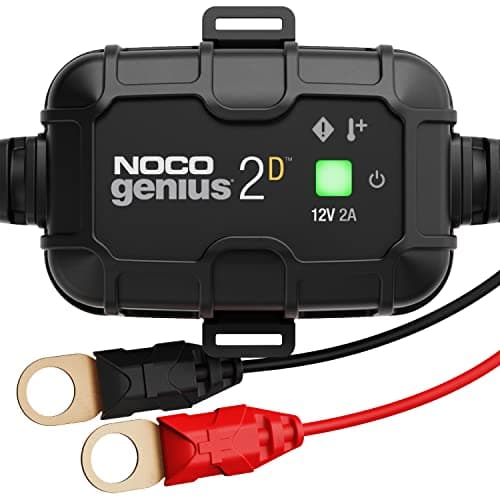
| 1 | NOCO GENIUS5 Battery Charger A car that sits, or a battery that keeps going flat | Plugs in | 9.2/10 | $39.95 - view on Amazon |
| 2 | ANCEL BA101 Battery Tester Knowing whether the battery or the alternator is at fault | Plugs in | 8.9/10 | $36.99 - view on Amazon |
| 3 | TOPDON BT100 Battery Tester The same three tests, smaller and simpler | Plugs in | 7.3/10 | $53.99 - view on Amazon |
Prices last verified October 26, 2026. They move constantly; the figure on Amazon when you click is the real one.
Three separate tests, and people only think about one
Both testers here run battery, cranking and charging tests. They answer different questions and the third is the valuable one.
- Battery test. Measures the battery's actual cold cranking amps against the rating printed on its label. A battery reading well below its rating is worn, regardless of whether the car started this morning
- Cranking test. Watches voltage while the starter turns the engine. A deep voltage drop under cranking load points at a battery that tests acceptably at rest and collapses under demand
- Charging test. Measures what the alternator is putting out with the engine running. This is the one that tells you the battery is a symptom rather than the cause
CCA, and entering it correctly
Cold cranking amps is the current a battery can deliver at 0 F for 30 seconds while holding usable voltage. It is the rating printed on the battery label and it is what a tester measures against.
Both units here publish a measurement range of 100 to 2000 CCA, which covers every passenger car battery and most light trucks.
The catch: you enter the battery's rated CCA and the tester reports measured against that. Enter the wrong figure and you get a confidently wrong verdict. Read the label, not the parts catalog — batteries get replaced with whatever was in stock and the label is the only reliable source.
AGM is where cheap testers get it wrong
Battery chemistry has diversified and the testing behavior is not the same across types.
The ANCEL publishes support for flooded, AGM, GEL and EFB. That matters because AGM and EFB batteries are now standard on anything with stop-start, which is most cars sold in the last decade. They have different internal resistance characteristics, and a tester that assumes flooded chemistry can report a healthy AGM battery as failing.
| ANCEL BA101 | TOPDON BT100 | |
|---|---|---|
| CCA range | 100-2000 | 100-2000 |
| Battery types | Flooded, AGM, GEL, EFB | Not published |
| Minimum capacity | Over 30Ah | Not published |
| Operating voltage | 8-30V DC | Not published |
| Tests | Battery, cranking, charging | Battery, cranking, charging |
| Power source | Vehicle battery | Vehicle battery |
| Warranty | Not published | Not published |
That table is the whole ranking. The two units do the same three tests over the same CCA range; the ANCEL publishes three more rows about its limits, and a tool that states its own limits is more useful than one that does not.
The 30Ah floor ANCEL publishes is a real constraint worth reading — below it, the tester is out of its stated range. That rules out most motorcycle and lawn tractor batteries.
Reading the result honestly
A tester gives numbers, not a diagnosis. Rough guidance on what the numbers mean:
- Measured CCA near or above the rating: the battery is healthy. Look elsewhere
- Measured CCA well below the rating: the battery has lost capacity. It may still start the car in mild weather and will not in the cold
- Cranking voltage dropping very low: either the battery cannot hold up under load, or there is resistance in the connections. Clean the terminals and retest before buying anything
- Charging voltage low with the engine running: the alternator or its belt. A new battery will not fix this
- Charging voltage very high: a regulator fault, which cooks batteries. The battery you just replaced may have died of this
Test with the battery rested if you can — straight after a drive it is surface-charged and reads better than it is. Overnight, or half an hour after switching off, gives a truer figure.
Why it went flat, which the tester does not tell you
A tester measures condition. It does not explain how the battery got there, and the answer usually is not the battery.
Most starter batteries last three to five years. Short trips are the other common cause: cranking takes a lot out and a ten-minute commute does not put it back, so weeks of that produces a chronically undercharged battery that reads low and is not actually faulty. A maintenance charger overnight fixes that one — best car battery chargers.
Then there is parasitic draw. A hardwired dash cam in parking mode is the one this site sees most, and the fix is the cutoff voltage setting rather than the camera — does parking mode drain your battery.
And cold does not cause battery failure so much as expose it. A battery delivers substantially less at 0 C than at 21 C, which is why marginal batteries die in December — what to keep in your car in winter.
What else belongs in the same drawer
A battery tester answers one question well. Two adjacent tools answer the next ones.
A code reader turns a warning light into a specific fault, which covers everything the battery is not — best OBD2 scanners. And a jump pack is the thing that gets you home while you work out which of the above applies — best portable jump starters.
The honest ordering for someone with an intermittently flat battery: test it, charge it properly, retest it, and only then buy a battery.
Every pick, with the working
Each entry lists the specifications the maker publishes, the axis scores those specifications produce, and what you give up. Rows that read “Not published” are not omissions on our side: they are things the maker will not commit to in writing, and they cost the product points on the transparency axis. Specifications compiled September 4, 2026.
Our pickA car that sits, or a battery that keeps going flat
NOCO GENIUS5 Battery Charger
Skip this one. A charger is not a tester and this page exists partly to separate them. A smart charger will recover a discharged battery and maintain a healthy one, and it will happily keep reviving a battery that has lost half its capacity without ever telling you so. Buy both if the car has a battery problem; buy the tester first, because it tells you whether the charger will help.
Publishes what almost nothing in this category does: the chemistries it supports by name, the capacity ceiling, and the fact that it has a thermal sensor adjusting charge to ambient temperature. Seven modes including a repair mode and a force mode for a battery at 0 V.
- Output
- 5 A
- Voltages
- 6 V and 12 V
- Chemistries
- Wet, gel, MF, CA, EFB, AGM, lithium
- Capacity ceiling
- Up to 120 Ah
- Modes
- 7 — Standby, 12V, 12V AGM, 12V Lithium, 6V, Repair, Force
- Thermal compensation
- Integrated thermal sensor
- Minimum start voltage
- 1 V (0 V in Force mode)
- Warranty
- Not published
- List price
- Not published
What it gets right
- Publishes supported chemistries by name — wet, gel, MF, CA, EFB, AGM and lithium — rather than 'all battery types'
- Publishes a capacity ceiling of 120 Ah, so you can check it against your battery
- Integrated thermal sensor adjusts charging to ambient temperature, which prevents overcharging in heat
- Charges from as low as 1 V, with a force mode for a battery that has gone fully to 0 V
- 6 V and 12 V, which covers motorcycles and older vehicles as well as cars
Flaws
- 5 A is a maintainer and a slow charger, not a fast one. A deeply flat large battery takes many hours
- Force mode bypasses the safety detection that stops it charging a dead battery, and a battery that dead may be scrap
- It is a garage tool that needs mains power — it does nothing at the roadside
- No published warranty term
The working behind the 9.2
- Heat headroom: not scored (weight 22%)
- The maker publishes no operating-temperature ceiling, so this axis is dropped and the other weights are re-normalized.
- Install effort: 10.0 (weight 24%)
- Plugs into a 12V socket or a USB port. Nothing to mount, nothing to route, reversible in a second.
- Price against the ceiling: not scored (weight 24%)
- No published list price we could cite on the compile date, so this axis is dropped and the other weights are re-normalized.
- Written commitment: not scored (weight 15%)
- No warranty term published, so this axis is dropped and the other weights are re-normalized.
- Spec transparency: 7.8 (weight 15%)
- 7 of the 9 specifications we went looking for are published by the maker (78%). A blank row is never a guess here: it prints “Not published” and it costs the product points, because a figure nobody will commit to in writing is a figure you cannot check.
Axes with no published input are dropped and the remaining weights re-normalized, so a product is not punished for a category where an axis does not apply. Specifications compiled September 4, 2026 from NOCO GENIUS5 published specifications.
2Knowing whether the battery or the alternator is at fault
ANCEL BA101 Battery Tester
Publishes the three things that decide whether a battery tester is any use to you: the CCA range it measures, the battery chemistries it supports, and the voltage range it will operate across. It tests the charging system as well as the battery, which is what separates diagnosis from guessing.
- CCA measurement range
- 100-2000 CCA
- Battery types
- Flooded, AGM, GEL, EFB
- Minimum battery capacity
- Over 30Ah
- Operating voltage
- 8-30V DC
- Tests
- Battery, cranking, charging
- Warranty
- Not published
- List price
- Not published
What it gets right
- Publishes a measurement range of 100-2000 CCA, which covers every passenger car battery and most trucks
- Publishes supported chemistries: flooded, AGM, GEL and EFB — AGM in particular tests differently and cheap testers get it wrong
- Tests battery, cranking and charging systems separately, so a failing alternator does not read as a failing battery
- Published operating range of 8-30V DC, powered from the battery under test
Flaws
- Stated for batteries over 30Ah — it is not the tool for a motorcycle or lawn tractor battery below that
- Reads CCA against the rating you enter, so a wrong entry gives a confidently wrong result
- No printout and no logging; you read it and write it down
- No warranty published
The working behind the 8.9
- Heat headroom: not scored (weight 22%)
- The maker publishes no operating-temperature ceiling, so this axis is dropped and the other weights are re-normalized.
- Install effort: 10.0 (weight 24%)
- Plugs into a 12V socket or a USB port. Nothing to mount, nothing to route, reversible in a second.
- Price against the ceiling: not scored (weight 24%)
- No published list price we could cite on the compile date, so this axis is dropped and the other weights are re-normalized.
- Written commitment: not scored (weight 15%)
- No warranty term published, so this axis is dropped and the other weights are re-normalized.
- Spec transparency: 7.1 (weight 15%)
- 5 of the 7 specifications we went looking for are published by the maker (71%). A blank row is never a guess here: it prints “Not published” and it costs the product points, because a figure nobody will commit to in writing is a figure you cannot check.
Axes with no published input are dropped and the remaining weights re-normalized, so a product is not punished for a category where an axis does not apply. Specifications compiled September 4, 2026 from ANCEL BA101 published measurement range, chemistries and operating voltage.
3The same three tests, smaller and simpler
TOPDON BT100 Battery Tester
Covers the same 100-2000 CCA range and the same battery, cranking and charging tests. It publishes less detail than the ANCEL — no operating voltage range, no minimum capacity — which is the only reason it is second rather than first.
- CCA measurement range
- 100-2000 CCA
- Battery types
- Not published
- Minimum battery capacity
- Not published
- Operating voltage
- Not published
- Tests
- Battery, cranking, charging
- Warranty
- Not published
- List price
- Not published
What it gets right
- Published 100-2000 CCA measurement range, the same span as the pricier options
- Tests battery, cranking and charging systems rather than voltage alone
- Clip-on leads and a single screen; nothing to pair, install or update
- Small enough to live in a glovebox rather than a garage drawer
Flaws
- No published operating voltage range
- No published minimum battery capacity, so its limits at the small end are unstated
- Battery chemistry support is not published in the same detail
- No warranty published
The working behind the 7.3
- Heat headroom: not scored (weight 22%)
- The maker publishes no operating-temperature ceiling, so this axis is dropped and the other weights are re-normalized.
- Install effort: 10.0 (weight 24%)
- Plugs into a 12V socket or a USB port. Nothing to mount, nothing to route, reversible in a second.
- Price against the ceiling: not scored (weight 24%)
- No published list price we could cite on the compile date, so this axis is dropped and the other weights are re-normalized.
- Written commitment: not scored (weight 15%)
- No warranty term published, so this axis is dropped and the other weights are re-normalized.
- Spec transparency: 2.9 (weight 15%)
- 2 of the 7 specifications we went looking for are published by the maker (29%). A blank row is never a guess here: it prints “Not published” and it costs the product points, because a figure nobody will commit to in writing is a figure you cannot check.
Axes with no published input are dropped and the remaining weights re-normalized, so a product is not punished for a category where an axis does not apply. Specifications compiled September 4, 2026 from TOPDON BT100 published measurement range and test modes.
Prices last verified October 26, 2026. They move constantly; the figure on Amazon when you click is the real one.
Questions people actually ask
How do I know if it is the battery or the alternator?
Run the charging test with the engine running. Low charging voltage points at the alternator or its belt, and a new battery will not fix it. Normal charging voltage with a battery testing well below its CCA rating means the battery is worn.
Do I need a tester that supports AGM batteries?
If your car has stop-start, almost certainly — AGM and EFB are standard on those. They test differently from flooded batteries, and a tester that assumes flooded chemistry can report a healthy AGM as failing. The ANCEL BA101 publishes support for all four types.
What CCA reading means a battery is bad?
A measured figure well below the rating printed on the battery label. Enter the label's rating correctly first — entering the wrong number gives a confidently wrong result — and test the battery rested rather than straight after a drive.
Is a battery charger the same as a tester?
No. A charger recovers and maintains a battery; a tester tells you whether it is worth recovering. A smart charger will keep reviving a battery that has lost half its capacity without ever reporting the problem.