The best sun visor extenders
There is a band of sky between the bottom of your visor and the top of your sightline that the factory visor cannot cover. Low sun sits in exactly that band.
By Sawyer V. · Published · How we research
We have not tested any of this. Everything below is compiled from published manufacturer specifications, and the arithmetic is printed so you can check it. This page carries affiliate links: if you buy through one we earn a commission at no extra cost to you, and it does not change the order of the picks. Full disclosure.
The short answer
Buy polarized, not tinted, and position it carefully. Polarization filters reflected glare specifically — off wet roads, off body panels, off the hood — where a tinted panel just dims everything including what you need to see. Glare Guard states UV400 and polarized optics. Two honest caveats: it is an object in your forward view, so a badly placed one obstructs more than it helps, and polarized panels can make some LCD instrument displays hard to read at certain angles.
| # | Pick | Install | Score | Price |
|---|---|---|---|---|
| 1 | EcoNour Windshield Sun Shade The cheapest real temperature drop in the car | Drops in | 9.3/10 | $11.99 - view on Amazon |
| 2 | 303 Automotive Protectant A dashboard in permanent sunlight | Drops in | 8.7/10 | $17.99 - view on Amazon |
| 3 | Glare Guard Polarized Sun Visor Extender Low sun that sits under the factory visor | Clips on | 8.1/10 | $39.99 - view on Amazon |
Prices last verified October 24, 2026. They move constantly; the figure on Amazon when you click is the real one.
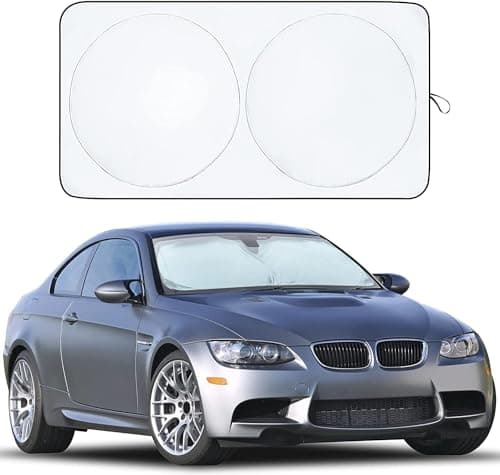
The band the factory visor cannot cover
A sun visor pivots from the roof line. Flip it down and it covers the upper part of the windshield — which is where the sun sits at midday, and exactly where it does not sit in the hour before sunset.
Low sun comes in beneath the visor, at roughly the height of the road ahead. Drop the visor further and you block your view of the road along with the sun. That geometric conflict is the entire reason this product exists.
An extender adds a translucent panel below the visor's edge, so the band gets covered without the road being blocked — you look through it rather than under it.
Polarized versus tinted, which is the whole product
Light reflected off a flat surface — wet asphalt, a hood, another car's roof — becomes largely polarized in one plane. A polarizing filter is oriented to block that plane specifically.
So a polarized panel removes a large share of reflected glare while letting most direct light through. A tinted panel dims everything equally: the glare, the road, the brake lights ahead, the pedestrian at the curb.
That difference matters most in exactly the conditions you bought it for. Wet road with low sun on it is the worst glare case in normal driving and it is almost entirely reflected light, which is what polarization is for.
| Property | Why it matters | Glare Guard |
|---|---|---|
| Polarized | Filters reflected glare specifically | Stated |
| UV rating | Blocks UVA/UVB through side of windshield | Stated UV400 |
| Mounting | Whether it grips your visor thickness | Clip-on, tool free |
| Adjustment | Flip out of the way when not needed | Flip up and down |
| Warranty | Written commitment | Not published |
Placement, which decides whether it helps or hurts
This is the part to get right, because a visor extender is the one accessory on this site that sits deliberately in your forward field of view.
- Sit in your normal driving position first, then set the panel. Adjusting it while leaning forward gives you a panel that is wrong when you sit back
- Cover the sun, not the road. The bottom edge should sit above your view of the road surface at a normal following distance
- Flip it up when the sun moves. Leaving it down all the time is how a useful accessory becomes a permanent obstruction
- Check the clip grips your visor. Visor thickness varies and a loose clip drops the panel into your lap over a bump
The general principle — keep the driver's forward view clear — is the same one governing where a phone mount or dash cam may go, and it is worth applying with the same discipline: where to mount your phone in a car.
The LCD trade-off
Polarizing filters interact with LCD screens, which emit polarized light themselves. Depending on the relative orientation, an LCD viewed through a polarizer can dim dramatically or go black entirely.
Modern cars are full of LCDs — instrument clusters, head units, phone screens. If you look at a screen through the panel at certain angles it may be unreadable, and the same effect appears with polarized sunglasses.
In practice this is manageable, because the panel covers a band above your instruments rather than across them. It is worth knowing before you buy, and worth checking in your specific car rather than assuming.
Laminated windshields can also show visible stress patterns through a polarizer — mildly distracting, entirely harmless, and worth expecting.
The free things to try first
Two of them, and both address the same problem more directly than any panel.
Clean the inside of the windshield. Interior plastics off-gas and condense on the glass, and that film scatters low sun across your entire field of view. It is invisible looking straight through and obvious at a low angle — which is precisely the angle low sun arrives at. Free, and it does more than people expect: how to clean car windows without streaks.
Check for a dashboard reflection. A raked windshield acts partly as a mirror, and a glossy dash puts a ghost image of itself in your view. Glossy interior dressings cause this; a matte protectant avoids it — 303 publishes an SPF 40 equivalent and dries matte, best dashboard protectants.
The full diagnosis of driving glare, including the night version, is in how to stop glare while driving.
Extender or sunglasses
Polarized sunglasses do the same optical job and go with you. They are the better first purchase for most people, and the same LCD caveat applies.
Where an extender wins is that it covers a fixed band regardless of where you look, and it works for anyone driving the car rather than only the person wearing the glasses. It also does not have to come off when the sun goes behind a cloud.
Using both is entirely reasonable. And if the complaint is a passenger rather than you — a rear passenger with sun on their face who cannot move out of it — that is a different product again: best side window sun shades.
Every pick, with the working
Each entry lists the specifications the maker publishes, the axis scores those specifications produce, and what you give up. Rows that read “Not published” are not omissions on our side: they are things the maker will not commit to in writing, and they cost the product points on the transparency axis. Specifications compiled September 4, 2026.
Our pickThe cheapest real temperature drop in the car
EcoNour Windshield Sun Shade
Skip this one. A windshield shade is for a parked car and does nothing while driving — the two get confused constantly because both are sold as sun protection. If your problem is the cabin being an oven when you get in, that is the product. If it is low sun in your eyes at 5pm, it is not.
240T polyester with a reflective coating and reinforced steel rings, in sizes from 53 by 30 up to 75 by 37 inches. EcoNour states its shades keep an interior up to 40 F cooler and block 99 percent of heat and UV. Those are the maker's own figures rather than an independent test, and even at half of them this is the best dollar-per-degree in the whole car.
- Material
- 240T polyester with reflective coating
- Frame
- Reinforced steel rings
- Sizes published
- 53x30, 59x29, 64x32, 66x27, 75x37 in
- Maker's temperature claim
- Up to 40 F cooler interior
- Maker's UV claim
- Blocks 99% of heat and UV
- Independent verification
- Not published
- Warranty
- Not published
List price $20.99 per EcoNour's own store, 53 x 30 in umbrella model, captured on the compile date below. Not a live price and not what you will pay — the button is where the real number is.
What it gets right
- Multiple published sizes, so you can actually match your windshield rather than fold a compromise
- Reinforced steel rings, which is what stops the frame collapsing after one summer
- Under $25 across most sizes
- Folds down small enough to live behind a seat rather than in the trunk
Flaws
- The 40 F figure is EcoNour's own claim, not an independent measurement, and the conditions behind it are not published
- You have to actually put it up every time, which is the real reason sun shades fail
- Sizing is on you: too small leaves a gap, too big will not sit flat
The working behind the 9.3
- Heat headroom: not scored (weight 22%)
- The maker publishes no operating-temperature ceiling, so this axis is dropped and the other weights are re-normalized.
- Install effort: 10.0 (weight 24%)
- Drops in and sits there. No fixing of any kind, and it comes out again when you sell the car.
- Price against the ceiling: 10.0 (weight 24%)
- Listed at $20.99 on the compile date. This site's buyer has a practical ceiling around $150 for a single upgrade, so the scale rewards everything under $100 and falls away sharply past $150. The live price is very often different, and that is what the button is for.
- Written commitment: not scored (weight 15%)
- No warranty term published, so this axis is dropped and the other weights are re-normalized.
- Spec transparency: 7.1 (weight 15%)
- 5 of the 7 specifications we went looking for are published by the maker (71%). A blank row is never a guess here: it prints “Not published” and it costs the product points, because a figure nobody will commit to in writing is a figure you cannot check.
Axes with no published input are dropped and the remaining weights re-normalized, so a product is not punished for a category where an axis does not apply. Specifications compiled September 4, 2026 from EcoNour's windshield sunshade range.
2A dashboard in permanent sunlight
303 Automotive Protectant
The only interior protectant here that publishes a comparable UV figure — an SPF 40 equivalent — instead of saying 'UV protection' and stopping. It also dries matte, which matters because a shiny dashboard reflects into the windshield.
- UV rating
- SPF 40 equivalent
- Duration per application
- 30 to 45 days
- Finish
- Matte, non-greasy
- Surfaces
- Vinyl, rubber, plastic, leather
- Warranty
- Not published
- List price
- Not published
What it gets right
- Publishes an SPF 40 rating, a number you can compare, where the category publishes adjectives
- Dries to a matte finish — a glossy dash reflects sunlight straight into the windshield in your eyeline
- Stated 30 to 45 days per application, so you know the reapplication interval rather than guessing
- Works on vinyl, rubber, plastic and leather, so one bottle covers the cabin
Flaws
- 30 to 45 days means this is a recurring job, not a one-time treatment
- Any protectant on a steering wheel or pedals is a slip hazard — keep it off contact surfaces
- It slows UV damage; it does not reverse a dashboard that has already cracked
The working behind the 8.7
- Heat headroom: not scored (weight 22%)
- The maker publishes no operating-temperature ceiling, so this axis is dropped and the other weights are re-normalized.
- Install effort: 10.0 (weight 24%)
- Drops in and sits there. No fixing of any kind, and it comes out again when you sell the car.
- Price against the ceiling: not scored (weight 24%)
- No published list price we could cite on the compile date, so this axis is dropped and the other weights are re-normalized.
- Written commitment: not scored (weight 15%)
- No warranty term published, so this axis is dropped and the other weights are re-normalized.
- Spec transparency: 6.7 (weight 15%)
- 4 of the 6 specifications we went looking for are published by the maker (67%). A blank row is never a guess here: it prints “Not published” and it costs the product points, because a figure nobody will commit to in writing is a figure you cannot check.
Axes with no published input are dropped and the remaining weights re-normalized, so a product is not punished for a category where an axis does not apply. Specifications compiled September 4, 2026 from 303 Automotive Protectant published specifications.
3Low sun that sits under the factory visor
Glare Guard Polarized Sun Visor Extender
A polarized panel that clips to the existing visor and flips down into the gap the factory visor cannot reach. Polarization is the functional part — it filters the reflected glare a tinted panel only dims.
- Optics
- Polarized
- UV
- Stated UV400
- Mounting
- Clip-on to existing visor, tool free
- Adjustment
- Flip up and down
- Warranty
- Not published
- List price
- Not published
What it gets right
- Polarized rather than simply tinted, which filters reflected glare off wet roads and body panels specifically
- Stated UV400, blocking a high proportion of UVA and UVB
- Flips up out of the way and clips on without tools, so it is not permanent
- Covers the band between the bottom of the factory visor and the top of your sightline, which is exactly where low sun sits
Flaws
- It is an object in your forward field of view, and a poorly positioned one obstructs more than it helps
- Polarized panels can make some LCD instrument displays hard to read at certain angles
- Clip strength varies with visor thickness, and a loose one drops into your lap on a bump
- No published warranty term
The working behind the 8.1
- Heat headroom: not scored (weight 22%)
- The maker publishes no operating-temperature ceiling, so this axis is dropped and the other weights are re-normalized.
- Install effort: 9.0 (weight 24%)
- Clips onto a vent blade or a headrest post. Two minutes, no tools, no adhesive, no residue.
- Price against the ceiling: not scored (weight 24%)
- No published list price we could cite on the compile date, so this axis is dropped and the other weights are re-normalized.
- Written commitment: not scored (weight 15%)
- No warranty term published, so this axis is dropped and the other weights are re-normalized.
- Spec transparency: 6.7 (weight 15%)
- 4 of the 6 specifications we went looking for are published by the maker (67%). A blank row is never a guess here: it prints “Not published” and it costs the product points, because a figure nobody will commit to in writing is a figure you cannot check.
Axes with no published input are dropped and the remaining weights re-normalized, so a product is not punished for a category where an axis does not apply. Specifications compiled September 4, 2026 from Glare Guard published polarization and UV rating.
Prices last verified October 24, 2026. They move constantly; the figure on Amazon when you click is the real one.
Questions people actually ask
Do sun visor extenders block your view?
They sit in your forward field of view by design — you look through the panel rather than under it. Set it from your normal seating position so the bottom edge stays above your view of the road, and flip it up when the sun moves.
Is polarized better than tinted?
For this job, clearly. Polarization filters reflected glare — off wet roads and body panels — specifically, where tint dims everything equally including the road, brake lights and pedestrians.
Will a polarized visor affect my car's screens?
It can. LCDs emit polarized light, so viewed through a polarizer at certain angles they dim or go black. The panel usually sits above the instruments, but it is worth checking in your own car.
Are polarized sunglasses just as good?
They do the same optical job and travel with you. An extender covers a fixed band regardless of where you look and works for whoever is driving. Using both is reasonable.