The best Bluetooth FM transmitters
The one product in this section that works in literally any car with an FM radio — no CarPlay required, no aux socket required, nothing required. Here is what it costs you in sound quality and when something better exists.
By Sawyer V. · Published · How we research
We have not tested any of this. Everything below is compiled from published manufacturer specifications, and the arithmetic is printed so you can check it. This page carries affiliate links: if you buy through one we earn a commission at no extra cost to you, and it does not change the order of the picks. Full disclosure.
The short answer
An FM transmitter is the answer when nothing else works. The Nulaxy KM18 publishes the 87.5 to 108.0 MHz band, Bluetooth 5.0, a 1.44-inch screen and 12-24 V input, on a gooseneck in the 12V socket. It works in any car with a radio, which is the one thing no other product in this section can claim. It also broadcasts your audio over an analog radio hop, and that costs you sound quality permanently. If your car has an aux socket or factory CarPlay, use those instead.
| # | Pick | Install | Score | Price |
|---|---|---|---|---|
| 1 | Anker 323 Car Charger (52.5W) The one most people should actually buy | Plugs in | 9.2/10 | $14.99 - view on Amazon |
| 2 | Nulaxy KM18 Bluetooth FM Transmitter A car with a radio and nothing else | Plugs in | 9.2/10 | $21.99 - view on Amazon |
| 3 | CarlinKit 5.0 (CPC200-2air) Making factory wired CarPlay wireless | Plugs in | 8.2/10 | $54.99 - view on Amazon |
Prices last verified October 19, 2026. They move constantly; the figure on Amazon when you click is the real one.
How it actually works
Your phone connects to the transmitter over Bluetooth. The transmitter converts that audio to an analog FM radio signal and broadcasts it a few feet, at very low power, on a frequency you choose. Your car radio tunes to that frequency and plays it.
Which means you are running a digital stream through a deliberate analog radio hop, and every limitation of FM broadcast applies to it: limited bandwidth, background hiss, and vulnerability to whatever else is on that frequency.
That is the trade, and it is not a small one. It is also the only way to get audio into a car that has no aux socket, no USB input and no CarPlay.
Who this is actually for
| Your car has | Use instead | FM transmitter? |
|---|---|---|
| Factory wired CarPlay or Android Auto | A wireless adapter | No — much better options exist |
| Bluetooth audio built in | The car's own Bluetooth | No |
| A USB input for audio | A cable | No |
| An aux (3.5 mm) socket | An aux cable, or a Bluetooth aux receiver | No |
| Only an FM radio | Nothing else exists | Yes, this is the product |
If you got to the bottom row, this is genuinely the best available answer and it is worth about twenty dollars. If you stopped earlier, everything above the line you stopped at will sound better.
Finding an empty frequency is the whole install
An FM transmitter shares the band with actual radio stations, and if you broadcast on a frequency a station is using, you will hear both.
- Look at the extreme ends of the dial — the low 80s and the high 100s are usually emptiest.
- Find genuine static, not a weak station. A quiet station is still a station and it will fade in and out over your audio.
- Expect to change it on a long drive. An empty frequency in one city is somebody's transmitter two hundred miles later.
- In a dense urban area, there may not be a genuinely clear frequency. That is the honest limitation of the technology and no product fixes it.
What to expect, honestly
It will not sound as good as a cable, and it will not sound as good as the car's own Bluetooth if it had any. There is a noticeable noise floor, the top end is limited, and the dynamic range is compressed by the FM broadcast standard itself.
For podcasts, audiobooks, navigation prompts and hands-free calls, that is entirely fine — it is speech, and FM handles speech well. For music you care about, it is a compromise you will hear. Set expectations accordingly.
It occupies your 12V socket
The KM18 mounts on a gooseneck in the 12V socket, which is convenient and costs you the socket. On an older car with one socket that is a real trade, because that socket is also where your phone charger goes.
Nulaxy publishes USB and TF card inputs on the unit itself, so it will charge a phone directly — at whatever rate its own ports supply, which will be well below what a proper USB-C charger does. If charging speed matters to you, that is a point against, and the arithmetic is on the wattage page.
Two alternatives worth knowing
- A Bluetooth aux receiver, if your car has a 3.5 mm socket. Same convenience, no radio hop, dramatically better sound. If you have the socket, this is strictly the better product.
- A replacement head unit. The real fix. It brings Bluetooth, USB and often CarPlay, and it costs an order of magnitude more plus an installation. Worth it on a car you are keeping for years; not worth it otherwise.
And if your car does have factory wired CarPlay, a wireless adapter is a completely different and much better product — the explainer covers the prerequisite.
What we cannot tell you
How it sounds, because we have not listened to one. What is here is Nulaxy's published frequency range, Bluetooth version, input voltage and inputs, plus an honest account of what FM broadcast does to audio as a matter of physics rather than of product quality. The method is here.
Every pick, with the working
Each entry lists the specifications the maker publishes, the axis scores those specifications produce, and what you give up. Rows that read “Not published” are not omissions on our side: they are things the maker will not commit to in writing, and they cost the product points on the transparency axis. Specifications compiled September 4, 2026.
Our pickThe one most people should actually buy
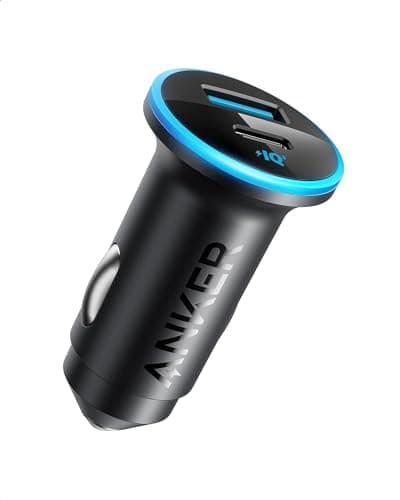
Anker 323 Car Charger (52.5W)
Two ports, 52.5W total, and a published voltage table showing 30W maximum on the USB-C port. Thirty watts charges any phone at or near its own ceiling, which means the 67W chargers above it are selling you headroom nothing in your pocket can use. At $19.99 this is the honest default.
- Ports
- 1 x USB-C, 1 x USB-A
- Total output
- 52.5 W
- USB-C output
- 5V/3A, 9V/3A, 12V/2.5A, 15V/2A, 20V/1.5A (30 W max)
- USB-A output
- 5V/3A, 9V/2A, 10V/2.25A (22.5 W max)
- Input
- 12V at 5.6 A, 24V at 3.6 A
- Safety
- ActiveShield 2.0
- Model
- A2735
- Warranty
- 18 months
- Operating range
- Not published
List price $19.99 per Anker's own store, captured on the compile date below. Not a live price and not what you will pay — the button is where the real number is.
What it gets right
- Anker publishes the full PDO table — 5V/3A, 9V/3A, 12V/2.5A, 15V/2A, 20V/1.5A — rather than a headline number
- 30 W on USB-C is at or above what almost every phone will accept
- Input rated 12V and 24V, so it works in a truck as well as a car
- $19.99 list and physically small, which matters in a tight console
Flaws
- Two ports, not three. A second passenger and a tablet is one device too many
- 30 W will not charge a laptop at any useful speed
- The USB-A port tops out at 22.5 W, so it is the slow one
The working behind the 9.2
- Heat headroom: not scored (weight 22%)
- The maker publishes no operating-temperature ceiling, so this axis is dropped and the other weights are re-normalized.
- Install effort: 10.0 (weight 24%)
- Plugs into a 12V socket or a USB port. Nothing to mount, nothing to route, reversible in a second.
- Price against the ceiling: 10.0 (weight 24%)
- Listed at $19.99 on the compile date. This site's buyer has a practical ceiling around $150 for a single upgrade, so the scale rewards everything under $100 and falls away sharply past $150. The live price is very often different, and that is what the button is for.
- Written commitment: 7.0 (weight 15%)
- 18-month warranty. This is the only promise in the entire listing that a court would read, which is why it is scored and the marketing copy is not.
- Spec transparency: 8.9 (weight 15%)
- 8 of the 9 specifications we went looking for are published by the maker (89%). A blank row is never a guess here: it prints “Not published” and it costs the product points, because a figure nobody will commit to in writing is a figure you cannot check.
Axes with no published input are dropped and the remaining weights re-normalized, so a product is not punished for a category where an axis does not apply. Specifications compiled September 4, 2026 from Anker's 323 Car Charger product page.
2A car with a radio and nothing else
Nulaxy KM18 Bluetooth FM Transmitter
Bluetooth 5.0 into the 87.5 to 108.0 MHz FM band, on a gooseneck with a 1.44-inch screen, running from 12 V or 24 V. It is the answer for a car too old for CarPlay, Android Auto or even an aux socket — and it is a genuinely different product from the CarPlay adapters, which need a car that already has CarPlay.
- Frequency range
- 87.5 - 108.0 MHz
- Bluetooth
- 5.0
- Display
- 1.44 in LCD
- Input voltage
- 12 V - 24 V
- Extra inputs
- TF card, aux
- Calls
- Hands-free supported
- Mounting
- Rotatable gooseneck in the 12V socket
- List price
- Not published
- Warranty
- Not published
What it gets right
- Works in literally any car with an FM radio, which no other connectivity product on this site can claim
- Published frequency range and Bluetooth version, and 12-24 V input so it works in a truck
- Screen shows battery voltage as well as the station, which is a genuinely useful extra on an old car
- Handles calls, plus TF card and aux input for when Bluetooth is not the answer
Flaws
- FM transmission is a lossy analog hop. It will never sound as good as a cable or a proper head unit
- You have to find a genuinely empty frequency, and in a city there may not be one
- Gooseneck mounted in the 12V socket means it occupies the socket and sticks out into the console
The working behind the 9.2
- Heat headroom: not scored (weight 22%)
- The maker publishes no operating-temperature ceiling, so this axis is dropped and the other weights are re-normalized.
- Install effort: 10.0 (weight 24%)
- Plugs into a 12V socket or a USB port. Nothing to mount, nothing to route, reversible in a second.
- Price against the ceiling: not scored (weight 24%)
- No published list price we could cite on the compile date, so this axis is dropped and the other weights are re-normalized.
- Written commitment: not scored (weight 15%)
- No warranty term published, so this axis is dropped and the other weights are re-normalized.
- Spec transparency: 7.8 (weight 15%)
- 7 of the 9 specifications we went looking for are published by the maker (78%). A blank row is never a guess here: it prints “Not published” and it costs the product points, because a figure nobody will commit to in writing is a figure you cannot check.
Axes with no published input are dropped and the remaining weights re-normalized, so a product is not punished for a category where an axis does not apply. Specifications compiled September 4, 2026 from Nulaxy's KM18 product page.
3Making factory wired CarPlay wireless
CarlinKit 5.0 (CPC200-2air)
Skip this one. A far better answer, and only if your car qualifies. It needs factory wired CarPlay or Android Auto already present — if your car has that, buy it instead of anything on this page. If your car is old enough to need an FM transmitter, this is not an option at all.
A dongle that plugs into the USB port your wired CarPlay already uses and turns it wireless, on 2.4 and 5 GHz, drawing 0.75 watts. CarlinKit states compatibility with more than 800 car models from 2016 onwards. The prerequisite is absolute: your car must already have wired CarPlay or Android Auto. This adds no CarPlay to a car that has none.
- Wi-Fi
- 2.4 GHz and 5.0 GHz
- Power consumption
- 0.75 W
- Power input
- 5 V +/- 0.2 V, 1.0 A
- Vehicle compatibility
- Stated 800+ models from 2016 with factory wired CarPlay or Android Auto
- Requirement
- Factory wired CarPlay or Android Auto must already be present
- Dimensions
- 76 x 43 x 12.3 mm
- Brand exclusion
- Stated not compatible with BMW vehicles
- List price
- Not published
- Operating range
- Not published
- Warranty
- 1 year
What it gets right
- Removes the single most annoying thirty seconds of every commute
- Dual band 2.4 and 5 GHz, published, which is what keeps the link stable
- 0.75 W draw, published, so it is not a parasitic load worth worrying about
- Nothing to install: it plugs into the existing USB port
Flaws
- Requires factory wired CarPlay or Android Auto already present. This is not optional
- Adds a handshake delay at startup, which is shorter than plugging a cable in but not zero
- Firmware updates are a manual job through a web interface, and they are occasionally necessary
The working behind the 8.2
- Heat headroom: not scored (weight 22%)
- The maker publishes no operating-temperature ceiling, so this axis is dropped and the other weights are re-normalized.
- Install effort: 10.0 (weight 24%)
- Plugs into a 12V socket or a USB port. Nothing to mount, nothing to route, reversible in a second.
- Price against the ceiling: not scored (weight 24%)
- No published list price we could cite on the compile date, so this axis is dropped and the other weights are re-normalized.
- Written commitment: 5.5 (weight 15%)
- 12-month warranty. This is the only promise in the entire listing that a court would read, which is why it is scored and the marketing copy is not.
- Spec transparency: 8.0 (weight 15%)
- 8 of the 10 specifications we went looking for are published by the maker (80%). A blank row is never a guess here: it prints “Not published” and it costs the product points, because a figure nobody will commit to in writing is a figure you cannot check.
Axes with no published input are dropped and the remaining weights re-normalized, so a product is not punished for a category where an axis does not apply. Specifications compiled September 4, 2026 from CarlinKit's 2air product page.
Prices last verified October 19, 2026. They move constantly; the figure on Amazon when you click is the real one.
Questions people actually ask
Do FM transmitters sound bad?
They sound like FM radio, because that is what they are. Noticeable noise floor, limited top end, compressed dynamics. Fine for podcasts, calls and navigation; a real compromise for music you care about.
How do I find a good frequency?
Look at the extreme ends of the dial and find genuine static rather than a weak station. Expect to change it on a long drive, and accept that a dense urban area may not have a genuinely clear frequency at all.
Should I get an FM transmitter or something else?
Something else, if your car offers it. Factory CarPlay, built-in Bluetooth, a USB audio input or an aux socket all sound better. An FM transmitter is for a car that has none of those.
Will it charge my phone too?
The KM18 publishes USB output, so yes — at whatever rate its own port supplies, which is well below a proper USB-C car charger. It also occupies your 12V socket, which on a one-socket car is the socket the charger wanted.