The best 12V cigarette lighter car chargers
The socket in your dashboard is the oldest interface in the car and it still has a fuse behind it. Four chargers ranked on what they publish about their input as well as their output.
By Sawyer V. · Published · How we research
We have not tested any of this. Everything below is compiled from published manufacturer specifications, and the arithmetic is printed so you can check it. This page carries affiliate links: if you buy through one we earn a commission at no extra cost to you, and it does not change the order of the picks. Full disclosure.
The short answer
The Anker 323 at $19.99 is the right 12V charger for almost everyone. It publishes its input rating — 12 V at 5.6 A, 24 V at 3.6 A — as well as its output, which almost nothing in this category does, and its 30 W USB-C port charges any phone at full speed. Before buying anything more powerful, find out what your 12V socket is fused at: a 15-amp circuit supplies about 180 W and that is the real ceiling, not the charger's rating.
| # | Pick | Install | Score | Price |
|---|---|---|---|---|
| 1 | UGREEN 130W 3-Port Car Charger A laptop and two phones at once | Plugs in | 9.5/10 | $21.99 - view on Amazon |
| 2 | Anker 323 Car Charger (52.5W) The one most people should actually buy | Plugs in | 9.2/10 | $14.99 - view on Amazon |
| 3 | Anker 335 Car Charger (67W) Three devices, no arguments | Plugs in | 9.0/10 | $42.99 - view on Amazon |
| 4 | Anker 535 Car Charger (67W) Charging a laptop in the car | Plugs in | 8.6/10 | $42.99 - view on Amazon |
Prices last verified October 19, 2026. They move constantly; the figure on Amazon when you click is the real one.
What the socket actually is
A cigarette lighter socket was designed to heat a coil of nichrome wire. It is a surprisingly capable power outlet as a side effect: 12 volts, and typically fused at 10, 15 or 20 amps depending on the car and the circuit.
That fuse is the constraint on everything you plug in, and it is worth knowing yours. Watts equal volts times amps, so:
- A 10 A circuit supplies about 120 W.
- A 15 A circuit supplies about 180 W.
- A 20 A circuit supplies about 240 W.
Every charger on this page fits comfortably inside all three. What does not is a tire inflator, which is why the bigger ones clamp to the battery instead — the inflator page covers that.
The specification hardly anyone publishes
Output tables have become common. Input ratings have not, and they tell you something useful: what the charger will draw from the circuit, and whether it works on a 24V system. Anker publishes both for the 323 — 12V at 5.6 A and 24V at 3.6 A — which is covered in the Anker 323 review.
Anker publishes both. The 323 states 12 V at 5.6 A and 24 V at 3.6 A; the 535 states 12 V to 24 V at 7.2 A. If you drive a truck, an RV or anything with a 24V system, that line is the one that decides whether the charger works at all.
Is a USB-A port still worth having?
Yes, for one reason: everything old still uses it. A dash cam's power cable, an older tablet, a passenger's cable, a Bluetooth adapter. Every charger here includes one.
What is not worth doing is charging a modern phone from it. USB-A tops out at 22.5 W on these chargers and cannot negotiate the higher voltages that USB Power Delivery uses. Put the phone on USB-C and leave USB-A for the accessories.
The specification that decides whether you keep it
How far it sticks out. Nobody publishes it, and it is the reason a lot of chargers end up in a drawer. A three-port charger in a socket set low in a center console can foul the gear selector, the armrest or a cup holder.
UGREEN publishes a 45-gram weight, which is a weak proxy but the only number available. If your socket is somewhere awkward, the two-port Anker 323 is the compact one and that is a perfectly good reason to prefer it.
Does your socket stay live with the ignition off?
Most cars cut it. Some do not, and on those a charger left plugged in draws a small standby current permanently. It is very unlikely to flatten a healthy battery on its own, and it is worth knowing about if the car sits for weeks or if you also run a dash cam in parking mode off the same battery.
Two-minute test: plug in a charger with an indicator light, switch the ignition off, take the key out, and see whether the light stays on.
What to actually buy
- Phones only, tight console: the Anker 323. Cheapest, smallest, publishes everything.
- Two or three devices at once: the Anker 335. Three ports, 35W each, nothing bottlenecked.
- A laptop as well: the UGREEN, with its 100W port and included E-marked cable — after checking your fuse.
- A laptop from a brand with a published warranty: the Anker 535, which is the same idea with 18 months behind it.
If the problem is not enough sockets rather than not enough watts, a splitter divides what the socket already has rather than adding any — and your car's accessory fuse, typically 10 to 20A, is the real ceiling — best 12V socket splitters.
Every pick, with the working
Each entry lists the specifications the maker publishes, the axis scores those specifications produce, and what you give up. Rows that read “Not published” are not omissions on our side: they are things the maker will not commit to in writing, and they cost the product points on the transparency axis. Specifications compiled September 4, 2026.
Our pickA laptop and two phones at once
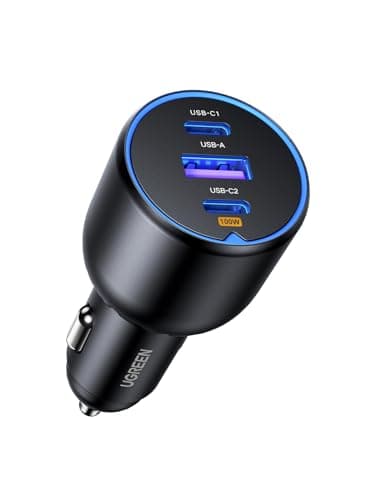
UGREEN 130W 3-Port Car Charger
Skip this one. 130 W is a lot to ask of a socket that is commonly fused at 15 amps. It fits inside the budget on paper and it leaves very little margin, particularly if something else shares the circuit. Know your fuse rating before you buy this one.
Three ports totaling 130W with one USB-C rated at 100W on its own, a 100W E-marked cable in the box, and a published 45-gram weight. It is the only charger here that will genuinely run a laptop at full speed, and it costs less than the 67W chargers do because UGREEN prices aggressively.
- Ports
- 2 x USB-C, 1 x USB-A
- Total output
- 130 W
- USB-C 1 maximum
- 30 W
- USB-C 2 maximum
- 100 W
- USB-A maximum
- 22.5 W (SCP) / 18 W (QC 3.0)
- Protocols
- PD 3.0, QC 4.0, QC 3.0, SCP, AFC, PPS
- In the box
- 100 W E-marked USB-C to USB-C cable
- Weight
- 45 g
- Warranty
- Not published
- Operating range
- Not published
List price $22.49 per UGREEN's own store, sale price (regular $39.99), captured on the compile date below. Not a live price and not what you will pay — the button is where the real number is.
What it gets right
- 100 W on a single USB-C port, which is a real laptop charge rather than a trickle
- A 100 W E-marked USB-C cable is included, and that cable alone is often $15
- Publishes both per-port ceilings separately (30 W and 100 W) instead of one combined figure
- Broad protocol support: PD 3.0, QC 4.0, QC 3.0, SCP, AFC and PPS
Flaws
- 130 W in a 12V socket is close to what many car circuits are fused for; check your fuse rating
- The second USB-C port is only 30 W, so it is not two laptop ports
- UGREEN publishes no warranty term and no operating-temperature range
The working behind the 9.5
- Heat headroom: not scored (weight 22%)
- The maker publishes no operating-temperature ceiling, so this axis is dropped and the other weights are re-normalized.
- Install effort: 10.0 (weight 24%)
- Plugs into a 12V socket or a USB port. Nothing to mount, nothing to route, reversible in a second.
- Price against the ceiling: 10.0 (weight 24%)
- Listed at $22.49 on the compile date. This site's buyer has a practical ceiling around $150 for a single upgrade, so the scale rewards everything under $100 and falls away sharply past $150. The live price is very often different, and that is what the button is for.
- Written commitment: not scored (weight 15%)
- No warranty term published, so this axis is dropped and the other weights are re-normalized.
- Spec transparency: 8.0 (weight 15%)
- 8 of the 10 specifications we went looking for are published by the maker (80%). A blank row is never a guess here: it prints “Not published” and it costs the product points, because a figure nobody will commit to in writing is a figure you cannot check.
Axes with no published input are dropped and the remaining weights re-normalized, so a product is not punished for a category where an axis does not apply. Specifications compiled September 4, 2026 from UGREEN's 130W car charger product page.
2The one most people should actually buy
Anker 323 Car Charger (52.5W)
Two ports, 52.5W total, and a published voltage table showing 30W maximum on the USB-C port. Thirty watts charges any phone at or near its own ceiling, which means the 67W chargers above it are selling you headroom nothing in your pocket can use. At $19.99 this is the honest default.
- Ports
- 1 x USB-C, 1 x USB-A
- Total output
- 52.5 W
- USB-C output
- 5V/3A, 9V/3A, 12V/2.5A, 15V/2A, 20V/1.5A (30 W max)
- USB-A output
- 5V/3A, 9V/2A, 10V/2.25A (22.5 W max)
- Input
- 12V at 5.6 A, 24V at 3.6 A
- Safety
- ActiveShield 2.0
- Model
- A2735
- Warranty
- 18 months
- Operating range
- Not published
List price $19.99 per Anker's own store, captured on the compile date below. Not a live price and not what you will pay — the button is where the real number is.
What it gets right
- Anker publishes the full PDO table — 5V/3A, 9V/3A, 12V/2.5A, 15V/2A, 20V/1.5A — rather than a headline number
- 30 W on USB-C is at or above what almost every phone will accept
- Input rated 12V and 24V, so it works in a truck as well as a car
- $19.99 list and physically small, which matters in a tight console
Flaws
- Two ports, not three. A second passenger and a tablet is one device too many
- 30 W will not charge a laptop at any useful speed
- The USB-A port tops out at 22.5 W, so it is the slow one
The working behind the 9.2
- Heat headroom: not scored (weight 22%)
- The maker publishes no operating-temperature ceiling, so this axis is dropped and the other weights are re-normalized.
- Install effort: 10.0 (weight 24%)
- Plugs into a 12V socket or a USB port. Nothing to mount, nothing to route, reversible in a second.
- Price against the ceiling: 10.0 (weight 24%)
- Listed at $19.99 on the compile date. This site's buyer has a practical ceiling around $150 for a single upgrade, so the scale rewards everything under $100 and falls away sharply past $150. The live price is very often different, and that is what the button is for.
- Written commitment: 7.0 (weight 15%)
- 18-month warranty. This is the only promise in the entire listing that a court would read, which is why it is scored and the marketing copy is not.
- Spec transparency: 8.9 (weight 15%)
- 8 of the 9 specifications we went looking for are published by the maker (89%). A blank row is never a guess here: it prints “Not published” and it costs the product points, because a figure nobody will commit to in writing is a figure you cannot check.
Axes with no published input are dropped and the remaining weights re-normalized, so a product is not punished for a category where an axis does not apply. Specifications compiled September 4, 2026 from Anker's 323 Car Charger product page.
3Three devices, no arguments
Anker 335 Car Charger (67W)
Two USB-C and one USB-A totaling 67W, with a per-port ceiling of 35W. That per-port number is the whole difference between this and the 535: 35W charges any phone at full speed and charges a laptop slowly. For a car with two phones and a tablet in it, this is the right one and it is the cheaper one.
- Ports
- 2 x USB-C, 1 x USB-A
- Total output
- 67 W
- Maximum per port
- 35 W
- Protocols
- USB Power Delivery and PPS
- Safety
- ActiveShield 2.0
- Model
- A2736H11-1
- Warranty
- 18 months
- Operating range
- Not published
List price $29.99 per Best Buy listing for A2736H11-1, captured on the compile date below. Not a live price and not what you will pay — the button is where the real number is.
What it gets right
- Three ports, so the passenger argument ends
- PD and PPS support, which is what Samsung phones need for their fastest charging
- 35W per port is more than any phone can take, so nothing is bottlenecked
- ActiveShield 2.0 thermal management, and an 18-month warranty
Flaws
- 35W per-port ceiling means a laptop charges slowly even though the unit says 67W
- Three ports in one 12V socket is a physically chunky thing in a tight console
- Anker does not publish an operating-temperature range
The working behind the 9.0
- Heat headroom: not scored (weight 22%)
- The maker publishes no operating-temperature ceiling, so this axis is dropped and the other weights are re-normalized.
- Install effort: 10.0 (weight 24%)
- Plugs into a 12V socket or a USB port. Nothing to mount, nothing to route, reversible in a second.
- Price against the ceiling: 9.5 (weight 24%)
- Listed at $29.99 on the compile date. This site's buyer has a practical ceiling around $150 for a single upgrade, so the scale rewards everything under $100 and falls away sharply past $150. The live price is very often different, and that is what the button is for.
- Written commitment: 7.0 (weight 15%)
- 18-month warranty. This is the only promise in the entire listing that a court would read, which is why it is scored and the marketing copy is not.
- Spec transparency: 8.8 (weight 15%)
- 7 of the 8 specifications we went looking for are published by the maker (88%). A blank row is never a guess here: it prints “Not published” and it costs the product points, because a figure nobody will commit to in writing is a figure you cannot check.
Axes with no published input are dropped and the remaining weights re-normalized, so a product is not punished for a category where an axis does not apply. Specifications compiled September 4, 2026 from Anker's 335 Car Charger product page.
4Charging a laptop in the car
Anker 535 Car Charger (67W)
Skip this one. If you only ever charge phones, this is the wrong one. Nothing with a phone battery in it can take more than 35W, so the 335 does the identical job for less.
Same three ports and same 67W total as the 335, but one USB-C port will deliver the whole 67W on its own at 20V and 3.35A. That is a real laptop charge rather than a trickle, and it is the only reason to pay more than the 335 costs. If nothing you own draws more than 35W, this is money spent on a number you will never see.
- Ports
- 2 x USB-C, 1 x USB-A
- Total output
- 67 W
- USB-C output
- 5V/3A, 9V/3A, 12V/3A, 15V/3A, 20V/3.35A (67 W max)
- USB-A output
- 5V/3A, 9V/2A, 10V/2.25A, 12V/1.5A (22.5 W max)
- Input
- 12V to 24V, 7.2 A
- Safety
- ActiveShield 2.0
- Model
- A2731
- List price
- Not published
- Operating range
- Not published
What it gets right
- Full 67W from a single USB-C port at 20V 3.35A, published as an explicit voltage table
- Anker publishes the complete PDO table rather than a headline wattage, which almost nobody does
- Input rated 12V to 24V, so it works in a truck as well as a car
- ActiveShield 2.0 thermal management
Flaws
- Pointless unless something you charge actually draws more than 35W
- The USB-A port tops out at 22.5W, so it is the slow port whichever charger you pick
- Frequently out of stock at Anker directly
The working behind the 8.6
- Heat headroom: not scored (weight 22%)
- The maker publishes no operating-temperature ceiling, so this axis is dropped and the other weights are re-normalized.
- Install effort: 10.0 (weight 24%)
- Plugs into a 12V socket or a USB port. Nothing to mount, nothing to route, reversible in a second.
- Price against the ceiling: not scored (weight 24%)
- No published list price we could cite on the compile date, so this axis is dropped and the other weights are re-normalized.
- Written commitment: 7.0 (weight 15%)
- 18-month warranty. This is the only promise in the entire listing that a court would read, which is why it is scored and the marketing copy is not.
- Spec transparency: 7.8 (weight 15%)
- 7 of the 9 specifications we went looking for are published by the maker (78%). A blank row is never a guess here: it prints “Not published” and it costs the product points, because a figure nobody will commit to in writing is a figure you cannot check.
Axes with no published input are dropped and the remaining weights re-normalized, so a product is not punished for a category where an axis does not apply. Specifications compiled September 4, 2026 from Anker's 535 Car Charger product page.
Prices last verified October 19, 2026. They move constantly; the figure on Amazon when you click is the real one.
Questions people actually ask
How many watts can a cigarette lighter socket supply?
It depends on the fuse: about 120 W on a 10-amp circuit, 180 W on 15 amps and 240 W on 20 amps. Your owner's manual has the rating. Every charger on this page fits inside all three; a tire inflator often does not.
Can I leave a charger plugged in all the time?
If your socket cuts with the ignition, yes, and most do. If it stays live, the charger draws a small standby current permanently — negligible on a car driven daily, worth unplugging on one that sits for weeks.
Is USB-A obsolete?
For phones, effectively — it tops out at 22.5 W here and cannot negotiate the higher voltages Power Delivery uses. For accessories with fixed USB-A cables, including many dash cams, it is still the port you need.
Will a 130 W charger blow my fuse?
Not by itself on a 15-amp circuit, which supplies about 180 W. It leaves less margin than a smaller charger though, especially if the socket shares its fuse with the radio or another socket. Check the rating before you buy the biggest one available.