The best portable jump starter for a commuter car
The one accessory here that changes the worst morning of your year, and the one most likely to be flat when you need it. What the published numbers mean and which one covers your engine.
By Sawyer V. · Published · How we research
We have not tested any of this. Everything below is compiled from published manufacturer specifications, and the arithmetic is printed so you can check it. This page carries affiliate links: if you buy through one we earn a commission at no extra cost to you, and it does not change the order of the picks. Full disclosure.
The short answer
The NOCO Boost Plus GB40. 1,000 peak amps from a 24 Wh lithium pack that weighs 2.4 pounds and measures 7.7 inches long, rated by NOCO for gasoline engines up to 6.0 liters and diesel up to 3.0, with spark-proof clamps and reverse-polarity protection. Check your engine size against those published ceilings, and then — this is the part people miss — charge it twice a year, or it is a brick on the morning you need it.
| # | Pick | Install | Score | Price |
|---|---|---|---|---|
| 1 | AstroAI Portable Tire Inflator (150 PSI) Topping up four tires in a driveway | Plugs in | 9.1/10 | $26.99 - view on Amazon |
| 2 | NOCO Boost Plus GB40 Not needing anybody else's car | Plugs in | 8.0/10 | Check price on Amazon |
Prices last verified October 19, 2026. They move constantly; the figure on Amazon when you click is the real one.
What a lithium jump starter replaced
A favor. For decades the answer to a flat battery was another car, another person, and a set of leads long enough to reach. That meant either a neighbor, a stranger, or a callout.
A pack that fits in a glovebox removes all three. It is the only item on this whole site whose value is entirely about a morning that has already gone wrong, and it is the reason it belongs in the trunk of a car you rely on to get to work.
The three published numbers that matter
- Peak amps. The brief maximum the pack can deliver. NOCO publishes 1,000 A for the GB40. It is a headline figure and it is not, on its own, what decides whether the pack starts your car.
- Capacity in watt-hours. 24 Wh on the GB40. This is what governs how many attempts you get before it is empty — NOCO publishes up to 20 starts on one charge.
- The engine-size ceiling. The number that actually answers your question. NOCO publishes gasoline to 6.0 liters and diesel to 3.0. Diesel engines need substantially more cranking current for the same displacement, which is why the two figures differ so much.
Check the third one against your own car before anything else. A pack rated below your engine will crank slowly or not at all, and the peak-amp number on the box will not have warned you.
Why the safety features are the reason to buy a good one
You will be using this in the dark, in the cold, probably late, and probably slightly panicked. That is exactly when people connect clamps the wrong way round.
NOCO publishes spark-proof technology and reverse-polarity protection on the GB40. What those mean in practice: connecting the clamps backwards does nothing rather than damaging the car's electronics, and touching the clamps together does not throw sparks near a battery that vents hydrogen. Both are worth more at 6am than the peak-amp figure is.
How to use one, in order
- Check the pack's own charge first. Before anything is connected. If it is low, this is the moment you find out rather than mid-attempt.
- Ignition off, everything off. Lights, radio, air conditioning, and take the phone charger out.
- Red to the positive terminal, black to the negative. The pack's protection will tell you if it is wrong; do not rely on it as a first line.
- Wait for the pack to indicate it is ready, then crank for no more than a few seconds.
- If it does not start, wait a minute before trying again. Repeated cranking heats the starter motor and empties the pack.
- Once it is running, disconnect and drive for at least twenty minutes. The alternator needs real running time to put back what cranking took out. A five-minute trip guarantees you are doing this again tomorrow.
Why the battery went flat, which is the actual problem
A jump starter treats the symptom. Worth asking what caused it:
- Age. Most starter batteries last three to five years. If yours is older, that is the answer and a jump starter is a stopgap.
- Short trips only. Cranking takes a lot out and a ten-minute drive does not put it back. Weeks of this produces a chronically undercharged battery.
- Something left on. An interior light, a door not fully shut, a boot light.
- Parking mode. If you hardwired a dash cam, check the cutoff voltage setting. The battery arithmetic is here, and the short version is: set the cutoff high.
- Cold. A battery delivers substantially less at 0 C than at 21 C. Cold does not cause a failure; it exposes one that was already there.
If the answer is age or short trips, a jump starter is treating the symptom every time. A maintenance charger left on overnight puts back what a ten-minute commute never does, and it is the only item here that addresses the cause rather than the morning it produces best car battery chargers.
The two-item trunk kit
A jump starter and a tire inflator between them cover most of what actually strands a commuter. Neither is exciting, both live in a trunk organizer and are forgotten, and both are worth several times their price on the one morning they are needed.
Every pick, with the working
Each entry lists the specifications the maker publishes, the axis scores those specifications produce, and what you give up. Rows that read “Not published” are not omissions on our side: they are things the maker will not commit to in writing, and they cost the product points on the transparency axis. Specifications compiled September 4, 2026.
Our pickTopping up four tires in a driveway
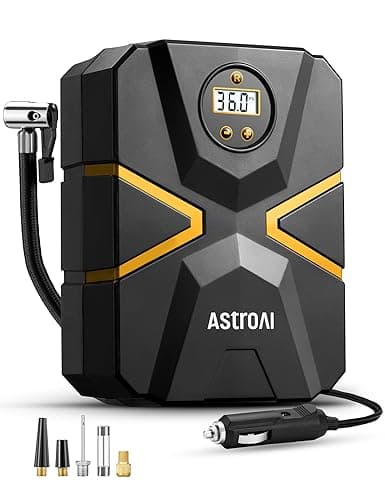
AstroAI Portable Tire Inflator (150 PSI)
Skip this one. It is on this page because it is the other half of a trunk kit, not because it starts a car. If the battery is flat, an inflator does nothing at all — but the two together cover the overwhelming majority of what strands a commuter, which is why they belong on the same list.
150 PSI maximum, a digital gauge, and AstroAI's own published figure of a 195/65/R15 tire going 30 to 36 PSI in under a minute. It also publishes the duty cycle honestly: fifteen minutes of continuous use and then ten minutes of cooling. That duty cycle is the specification that separates a topping-up tool from a tire-filling one.
- Maximum pressure
- 150 PSI
- Power
- 12 V DC
- Duty cycle
- 15 minutes continuous, then 10 minutes cooling
- Published inflation rate
- 195/65/R15 from 30 to 36 PSI in under 1 minute
- Gauge
- Digital, automatic shutoff
- Warranty
- Not published
- Operating range
- Not published
List price $37.99 per AstroAI's own store, captured on the compile date below. Not a live price and not what you will pay — the button is where the real number is.
What it gets right
- Published inflation rate on a named tire size, which is the only useful way to state this figure
- Published duty cycle: 15 minutes on, 10 minutes cooling
- Digital gauge with automatic shutoff at the set pressure
- Around $32 to $38 depending on the model
Flaws
- 15 minutes of continuous running is four tires topped up, not one tire filled from flat
- 150 PSI is a headline number a passenger car will never approach
- 12V socket powered, so a car with the ignition off will run its battery down doing this
The working behind the 9.1
- Heat headroom: not scored (weight 22%)
- The maker publishes no operating-temperature ceiling, so this axis is dropped and the other weights are re-normalized.
- Install effort: 10.0 (weight 24%)
- Plugs into a 12V socket or a USB port. Nothing to mount, nothing to route, reversible in a second.
- Price against the ceiling: 9.5 (weight 24%)
- Listed at $37.99 on the compile date. This site's buyer has a practical ceiling around $150 for a single upgrade, so the scale rewards everything under $100 and falls away sharply past $150. The live price is very often different, and that is what the button is for.
- Written commitment: not scored (weight 15%)
- No warranty term published, so this axis is dropped and the other weights are re-normalized.
- Spec transparency: 7.1 (weight 15%)
- 5 of the 7 specifications we went looking for are published by the maker (71%). A blank row is never a guess here: it prints “Not published” and it costs the product points, because a figure nobody will commit to in writing is a figure you cannot check.
Axes with no published input are dropped and the remaining weights re-normalized, so a product is not punished for a category where an axis does not apply. Specifications compiled September 4, 2026 from AstroAI's 150 PSI tire inflator page.
2Not needing anybody else's car
NOCO Boost Plus GB40
1,000 peak amps out of a 24 watt-hour lithium pack that weighs 2.4 pounds, rated for gasoline engines to 6.0 liters and diesel to 3.0, with spark-proof clamps and reverse-polarity protection. It is the single accessory here that changes what happens on the worst morning of your year, and it fits in a glovebox.
- Peak amps
- 1,000 A
- Battery
- 24 Wh lithium-ion
- Engine ceiling
- Gasoline to 6.0 L, diesel to 3.0 L
- Starts per charge
- Up to 20
- Dimensions
- 7.7 x 3.2 x 1.7 in
- Weight
- 2.4 lb with clamps
- Light
- 100 lumens
- Safety
- Spark proof, reverse polarity protected
- Operating range
- Not published
List price $99.95 per NOCO's listed price, captured on the compile date below. Not a live price and not what you will pay — the button is where the real number is.
What it gets right
- 1,000 peak amps and up to 20 starts on one charge, both published
- Spark-proof and reverse-polarity protected, which matters when you are doing this in the dark
- 2.4 lb and 7.7 inches long — it genuinely lives in the car rather than the garage
- USB port and a 100-lumen light, so it is also the thing you reach for in a power cut
Flaws
- Lithium, so it self-discharges and needs topping up every few months or it is a brick when you need it
- 6.0 L gasoline and 3.0 L diesel is the published ceiling — a big diesel needs the bigger model
- $99.95 for something you hope never to use
The working behind the 8.0
- Heat headroom: not scored (weight 22%)
- The maker publishes no operating-temperature ceiling, so this axis is dropped and the other weights are re-normalized.
- Install effort: 10.0 (weight 24%)
- Plugs into a 12V socket or a USB port. Nothing to mount, nothing to route, reversible in a second.
- Price against the ceiling: 7.0 (weight 24%)
- Listed at $99.95 on the compile date. This site's buyer has a practical ceiling around $150 for a single upgrade, so the scale rewards everything under $100 and falls away sharply past $150. The live price is very often different, and that is what the button is for.
- Written commitment: 5.5 (weight 15%)
- 12-month warranty. This is the only promise in the entire listing that a court would read, which is why it is scored and the marketing copy is not.
- Spec transparency: 8.9 (weight 15%)
- 8 of the 9 specifications we went looking for are published by the maker (89%). A blank row is never a guess here: it prints “Not published” and it costs the product points, because a figure nobody will commit to in writing is a figure you cannot check.
Axes with no published input are dropped and the remaining weights re-normalized, so a product is not punished for a category where an axis does not apply. Specifications compiled September 4, 2026 from NOCO Boost Plus GB40 published specifications.
Prices last verified October 19, 2026. They move constantly; the figure on Amazon when you click is the real one.
Questions people actually ask
What size jump starter do I need?
Match your engine to the maker's published ceiling rather than to the peak-amp headline. NOCO publishes gasoline to 6.0 liters and diesel to 3.0 for the GB40. Diesel needs much more cranking current for the same displacement, which is why the two figures are so different.
How often should I recharge a jump starter?
Twice a year, and put it in a calendar. Lithium packs self-discharge and heat accelerates it, so one that has spent summers in a trunk is not at the charge it reports. This is the most common way the product fails.
Is it safe to use on a modern car?
The ones worth buying publish spark-proof and reverse-polarity protection, which is what makes connecting in the dark forgiving. Follow the maker's sequence and check the published engine ceiling matches your car.
My car needed a jump. Do I need a new battery?
Possibly. If it is over three years old, or you mostly do short trips, or it has now happened twice, the jump starter is treating a symptom. Have the battery tested rather than carrying a jump starter to work around it.