REDTIGER F7N review
A 4K front-and-rear pair at the price of a single-channel camera. The catch is not the camera. It is working out which of five near-identical listings you are actually looking at.
By Sawyer V. · Published · How we research
We have not tested any of this. Everything below is compiled from published manufacturer specifications, and the arithmetic is printed so you can check it. This page carries affiliate links: if you buy through one we earn a commission at no extra cost to you, and it does not change the order of the picks. Full disclosure.
The verdict
Buy it for the price of entry into two channels. A 4K front and a 1080p rear with GPS, a supercapacitor and an 18-month warranty, at roughly what single-channel cameras cost, is a genuinely good trade. Then budget past the listing price, because two things are not in the box.
The part that needs saying first: REDTIGER sells at least five cameras whose names all start with F7N, from about $90 to about $190, and the differences live in the listing rather than the name. The cheapest one — the one most searches land on, and the one this page covers — ships with no memory card, needs a hardwire kit bought separately for parking mode, and is the only one in the family whose listing does not name a STARVIS 2 sensor.
| # | Pick | Install | Score | Price |
|---|---|---|---|---|
| 1 | REDTIGER F7N The cheapest way into 4K front and rear | Adhesive | 7.2/10 | $89.99 - view on Amazon |
Prices last verified November 17, 2026. They move constantly; the figure on Amazon when you click is the real one.
Five cameras, one name
This is the single most useful thing this review can tell you. Search the model number and you will be offered the F7N, the F7NP, the F7NA and the F7N Touch — and the F7N Touch twice, at two prices, for reasons the names do not explain.
| Listing | Price | Sensor named? | Card included? | Screen |
|---|---|---|---|---|
| F7N | About $90 | No | No | 3.18 in |
| F7N Touch | About $120 | STARVIS 2 | No | Touch |
| F7NP | About $150 | STARVIS 2 | Yes, free card | Not stated |
| F7NA | About $160 | STARVIS 2 IMX678 | No | Touch |
| F7N Touch (card bundle) | About $190 | STARVIS 2 | Yes, 128GB | Touch |
Three things fall out of that table and none of them is visible from the product name.
- The cheapest one is the only listing that does not name its sensor. Every other variant says STARVIS 2 in the title or the bullets. The F7N listing describes a 6-layer glass lens and an F1.5 aperture and stops there. That is not proof of a lesser sensor, but it is a maker declining to name the part everyone else in its own range names, and it is the difference you are paying for when you step up.
- The same F7N Touch is sold at about $120 and about $190. The published difference is a 128GB card. Buying the cheaper listing and a high-endurance card separately is almost always the better deal, and a better card — SD cards for dash cams explains why the card that comes free is rarely the card you want.
- Paying more does not always widen the lens. The F7NA, at about $160, publishes a 160-degree front field of view. The $90 F7N publishes 170. More money, less road.
What the cheap one actually is
Taken on its own terms, and ignoring the family around it, the $90 F7N is a lot of published specification for the money.
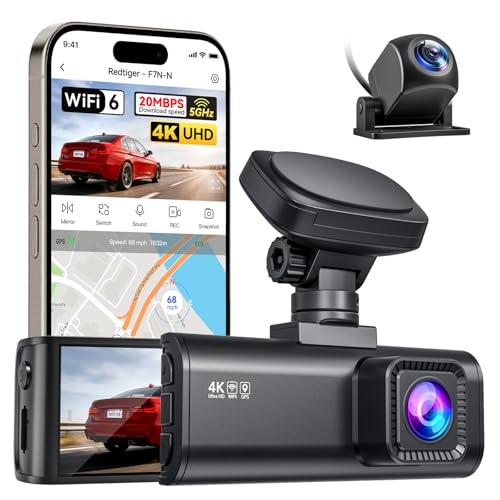
It records 3840 x 2160 at the front and 1920 x 1080 at the rear, across a 170-degree front and 140-degree rear lens. It has GPS, and embeds speed, location and compass direction into the footage. It runs a supercapacitor rather than a lithium cell, which is the component that swells and fails in a hot cabin — the reason heat is the axis this site ranks on. It accepts cards up to 512GB, and REDTIGER backs it for 18 months.
The Wi-Fi deserves its own sentence because it is the best figure on the spec sheet. REDTIGER publishes 5.8 GHz and a transfer rate of up to 20 MB/s, which it translates as a one-minute clip reaching your phone in about eight seconds. Most cameras in this bracket publish a band and no rate at all, and the rate is the number that decides whether you ever actually pull footage off the thing.
The two things that are not in the box
Both are stated in the listing, and both are routinely missed because they sit at the end of bullet points rather than in the title.
There is no memory card. A dash cam without a card records nothing at all, so this is not an accessory, it is a required part. Budget for a high-endurance card of the capacity you intend to use, not the cheapest card of that size — a dash cam rewrites the same card continuously for years, which is precisely the workload consumer cards fail at.
There is no hardwire kit. The listing states parking mode requires one. This matters more than it sounds: the 12V socket in most cars is dead with the ignition off, so parking mode on socket power does nothing once you walk away. A kit taps a constant-power fuse instead. Hardwire kits are ranked here, and the install guide covers the afternoon it costs you.
What it actually costs
The honest way to price this camera is to price the things it needs, because the listing price is not the entry fee.
Camera, plus a high-endurance card of a capacity worth having, plus a hardwire kit if you want the parking mode the listing advertises. That total still lands below most two-channel cameras bought complete, which is the real argument for this camera rather than the headline. But it is meaningfully above $90, and anybody comparing it against a camera that includes a card and a kit is not comparing like with like.
If parking mode is not something you want, ignore the kit entirely and the arithmetic gets much friendlier. Most people who think they want parking mode want it for a specific reason — a street-parked car, a history of door dings — and if you cannot name yours, you probably do not need it.
4K front, 1080p rear, and what that is worth
The front camera resolves four times the pixels of the rear one, and that asymmetry is deliberate across the whole category rather than a corner cut here.
A front camera is doing plate-reading work on a vehicle that may be several car lengths ahead and moving. A rear camera is mostly evidencing what hit you, usually from close range, usually stationary. 1080p is enough for the second job and not for the first.
What 4K also does is fill a card. Two channels at that resolution consume storage substantially faster than one, which is why the 512GB ceiling matters more on this camera than on a single-channel one — resolution is a storage decision as much as an image one.
Who should skip it
- Anyone who wants a camera that works out of the box. Between the card and the kit, this one needs assembling into a working setup. If you want to buy once and be done, pay more for a bundle that includes what it needs.
- Anyone who needs a published temperature rating. REDTIGER does not publish an operating range for this camera. If your car bakes in a summer lot, buy from a maker that states a ceiling — the hot-weather page ranks on exactly that, and it is the one axis where this camera has nothing to show.
- Anyone who wants an interior channel. This is a two-channel camera. A rideshare driver wants three, and the dual-versus-three comparison works through the trade.
For everyone else, this is the cheapest honest route into 4K front and rear, from a maker that publishes a transfer rate, a storage ceiling and a warranty term. Just buy the card with it, read the title before you click, and know that the name on the box is shared by four other cameras.
Every pick, with the working
Each entry lists the specifications the maker publishes, the axis scores those specifications produce, and what you give up. Rows that read “Not published” are not omissions on our side: they are things the maker will not commit to in writing, and they cost the product points on the transparency axis. Specifications compiled September 4, 2026.
Our pickThe cheapest way into 4K front and rear
REDTIGER F7N
4K front and 1080p rear with GPS, a supercapacitor and an 18-month warranty, at the lowest price of anything with two channels here. Read the listing before you read the name: this is the variant that ships with no memory card, needs a hardwire kit bought separately for parking mode, and is the only camera in REDTIGER's F7N family whose listing does not name a STARVIS 2 sensor.
- Front resolution
- 3840 x 2160 (4K UHD)
- Rear resolution
- 1920 x 1080
- Front field of view
- 170 degrees
- Rear field of view
- 140 degrees
- Max microSD
- 512 GB
- GPS
- Built in
- Wi-Fi
- 5.8 GHz
- Hardwire kit
- Required for parking mode, not included
- Memory card
- Not included
- Warranty
- 18 months
- Operating range
- Not published
- Power store
- Supercapacitor
What it gets right
- Supercapacitor rather than a lithium cell, which is the part that swells and dies in a hot cabin
- Front and rear in one box, with a 170-degree front lens
- 5.8 GHz Wi-Fi with a published 20 MB/s transfer rate, the fastest single band in this ledger
- Screen on the body, which makes aiming the camera a two-minute job rather than a phone-app job
Flaws
- No memory card in the box, and the camera records nothing without one. Budget for a high-endurance card on top of the price
- No published operating-temperature range
- The rear camera is 1080p, so it is evidence of an impact rather than a plate reader
- Parking mode needs a hardwire kit that is not in the box, which no listing in the F7N family includes
The working behind the 7.2
- Heat headroom: not scored (weight 22%)
- The maker publishes no operating-temperature ceiling, so this axis is dropped and the other weights are re-normalized.
- Install effort: 6.0 (weight 24%)
- Adhesive pad onto the dashboard. Permanent in practice: repositioning means a new pad, and the pad is the part that fails first.
- Price against the ceiling: not scored (weight 24%)
- No published list price we could cite on the compile date, so this axis is dropped and the other weights are re-normalized.
- Written commitment: 7.0 (weight 15%)
- 18-month warranty. This is the only promise in the entire listing that a court would read, which is why it is scored and the marketing copy is not.
- Spec transparency: 9.2 (weight 15%)
- 11 of the 12 specifications we went looking for are published by the maker (92%). A blank row is never a guess here: it prints “Not published” and it costs the product points, because a figure nobody will commit to in writing is a figure you cannot check.
Axes with no published input are dropped and the remaining weights re-normalized, so a product is not punished for a category where an axis does not apply. Specifications compiled September 4, 2026 from REDTIGER F7N published resolution, storage ceiling, warranty and parking-mode requirement.
Prices last verified November 17, 2026. They move constantly; the figure on Amazon when you click is the real one.
Questions people actually ask
What is the difference between the REDTIGER F7N and the F7NP?
On the published listings: the F7NP names a STARVIS 2 sensor and includes a free memory card, and costs roughly $60 more. The F7N names no sensor and includes no card. Both state 4K front and 1080p rear, both state an 18-month warranty, and neither includes a hardwire kit.
Does the REDTIGER F7N come with a memory card?
No. The listing states “No Card” in its title and repeats it in the bullets. The camera records nothing without one, so treat a high-endurance card as part of the purchase rather than an upgrade. It accepts cards up to 512GB.
Does the REDTIGER F7N include a hardwire kit?
No, and nor does any other camera in the F7N family. Every listing states that the 24-hour parking monitor requires a hardwire kit, bought separately. Without one, the camera stops when the ignition does on most cars.
What size memory card does the REDTIGER F7N take?
Up to 512GB, per its listing. That ceiling is worth using on a two-channel camera, because 4K plus 1080p fills storage considerably faster than a single channel does.
How long is the REDTIGER F7N warranty?
REDTIGER publishes an 18-month warranty on the F7N, and the same term on the F7NP. That is longer than the 12 months most of this category commits to.
Sources
- REDTIGER F7N listing, the source of the 4K/1080p resolutions, 170/140 degree lenses, 512GB ceiling, supercapacitor, 18-month warranty and the no-card and hardwire-kit statements
- REDTIGER F7NP listing, the source of its STARVIS 2 sensor, included card and 18-month warranty
- REDTIGER F7NA listing, the source of its STARVIS 2 IMX678 sensor and 160 degree front lens
- REDTIGER F7N Touch listings, the two prices with and without a bundled 128GB card