The best rear window and sunroof shades
Everyone shades the windshield. The panel directly above your head and the glass behind the rear seats are where the heat actually gets in on a parked car.
By Sawyer V. · Published · How we research
We have not tested any of this. Everything below is compiled from published manufacturer specifications, and the arithmetic is printed so you can check it. This page carries affiliate links: if you buy through one we earn a commission at no extra cost to you, and it does not change the order of the picks. Full disclosure.
The short answer
The sunroof first, then the rear side glass. A sunroof is the only piece of glass directly above an occupant's head, and a magnetic mesh panel covers it without adhesive or suction cups — the two things that fail in heat. For side windows, stretch mesh socks fit over the door frame so the glass still opens underneath. Published UV figures in this category sit around 84-85% with no test standard attached, so treat them as a comparison rather than a measurement.
| # | Pick | Install | Score | Price |
|---|---|---|---|---|
| 1 | EcoNour Car Side Window Sun Shade (2 pack) A rear passenger in afternoon sun | Drops in | 8.6/10 | $17.99 - view on Amazon |
| 2 | Universal Mesh Rear Window Sun Shade Shade that still lets the window open | Drops in | 8.3/10 | Check price on Amazon |
| 3 | Universal Magnetic Sunroof Shade The panel of glass directly above your head | Drops in | 8.1/10 | Check price on Amazon |
Prices last verified October 26, 2026. They move constantly; the figure on Amazon when you click is the real one.
Where the heat and UV actually get in
The windshield gets all the attention and is the glass least in need of help.
A windshield is laminated — two layers of glass with a plastic interlayer — and that interlayer is a good UV blocker by construction. Side and rear glass is usually tempered rather than laminated, and blocks considerably less. That is why the sunny-side door card and the rear parcel shelf fade before the dashboard does.
A sunroof is the specific case worth addressing first, because it is the only glass directly above a person's head. On a parked car it is admitting sun straight down into the cabin all day, and on the move it is above an occupant with no visor to intercept anything.
Why magnetic beats suction and adhesive
Every mounting method in car interiors fails in the same conditions, and the conditions are exactly when you want the product working.
- Suction cups release on hot glass. A parked car in summer is the worst case for suction and the case where a shade matters most
- Adhesive near a headliner is a bad idea permanently — headliner fabric is glued to foam, and removing adhesive takes the fabric with it
- Magnets grip steel and do not care about temperature. For a sunroof aperture with a steel surround, this is the mounting method that keeps working
The caveat is real: magnets need something ferrous. An aluminum roof panel or a full glass panoramic aperture with plastic trim may leave nothing to grip, and that is worth checking with a fridge magnet before ordering.
| Magnetic sunroof panel | Stretch mesh window sock | |
|---|---|---|
| Mounting | Magnetic | Over the door frame |
| Published size | Around 21.6 x 37.4 in | Stretch, 16.5-20 x 27-43 in |
| Window still opens | N/A | Yes |
| Stated UV block | Not published | Around 84-85% on typical listings |
| Test standard | Not published | Not published |
| Keeps insects out | No | Yes |
Reading the UV claims honestly
Mesh shades publish UV block percentages — commonly 84 to 85% — and those figures come with no stated test method.
Compare that with what a well-specified product in an adjacent category publishes: 303 publishes an SPF 40 equivalent and a 30-45 day reapplication interval for its protectant, and WeatherTech states its side window deflectors use a US DOT-approved glazing material in 3 mm UV-treated acrylic. Those are checkable claims. "84.6% UV protection" with no method behind it is a number in a listing.
That does not make mesh shades useless — they visibly reduce glare and warmth on the person sitting behind them. It means the percentage should not be the reason you pick one over another.
Fitting, and the measurement to take
Stretch mesh socks publish a range rather than a size, which is how they claim to fit most cars. The range is the specification.
Measure the door frame — not the glass — top to bottom and front to back at its widest. A sock rated for 16.5 to 20 inches of height and 27 to 43 inches of width covers a very large proportion of cars, and the ones it does not fit are usually large SUVs and trucks at the top of the range.
For the sunroof panel, measure the aperture rather than the glass. A published 21.6 by 37.4 inch panel needs to overlap the opening on all sides to sit against steel.
If the goal is a cooler car, read this first
Shades reduce how much solar energy enters through the glass they cover. They do not ventilate, and a sealed car in the sun heats up regardless.
The measures that actually move cabin temperature are, in order: parking in shade, cracking the windows a few millimeters if it is safe to do so, and a reflective windshield shade — because the windshield is the largest glass area and the most steeply angled to the sun.
That hierarchy is worked through in how to keep your car cool when parked, and the windshield options in best windshield sun shades.
For protecting the interior rather than cooling it, the ranked interventions are in how to protect your car interior from sun, and the side-glass case specifically in best side window sun shades.
The passenger case
Most people buying rear shades are buying them for somebody sitting in the back — usually a child in a rear-facing seat who has no way to move out of the sun and no visor.
For that job the stretch mesh sock is the better product despite the vaguer UV figure, because it shades the whole window rather than a patch of it, it lets the window open for ventilation, and it cannot fall off onto the occupant the way a suction shade can.
Do not use a shade that attaches by suction cup above a child seat. A suction cup on hot glass is a thing that falls, and what it falls onto is the point.
The rest of the back-seat setup is in best car accessories for families.
Every pick, with the working
Each entry lists the specifications the maker publishes, the axis scores those specifications produce, and what you give up. Rows that read “Not published” are not omissions on our side: they are things the maker will not commit to in writing, and they cost the product points on the transparency axis. Specifications compiled September 4, 2026.
Our pickA rear passenger in afternoon sun
EcoNour Car Side Window Sun Shade (2 pack)
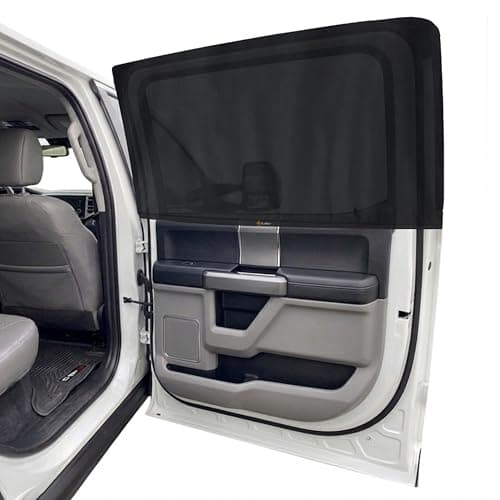
A stretch mesh sock that goes over the whole door frame rather than a suction-cup square that covers a third of the glass. The trade is that it is a screen, not a blackout: it cuts glare and direct sun while you can still see out and still lower the window.
- Sizes offered
- 18 x 20 in, 36 x 17 in, XL 24 x 38 in
- Material
- Nylon, spandex and rubber stretch mesh
- Fitment
- Over the door frame, not on the glass
- Window still opens
- Yes
- Pack size
- 2
- UV blocking percentage
- Not published
- List price
- Not published
- Warranty
- Not published
What it gets right
- Covers the full window aperture instead of a suction-cupped rectangle in the middle of it
- Breathable stretch fabric means the window still opens with the shade fitted
- No suction cups, so nothing falls off the glass on a hot day
- Sold in pairs, which is what a car with two rear windows actually needs
Flaws
- It is a mesh screen. It reduces glare and direct sun; it is not a blackout and does not make the back seat dark
- Sizing is by window aperture, and a shade sized for a sedan will not stretch over a minivan frame
- No published UV-blocking percentage or UPF rating for the mesh
The working behind the 8.6
- Heat headroom: not scored (weight 22%)
- The maker publishes no operating-temperature ceiling, so this axis is dropped and the other weights are re-normalized.
- Install effort: 10.0 (weight 24%)
- Drops in and sits there. No fixing of any kind, and it comes out again when you sell the car.
- Price against the ceiling: not scored (weight 24%)
- No published list price we could cite on the compile date, so this axis is dropped and the other weights are re-normalized.
- Written commitment: not scored (weight 15%)
- No warranty term published, so this axis is dropped and the other weights are re-normalized.
- Spec transparency: 6.3 (weight 15%)
- 5 of the 8 specifications we went looking for are published by the maker (63%). A blank row is never a guess here: it prints “Not published” and it costs the product points, because a figure nobody will commit to in writing is a figure you cannot check.
Axes with no published input are dropped and the remaining weights re-normalized, so a product is not punished for a category where an axis does not apply. Specifications compiled September 4, 2026 from EcoNour side window shade published specifications.
2Shade that still lets the window open
Universal Mesh Rear Window Sun Shade
Skip this one. A screen rather than a shade, and worth being clear about before you buy. Published UV figures in this style hover around 84-85% with no test standard attached, and mesh reduces glare and heat without eliminating either. Buy it for the thing it uniquely does — shade with the window still able to open, and insects kept out — not as a heat solution.
A stretch mesh sock that goes over the whole door frame, so the glass can still go up and down underneath it. That is the practical advantage over a suction-cup shade, and the published stretch range is what tells you whether it will fit your car.
- Fit
- Stretch, roughly 16.5-20 in x 27-43 in
- Mounting
- Over the door frame
- Window still opens
- Yes
- Stated UV block
- Around 84-85% on typical listings
- Test standard
- Not published
- Warranty
- Not published
- List price
- Not published
What it gets right
- Published stretch range — roughly 16.5-20 in height by 27-43 in width on typical listings — rather than one fixed size
- Fits over the door frame so the window still operates underneath
- Double-layer mesh on better versions, and see-through from the inside
- Also keeps insects out with the window down, which a solid shade cannot do
Flaws
- Published UV figures in this category hover around 84-85% rather than near-total, and are rarely tied to a test standard
- Mesh reduces glare and heat without eliminating either — it is a screen, not a blackout
- Fitting it over the door frame means opening the door every time it goes on or off
- Nothing in this category publishes a warranty
The working behind the 8.3
- Heat headroom: not scored (weight 22%)
- The maker publishes no operating-temperature ceiling, so this axis is dropped and the other weights are re-normalized.
- Install effort: 10.0 (weight 24%)
- Drops in and sits there. No fixing of any kind, and it comes out again when you sell the car.
- Price against the ceiling: not scored (weight 24%)
- No published list price we could cite on the compile date, so this axis is dropped and the other weights are re-normalized.
- Written commitment: not scored (weight 15%)
- No warranty term published, so this axis is dropped and the other weights are re-normalized.
- Spec transparency: 5.7 (weight 15%)
- 4 of the 7 specifications we went looking for are published by the maker (57%). A blank row is never a guess here: it prints “Not published” and it costs the product points, because a figure nobody will commit to in writing is a figure you cannot check.
Axes with no published input are dropped and the remaining weights re-normalized, so a product is not punished for a category where an axis does not apply. Specifications compiled September 4, 2026 from Published stretch range, mesh construction and UV claim.
3The panel of glass directly above your head
Universal Magnetic Sunroof Shade
A mesh panel held up by magnets against the sunroof aperture, which takes no adhesive and no suction cups — the two things that fail in heat. Published dimensions are how you check it covers your aperture, and this is a category where a stated size is the whole specification.
- Dimensions
- Around 21.6 in x 37.4 in on typical listings
- Mounting
- Magnetic
- Material
- Breathable mesh
- Stated UV block
- Not published
- Test standard
- Not published
- List price
- Not published
What it gets right
- Magnetic attachment, so nothing adhesive is going near a headliner and nothing suctions onto hot glass
- Published panel dimensions on typical listings — around 21.6 x 37.4 in — so the fit is checkable
- Breathable mesh rather than a solid panel, so the cabin does not go completely dark
- Removes in seconds and folds away, unlike a factory sunshade that is either open or shut
Flaws
- Magnets need steel to grip — an aluminum roof or a full panoramic glass aperture may leave nothing to hold onto
- No published UV figure and no test standard
- Mesh shades reduce heat without stopping it; a factory solid blind blocks more
- No warranty published
The working behind the 8.1
- Heat headroom: not scored (weight 22%)
- The maker publishes no operating-temperature ceiling, so this axis is dropped and the other weights are re-normalized.
- Install effort: 10.0 (weight 24%)
- Drops in and sits there. No fixing of any kind, and it comes out again when you sell the car.
- Price against the ceiling: not scored (weight 24%)
- No published list price we could cite on the compile date, so this axis is dropped and the other weights are re-normalized.
- Written commitment: not scored (weight 15%)
- No warranty term published, so this axis is dropped and the other weights are re-normalized.
- Spec transparency: 5.0 (weight 15%)
- 3 of the 6 specifications we went looking for are published by the maker (50%). A blank row is never a guess here: it prints “Not published” and it costs the product points, because a figure nobody will commit to in writing is a figure you cannot check.
Axes with no published input are dropped and the remaining weights re-normalized, so a product is not punished for a category where an axis does not apply. Specifications compiled September 4, 2026 from Published dimensions, mesh construction and magnetic mounting.
Prices last verified October 26, 2026. They move constantly; the figure on Amazon when you click is the real one.
Questions people actually ask
Do sunroof shades actually help?
On a parked car, yes — a sunroof is the only glass directly above an occupant and it admits sun straight down all day. A mesh panel stacks with the factory blind rather than replacing it, and many factory blinds are perforated or fabric and pass more light than people expect.
Are magnetic sunroof shades better than suction ones?
For a sunroof, yes. Suction cups release on hot glass, which is exactly when you want the shade working, and adhesive near a headliner takes the fabric with it when removed. Magnets need something ferrous though — check with a fridge magnet first.
How much UV do mesh window shades block?
Typical listings state around 84-85%, with no test standard attached. Treat that as a rough comparison rather than a measurement — it is not equivalent to a figure published against a named standard.
Will a rear shade keep my car cooler?
A little, on the glass it covers. Shades reduce solar gain but do not ventilate, and a sealed car heats regardless. Shade parking, slightly cracked windows where safe, and a windshield shade do more.