The best upholstery and fabric protectors
A protector buys you time between a spill landing and it soaking in. That is a smaller claim than the marketing makes and it is the difference between a wipe and a stain.
By Sawyer V. · Published · How we research
We have not tested any of this. Everything below is compiled from published manufacturer specifications, and the arithmetic is printed so you can check it. This page carries affiliate links: if you buy through one we earn a commission at no extra cost to you, and it does not change the order of the picks. Full disclosure.
The short answer
Buy Scotchgard Auto for cloth seats and carpet, and understand what it buys you. It publishes the two figures that let you plan the job: roughly a 7 ft by 5 ft area per 10 oz can, and reapplication every 6 months or after any wet cleaning. A protector makes water bead so you can lift it before it soaks into the foam. It is explicitly not for leather or plastic, and it is not waterproofing — a spill left sitting still gets through.
| # | Pick | Install | Score | Price |
|---|---|---|---|---|
| 1 | Chemical Guys Leather Cleaner & Conditioner Kit Leather and leatherette that gets sat on daily | Drops in | 8.9/10 | $27.99 - view on Amazon |
| 2 | Scotchgard Auto Fabric & Carpet Water Shield Cloth seats and carpet before the first spill | Drops in | 8.9/10 | $19.99 - view on Amazon |
| 3 | FH Group Universal Cloth Seat Covers Covering a seat you have already ruined | Drops in | 8.1/10 | $44.97 - view on Amazon |
| 4 | Chemical Guys Easy All Interior Care Kit Doing it properly rather than quickly | Drops in | 7.7/10 | $39.99 - view on Amazon |
Prices last verified October 24, 2026. They move constantly; the figure on Amazon when you click is the real one.
What a protector actually does
Untreated automotive fabric is absorbent by design — it is woven, it has texture, and liquid wicks into it and then down into the foam beneath.
A fluoropolymer protector coats individual fibers with a low-surface-energy layer. Water cannot spread across it, so instead of wicking in, a spill beads and sits on the surface for a while.
“For a while” is the honest framing and the whole value. You have not made the seat waterproof; you have bought a window of perhaps a minute in which blotting removes the spill completely instead of removing the top of it. That window is the difference between a wipe and a stain, and it is genuinely worth having — it is just smaller than the marketing implies.
The two published figures
| Specification | Published |
|---|---|
| Coverage | About 7 ft x 5 ft per 10 oz can |
| Reapplication | Every 6 months, or after any water or solvent cleaning |
| Dry time | Overnight at about 70 F, 50% humidity |
| Surfaces | Fabric seats, carpets, floor mats, trunks, cargo areas |
| Not for | Leather or plastic |
| Effect on feel | Stated not to change look or feel |
Coverage is the one that decides how much you buy. A full interior — two front seats, a rear bench, carpet and mats — is comfortably more than one can. Work out the area first rather than running out halfway through the rear bench, because a partially treated interior is a seat with an obvious line across it after the first spill.
The reapplication interval is the more useful disclosure. Six months, or after any wet cleaning — which is the part people miss. Shampooing a seat strips the protector, so the cleaning that made the seat look new also removed its protection.
The exclusion that catches people out
Scotchgard states plainly that it is not for leather or plastic. That is not a hedge, it is a genuine incompatibility — a fluoropolymer coating on a leather surface can block the finish's breathability and change its appearance.
Most modern car leather is coated anyway: a hide with a pigmented polyurethane top layer, or leatherette which is polyurethane on a fabric backing. Those surfaces already repel liquid, which is why a spill on a leather seat wipes off if you catch it. They do not need a fabric protector and should not have one.
What coated leather does need is UV protection, because the coating is what cracks — best leather cleaners and conditioners.
On a mixed interior — leather bolsters, cloth inserts — treat only the cloth, and mask the boundary rather than trusting your aim.
Applying it
- Vacuum thoroughly first, with a crevice tool. Anything you seal under the coating stays there
- Clean and let it dry completely. Applying over damp fabric traps the moisture
- Test a hidden area — under a seat, or the rear face of a backrest — and check after it dries, not while wet
- Mask anything adjacent that is leather, plastic or glass
- Apply in even, overlapping passes rather than soaking one area. Two light coats beat one heavy one
- Ventilate, and leave it overnight. The car is out of use while it cures
Do this outdoors or with the doors open. Aerosol solvents in a closed cabin are unpleasant and unnecessary when opening two doors solves it.
The alternative that beats it
And if the seats are leather rather than fabric, a protector is the wrong product entirely — leather cleaner against all-purpose cleaner covers identifying what you actually have.
For the seat that actually gets messy — the one under a child, or the one a dog sits on — a removable cover does something no protector can: it takes the spill entirely and goes in a washing machine.
A protector buys a minute. A cover removes the problem. If you know which seat is the problem seat, the cover is the better spend — with the airbag-compatible stitching requirement covered in best car seat covers, and the dog-specific version in best dog car seat covers.
Where a protector wins is the surfaces you cannot cover: carpet, the trunk floor, door card inserts, and the seats you want to keep looking original. Use both — cover the problem seat, treat everything else.
When to do it
The best moment is when the interior is new or freshly deep-cleaned, because the protector goes onto fabric with nothing sealed underneath it.
The second-best moment is right after any interior shampoo, since wet cleaning strips whatever was there. If you clean the interior twice a year and re-treat each time, you have met the published interval without tracking it separately — how to clean your car interior.
And when something does get through, blot rather than rub and use an enzyme cleaner for anything organic — how to remove stains from car seats.
Every pick, with the working
Each entry lists the specifications the maker publishes, the axis scores those specifications produce, and what you give up. Rows that read “Not published” are not omissions on our side: they are things the maker will not commit to in writing, and they cost the product points on the transparency axis. Specifications compiled September 4, 2026.
Our pickLeather and leatherette that gets sat on daily
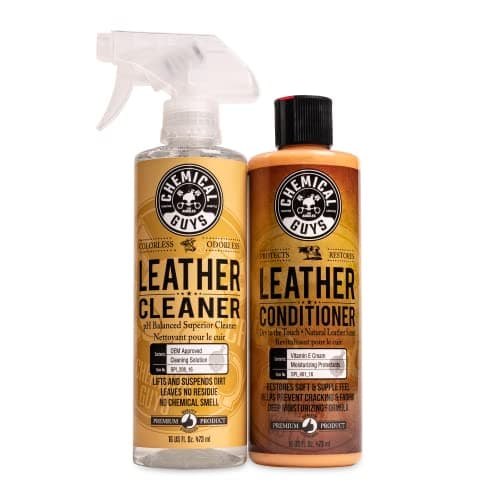
Chemical Guys Leather Cleaner & Conditioner Kit
Skip this one. Leather care, not fabric protection, and it is here because the products get bought interchangeably. Scotchgard states explicitly that it is not for leather or plastic. If your seats are leather or leatherette, this whole page is the wrong aisle and the coated-surface argument applies instead.
A two-step kit that separates cleaning from conditioning, which matters because a combined product does neither well. Stated pH-balanced and safe on natural, sealed and synthetic leather — the last one covers most modern car seats.
- Steps
- Two — cleaner then conditioner
- pH
- Stated pH-balanced (no figure published)
- Safe on
- Natural, sealed and synthetic leather
- Conditioner claims
- UV protection, prevents drying and cracking
- Size
- 2 x 16 fl oz
- Warranty
- Not published
- List price
- Not published
What it gets right
- Two separate steps: clean first, then condition. An all-in-one seals dirt under the conditioner
- Stated pH-balanced, so it does not strip dye or change the surface texture
- Explicitly safe on synthetic leather, which is what most cars badged as leather actually have
- Conditioner is stated to include UV protection, which is the mechanism that cracks a dashboard-adjacent seat
Flaws
- Chemical Guys does not publish an actual pH number, only that it is balanced
- Two products means two steps, and people skip the second one
- Most cars sold with leather have a sealed urethane top coat, so conditioner does far less than the marketing implies
The working behind the 8.9
- Heat headroom: not scored (weight 22%)
- The maker publishes no operating-temperature ceiling, so this axis is dropped and the other weights are re-normalized.
- Install effort: 10.0 (weight 24%)
- Drops in and sits there. No fixing of any kind, and it comes out again when you sell the car.
- Price against the ceiling: not scored (weight 24%)
- No published list price we could cite on the compile date, so this axis is dropped and the other weights are re-normalized.
- Written commitment: not scored (weight 15%)
- No warranty term published, so this axis is dropped and the other weights are re-normalized.
- Spec transparency: 7.1 (weight 15%)
- 5 of the 7 specifications we went looking for are published by the maker (71%). A blank row is never a guess here: it prints “Not published” and it costs the product points, because a figure nobody will commit to in writing is a figure you cannot check.
Axes with no published input are dropped and the remaining weights re-normalized, so a product is not punished for a category where an axis does not apply. Specifications compiled September 4, 2026 from Chemical Guys leather care published information.
2Cloth seats and carpet before the first spill
Scotchgard Auto Fabric & Carpet Water Shield
Publishes coverage area and a reapplication interval, which between them are the two figures that let you plan the job. One 10 oz can covers roughly a 7 by 5 foot area, and it wants reapplying every six months or after any wet cleaning.
- Coverage
- About 7 ft x 5 ft per 10 oz can
- Reapplication
- Every 6 months, or after any wet cleaning
- Dry time
- Overnight at about 70 F, 50% humidity
- Surfaces
- Fabric seats, carpets, floor mats, cargo areas
- Not for
- Leather or plastic
- Warranty
- Not published
- List price
- Not published
What it gets right
- Publishes coverage: roughly 7 ft x 5 ft per 10 oz can, so you can work out how many you need
- Publishes a reapplication interval — every six months, or after any water or solvent-based cleaning
- Stated not to change the look or feel of the fabric, which is the failure mode of cheaper protectants
- Repels water-based spills so they bead and lift rather than soaking into foam
Flaws
- Explicitly not for leather or plastic — on a leather-trimmed interior it covers only the cloth inserts
- Overnight dry time at room temperature, so the car is out of use while it cures
- It repels; it does not make fabric waterproof. A spill left sitting still gets through
- No published warranty term
The working behind the 8.9
- Heat headroom: not scored (weight 22%)
- The maker publishes no operating-temperature ceiling, so this axis is dropped and the other weights are re-normalized.
- Install effort: 10.0 (weight 24%)
- Drops in and sits there. No fixing of any kind, and it comes out again when you sell the car.
- Price against the ceiling: not scored (weight 24%)
- No published list price we could cite on the compile date, so this axis is dropped and the other weights are re-normalized.
- Written commitment: not scored (weight 15%)
- No warranty term published, so this axis is dropped and the other weights are re-normalized.
- Spec transparency: 7.1 (weight 15%)
- 5 of the 7 specifications we went looking for are published by the maker (71%). A blank row is never a guess here: it prints “Not published” and it costs the product points, because a figure nobody will commit to in writing is a figure you cannot check.
Axes with no published input are dropped and the remaining weights re-normalized, so a product is not punished for a category where an axis does not apply. Specifications compiled September 4, 2026 from Scotchgard Auto published coverage and reapplication interval.
3Covering a seat you have already ruined
FH Group Universal Cloth Seat Covers
Semi-universal cloth covers with 3 mm of breathable foam backing and — this is the specification that matters — stitching designed to let a side airbag deploy through the seam, which FH Group states is tested. A seat cover without that is a genuine safety problem, and plenty of cheap ones do not mention it at all.
- Airbag compatibility
- Stitched for side-airbag deployment, stated as tested
- Padding
- 3 mm breathable foam backing
- Care
- Machine washable, air dry
- Fit
- Semi-universal; full set or front set
- Material weight
- Not published
- Durability rating
- Not published
- List price
- Not published
- Warranty
- Not published
What it gets right
- Airbag-compatible stitching, stated as officially tested. This is the one specification to insist on
- 3 mm breathable foam backing, published, which is what stops them feeling like a bin bag
- Machine washable, which is the entire point for anyone with children or a dog
- Semi-universal fit covering most sedans, SUVs and trucks, with full-set and front-only options
Flaws
- Semi-universal means it will never look like upholstery. It looks like a cover, because it is one
- Getting them taut takes far longer than the listing suggests, and a loose cover slides
- FH Group publishes no material weight or durability figure, only the foam thickness
The working behind the 8.1
- Heat headroom: not scored (weight 22%)
- The maker publishes no operating-temperature ceiling, so this axis is dropped and the other weights are re-normalized.
- Install effort: 10.0 (weight 24%)
- Drops in and sits there. No fixing of any kind, and it comes out again when you sell the car.
- Price against the ceiling: not scored (weight 24%)
- No published list price we could cite on the compile date, so this axis is dropped and the other weights are re-normalized.
- Written commitment: not scored (weight 15%)
- No warranty term published, so this axis is dropped and the other weights are re-normalized.
- Spec transparency: 5.0 (weight 15%)
- 4 of the 8 specifications we went looking for are published by the maker (50%). A blank row is never a guess here: it prints “Not published” and it costs the product points, because a figure nobody will commit to in writing is a figure you cannot check.
Axes with no published input are dropped and the remaining weights re-normalized, so a product is not punished for a category where an axis does not apply. Specifications compiled September 4, 2026 from FH Group seat cover published specifications.
4Doing it properly rather than quickly
Chemical Guys Easy All Interior Care Kit
Leather cleaner and conditioner, streak-free glass spray, microfiber towels and quick wipes, sold as a set. The glass spray is the item that earns the kit its place: the film on the inside of a windshield is the single biggest contributor to night glare, and almost nobody owns a cleaner that removes it without leaving a haze.
- Contents
- Leather cleaner and conditioner, glass spray, microfiber towels, quick wipes
- Interior type
- Leather-focused
- Bottle volumes
- Not published
- List price
- Not published
- Warranty
- Not published
What it gets right
- Includes a proper glass cleaner, which is the most-skipped and most-valuable interior job
- Leather cleaner and conditioner as separate steps rather than a single 'wipe' product
- Microfiber towels included, so the kit is genuinely complete
- Chemical Guys publishes what is in each kit, which lets you compare kits rather than trusting a photo
Flaws
- Leather products are wasted on a cloth interior — check which kit matches your seats
- More expensive than a supermarket bundle, and for a car you keep clean anyway that is hard to justify
- Chemical Guys publishes no bottle volumes on the kit page, so value per ounce is unknowable
The working behind the 7.7
- Heat headroom: not scored (weight 22%)
- The maker publishes no operating-temperature ceiling, so this axis is dropped and the other weights are re-normalized.
- Install effort: 10.0 (weight 24%)
- Drops in and sits there. No fixing of any kind, and it comes out again when you sell the car.
- Price against the ceiling: not scored (weight 24%)
- No published list price we could cite on the compile date, so this axis is dropped and the other weights are re-normalized.
- Written commitment: not scored (weight 15%)
- No warranty term published, so this axis is dropped and the other weights are re-normalized.
- Spec transparency: 4.0 (weight 15%)
- 2 of the 5 specifications we went looking for are published by the maker (40%). A blank row is never a guess here: it prints “Not published” and it costs the product points, because a figure nobody will commit to in writing is a figure you cannot check.
Axes with no published input are dropped and the remaining weights re-normalized, so a product is not punished for a category where an axis does not apply. Specifications compiled September 4, 2026 from Chemical Guys' Easy All Interior Care Kit page.
Prices last verified October 24, 2026. They move constantly; the figure on Amazon when you click is the real one.
Questions people actually ask
Does fabric protector make car seats waterproof?
No. It makes liquid bead on the surface instead of wicking in, which buys you a window of about a minute to blot it away completely. A spill left sitting will still get through.
Can I use Scotchgard on leather seats?
No — it states explicitly that it is not for leather or plastic. Most modern car leather is polyurethane-coated and already repels liquid; what it needs is UV protection rather than a fabric treatment.
How often do I need to reapply it?
Every six months, or after any water or solvent-based cleaning — whichever comes first. The second condition is the one people miss: shampooing a seat strips the protector off.
How much do I need for a whole car?
More than one can. A 10 oz can covers roughly 7 ft by 5 ft, and a full interior of two fronts, a rear bench, carpet and mats exceeds that. Work out the area before starting.