ThisWorx Car Vacuum review
The best-known cheap car vacuum on the internet, sold in two versions that look identical in a search result. Here is which one you land on and what its maker will actually commit to.
By Sawyer V. · Published · How we research
We have not tested any of this. Everything below is compiled from published manufacturer specifications, and the arithmetic is printed so you can check it. This page carries affiliate links: if you buy through one we earn a commission at no extra cost to you, and it does not change the order of the picks. Full disclosure.
The verdict
Buy it, for the cord rather than the suction. Sixteen published feet reaches the trunk of a normal car from the front 12V socket, and that is the thing a cheap cordless handheld cannot do at any price. It is a crumbs, sand and footwell tool. It has no motorized brush, so hair woven into carpet pile is the wrong job for it.
The thing to know before you click: ThisWorx sells two of these. The original TWC-01 publishes 106 W and 2.4 lb; the current 2.0 (TWC-02) publishes 110 W, 9.17 A and 2.6 lb, and adds an LED light and a washable double filter. Both are listed at the same price. Most of the specifications quoted for “the ThisWorx” online — including, until this review, the ones on this site — are the older model’s. The buy button here goes to the 2.0.
| # | Pick | Install | Score | Price |
|---|---|---|---|---|
| 1 | ThisWorx Car Vacuum Cleaner 2.0 Reaching the trunk without an extension lead | Plugs in | 9.2/10 | $20.99 - view on Amazon |
Prices last verified November 9, 2026. They move constantly; the figure on Amazon when you click is the real one.
What it is
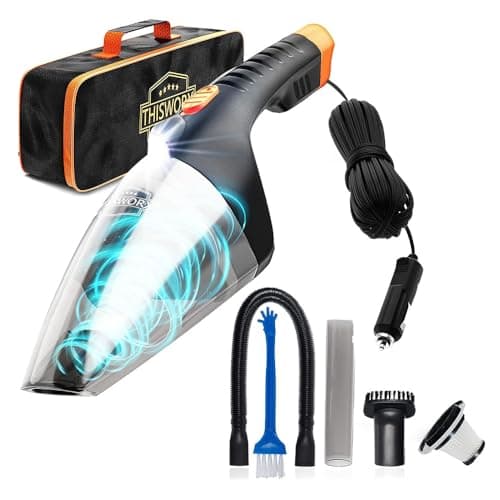
A corded handheld vacuum that runs off the 12V accessory socket instead of a battery. It is roughly the size of a large flashlight, weighs a published 2.6 lb, and comes with three nozzles, a carry bag and a small brush for cleaning the filter.
That is the whole product. There is no dock, no battery, no app and nothing to charge. You plug it into the socket, you vacuum the car, you unplug it. The design has barely changed in years, which in a category full of rebadged unknowns is itself worth something.
There are two of these, and the internet mixes them up
This is the single most useful thing this review can tell you, and it is the reason the page exists.
ThisWorx lists the original TWC-01 and the 2.0 (TWC-02) as separate products. They look nearly identical in a search result, they are listed at the same price, and the published figures are not the same:
| ThisWorx TWC-01 | ThisWorx 2.0 (TWC-02) | |
|---|---|---|
| Power | 106 W | 110 W |
| Current draw | Not stated; 106 W at 12 V is about 8.8 A | 9.17 A, published |
| Weight | 2.4 lb | 2.6 lb |
| Cord | 16 ft | 16 ft |
| Filter | Washable HEPA, spare included | Washable double filter |
| LED light | Not published | Integrated |
| In the box | 3 attachments, bag, filter brush, spare filter | 3 attachments, bag, filter brush |
| Suction (kPa or air watts) | Not published | Not published |
Read that table in both directions before you decide the newer one is automatically better. The 2.0 gains a light and a second filter layer and loses the spare filter that came in the older box. It is also two tenths of a pound heavier, which matters slightly more than it sounds when you are holding it at arm’s length under a seat.
The cord is the actual product
Sixteen feet is the specification that earns this thing its place, and it is published rather than implied.
From a front 12V socket, 16 ft reaches the back seats and the trunk of most sedans and hatchbacks without unplugging anything. That is the job a cheap cordless handheld fails at — not because its suction is worse, but because a small battery runs down somewhere around the second footwell and then you are waiting instead of cleaning.
The trade is real and worth stating plainly: a cord is always in the way of the thing you are vacuuming. You will drape it over a seat back, it will catch on a seat rail, and you will move it four times. Unlimited runtime is what you are buying that annoyance for. If your car is small and you vacuum it often, a cordless unit is genuinely the nicer tool, and the comparison is laid out on the car vacuum roundup.
What 9.17 amps means for your car
The 2.0 publishes its current draw, which almost nothing in this category does, and the number deserves a sentence of arithmetic rather than a shrug.
At 9.17 A, this vacuum is close to the ceiling of a typical accessory circuit. Many cars fuse the 12V socket at 10 A, some at 15 A, and the figure is printed in the owner’s manual and usually on the fuse box lid. Nothing dramatic happens if you are under it; if you are at it, a blown fuse is the likely outcome rather than any damage.
- Run the engine. Ten minutes of near-10 A draw on a parked car is a meaningful bite out of a battery that is already sitting at rest, and batteries that start cars do not enjoy deep discharge.
- Check the fuse rating before you assume. On a car with a 10 A socket you are running at roughly 92 percent of the fuse. That works until a nozzle blocks and the motor loads up.
- Do not run it through a splitter with other things plugged in. The fuse protects the circuit, not the device, and the circuit is shared. The same arithmetic is why 12V accessory loads are worth adding up.
The figure nobody publishes
ThisWorx does not publish a suction figure. Not in kPa, not in air watts, not in CFM. Neither does anything else in this price bracket.
Watts are not suction. 110 W is what the motor consumes from the socket, and how much of that becomes airflow at the nozzle depends on the fan, the sealing and the filter — none of which is published either. Two vacuums with identical wattage can move meaningfully different amounts of air, and there is no way to tell from the listings which is which.
This matters for expectations more than for the buying decision. At this price there is nothing to compare against on the figure that counts, so the honest basis for choosing is the things that are published: cord length, weight, current draw, what is in the box and whether the filter washes. That is what this site ranks the category on, and it is why the ranking says what it says.
What it is genuinely good at, and what it is not
A handheld with no driven brush is a suction-only tool, and that draws a clean line through the jobs people buy it for.
| Job | Right tool? | Why |
|---|---|---|
| Crumbs, grit, dried mud in footwells | Yes | Loose debris on a hard or shallow surface is pure suction work |
| Sand after the beach | Yes | Heavy, loose, and the extendable nozzle reaches seat rails |
| Ash and dust in vents and seams | Yes | The brush nozzle is made for this and the LED helps |
| Trunk and under seats | Yes | This is what the 16 ft cord is for |
| Pet hair woven into carpet pile | No | Hair needs a rotating brush to lift it; this has none |
| Wet spills | No | Nothing in the listing describes it as a wet/dry vacuum |
| Whole-car deep clean every week | Marginal | A 2.6 lb handheld held at arm's length gets tiring before a full car is done |
The pet hair line is the one people get wrong, and it is not a criticism of this vacuum so much as of the category. Hair that has worked into carpet pile is held there mechanically; suction pulls at it and the nozzle slides over the top. Lifting it takes a motorized brush, which is a different and more expensive class of tool — see the pet hair vacuum ranking if that is your actual problem.
Emptying it and washing the filter
These are the two questions people search for most about this vacuum after they own it, and the answers are short.
The bin twists off the body. The filter sits inside it and lifts out; the small brush in the box is for knocking debris off the pleats, and ThisWorx states the filter is washable, which means rinsing it rather than buying a replacement. A washed filter has to be fully dry before it goes back in — a damp filter is a blocked filter, and a blocked filter is the single most common reason one of these feels like it has stopped working.
Empty it more often than feels necessary. A small bin fills fast, and suction falls off well before the bin looks full. If the car is genuinely dirty, plan on emptying it partway through rather than at the end.
Who should skip it
- Anyone whose main problem is pet hair. Covered above. Buy the brush, not the suction.
- Anyone who already owns a decent cordless handheld. The only thing this adds is runtime and reach. If your car is small, that is not worth a second tool.
- Anyone expecting household-vacuum performance. It is a 12V socket device and it behaves like one. It is for maintaining a clean car, not rescuing a neglected one.
For everyone else — a commuter car that collects crumbs, grit and the general sediment of daily driving — it is the cheapest tool that does the job properly, and the cord is the reason. If you want the broader picture of how it stacks up against a cordless, the roundup runs the trade in full, and the interior cleaning guide puts vacuuming in the right order relative to everything else.
Every pick, with the working
Each entry lists the specifications the maker publishes, the axis scores those specifications produce, and what you give up. Rows that read “Not published” are not omissions on our side: they are things the maker will not commit to in writing, and they cost the product points on the transparency axis. Specifications compiled September 4, 2026.
Our pickReaching the trunk without an extension lead
ThisWorx Car Vacuum Cleaner 2.0
A 110 W corded vacuum drawing a published 9.17 amps from the 12V socket, with a 16-foot cord and an LED light in the nose. The cord is the reason to buy the corded one: sixteen feet reaches the trunk of most cars from the front socket, and a cordless handheld runs out of battery halfway through the back seat.
- Power
- 110 W
- Current draw
- 9.17 A
- Cord length
- 16 ft
- Weight
- 2.6 lb
- Power source
- 12 V socket
- Filter
- Washable double filter
- Attachments
- Flathead, extendable, brush nozzle
- Light
- Integrated LED
- Suction (kPa or air watts)
- Not published
- Warranty
- Not published
What it gets right
- 16 ft cord, published — genuinely reaches every corner of a normal car from one socket
- 110 W and 9.17 A both published, which is more useful than the 'high power' every listing in this category claims
- 2.6 lb, so it is easy to hold at an angle under a seat for five minutes
- Ships with three attachments, a carry bag and a filter cleaning brush, and the double filter is washable rather than consumable
Flaws
- ThisWorx publishes no suction figure in kPa or air watts, which is the number that would let you compare it to anything
- 9.17 A is a real load on the 12V socket; run the engine
- Corded means the cord is always in the way of what you are vacuuming
The working behind the 9.2
- Heat headroom: not scored (weight 22%)
- The maker publishes no operating-temperature ceiling, so this axis is dropped and the other weights are re-normalized.
- Install effort: 10.0 (weight 24%)
- Plugs into a 12V socket or a USB port. Nothing to mount, nothing to route, reversible in a second.
- Price against the ceiling: not scored (weight 24%)
- No published list price we could cite on the compile date, so this axis is dropped and the other weights are re-normalized.
- Written commitment: not scored (weight 15%)
- No warranty term published, so this axis is dropped and the other weights are re-normalized.
- Spec transparency: 8.0 (weight 15%)
- 8 of the 10 specifications we went looking for are published by the maker (80%). A blank row is never a guess here: it prints “Not published” and it costs the product points, because a figure nobody will commit to in writing is a figure you cannot check.
Axes with no published input are dropped and the remaining weights re-normalized, so a product is not punished for a category where an axis does not apply. Specifications compiled September 4, 2026 from ThisWorx Car Vacuum Cleaner 2.0 published power, current draw, cord length and weight.
Prices last verified November 9, 2026. They move constantly; the figure on Amazon when you click is the real one.
Questions people actually ask
What is the difference between the ThisWorx car vacuum and the 2.0?
The 2.0 (TWC-02) publishes 110 W, 9.17 A and 2.6 lb, with an integrated LED light and a washable double filter. The original TWC-01 publishes 106 W and 2.4 lb, with a washable HEPA filter and a spare in the box. Both have the same 16 ft cord and both were listed at the same price when this page was written. Neither publishes a suction figure.
How many amps does the ThisWorx car vacuum draw?
The 2.0 publishes 9.17 A. The original does not publish a current figure, but 106 W at 12 V works out at roughly 8.8 A. Either way it sits close to a typical 10 A accessory-socket fuse, so run the engine and do not share the circuit with anything else while you use it.
Is the ThisWorx car vacuum good for pet hair?
Not for hair that has woven into carpet pile. It has no motorized brush, so it pulls at embedded hair rather than lifting it. It is fine for loose hair sitting on a seat surface. For the embedded kind you need a driven brush head, which is a different class of tool.
How do you clean the ThisWorx filter?
Twist off the bin, lift the filter out, knock the loose debris off with the brush supplied, and rinse it. ThisWorx states the filter is washable. Let it dry completely before refitting — a damp filter chokes airflow and is the usual reason one of these seems to lose suction.
How much suction does it have?
Unknown, and that is the honest answer. ThisWorx publishes wattage rather than suction, and so does every competitor at this price. Watts describe what the motor draws, not what reaches the nozzle, so there is no published figure here to compare against anything.