The best car covers for outdoor use
The instinct is to buy the most waterproof cover available. On a car parked outdoors that is precisely the wrong instinct, and it is the mistake this category is built on.
By Sawyer V. · Published · How we research
We have not tested any of this. Everything below is compiled from published manufacturer specifications, and the arithmetic is printed so you can check it. This page carries affiliate links: if you buy through one we earn a commission at no extra cost to you, and it does not change the order of the picks. Full disclosure.
The short answer
Buy breathable and fitted, not waterproof and loose. A sealed cover on a car parked outdoors traps the moisture that condenses underneath it, holding damp against paint and trim indefinitely. Covercraft publishes a 4-year warranty on WeatherShield HP and states plainly that fading is excluded, which is the most honest sentence in this category. The other rule matters just as much: never fit a cover over a dirty car — that grinds the dirt into the finish every time the wind moves.
| # | Pick | Install | Score | Price |
|---|---|---|---|---|
| 1 | Covercraft WeatherShield HP Car Cover A car that lives outside permanently | Drops in | 9.1/10 | $374.99 - view on Amazon |
| 2 | 3M Ultra Headlight Restoration Kit Yellowed lenses on a car worth keeping | Drops in | 8.7/10 | $14.49 - view on Amazon |
| 3 | Kayme 6-Layer Universal Car Cover Covering a car you are not precious about | Drops in | 8.1/10 | $74.96 - view on Amazon |
Prices last verified October 24, 2026. They move constantly; the figure on Amazon when you click is the real one.
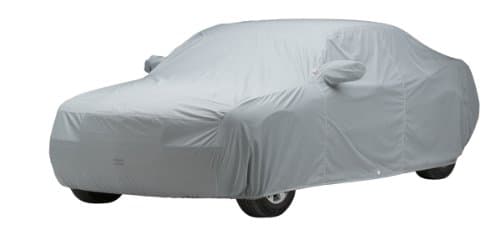
The waterproofing trap
Every listing in this category leads with waterproof, and for a car stored outdoors that is the wrong specification to optimize.
Here is what happens under a sealed cover. The car and the ground beneath it hold moisture. Temperature swings through the day and night drive condensation. A breathable fabric lets that vapor pass out through the weave; an impermeable one does not, so it condenses on the inside of the cover and runs back down onto the paint.
The result is a car sitting in a permanently damp envelope. That is worse for paint, trim and any brightwork than simply leaving it uncovered in the rain, because rain dries and this does not.
What we ranked on
- Breathability. Stated, not implied. The single most important property for outdoor storage
- Published warranty term. On a fabric item left in the sun, a written term is the maker's own estimate of service life
- Fit method. Custom, or universal by length. Fit decides how much the fabric moves, and movement is what abrades paint
- Dye method. Solution-dyed carries color through the fiber; surface-dyed sits on it and fades faster
| Covercraft WeatherShield HP | Kayme 6-Layer | |
|---|---|---|
| Breathable | Stated yes | Not published |
| Water handling | Disperses and beads | Stated 100% waterproof |
| Fit | Custom per vehicle | Universal by length range |
| Dye | Solution dyed | Not published |
| Warranty | 48 months, excludes fading | Not published |
| Washable | Machine washable | Not published |
| Fabric weight | Not published | Not published |
The warranty, and the exclusion that makes it credible
Covercraft publishes four years against defects in materials and workmanship, and states explicitly that the warranty does not cover fading, which occurs naturally on all products used outdoors.
Read as a sales claim, naming an exclusion looks like a weaker offer. Read as information it is the most useful sentence on the page: the maker telling you that any fabric left in the sun will fade, that this is expected rather than a defect, and that the warranty covers the thing it can actually control.
That is the same pattern as 4Knines warranting its dog seat cover fabric for life and its waterproof coating for twelve months separately — a maker being specific about which part wears. It is the signal we weight most heavily across this whole site, and the reasoning is in how to choose car accessories that last.
Why fit is a paint question
A loose cover moves. Wind gets under it, it flaps, and every flap drags fabric across the paint. Over a season of exposure that is a polishing action with whatever grit is on the car acting as the abrasive.
A custom cover is cut to the vehicle, so there is far less slack to catch wind. Covercraft adds urethane elastic sewn into front and rear hems and reinforced non-scratch grommets for a tie-down cord underneath.
A universal cover cannot do that, which is why Kayme supplies windproof straps front and rear — a reasonable mitigation rather than a solution. If you buy universal, use the straps and size down rather than up if you are between length ranges.
The rule that matters more than the cover
Never fit a cover over a dirty car. This does more damage than any cover choice. Wash it first with a pH-neutral shampoo, and get the bonded residue off before the cover goes on.
Dust and grit on the paint sit trapped between the finish and the fabric. Every gust that moves the cover drags that grit across the clear coat. People fit a cover to protect the paint and produce a uniform haze of fine scratching over a season.
Wash the car before covering it, and take the cover off periodically rather than leaving it undisturbed for months — both to check what is happening underneath and to let the car air. Washing method is in best car detailing kits, and the grit guard is the item that matters there for exactly the same reason.
What a cover does and does not protect against
It does block UV, which is the main thing degrading paint, plastic trim and rubber seals outdoors. It keeps leaves, sap, bird droppings and industrial fallout off, and those are the things that etch clear coat if left.
It does not protect the interior meaningfully, because the dashboard's enemy is UV through glass and a cover over the windshield helps only while it is on. For the cabin, a windshield shade does the daily work — how to protect your car interior from sun.
It does not deter theft, and a cover on a car in a public place is a privacy screen for anyone working on it. It also does nothing about hail beyond the trivial.
Who should buy which
- A car outdoors permanently that you intend to keep: custom, breathable, with a published warranty
- Seasonal storage or a car under a carport: a universal cover is proportionate — the exposure is lower and so is the fit penalty
- Indoors in a garage: you want a soft dust cover, not a weather cover. Different product entirely
- A car you cannot reliably keep clean before covering: honestly, no cover. You will do more harm than the weather would
Every pick, with the working
Each entry lists the specifications the maker publishes, the axis scores those specifications produce, and what you give up. Rows that read “Not published” are not omissions on our side: they are things the maker will not commit to in writing, and they cost the product points on the transparency axis. Specifications compiled September 4, 2026.
Our pickA car that lives outside permanently
Covercraft WeatherShield HP Car Cover
The only cover here with a published warranty term — four years — and it states what the warranty excludes, which is fading. Solution-dyed, breathable, custom fit to the vehicle, and machine washable.
- Fabric
- WeatherShield HP, solution dyed
- Breathable
- Yes
- Fit
- Custom per vehicle
- Hems
- Urethane elastic front and rear
- Grommets
- Reinforced, non-scratch
- Washable
- Machine washable
- Warranty
- 48 months (excludes fading)
- Fabric weight
- Not published
- List price
- Not published
What it gets right
- Publishes a 4-year warranty against defects in materials and workmanship
- States plainly that fading is excluded, which is honest about what happens to any fabric left outdoors
- Solution-dyed fabric, so color runs through the fiber rather than sitting on it — the reason it resists fading longer
- Breathable rather than sealed, which is what stops moisture being trapped against paint
- Custom fit per vehicle, with urethane elastic hems and non-scratch grommets
- Machine washable
Flaws
- Custom fit means vehicle-specific, so it is worthless when you change cars
- The most expensive way to cover a car by a wide margin
- Any cover on a dirty car grinds that dirt into the paint every time the wind moves it
- Fabric weight and thickness are not published as figures
The working behind the 9.1
- Heat headroom: not scored (weight 22%)
- The maker publishes no operating-temperature ceiling, so this axis is dropped and the other weights are re-normalized.
- Install effort: 10.0 (weight 24%)
- Drops in and sits there. No fixing of any kind, and it comes out again when you sell the car.
- Price against the ceiling: not scored (weight 24%)
- No published list price we could cite on the compile date, so this axis is dropped and the other weights are re-normalized.
- Written commitment: 9.0 (weight 15%)
- 48-month warranty. This is the only promise in the entire listing that a court would read, which is why it is scored and the marketing copy is not.
- Spec transparency: 7.8 (weight 15%)
- 7 of the 9 specifications we went looking for are published by the maker (78%). A blank row is never a guess here: it prints “Not published” and it costs the product points, because a figure nobody will commit to in writing is a figure you cannot check.
Axes with no published input are dropped and the remaining weights re-normalized, so a product is not punished for a category where an axis does not apply. Specifications compiled September 4, 2026 from Covercraft WeatherShield HP published fabric and warranty.
2Yellowed lenses on a car worth keeping
3M Ultra Headlight Restoration Kit
Publishes its exact abrasive sequence by grit, which is the only way to judge a restoration kit — the grit steps are the process. It finishes with a UV clear coat rather than a polish, which is the difference between a fix and a six-week reprieve.
- Abrasive sequence
- 500 grit, 800 grit, 3000 grit Trizact refining
- Finish
- Quick Headlight Clear Coat wipes
- Also included
- 3.25 in disc pad holder, masking tape, instructions
- Reapplication
- 3M states sealant wears; reapply roughly annually
- Warranty
- Not published
- List price
- Not published
What it gets right
- Publishes the full abrasive sequence: 500 grit, 800 grit, then 3000 grit Trizact refining
- Finishes with a clear coat wipe rather than a polish — a polished lens with no UV coat yellows again quickly
- Includes the disc pad holder and masking tape, so the kit is genuinely complete
- Restoring a lens recovers real light output, which is a safety gain rather than a cosmetic one
Flaws
- It is genuine physical work: masking, three wet-sanding stages, then compounding
- 3M states the UV sealant wears and needs reapplying roughly annually — this is maintenance, not a permanent repair
- Sanding a lens removes material. There is a finite number of times a lens can be restored
- Get the masking wrong and you sand the paint next to the lens
The working behind the 8.7
- Heat headroom: not scored (weight 22%)
- The maker publishes no operating-temperature ceiling, so this axis is dropped and the other weights are re-normalized.
- Install effort: 10.0 (weight 24%)
- Drops in and sits there. No fixing of any kind, and it comes out again when you sell the car.
- Price against the ceiling: not scored (weight 24%)
- No published list price we could cite on the compile date, so this axis is dropped and the other weights are re-normalized.
- Written commitment: not scored (weight 15%)
- No warranty term published, so this axis is dropped and the other weights are re-normalized.
- Spec transparency: 6.7 (weight 15%)
- 4 of the 6 specifications we went looking for are published by the maker (67%). A blank row is never a guess here: it prints “Not published” and it costs the product points, because a figure nobody will commit to in writing is a figure you cannot check.
Axes with no published input are dropped and the remaining weights re-normalized, so a product is not punished for a category where an axis does not apply. Specifications compiled September 4, 2026 from 3M headlight restoration kit published contents and process.
3Covering a car you are not precious about
Kayme 6-Layer Universal Car Cover
Skip this one. It publishes its layer stack, which is more than most universal covers do, and its headline feature is the problem. A cover stated 100% waterproof, fitted loosely over a car that gets damp underneath, holds that moisture against the paint. Buy it for short-term or indoor-adjacent use, not for a car living outdoors permanently.
A universal multi-layer cover built around a reflective aluminum layer for sun and a PEVA layer for water, with a soft inner face. It publishes its layer stack and its fit is by length range rather than by vehicle.
- Layers
- 6, published as PE/PEVA, reflective aluminum, soft cotton inner
- Water
- Stated 100% waterproof
- Fit
- Universal, by vehicle length range
- Retention
- Windproof straps front and rear
- Breathable
- Not published
- Fabric weight
- Not published
- Warranty
- Not published
- List price
- Not published
What it gets right
- Publishes the layer construction: PE and PEVA for water, reflective aluminum for sun, soft cotton inner face
- Sized by vehicle length range, so it fits without being vehicle-specific and moves to the next car
- Windproof straps front and rear, which is the failure mode of every universal cover
- A fraction of the price of a custom cover
Flaws
- Fully waterproof is the wrong goal for a cover left on a damp car — a sealed cover traps moisture against paint
- Universal fit means slack, and slack fabric moving in wind is what abrades paint
- No published warranty term and no published fabric weight
- Reflective aluminum layers crack and delaminate with age; nobody publishes a service life
The working behind the 8.1
- Heat headroom: not scored (weight 22%)
- The maker publishes no operating-temperature ceiling, so this axis is dropped and the other weights are re-normalized.
- Install effort: 10.0 (weight 24%)
- Drops in and sits there. No fixing of any kind, and it comes out again when you sell the car.
- Price against the ceiling: not scored (weight 24%)
- No published list price we could cite on the compile date, so this axis is dropped and the other weights are re-normalized.
- Written commitment: not scored (weight 15%)
- No warranty term published, so this axis is dropped and the other weights are re-normalized.
- Spec transparency: 5.0 (weight 15%)
- 4 of the 8 specifications we went looking for are published by the maker (50%). A blank row is never a guess here: it prints “Not published” and it costs the product points, because a figure nobody will commit to in writing is a figure you cannot check.
Axes with no published input are dropped and the remaining weights re-normalized, so a product is not punished for a category where an axis does not apply. Specifications compiled September 4, 2026 from Kayme published layer construction.
Prices last verified October 24, 2026. They move constantly; the figure on Amazon when you click is the real one.
Questions people actually ask
Should a car cover be waterproof?
Not fully. A sealed cover traps condensation against the paint and holds it there. You want a fabric that sheds bulk water while remaining vapor-permeable, which is what breathable means in this context.
Can a car cover scratch my paint?
Yes, and it is the most common way covers cause damage. Grit trapped between a dirty car and the fabric is dragged across the clear coat every time wind moves the cover. Always wash the car first.
Is a custom cover worth it over a universal one?
For permanent outdoor storage, yes — less slack means less movement, and movement is what abrades paint. For a carport or seasonal use, a universal cover with its windproof straps fitted properly is proportionate.
Do car covers stop hail damage?
Not meaningfully. A standard cover is a fabric layer, not padding, and it will not absorb hail impact. Dedicated hail protection is a separate and much bulkier product category.