The best headlight restoration kits
A kit is its abrasive sequence and its final coat. Everything else on the box is packaging, and the kits that skip the UV step are selling you a six-week reprieve.
By Sawyer V. · Published · How we research
We have not tested any of this. Everything below is compiled from published manufacturer specifications, and the arithmetic is printed so you can check it. This page carries affiliate links: if you buy through one we earn a commission at no extra cost to you, and it does not change the order of the picks. Full disclosure.
The short answer
Buy the 3M Ultra kit, and check any alternative finishes with UV clear coat. 3M publishes its full abrasive sequence — 500 grit, 800 grit, then 3000 grit refining — which is the only meaningful way to judge a kit, because the grit steps are the process. It finishes with a clear coat wipe rather than a polish. That distinction decides whether the result lasts a year or clouds over again in six weeks.
| # | Pick | Install | Score | Price |
|---|---|---|---|---|
| 1 | 3M Ultra Headlight Restoration Kit Yellowed lenses on a car worth keeping | Drops in | 8.7/10 | $14.49 - view on Amazon |
| 2 | SYLVANIA SilverStar zXe Gold Halogen A whiter beam that is actually street legal | Drops in | 8.6/10 | Check price on Amazon |
| 3 | Chemical Guys 16-Piece Arsenal Builder Kit Starting exterior detailing from nothing | Drops in | 8.3/10 | $169.99 - view on Amazon |
Prices last verified October 24, 2026. They move constantly; the figure on Amazon when you click is the real one.
What actually happened to the lens
Headlight lenses have been polycarbonate rather than glass for decades, because polycarbonate is far lighter and does not shatter. It has one weakness: ultraviolet light degrades it.
From the factory the lens carries a hard UV-resistant coating. That coating is what fails — it thins, crazes and breaks down under years of sun, and once it is gone the polycarbonate underneath oxidizes directly. The yellow you see is the plastic itself degrading.
Two things follow, and they explain the whole product category. Polishing removes some oxidized material and makes it look better temporarily. And unless you replace the UV protection you have just exposed fresh polycarbonate to the same sun that ruined the original, which is why an uncoated restoration yellows again fast.
How to judge a kit
- Published grit sequence. The steps are the process. A kit that lists its grits is describing its method; a kit that says “restores clarity” is not
- A UV clear coat step. Not a polish, not a wax. If the kit ends with rubbing compound, it is incomplete
- Enough abrasive for two lenses. Discs load up with removed material and a spent disc stops cutting
- Masking tape included. Sounds trivial; it is what stands between you and sanding the paint beside the lens
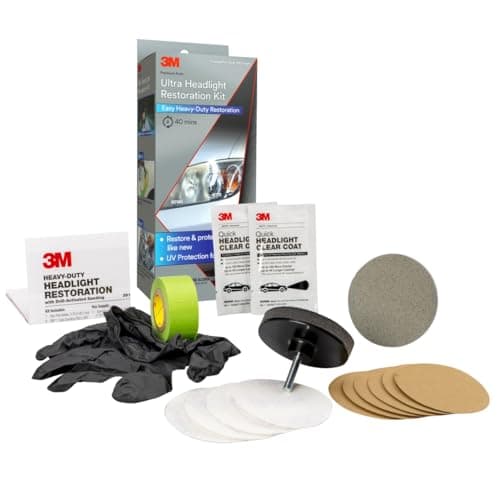
3M publishes 6 x 500-grit discs, 4 x 800-grit, one 3000-grit Trizact refining disc, two clear coat wipes, a 3.25 in pad holder, masking tape and instructions. That is a complete, checkable contents list, which is precisely what this site ranks on.
Why three grits and not one
Each abrasive stage removes the scratches left by the previous one. You are not polishing the lens clear — you are cutting away the degraded layer and then progressively refining the surface until the scratches are finer than visible light can scatter.
- 500 grit removes the oxidized layer. The lens goes uniformly frosted, and that frosting is the signal the yellowing is gone. This stage looks alarming and is correct
- 800 grit refines the 500-grit scratches into finer ones
- 3000 grit takes it to the point where compound can finish the job
- Compound removes the last visible scratching and returns clarity
- UV clear coat replaces the protection you just removed. Without this step the rest was temporary
Skipping a grit does not save time, it costs it — the next stage has to remove deeper scratches than it was designed for, and the usual result is a lens that never fully clears.
The four ways this goes wrong
Not masking properly. Sandpaper does not distinguish between lens and paint. Tape generously, two layers on the edge nearest the lens.
Sanding dry when the instructions say wet. Wet sanding floats away the removed material; dry sanding lets it load the disc and drag, which puts in deeper scratches than the grit should.
Stopping at compound. The lens looks finished at that point, which is exactly the trap. Without the UV coat you have exposed bare polycarbonate.
Touching the coating while it cures. 3M states to apply the clear coat wipe evenly and avoid touching it while it cures. Fingerprints in curing clear coat are permanent.
How long it lasts, honestly
3M states the UV sealant wears over time and recommends reapplying roughly annually. That is a maintenance interval, not a repair — and it is the honest framing this category usually avoids.
The good news is that reapplication after the first full restoration is just the coat, not the sanding. Once the lens is clear, keeping it clear is a ten-minute job with a fresh wipe.
There is also a limit. Sanding removes material, and a lens can only be restored a finite number of times before it is too thin and the surface goes soft and hazy in a way no abrasive fixes. Applying the UV coat on schedule is what pushes that limit out.
When to replace instead
Restoration works on surface degradation. It does not fix a lens that is cracked, one where moisture is getting inside the housing and condensing, or one where the reflector coating behind the lens has gone dull.
The reflector is the one people miss: if the lens comes up perfectly clear and the output is still poor, look at the reflector surface behind it. A degraded reflector is not repairable and the assembly needs replacing.
Condensation inside the housing means a failed seal or a blocked vent, and restoring the outside of a lens with water sitting behind it achieves nothing.
While you have the car outside
Two adjacent jobs cost almost nothing and compound the benefit. Clean the inside of the windshield, where off-gassed interior film scatters oncoming light into starbursts. And check the wipers, because smear is invisible in daylight and catches every headlight after dark. While you are working on faded plastic, the bumper trim and mirror caps respond to the same afternoon — see trim restorers.
How to clean car windows without streaks and best windshield wipers. The full picture on night visibility is in how to stop glare while driving.
The technique here — abrade, then refine, then seal — is the same one that removes a scratch from paint, and the same caution applies: you are removing material that does not grow back, so stop when it stops improving rather than pushing harder — best car scratch removers.
Every pick, with the working
Each entry lists the specifications the maker publishes, the axis scores those specifications produce, and what you give up. Rows that read “Not published” are not omissions on our side: they are things the maker will not commit to in writing, and they cost the product points on the transparency axis. Specifications compiled September 4, 2026.
Our pickYellowed lenses on a car worth keeping
3M Ultra Headlight Restoration Kit
Publishes its exact abrasive sequence by grit, which is the only way to judge a restoration kit — the grit steps are the process. It finishes with a UV clear coat rather than a polish, which is the difference between a fix and a six-week reprieve.
- Abrasive sequence
- 500 grit, 800 grit, 3000 grit Trizact refining
- Finish
- Quick Headlight Clear Coat wipes
- Also included
- 3.25 in disc pad holder, masking tape, instructions
- Reapplication
- 3M states sealant wears; reapply roughly annually
- Warranty
- Not published
- List price
- Not published
What it gets right
- Publishes the full abrasive sequence: 500 grit, 800 grit, then 3000 grit Trizact refining
- Finishes with a clear coat wipe rather than a polish — a polished lens with no UV coat yellows again quickly
- Includes the disc pad holder and masking tape, so the kit is genuinely complete
- Restoring a lens recovers real light output, which is a safety gain rather than a cosmetic one
Flaws
- It is genuine physical work: masking, three wet-sanding stages, then compounding
- 3M states the UV sealant wears and needs reapplying roughly annually — this is maintenance, not a permanent repair
- Sanding a lens removes material. There is a finite number of times a lens can be restored
- Get the masking wrong and you sand the paint next to the lens
The working behind the 8.7
- Heat headroom: not scored (weight 22%)
- The maker publishes no operating-temperature ceiling, so this axis is dropped and the other weights are re-normalized.
- Install effort: 10.0 (weight 24%)
- Drops in and sits there. No fixing of any kind, and it comes out again when you sell the car.
- Price against the ceiling: not scored (weight 24%)
- No published list price we could cite on the compile date, so this axis is dropped and the other weights are re-normalized.
- Written commitment: not scored (weight 15%)
- No warranty term published, so this axis is dropped and the other weights are re-normalized.
- Spec transparency: 6.7 (weight 15%)
- 4 of the 6 specifications we went looking for are published by the maker (67%). A blank row is never a guess here: it prints “Not published” and it costs the product points, because a figure nobody will commit to in writing is a figure you cannot check.
Axes with no published input are dropped and the remaining weights re-normalized, so a product is not punished for a category where an axis does not apply. Specifications compiled September 4, 2026 from 3M headlight restoration kit published contents and process.
2A whiter beam that is actually street legal
SYLVANIA SilverStar zXe Gold Halogen
A xenon-filled halogen with a cobalt coating that reads white rather than yellow, and — the part that matters — it is stated compliant with DOT regulations and SAE standards. It is a direct replacement for the factory bulb with no modification.
- Technology
- Xenon-filled halogen with cobalt coating
- Compliance
- Stated compliant with DOT regulations and SAE standards
- Fitment
- Direct factory replacement, no modification
- Sockets
- H1, H7, H11, H13, 9003, 9006, 9007, 9012
- Pack
- 2
- Rated life
- Not published
- Warranty
- Not published
- List price
- Not published
What it gets right
- Stated DOT and SAE compliant, which drop-in LED replacements for halogen housings are not
- Direct replacement in the factory socket with no modification and no adapters
- Whiter light than a standard halogen without moving outside the beam pattern the housing was designed around
- Available across the common sockets: H1, H7, H11, H13, 9003, 9006, 9007, 9012
Flaws
- It is still a halogen. It is a better halogen, not an LED, and the brightness gain over a standard bulb is modest
- Performance bulbs generally trade lifespan for output — expect to replace them sooner than a standard bulb
- Sold in pairs, and both sides should be replaced together or the colors will not match
- No published warranty term
The working behind the 8.6
- Heat headroom: not scored (weight 22%)
- The maker publishes no operating-temperature ceiling, so this axis is dropped and the other weights are re-normalized.
- Install effort: 10.0 (weight 24%)
- Drops in and sits there. No fixing of any kind, and it comes out again when you sell the car.
- Price against the ceiling: not scored (weight 24%)
- No published list price we could cite on the compile date, so this axis is dropped and the other weights are re-normalized.
- Written commitment: not scored (weight 15%)
- No warranty term published, so this axis is dropped and the other weights are re-normalized.
- Spec transparency: 6.3 (weight 15%)
- 5 of the 8 specifications we went looking for are published by the maker (63%). A blank row is never a guess here: it prints “Not published” and it costs the product points, because a figure nobody will commit to in writing is a figure you cannot check.
Axes with no published input are dropped and the remaining weights re-normalized, so a product is not punished for a category where an axis does not apply. Specifications compiled September 4, 2026 from SYLVANIA zXe Gold published compliance and fitments.
3Starting exterior detailing from nothing
Chemical Guys 16-Piece Arsenal Builder Kit
Skip this one. A wash kit is not a restoration kit and it is here because people reach for polish first. Compound and polish will make a lightly hazed lens look better for a few weeks. On a genuinely yellowed lens the damage is below the surface, and polishing without sanding and re-coating is work you will repeat before the season ends.
Publishes its contents rather than showing a photograph of bottles, which is the whole basis on which a kit can be judged. Sixteen pieces including a foam cannon, a bucket with grit guard, and six 16 oz chemicals.
- Piece count
- 16
- Includes
- Foam cannon, bucket, grit guard, wash mitt, drying towels, brush, applicators
- Chemicals
- 6 x 16 oz
- Requires
- A pressure washer for the foam cannon
- Polish or sealant step
- Not published
- Warranty
- Not published
- List price
- Not published
What it gets right
- Publishes the actual contents: foam cannon, bucket, grit guard, wash mitt, drying towels, detailing brush, applicators and six 16 oz chemicals
- The grit guard is the item that matters most and is missing from most starter kits — it keeps grit at the bottom of the bucket instead of back on your mitt
- A foam cannon changes the wash order: it lifts grit before a mitt touches paint, which is where swirl marks come from
- Chemicals in 16 oz rather than sample sizes, so the kit lasts past the first wash
Flaws
- The foam cannon needs a pressure washer, which the kit does not include and which costs more than the kit
- Sixteen pieces sounds comprehensive and it is a wash kit — there is no polish, no clay and no sealant step
- Chemical Guys does not publish dilution ratios per bottle in the kit listing
- No published warranty term
The working behind the 8.3
- Heat headroom: not scored (weight 22%)
- The maker publishes no operating-temperature ceiling, so this axis is dropped and the other weights are re-normalized.
- Install effort: 10.0 (weight 24%)
- Drops in and sits there. No fixing of any kind, and it comes out again when you sell the car.
- Price against the ceiling: not scored (weight 24%)
- No published list price we could cite on the compile date, so this axis is dropped and the other weights are re-normalized.
- Written commitment: not scored (weight 15%)
- No warranty term published, so this axis is dropped and the other weights are re-normalized.
- Spec transparency: 5.7 (weight 15%)
- 4 of the 7 specifications we went looking for are published by the maker (57%). A blank row is never a guess here: it prints “Not published” and it costs the product points, because a figure nobody will commit to in writing is a figure you cannot check.
Axes with no published input are dropped and the remaining weights re-normalized, so a product is not punished for a category where an axis does not apply. Specifications compiled September 4, 2026 from Chemical Guys Arsenal Builder published contents.
Prices last verified October 24, 2026. They move constantly; the figure on Amazon when you click is the real one.
Questions people actually ask
Does headlight restoration actually work?
Yes, on surface oxidation, which is what most yellowing is. It recovers real light output. It does not fix cracks, internal condensation, or a degraded reflector behind the lens.
How long does a headlight restoration last?
3M states the UV sealant wears and recommends reapplying roughly annually. Kits that finish with polish rather than a UV coat can cloud again within weeks, because bare polycarbonate is exposed to the same sun that degraded it originally.
Can I just use toothpaste or polish?
A mild abrasive will improve a lightly hazed lens briefly. It does not remove the degraded layer on a genuinely yellowed lens and it leaves no UV protection, so the result is short-lived.
How many times can a headlight be restored?
A finite number — sanding removes material each time. Applying the UV coat on schedule is what extends the interval between full restorations and pushes that limit further out.