The best torque wrenches for car work
The wrench that came with your car has no torque figure on it. Neither does your arm. For wheels, that matters more than people think.
By Sawyer V. · Published · How we research
We have not tested any of this. Everything below is compiled from published manufacturer specifications, and the arithmetic is printed so you can check it. This page carries affiliate links: if you buy through one we earn a commission at no extra cost to you, and it does not change the order of the picks. Full disclosure.
The short answer
Two published numbers decide this: accuracy and range. TEKTON publishes plus or minus 4% over 10-150 ft-lb, and EPAuto publishes the same tolerance over the same range for meaningfully less money. That span covers every lug nut specification on a passenger car. Buy a 1/2 inch drive click wrench, look your car's figure up in the manual, and wind the wrench back to its lowest setting before you put it away.
| # | Pick | Install | Score | Price |
|---|---|---|---|---|
| 1 | BIG RED Torin Double Locking Jack Stands (3 Ton) The only thing that should ever hold a car up | Drops in | 8.4/10 | $35.99 - view on Amazon |
| 2 | EPAuto 1/2 in. Drive Click Torque Wrench The same published accuracy for less | Drops in | 8.3/10 | $36.87 - view on Amazon |
| 3 | TEKTON 1/2 in. Drive Click Torque Wrench A published accuracy figure | Drops in | 8.3/10 | Check price on Amazon |
Prices last verified October 26, 2026. They move constantly; the figure on Amazon when you click is the real one.
Why a wheel needs a number
Lug nuts are the one fastener on a car that almost every owner removes and refits, and they are the one where both failure directions are bad.
Too loose and the wheel works against the studs. The nuts back off, the stud holes elongate, and eventually the wheel comes off — usually at speed, usually after a few hundred miles of the driver hearing a noise and not placing it.
Too tight and you stretch the studs past their elastic limit or warp the brake disc. A warped disc gives you a pulsing brake pedal, and the usual cause is not heat — it is uneven clamping from a rattle gun.
Both are solved by a number you can look up and a tool that reaches it. Without one you are estimating a force of well over a hundred foot-pounds by feel, which nobody can do repeatably.
Accuracy is the specification, and it is published
This is unusual for a category on this site: the makers do publish the number that matters.
TEKTON states plus or minus 4% on its click wrenches, with a tighter plus or minus 3% on some models in its range. EPAuto states plus or minus 4%, pre-calibrated. On a 100 ft-lb target, 4% is four foot-pounds — comfortably inside any manufacturer's tolerance, and dramatically better than a guess.
| TEKTON | EPAuto | |
|---|---|---|
| Accuracy | Plus or minus 4% | Plus or minus 4% |
| Range | 10-150 ft-lb | 10-150 ft-lb |
| Drive | 1/2 inch | 1/2 inch |
| Type | Click, micrometer scale | Click |
| Tighter option in range | Plus or minus 3% on some models | Not published |
| Calibration interval | Not published | Not published |
| Warranty | Not published | Not published |
The blank rows are the honest caveat. Both publish a factory accuracy figure and neither publishes how long that calibration holds, or a recalibration service. So the accuracy claim describes the wrench when new, and what happens after that is up to how you treat it.
The one rule that keeps it accurate
A click wrench works by a spring under compression. Setting a torque value compresses that spring; the click is the mechanism releasing at the set load.
Leave the wrench stored at 100 ft-lb and the spring sits compressed for months. Springs held under load take a permanent set, and a wrench whose spring has crept reads low — it clicks before it has reached the torque you dialed in, so you under-tighten while believing you did it properly.
- Wind it back to the lowest setting on the scale after every use. Not to zero if the scale does not go there — to the bottom of the marked range
- Store it in its case. Both wrenches ship in one and it is there to stop the mechanism taking knocks
- Never use it as a breaker bar. Loosening a seized nut with a torque wrench loads the mechanism backwards and is the fastest way to ruin one
- Stop at the click. The click is the measurement. Pulling through it applies an unknown amount more
- Pull smoothly from the end of the handle. Jerking it produces a click at a lower true torque than a steady pull
Torquing wheels properly
The wrench is half of it. The sequence is the other half and it is what stops a disc warping.
- Loosen nuts with the wheel on the ground, before jacking. A wheel in the air just spins
- Fit the wheel and hand-tighten all the nuts so it sits square against the hub
- Lower the car so the tire touches but is not carrying full weight
- Torque in a star pattern, never around the circle. Opposite nut each time, so the wheel is pulled down evenly rather than tipped onto one side
- Lower fully and go round once more in the same pattern to confirm
- Re-check after 50 to 100 miles. Alloy wheels bed in and nuts can lose tension in the first few drives
The full roadside version of this, including what to do when it is dark and raining, is in how to change a tire.
Anti-seize, lubricant, and why not to
Torque specifications are given for clean, dry threads unless the manufacturer says otherwise.
Putting anti-seize or oil on a wheel stud reduces friction in the threads, so more of your applied torque becomes clamping force. The wrench clicks at the same number and the stud is carrying considerably more load than intended — which is how studs stretch and snap.
Clean the threads if they are dirty. Replace a stud that is damaged. Do not lubricate one unless the manual tells you to.
What else you need to actually do the job
A torque wrench does not come with sockets, and the deep thin-wall socket that fits an alloy wheel's recessed nut is often not the one in a general set — best car tool kits covers what a set actually contains and what it does not.
For anything where the car has to come off the ground, stands and chocks are not optional — best jack stands and wheel chocks. And the honest scope question for any of this is answered in what car accessories can you install yourself.
Every pick, with the working
Each entry lists the specifications the maker publishes, the axis scores those specifications produce, and what you give up. Rows that read “Not published” are not omissions on our side: they are things the maker will not commit to in writing, and they cost the product points on the transparency axis. Specifications compiled September 4, 2026.
Our pickThe only thing that should ever hold a car up
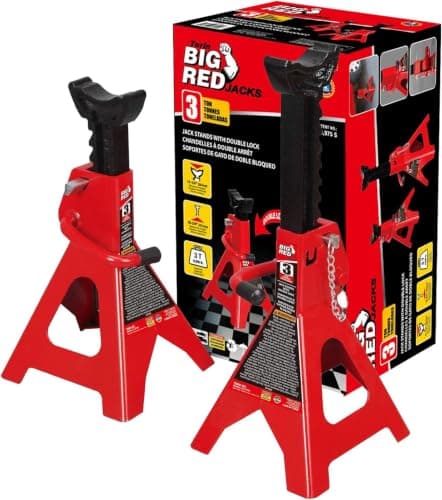
BIG RED Torin Double Locking Jack Stands (3 Ton)
Skip this one. Not a wrench, and on this page because the order of operations catches people out. Wheel nuts are loosened and finally tightened with the car's weight on the ground, not on stands — so the stands are for everything that happens in between, not for the torquing step itself. Buy them for working under a car; do not reach for the torque wrench while the wheel is still in the air.
Publishes a rated capacity, a height range, a base footprint and a stated double-lock design combining a ratchet bar with a separate removable safety pin. On equipment whose failure mode is a car falling on you, published figures are the entire purchase.
- Rated capacity
- 3 ton (6,000 lb)
- Height range
- 11.25 in to 16.75 in
- Base footprint
- 7.7 in x 6.9 in
- Locking
- Ratchet bar plus removable safety pin
- Standard
- Stated to meet ASME safety standards
- Material
- High-grade steel, welded frame
- Warranty
- 12 months limited
- List price
- Not published
What it gets right
- Double lock: a ratchet bar plus a separate removable locking pin, so the pawl is not the only thing holding the load
- Publishes rated capacity (3 ton / 6,000 lb per pair), height range (11.25 to 16.75 in) and base footprint (7.7 x 6.9 in)
- Stated to meet ASME safety standards
- Wide pyramid base, which is what resists tipping on an uneven surface
- Published 1-year limited warranty
Flaws
- Rated capacity is per pair on many listings and per stand on others — read the specific listing before assuming
- The ratchet-and-pin design gives coarse height steps, so leveling on an uneven floor takes packing
- Steel stands are heavy to move around
- A stand is only as safe as the jacking point you put it under, and that is your call not the product's
The working behind the 8.4
- Heat headroom: not scored (weight 22%)
- The maker publishes no operating-temperature ceiling, so this axis is dropped and the other weights are re-normalized.
- Install effort: 10.0 (weight 24%)
- Drops in and sits there. No fixing of any kind, and it comes out again when you sell the car.
- Price against the ceiling: not scored (weight 24%)
- No published list price we could cite on the compile date, so this axis is dropped and the other weights are re-normalized.
- Written commitment: 5.5 (weight 15%)
- 12-month warranty. This is the only promise in the entire listing that a court would read, which is why it is scored and the marketing copy is not.
- Spec transparency: 8.8 (weight 15%)
- 7 of the 8 specifications we went looking for are published by the maker (88%). A blank row is never a guess here: it prints “Not published” and it costs the product points, because a figure nobody will commit to in writing is a figure you cannot check.
Axes with no published input are dropped and the remaining weights re-normalized, so a product is not punished for a category where an axis does not apply. Specifications compiled September 4, 2026 from Torin BIG RED published capacity, dimensions and standards.
2The same published accuracy for less
EPAuto 1/2 in. Drive Click Torque Wrench
Publishes the same plus or minus 4% pre-calibrated accuracy over the same 10-150 ft-lb range, for meaningfully less money. On the published numbers there is nothing separating it from the TEKTON, which is worth saying plainly on a page about a category where price usually implies precision.
- Accuracy
- Plus or minus 4%, pre-calibrated
- Range
- 10-150 ft-lb
- Drive
- 1/2 inch
- Type
- Click
- Calibration interval
- Not published
- Warranty
- Not published
- List price
- Not published
What it gets right
- Published accuracy of plus or minus 4%, stated as pre-calibrated
- Published 10-150 ft-lb range on 1/2 in drive — the same working span as more expensive wrenches
- Supplied in a case, which is how a torque wrench should be stored
- The cheapest route to actually torquing lug nuts rather than guessing with a breaker bar
Flaws
- No published calibration certificate or traceability behind the stated accuracy
- Same storage rule as any click wrench: wind it back to the bottom of its range or it drifts
- Nothing published about recalibration service, so a drifted wrench is a replacement
- No warranty published
The working behind the 8.3
- Heat headroom: not scored (weight 22%)
- The maker publishes no operating-temperature ceiling, so this axis is dropped and the other weights are re-normalized.
- Install effort: 10.0 (weight 24%)
- Drops in and sits there. No fixing of any kind, and it comes out again when you sell the car.
- Price against the ceiling: not scored (weight 24%)
- No published list price we could cite on the compile date, so this axis is dropped and the other weights are re-normalized.
- Written commitment: not scored (weight 15%)
- No warranty term published, so this axis is dropped and the other weights are re-normalized.
- Spec transparency: 5.7 (weight 15%)
- 4 of the 7 specifications we went looking for are published by the maker (57%). A blank row is never a guess here: it prints “Not published” and it costs the product points, because a figure nobody will commit to in writing is a figure you cannot check.
Axes with no published input are dropped and the remaining weights re-normalized, so a product is not punished for a category where an axis does not apply. Specifications compiled September 4, 2026 from EPAuto click torque wrench published manual and specifications.
3A published accuracy figure
TEKTON 1/2 in. Drive Click Torque Wrench
Publishes an accuracy tolerance — plus or minus 4% — and a stated range, which together are the only two numbers that make a torque wrench a measuring instrument rather than a long ratchet. TEKTON publishes both across its range, including a tighter plus or minus 3% on some models.
- Accuracy
- Plus or minus 4%
- Range
- 10-150 ft-lb (13.6-203.5 Nm)
- Drive
- 1/2 inch
- Type
- Click, micrometer scale
- Calibration interval
- Not published
- Warranty
- Not published
- List price
- Not published
What it gets right
- Publishes accuracy as a percentage: plus or minus 4%, with plus or minus 3% on some models in the range
- Published range of 10-150 ft-lb (13.6-203.5 Nm), which brackets every lug nut spec on a passenger car
- 1/2 in drive, which is the size lug nut sockets come in
- Audible and tactile click rather than a scale you have to read at an angle in the dark
Flaws
- A click wrench must be wound back to its lowest setting for storage or the spring takes a set — nobody does this and it is why wrenches drift
- Accuracy figures are factory calibration; nothing published about how long that calibration holds
- Not a breaker bar — using it to loosen tight fasteners is how the mechanism gets damaged
- No warranty figure published alongside the accuracy claim
The working behind the 8.3
- Heat headroom: not scored (weight 22%)
- The maker publishes no operating-temperature ceiling, so this axis is dropped and the other weights are re-normalized.
- Install effort: 10.0 (weight 24%)
- Drops in and sits there. No fixing of any kind, and it comes out again when you sell the car.
- Price against the ceiling: not scored (weight 24%)
- No published list price we could cite on the compile date, so this axis is dropped and the other weights are re-normalized.
- Written commitment: not scored (weight 15%)
- No warranty term published, so this axis is dropped and the other weights are re-normalized.
- Spec transparency: 5.7 (weight 15%)
- 4 of the 7 specifications we went looking for are published by the maker (57%). A blank row is never a guess here: it prints “Not published” and it costs the product points, because a figure nobody will commit to in writing is a figure you cannot check.
Axes with no published input are dropped and the remaining weights re-normalized, so a product is not punished for a category where an axis does not apply. Specifications compiled September 4, 2026 from TEKTON published torque range and accuracy tolerance.
Prices last verified October 26, 2026. They move constantly; the figure on Amazon when you click is the real one.
Questions people actually ask
What torque should car wheel nuts be?
It is vehicle-specific and lives in your owner's manual — typically somewhere between 80 and 100 ft-lb on a passenger car, but varying by model and wheel. Do not use a figure from a forum for a different car.
Why should you wind a torque wrench back after use?
A click wrench works on a spring under compression. Stored at a high setting, that spring takes a permanent set and the wrench starts clicking early — so it under-tightens while you believe it is accurate. Wind it to the bottom of its scale after every use.
Can I use a torque wrench to loosen bolts?
No. Loosening a tight fastener loads the mechanism backwards and is the quickest way to damage one. Use a breaker bar to loosen and the torque wrench only for final tightening.
Should I put anti-seize on wheel studs?
Not unless the manufacturer specifies it. Torque figures assume clean dry threads; lubricant reduces thread friction so the same clicked torque produces much higher clamping load, which is how studs get stretched and snapped.