How to change a tire
Two rules cover the safety of the whole job: break the lug nuts loose before the wheel leaves the ground, and never put any part of yourself under a car on a jack.
By Sawyer V. · Published · How we research
We have not tested any of this. Everything below is compiled from published manufacturer specifications, and the arithmetic is printed so you can check it. This page carries affiliate links: if you buy through one we earn a commission at no extra cost to you, and it does not change the order of the picks. Full disclosure.
The short version
Break the lug nuts loose before the wheel leaves the ground, and never put any part of yourself under a car supported only by a jack. Those two rules cover the safety of the whole job. Use the jacking points identified in the owner's manual — modern cars have specific reinforced spots, and lifting anywhere else damages the car and can drop it. Then check the spare's pressure and the speed and distance limits printed on the wheel.
| # | Pick | Install | Score | Price |
|---|---|---|---|---|
| 1 | AstroAI Portable Tire Inflator (150 PSI) Topping up four tires in a driveway | Plugs in | 9.1/10 | $26.99 - view on Amazon |
| 2 | CARTMAN Warning Triangle Kit (3 pack) Being seen before someone hits you | Drops in | 8.9/10 | $27.99 - view on Amazon |
| 3 | Anker Bolder LC90 Flashlight A light that is not your phone | Drops in | 8.8/10 | Check price on Amazon |
| 4 | AstroAI Digital Tire Gauge (150 PSI) Knowing what your tires are actually at | Drops in | 8.4/10 | $6.99 - view on Amazon |
Prices last verified October 22, 2026. They move constantly; the figure on Amazon when you click is the real one.
Getting somewhere you can work
The surface matters more than the distance. A jack needs level, firm ground: on a slope the car can roll off it, and on soft ground or gravel the jack sinks and tips.
It is worth driving a short distance on a flat tire to reach somewhere safe. You will destroy the tire and possibly damage the wheel, and both are cheaper than the alternative. A shredded tire is a purchase; a car falling off a jack is not.
- Hazard lights on immediately
- As far off the carriageway as you can get, wheels straight
- Parking brake on, park or first gear
- Everyone out on the side away from traffic, behind a barrier if there is one
- Triangles out — best warning triangles and road flares
The jacking points, which are not obvious
This is the step most likely to go wrong on a modern car. Jacking points are specific reinforced locations, usually just behind the front wheels and just ahead of the rear ones, often marked by a notch, an arrow or a molding in the plastic sill trim.
Lifting anywhere else — the sill panel between the points, the floor pan, a suspension arm, a subframe edge — will bend metal, and a jack on a surface that deforms is a jack that can slip out.
The owner's manual has a diagram. Look at it now rather than at the roadside in the dark, and take thirty seconds to find your car's points while you are somewhere comfortable.
Why the nuts come loose before the lift
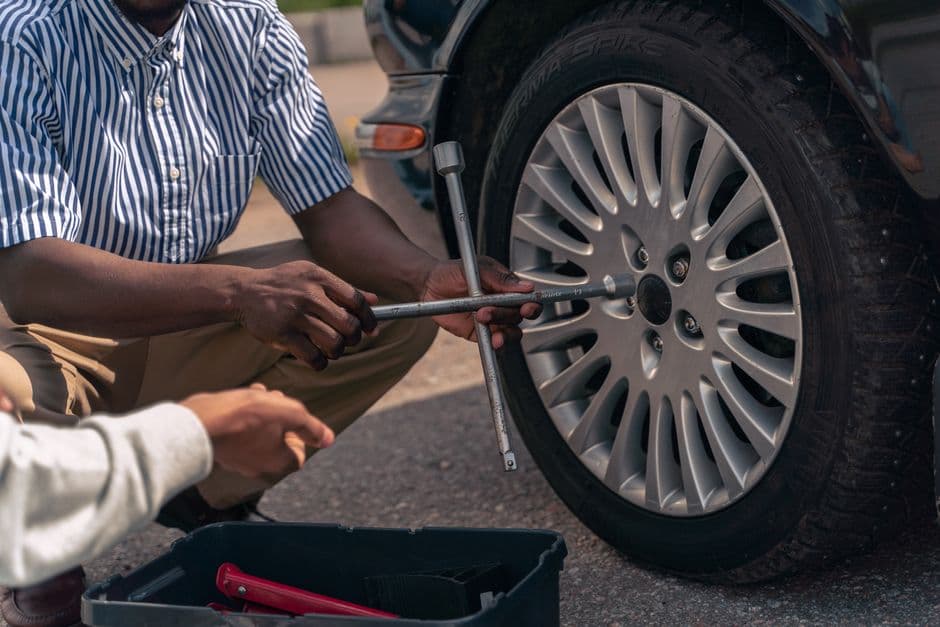
Lug nuts are tight, and loosening them takes real force. With the wheel on the ground, the tire's friction against the road holds it while you turn the wrench.
Once the wheel is in the air, nothing holds it. The wheel simply rotates, and you end up pushing hard against a car balanced on a jack — which is exactly the situation that shifts a jack.
A quarter turn each is enough. Do not remove them; just break them free. If a nut will not move, standing on the wrench with a foot is a common approach — but be aware that a wrench slipping under body weight is how people get hurt, so keep your face and hands clear.
The rule that has no exceptions
Never put any part of your body under a car supported only by a jack. Not an arm, not a leg, not your head. A jack is a lifting device, not a support device, and it can fail or slip.
The practical mitigation costs nothing: once the wheel is off, lay it flat under the sill near the jacking point. If the jack fails, the car drops onto the wheel rather than onto the ground — or onto you.
Also lift only as far as you need. An inch of clearance is plenty, and a car high on a narrow jack is less stable than one barely lifted.
The wheel under the sill is the roadside version of this rule. If you are working on a driveway rather than a highway shoulder, use proper stands and chock the wheels that stay down best jack stands and wheel chocks.
The star pattern, and what it is for
Tighten opposite nuts in sequence rather than going around the circle — on a five-stud wheel that means a star, on a four-stud wheel a criss-cross.
The reason is that a wheel has to seat flat against the hub. Tightening around the circle pulls one side down first and can cock the wheel very slightly, which produces a vibration at speed and uneven stress on the studs.
Do the final tightening with the wheel on the ground taking the car's weight. Fully torquing nuts while the wheel is still in the air pushes against a jacked car again, which is the thing to avoid.
Get the nuts checked with a proper torque wrench soon after. Under-tightened nuts can work loose; over-tightened ones stretch studs and are the reason a nut sometimes will not come off at the roadside at all.
The spare, and its limits
A space-saver spare is a temporary wheel with limits printed on it — commonly a speed limit around 50 mph and a distance limit. Those are on the wheel itself; read them before driving off.
Two other things people find out too late. A spare that has sat for years is very often well below usable pressure, so check it with a gauge — AstroAI publishes plus or minus 1 PSI, which is a stated accuracy figure almost nothing in that category offers. See best tire pressure gauges, or the review of the gauge itself for what that figure is worth.
And many cars no longer carry a spare at all — a sealant kit and an inflator is increasingly the factory provision. If that is your car, this page is not your procedure, and best tire repair kits is.
What makes this easier
- A flashlight, hands-free. Punctures happen at night. Anker publishes 900 lumens and IPX5 for the Bolder LC90 — best flashlights for a car
- Gloves. Wheels are filthy and hot, and brake dust is not something to have on your hands
- A gauge and an inflator, for the spare — best tire inflators
- A high-visibility vest, kept in the cabin so you can put it on before getting out
- A mat or a piece of cardboard to kneel on
Most of that is in a pre-packed kit — best emergency car kits. Keep the spare and jack accessible rather than buried under luggage, which is the recurring road-trip failure covered in how to pack a car for a road trip.
Every pick, with the working
Each entry lists the specifications the maker publishes, the axis scores those specifications produce, and what you give up. Rows that read “Not published” are not omissions on our side: they are things the maker will not commit to in writing, and they cost the product points on the transparency axis. Specifications compiled September 4, 2026.
Our pickTopping up four tires in a driveway
AstroAI Portable Tire Inflator (150 PSI)
150 PSI maximum, a digital gauge, and AstroAI's own published figure of a 195/65/R15 tire going 30 to 36 PSI in under a minute. It also publishes the duty cycle honestly: fifteen minutes of continuous use and then ten minutes of cooling. That duty cycle is the specification that separates a topping-up tool from a tire-filling one.
- Maximum pressure
- 150 PSI
- Power
- 12 V DC
- Duty cycle
- 15 minutes continuous, then 10 minutes cooling
- Published inflation rate
- 195/65/R15 from 30 to 36 PSI in under 1 minute
- Gauge
- Digital, automatic shutoff
- Warranty
- Not published
- Operating range
- Not published
List price $37.99 per AstroAI's own store, captured on the compile date below. Not a live price and not what you will pay — the button is where the real number is.
What it gets right
- Published inflation rate on a named tire size, which is the only useful way to state this figure
- Published duty cycle: 15 minutes on, 10 minutes cooling
- Digital gauge with automatic shutoff at the set pressure
- Around $32 to $38 depending on the model
Flaws
- 15 minutes of continuous running is four tires topped up, not one tire filled from flat
- 150 PSI is a headline number a passenger car will never approach
- 12V socket powered, so a car with the ignition off will run its battery down doing this
The working behind the 9.1
- Heat headroom: not scored (weight 22%)
- The maker publishes no operating-temperature ceiling, so this axis is dropped and the other weights are re-normalized.
- Install effort: 10.0 (weight 24%)
- Plugs into a 12V socket or a USB port. Nothing to mount, nothing to route, reversible in a second.
- Price against the ceiling: 9.5 (weight 24%)
- Listed at $37.99 on the compile date. This site's buyer has a practical ceiling around $150 for a single upgrade, so the scale rewards everything under $100 and falls away sharply past $150. The live price is very often different, and that is what the button is for.
- Written commitment: not scored (weight 15%)
- No warranty term published, so this axis is dropped and the other weights are re-normalized.
- Spec transparency: 7.1 (weight 15%)
- 5 of the 7 specifications we went looking for are published by the maker (71%). A blank row is never a guess here: it prints “Not published” and it costs the product points, because a figure nobody will commit to in writing is a figure you cannot check.
Axes with no published input are dropped and the remaining weights re-normalized, so a product is not punished for a category where an axis does not apply. Specifications compiled September 4, 2026 from AstroAI's 150 PSI tire inflator page.
2Being seen before someone hits you
CARTMAN Warning Triangle Kit (3 pack)
Built to FMVSS 571.125, which is a real federal standard with defined shape, size and performance requirements for roadside warning devices. In a category full of vague safety language, a named standard is the whole specification.
- Standard
- FMVSS 571.125 / 49 CFR Part 571.125
- Pack
- 3 triangles with case
- Visibility
- Reflective panels plus fluorescent plates
- Base
- Weighted non-skid
- Power
- None required
- Warranty
- Not published
- List price
- Not published
What it gets right
- Identical to the United States FMVSS 571.125 standard (49 CFR Part 571.125), which sets shape, size and performance requirements
- Reflective panels plus fluorescent plates, so they work in daylight and at night
- Weighted, non-skid bases that stay put in wind rather than blowing into traffic
- Sold as three, which is what the standard scenario actually calls for
- No battery, so it cannot be flat when you need it
Flaws
- Bulky compared with an LED flare, and they only fold so far
- Setting them out means walking back along a live carriageway, which is itself the dangerous part
- No published warranty term
The working behind the 8.9
- Heat headroom: not scored (weight 22%)
- The maker publishes no operating-temperature ceiling, so this axis is dropped and the other weights are re-normalized.
- Install effort: 10.0 (weight 24%)
- Drops in and sits there. No fixing of any kind, and it comes out again when you sell the car.
- Price against the ceiling: not scored (weight 24%)
- No published list price we could cite on the compile date, so this axis is dropped and the other weights are re-normalized.
- Written commitment: not scored (weight 15%)
- No warranty term published, so this axis is dropped and the other weights are re-normalized.
- Spec transparency: 7.1 (weight 15%)
- 5 of the 7 specifications we went looking for are published by the maker (71%). A blank row is never a guess here: it prints “Not published” and it costs the product points, because a figure nobody will commit to in writing is a figure you cannot check.
Axes with no published input are dropped and the remaining weights re-normalized, so a product is not punished for a category where an axis does not apply. Specifications compiled September 4, 2026 from CARTMAN warning triangle published standard compliance.
3A light that is not your phone
Anker Bolder LC90 Flashlight
900 lumens from a CREE LED, a published 6-hour runtime, IPX5 water resistance and five modes including strobe and SOS, on a rechargeable 18650. Using a phone as a flashlight at the roadside drains the one device you need to call for help, which is the entire argument for keeping a real one in the car.
- Output
- 900 lumens, CREE LED
- Runtime
- Up to 6 hours
- Ingress rating
- IPX5
- Modes
- High, medium, low, strobe, SOS
- Beam
- Zoomable
- Battery
- Rechargeable 18650, included
- Stated beam distance
- Over 660 ft
- Operating range
- Not published
What it gets right
- Published lumens (900), runtime (6 h) and ingress rating (IPX5) — all three, which is rare at this price
- Rechargeable 18650 included, so there is no scramble for AAs
- Zoomable from flood to spot, which covers both 'find the dropped bolt' and 'signal from the shoulder'
- SOS and strobe modes, which are exactly the modes a roadside light needs
Flaws
- IPX5 is rain resistance, not submersion. Fine for a breakdown, not for dropping in a puddle
- A lithium cell in a hot trunk self-discharges, so it needs charging on a schedule like the jump starter does
- 900 lumens on high for 6 hours is not the same as 900 lumens for 6 hours; brightness steps down between modes
The working behind the 8.8
- Heat headroom: not scored (weight 22%)
- The maker publishes no operating-temperature ceiling, so this axis is dropped and the other weights are re-normalized.
- Install effort: 10.0 (weight 24%)
- Drops in and sits there. No fixing of any kind, and it comes out again when you sell the car.
- Price against the ceiling: not scored (weight 24%)
- No published list price we could cite on the compile date, so this axis is dropped and the other weights are re-normalized.
- Written commitment: 7.0 (weight 15%)
- 18-month warranty. This is the only promise in the entire listing that a court would read, which is why it is scored and the marketing copy is not.
- Spec transparency: 8.8 (weight 15%)
- 7 of the 8 specifications we went looking for are published by the maker (88%). A blank row is never a guess here: it prints “Not published” and it costs the product points, because a figure nobody will commit to in writing is a figure you cannot check.
Axes with no published input are dropped and the remaining weights re-normalized, so a product is not punished for a category where an axis does not apply. Specifications compiled September 4, 2026 from Anker Bolder LC90 published specifications.
4Knowing what your tires are actually at
AstroAI Digital Tire Gauge (150 PSI)
0 to 150 PSI, factory calibrated to plus or minus 1 PSI, reading in 0.1 increments across four units with a backlit screen. The gas-station gauge you have been trusting is almost certainly worse than this, and this costs about the same as one tank of fuel.
- Range
- 0-150 PSI / 0-10 Bar / 0-10 Kgf/cm2 / 0-1000 kPa
- Accuracy
- Plus or minus 1 PSI
- Calibration standard
- ANSI B40.7, AstroAI UK listing only
- Resolution
- 0.1 PSI
- Display
- Backlit LCD, 4 selectable units
- Auto shut-off
- 30 seconds
- List price
- Not published
- Warranty
- 1 year, stated
What it gets right
- Published accuracy of plus or minus 1 PSI, stated in the listing title — almost nothing else in this category states an accuracy figure at all
- Reads to 0.1 PSI, which matters because a 3 PSI error is the difference between correct and noticeably underinflated
- Backlit screen, because tire pressures get checked in the dark more often than not
- Auto shut-off after 30 seconds, so the battery lasts
Flaws
- 150 PSI range is far beyond a passenger car, so the useful part of the scale is the bottom fifth
- A digital gauge has a battery, and a battery in a glovebox is a battery you will find dead
- It measures. It does not inflate — that is a separate tool
The working behind the 8.4
- Heat headroom: not scored (weight 22%)
- The maker publishes no operating-temperature ceiling, so this axis is dropped and the other weights are re-normalized.
- Install effort: 10.0 (weight 24%)
- Drops in and sits there. No fixing of any kind, and it comes out again when you sell the car.
- Price against the ceiling: not scored (weight 24%)
- No published list price we could cite on the compile date, so this axis is dropped and the other weights are re-normalized.
- Written commitment: 5.5 (weight 15%)
- 12-month warranty. This is the only promise in the entire listing that a court would read, which is why it is scored and the marketing copy is not.
- Spec transparency: 8.8 (weight 15%)
- 7 of the 8 specifications we went looking for are published by the maker (88%). A blank row is never a guess here: it prints “Not published” and it costs the product points, because a figure nobody will commit to in writing is a figure you cannot check.
Axes with no published input are dropped and the remaining weights re-normalized, so a product is not punished for a category where an axis does not apply. Specifications compiled September 4, 2026 from AstroAI 150 PSI gauge published specifications.
Prices last verified October 22, 2026. They move constantly; the figure on Amazon when you click is the real one.
Questions people actually ask
Can I drive on a flat tire to reach somewhere safe?
A short distance, yes, and accept you will destroy the tire and possibly the wheel. Both are cheaper than changing a wheel on a narrow shoulder or on soft ground where a jack can tip.
Why loosen the lug nuts before jacking?
With the wheel on the ground its friction against the road holds it while you turn the wrench. In the air the wheel just spins, and you end up pushing hard against a car balanced on a jack.
How fast can I drive on a space-saver spare?
The limits are printed on the wheel itself, commonly around 50 mph with a distance limit as well. Read them before driving off, and get the proper tire dealt with promptly.
What if a lug nut will not come off?
Usually it was over-torqued at a shop. A longer bar gives more leverage, and standing on the wrench is common — keep your face and hands clear in case it slips. If it will not move, call for assistance rather than damaging the stud.