Drop Stop seat gap filler review
It is two shaped pieces of neoprene for twenty-five dollars, and it is the pick on this site's gap filler page. Both of those things are true, and the second one is because of a slot.
By Sawyer V. · Published · How we research
We have not tested any of this. Everything below is compiled from published manufacturer specifications, and the arithmetic is printed so you can check it. This page carries affiliate links: if you buy through one we earn a commission at no extra cost to you, and it does not change the order of the picks. Full disclosure.
The verdict
Buy it, and buy it for the slot rather than the neoprene. The seat belt catch passes through a hole in the filler, so it anchors to the belt stalk and travels with the seat instead of being dragged loose every time you slide forward. That is the entire product, it is the one thing generic wedges do not copy, and it is why this is the pick on the gap filler page.
The honest objection is the price. Around $25 buys two shaped pieces of neoprene. Nothing about the materials justifies that. What you are paying for is the anchoring design and the fact that it does not need replacing — and the second half of that is a claim the company makes without a warranty term behind it.
| # | Pick | Install | Score | Price |
|---|---|---|---|---|
| 1 | Drop Stop Seat Gap Filler Never fishing a phone out of the seat rail again | Drops in | 9.3/10 | $24.99 - view on Amazon |
Prices last verified October 22, 2026. They move constantly; the figure on Amazon when you click is the real one.
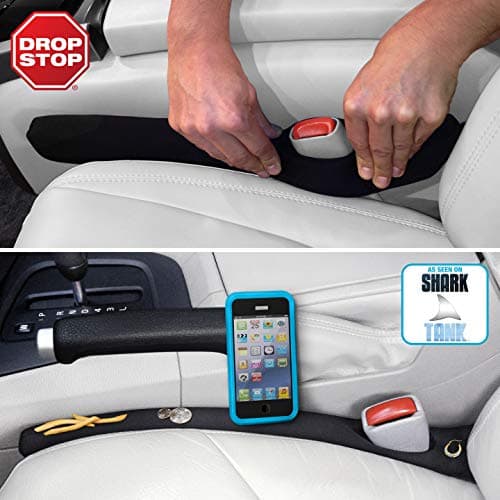
What it is, and what is actually in the box
Two long neoprene wedges, one for the driver side and one for the passenger side, each with a slot cut near one end that the seat belt catch passes through. The retail listing states each piece measures 17.95 by 5.04 by 2.6 inches and the pack weighs 0.7 lb.
The box also contains two things that are not gap fillers: a “Slide-Free Pad” and an LED credit card light. Neither is why anyone buys this, and neither is bad. The pad is a dashboard non-slip mat of the sort that costs a couple of dollars on its own; the card light is a novelty. If they vanished from the package tomorrow the product would be exactly as good, which is a reasonable way to judge a bonus item.
It is the pick on best car seat gap fillers and appears on ten pages across this site. It gets a page of its own because the thing that makes it work is a single design decision, and that decision deserves more than the paragraph a roundup can give it.
The slot is the product
The gap beside your seat is not a fixed-width slot. It exists because the seat has to slide through its full fore-and-aft travel, and the clearance changes shape as it does. That is the reason gap fillers fail.
A wedge works by friction: you press it into the gap and it stays until something moves. Then the seat slides, the gap narrows at one end and widens at the other, and the wedge gets squeezed up and out or dragged along the rail. Two weeks later it is sitting on top of the console and you have stopped noticing.
It is a genuinely good piece of design and it is almost comically simple. It is also the thing the copies get wrong: a foam wedge sold at a third of the price is solving the problem the way that does not work, and that is the entire difference between the two products.
What is published, and by whom
This is where the review turns, because there is less here than a product sold on being patented ought to have.
Drop Stop’s own website could not be reached while this review was written - the host refused the connection on the store home page and on the product and FAQ paths. Every figure below therefore comes from the retail listing, and this site has not tested the product.
| Specification | Retail listing | Maker's own site |
|---|---|---|
| Dimensions | 17.95 x 5.04 x 2.6 in | Unreachable |
| Weight | 0.7 lb per pack | Unreachable |
| Material | High grade neoprene casing | Unreachable |
| Quantity | 2, driver and passenger | Unreachable |
| Attachment | Built-in seat belt catch slot | Unreachable |
| Fit range | Not published - 'whatever size gap you have' | Unreachable |
| Patent number | Not published | Unreachable |
| Warranty field | '2' - unit not stated | Unreachable |
| Durability claim | 'lasts a lifetime' | Unreachable |
| Filling material | Not published | Unreachable |
“The Original Patented” - with no number
The word patented is in the product title. It is in the Walmart listing title. It is in nearly every piece of coverage written about the company since it appeared on Shark Tank. What is not anywhere a buyer would look is a patent number.
We checked three places: the maker’s own site, which was unreachable; the full retail listing, which uses the word patented twice and gives no number; and a general search, which surfaced retailer pages and press coverage all repeating the claim and none citing a number.
Be precise about what that does and does not mean. It is not evidence that no patent exists - a patent may well be registered and simply not advertised by number, which is common. What it means is that the central marketing claim of the product is not checkable by the person being asked to pay for it, and on a site whose whole method is checking published figures, that is worth saying out loud rather than repeating the word and moving on.
“Lasts a lifetime” against a warranty field that reads 2
The listing states, in the same bullet: “Drop Stop will never fall apart and lasts a lifetime.” The same listing’s warranty field contains a single character: 2. No unit. Not 2 years, not 2 months - just the number.
Those two statements are not compatible in any reading. A lifetime durability claim with a two-something warranty behind it is a promise in the marketing and a much shorter promise in the only part of the listing that would be read in a dispute.
In practical terms this matters less than it would on an expensive product. Neoprene with no moving parts is a material that genuinely does last, there is nothing to break, and the failure mode is cosmetic. But the durability claim is doing real work in justifying the price - the argument for $25 is that you buy it once - and the written commitment behind that argument is a field with an unexplained number in it.
What 18 inches covers, and what it does not
The 17.95 inch length is the figure to think about before buying, because it is the only published dimension that tells you anything about fit.
A front seat’s gap runs roughly the length of the seat base. Eighteen inches covers the part that matters - the stretch from the front of the seat cushion back past the belt catch, which is where a phone slides out of a pocket or off a lap. The listing’s claim of 100% gap coverage is specifically scoped to the area “in front of, surrounding & behind seat belt catch,” which is a narrower and more honest statement than the headline sounds.
What it does not cover is the far ends. If your console flares outward toward the rear, or your seat sits unusually far forward, items can still get past the back end of the filler. The neoprene is stated to contract and expand to fit whatever gap you have, but no minimum or maximum gap width is published, so there is no figure to check your own car against.
- Check the belt catch first. The slot has to line up with your buckle stalk. On most cars it does. On seats where the catch sits unusually low or is mounted on a short rigid stalk, the fit is tighter than the universal claim suggests
- Slide the seat through its full travel after fitting. All the way back, all the way forward. This is the thirty seconds that tells you whether it is going to work in your car
- Never let it block the buckle itself, a seat rail or a wiring connector. The gap contains the seat’s occupancy sensor and airbag wiring on many cars - the roundup sets out what must stay clear
Is twenty-five dollars defensible
Not on materials. Two shaped pieces of neoprene and a slot is not a twenty-five dollar bill of goods, and generic wedges sell for a third of it.
It is defensible on two other grounds, and only those. The first is that the cheap alternative does not work - not in the sense of working badly, but in the sense of solving the problem with a mechanism that the seat defeats within weeks. The second is that this is a buy-once item, which makes the comparison a single $25 against a sequence of eight-dollar wedges that keep migrating.
Both of those are fair. Neither makes it good value in the usual sense, and the review should not pretend otherwise. It is an expensive solution to a cheap problem, which is exactly what the under-$25 upgrades page says about it.
What this review cannot tell you
- What is inside it. The casing is stated to be high-grade neoprene. The filling is not described anywhere on the listing, and with the maker’s site unreachable there is nowhere else to check
- Whether it fits your gap. No minimum or maximum gap width is published by anyone. “One size fits most” is the only fitment statement available
- How long it actually lasts. The claim is a lifetime and the written term is a warranty field reading 2. Nobody publishes a figure that reconciles them
The verdict
It stays the pick, for the reason it was always the pick: the seat belt slot is the correct answer to a problem every other product in the category solves incorrectly. That is a real piece of design and it is worth paying for, once.
Buy it knowing what you are not getting. There is no patent number behind the word patented, no gap-width figure to check your car against, no description of what is inside it, and a lifetime durability claim with an unexplained warranty field behind it. None of that makes it a bad product. It makes it a product whose marketing is louder than its documentation, and on a twenty-five dollar purchase with no failure mode worse than cosmetic, that is a trade most people will reasonably take.
If the gap is one of several small annoyances rather than the only one, small fixes that declutter a car covers the rest of them, and how to organize your car is the systematic version.
Every pick, with the working
Each entry lists the specifications the maker publishes, the axis scores those specifications produce, and what you give up. Rows that read “Not published” are not omissions on our side: they are things the maker will not commit to in writing, and they cost the product points on the transparency axis. Specifications compiled September 4, 2026.
Our pickNever fishing a phone out of the seat rail again
Drop Stop Seat Gap Filler
A neoprene wedge that fills the gap between the seat and the center console, with a slot the seatbelt catch passes through. That slot is the patent and it is the reason this one stays put where generic wedges migrate. It is more expensive than it has any right to be, and it solves a problem that genuinely happens while you are driving.
- Material
- High grade neoprene casing
- Quantity
- 2 per pack, driver and passenger
- Dimensions
- 17.95 x 5.04 x 2.6 in, per the retail listing
- Weight
- 0.7 lb per pack, per the retail listing
- Fit method
- Expands and contracts to the gap; seatbelt slot anchors it
- Cleaning
- Liquid and stain resistant, wipe clean
- Warranty
- Listing's warranty field reads '2' with no unit, beside a 'lasts a lifetime' claim
- Patent number
- Not published
- Gap width range
- Not published
- Filling material
- Not published
List price $24.99 per Walmart listing, two-pack, captured on the compile date below. Not a live price and not what you will pay — the button is where the real number is.
What it gets right
- The seatbelt slot means it is anchored rather than wedged, which is the difference from every generic copy
- Neoprene expands and contracts to fit whatever gap your car has, so 'universal' is closer to true than usual
- Liquid and stain resistant, and it wipes clean
- Sold as a pair, so both front seats are covered
Flaws
- $25 to $40 for two pieces of shaped neoprene, depending entirely on where you buy
- It fills the gap, which also means the gap is no longer available for anything you wanted to put there
- Cars with an unusually wide gap or a console that flares will still see items get past the ends
The working behind the 9.3
- Heat headroom: not scored (weight 22%)
- The maker publishes no operating-temperature ceiling, so this axis is dropped and the other weights are re-normalized.
- Install effort: 10.0 (weight 24%)
- Drops in and sits there. No fixing of any kind, and it comes out again when you sell the car.
- Price against the ceiling: 10.0 (weight 24%)
- Listed at $24.99 on the compile date. This site's buyer has a practical ceiling around $150 for a single upgrade, so the scale rewards everything under $100 and falls away sharply past $150. The live price is very often different, and that is what the button is for.
- Written commitment: not scored (weight 15%)
- No warranty term published, so this axis is dropped and the other weights are re-normalized.
- Spec transparency: 7.0 (weight 15%)
- 7 of the 10 specifications we went looking for are published by the maker (70%). A blank row is never a guess here: it prints “Not published” and it costs the product points, because a figure nobody will commit to in writing is a figure you cannot check.
Axes with no published input are dropped and the remaining weights re-normalized, so a product is not punished for a category where an axis does not apply. Specifications compiled September 4, 2026 from Drop Stop published product description and materials.
Prices last verified October 22, 2026. They move constantly; the figure on Amazon when you click is the real one.
Questions people actually ask
Does the Drop Stop actually stay in place?
Yes, and it is the only thing it does differently. The seat belt catch passes through a built-in slot, so the filler is anchored to the belt stalk rather than wedged into the gap. The company states it “moves with seat, no need to readjust or reinstall.” Friction-fit wedges fail because the gap changes width as the seat slides; an anchored filler does not care.
Is the Drop Stop worth the money?
Not on materials - it is two shaped pieces of neoprene for about $25, and generic wedges cost a third of that. It is defensible on two other grounds: the cheap alternative uses a mechanism the seat defeats within weeks, and this is a buy-once item. Treat it as an expensive solution to a cheap problem that you only pay for once.
Is the Drop Stop patented?
The company says so - “patented” appears in the product title and across its retail listings. No patent number is published on the listing, and the maker's own website was unreachable when this review was written, so the claim is not checkable by a buyer. That is not evidence that no patent exists; it means the central marketing claim cannot be verified where you would go to verify it.
What size gap does the Drop Stop fit?
No minimum or maximum gap width is published. The listing says the neoprene “can contract or expand to fill whatever size gap you have” and that one size fits most vehicles from trucks to SUVs. Each piece measures 17.95 by 5.04 by 2.6 inches, which is the only fitment figure available. Check that the slot lines up with your seat belt catch and slide the seat through its full travel after fitting.
What comes in the Drop Stop package?
Two Drop Stops, one for the driver side and one for the passenger side, plus two bonus items: a Slide-Free Pad and an LED credit card light. Neither bonus is the reason to buy it. The pad is an ordinary dashboard non-slip mat and the light is a novelty.