The best car upgrades under $25
At this price the question is which categories are solved. Some genuinely are — a bin is a bin — and for those, paying more buys you almost nothing.
By Sawyer V. · Published · How we research
We have not tested any of this. Everything below is compiled from published manufacturer specifications, and the arithmetic is printed so you can check it. This page carries affiliate links: if you buy through one we earn a commission at no extra cost to you, and it does not change the order of the picks. Full disclosure.
The short answer
Buy a tire gauge and a bin first. The gauge is the cheapest instrument in the car and the only one whose entire job is accuracy — AstroAI publishes plus or minus 1 PSI, which almost nothing in the category states. The bin addresses what actually makes a car unpleasant. Then do the four free things, which beat everything on this page: set your driving position properly, clean the inside of the windshield, empty the car, and check your pressures.
| # | Pick | Install | Score | Price |
|---|---|---|---|---|
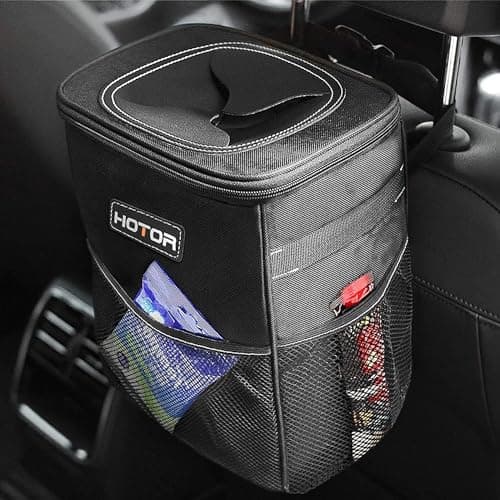
| 1 | HOTOR Car Trash Can (2 gallon) The cheapest fix for a permanently messy car | Drops in | 9.7/10 | $9.98 - view on Amazon |
| 2 | Drop Stop Seat Gap Filler Never fishing a phone out of the seat rail again | Drops in | 9.3/10 | $24.99 - view on Amazon |
| 3 | EcoNour Windshield Sun Shade The cheapest real temperature drop in the car | Drops in | 9.3/10 | $11.99 - view on Amazon |
| 4 | resqme Car Escape Tool Keeping an escape tool actually within reach | Drops in | 9.2/10 | $17.15 - view on Amazon |
| 5 | Amazon Basics Car Cup Holder Expander A bottle that does not fit the holder your car has | Drops in | 8.7/10 | Check price on Amazon |
| 6 | AstroAI Digital Tire Gauge (150 PSI) Knowing what your tires are actually at | Drops in | 8.4/10 | $6.99 - view on Amazon |
Prices last verified October 22, 2026. They move constantly; the figure on Amazon when you click is the real one.
Which categories are solved at this price
At twenty-five dollars the useful question is not which brand but which category. Some products are essentially solved down here — the physics is simple, the materials are cheap, and paying five times more buys you branding.
| Category | Solved at this price? | Why |
|---|---|---|
| Tire gauge | Yes | AstroAI publishes accuracy and a calibration standard |
| Bin | Yes | A lidded leakproof container is a simple object |
| Seat gap filler | Yes | Shaped foam with a belt slot |
| Escape tool | Yes | resqme is TUV certified at this price |
| Sun shade | Yes | Reflective material and folding structure |
| Dash cam | No | Heat ceiling and supercapacitor cost money |
| Jump starter | No | Cell quality and protection circuitry |
| Tire inflator | No | Duty cycle is the first thing cut |
The tire gauge, which is the best value object here
It is the cheapest instrument you can put in a car and the only one whose whole purpose is to be accurate. Everything else on a listing — backlight, units, grip — is convenience around a single number, and if that number is wrong the product has failed at its only job.
Which makes it genuinely odd how few publish an accuracy figure. AstroAI publishes plus or minus 1 PSI and 0.1 PSI resolution. Most competitors publish a pressure range and stop — and a range is not an accuracy claim, it is what the display can show. The gauge review goes through what that figure does and does not promise.
The reason it matters: TPMS typically warns only at around 25% below the recommended pressure — roughly 26 PSI on a 35 PSI target — by which point you have been driving underinflated for a long time. TPMS catches punctures; a gauge catches slow loss. Best tire pressure gauges.
The rest of the list
- A bin. Most of what makes a car unpleasant is rubbish, and rubbish accumulates because there is nowhere to put it. A leakproof lidded bin emptied on a schedule does more for how a car feels than any organizer — best car trash cans, and the one we recommend is reviewed in full in the HOTOR car trash can review
- A seat gap filler. The Drop Stop works because the seat belt catch passes through a slot in it, so it travels with the seat as it slides — which is why wedge fillers work loose and this one does not. Buy the pair — best car seat gap fillers
- A keyring escape tool. resqme is TUV certified, 2.93 in, and lives on your keys rather than in a glovebox you may not be able to reach. Check your side glass first — these break tempered and do nothing to laminated — best car escape tools
- A windshield sun shade. The highest-value summer purchase there is, addressing heat and UV on the largest glass area for less than a year of protectant — best windshield sun shades
- A cup holder expander, if you carry a large bottle. Amazon Basics publishes both fitment diameters, which the category rarely does — best cup holder organizers
The four free things, which beat all of it
On a budget page this is the most useful section, and it is worth doing before spending anything.
Set your driving position properly. Most cars have more adjustment than the driver has ever used — seat height and cushion tilt are the two least-touched controls, and they do what a wedge cushion does, built in. Ten minutes, and it changes every drive you take — how to set up your driving position.
Clean the inside of the windshield. Off-gassing interior plastics leave a film that scatters light, which is why oncoming headlights starburst at night and why the glass fogs so readily. Two microfiber cloths and glass cleaner. The first cloth will come away visibly dirty from glass that looked clean — how to clean car windows without streaks.
Empty the car. Everything out, including the trunk and the spare wheel well. Most of what makes a car feel cluttered is things nobody decided to keep — small fixes that declutter a car.
Check your tire pressures, cold, against the door jamb placard rather than the number on the tire sidewall — that one is a maximum, not a recommendation.
What not to buy at this price
A dash cam. The specification that decides whether footage exists is the published operating-temperature ceiling, and cheap cameras publish nothing. A parked car reaches 60-70 C, and a camera that failed in July looks identical to one that is working. The realistic entry point is under $100.
A jump starter. The whole product is a battery that must work once, in the cold, after months unused. Cell quality and protection circuitry are exactly what get cut — best portable jump starters.
A tire inflator. Duty cycle is the specification, and a unit that overheats partway through one tire has failed at its only job — best tire inflators.
A magnetic phone plate. The stick-on steel disc blocks wireless charging permanently and its adhesive fails on a hot dashboard while holding your phone. A magnetic case is the right answer — car accessories that are not worth buying.
If the budget stretches
The next tier up adds a phone mount, a decent 12V charger and a good E-marked USB-C cable — all three of which you use every journey. Best car upgrades under $50 and best car upgrades under $100.
And whatever your budget, the principle that survives every price tier is on how to choose car accessories that last: buy the thing whose maker publishes a number.
Every pick, with the working
Each entry lists the specifications the maker publishes, the axis scores those specifications produce, and what you give up. Rows that read “Not published” are not omissions on our side: they are things the maker will not commit to in writing, and they cost the product points on the transparency axis. Specifications compiled September 4, 2026.
Our pickThe cheapest fix for a permanently messy car
HOTOR Car Trash Can (2 gallon)
Two gallons, 7.9 by 5.5 by 10.2 inches, Oxford cloth over a waterproof PEVA lining, with four magnetic snaps holding the bag open and a strap that fastens it to a headrest or the console. A car gets cluttered because there is nowhere to put rubbish, and this is thirteen dollars of nowhere-to-put-rubbish solved.
- Capacity
- 2 gallons (3-gallon version also sold)
- Dimensions
- 7.9 x 5.5 x 10.2 in
- Weight
- 1.0 lb
- Outer material
- Oxford cloth
- Lining
- Waterproof PEVA
- Bag retention
- 4 magnetic snaps, 2 spare bags included
- Pockets
- 3 mesh
- Mounting
- Adjustable strap with quick-release buckle
- Warranty
- Not published
List price $12.99 per Walmart listing, 2-gallon, captured on the compile date below. Not a live price and not what you will pay — the button is where the real number is.
What it gets right
- Published dimensions and capacity, so you can check it against the space beside your seat
- PEVA waterproof lining — the difference between a bin and a stain when someone puts a coffee cup in it
- Four magnetic snaps hold a liner bag open, which is the detail that makes it usable one-handed while driving
- Strap and quick-release buckle, so it attaches to something rather than sliding around the footwell
Flaws
- Two gallons is small if you carry passengers who eat in the car; the 3-gallon version exists for that
- Soft-sided, so it needs to be strapped to something or it tips
- It only works if you empty it, which is the same problem as every bin ever made
The working behind the 9.7
- Heat headroom: not scored (weight 22%)
- The maker publishes no operating-temperature ceiling, so this axis is dropped and the other weights are re-normalized.
- Install effort: 10.0 (weight 24%)
- Drops in and sits there. No fixing of any kind, and it comes out again when you sell the car.
- Price against the ceiling: 10.0 (weight 24%)
- Listed at $12.99 on the compile date. This site's buyer has a practical ceiling around $150 for a single upgrade, so the scale rewards everything under $100 and falls away sharply past $150. The live price is very often different, and that is what the button is for.
- Written commitment: not scored (weight 15%)
- No warranty term published, so this axis is dropped and the other weights are re-normalized.
- Spec transparency: 8.9 (weight 15%)
- 8 of the 9 specifications we went looking for are published by the maker (89%). A blank row is never a guess here: it prints “Not published” and it costs the product points, because a figure nobody will commit to in writing is a figure you cannot check.
Axes with no published input are dropped and the remaining weights re-normalized, so a product is not punished for a category where an axis does not apply. Specifications compiled September 4, 2026 from the HOTOR 2-gallon listing — HOTOR's own product page publishes none of these figures.
2Never fishing a phone out of the seat rail again
Drop Stop Seat Gap Filler
A neoprene wedge that fills the gap between the seat and the center console, with a slot the seatbelt catch passes through. That slot is the patent and it is the reason this one stays put where generic wedges migrate. It is more expensive than it has any right to be, and it solves a problem that genuinely happens while you are driving.
- Material
- High grade neoprene casing
- Quantity
- 2 per pack, driver and passenger
- Dimensions
- 17.95 x 5.04 x 2.6 in, per the retail listing
- Weight
- 0.7 lb per pack, per the retail listing
- Fit method
- Expands and contracts to the gap; seatbelt slot anchors it
- Cleaning
- Liquid and stain resistant, wipe clean
- Warranty
- Listing's warranty field reads '2' with no unit, beside a 'lasts a lifetime' claim
- Patent number
- Not published
- Gap width range
- Not published
- Filling material
- Not published
List price $24.99 per Walmart listing, two-pack, captured on the compile date below. Not a live price and not what you will pay — the button is where the real number is.
What it gets right
- The seatbelt slot means it is anchored rather than wedged, which is the difference from every generic copy
- Neoprene expands and contracts to fit whatever gap your car has, so 'universal' is closer to true than usual
- Liquid and stain resistant, and it wipes clean
- Sold as a pair, so both front seats are covered
Flaws
- $25 to $40 for two pieces of shaped neoprene, depending entirely on where you buy
- It fills the gap, which also means the gap is no longer available for anything you wanted to put there
- Cars with an unusually wide gap or a console that flares will still see items get past the ends
The working behind the 9.3
- Heat headroom: not scored (weight 22%)
- The maker publishes no operating-temperature ceiling, so this axis is dropped and the other weights are re-normalized.
- Install effort: 10.0 (weight 24%)
- Drops in and sits there. No fixing of any kind, and it comes out again when you sell the car.
- Price against the ceiling: 10.0 (weight 24%)
- Listed at $24.99 on the compile date. This site's buyer has a practical ceiling around $150 for a single upgrade, so the scale rewards everything under $100 and falls away sharply past $150. The live price is very often different, and that is what the button is for.
- Written commitment: not scored (weight 15%)
- No warranty term published, so this axis is dropped and the other weights are re-normalized.
- Spec transparency: 7.0 (weight 15%)
- 7 of the 10 specifications we went looking for are published by the maker (70%). A blank row is never a guess here: it prints “Not published” and it costs the product points, because a figure nobody will commit to in writing is a figure you cannot check.
Axes with no published input are dropped and the remaining weights re-normalized, so a product is not punished for a category where an axis does not apply. Specifications compiled September 4, 2026 from Drop Stop published product description and materials.
3The cheapest real temperature drop in the car
EcoNour Windshield Sun Shade
240T polyester with a reflective coating and reinforced steel rings, in sizes from 53 by 30 up to 75 by 37 inches. EcoNour states its shades keep an interior up to 40 F cooler and block 99 percent of heat and UV. Those are the maker's own figures rather than an independent test, and even at half of them this is the best dollar-per-degree in the whole car.
- Material
- 240T polyester with reflective coating
- Frame
- Reinforced steel rings
- Sizes published
- 53x30, 59x29, 64x32, 66x27, 75x37 in
- Maker's temperature claim
- Up to 40 F cooler interior
- Maker's UV claim
- Blocks 99% of heat and UV
- Independent verification
- Not published
- Warranty
- Not published
List price $20.99 per EcoNour's own store, 53 x 30 in umbrella model, captured on the compile date below. Not a live price and not what you will pay — the button is where the real number is.
What it gets right
- Multiple published sizes, so you can actually match your windshield rather than fold a compromise
- Reinforced steel rings, which is what stops the frame collapsing after one summer
- Under $25 across most sizes
- Folds down small enough to live behind a seat rather than in the trunk
Flaws
- The 40 F figure is EcoNour's own claim, not an independent measurement, and the conditions behind it are not published
- You have to actually put it up every time, which is the real reason sun shades fail
- Sizing is on you: too small leaves a gap, too big will not sit flat
The working behind the 9.3
- Heat headroom: not scored (weight 22%)
- The maker publishes no operating-temperature ceiling, so this axis is dropped and the other weights are re-normalized.
- Install effort: 10.0 (weight 24%)
- Drops in and sits there. No fixing of any kind, and it comes out again when you sell the car.
- Price against the ceiling: 10.0 (weight 24%)
- Listed at $20.99 on the compile date. This site's buyer has a practical ceiling around $150 for a single upgrade, so the scale rewards everything under $100 and falls away sharply past $150. The live price is very often different, and that is what the button is for.
- Written commitment: not scored (weight 15%)
- No warranty term published, so this axis is dropped and the other weights are re-normalized.
- Spec transparency: 7.1 (weight 15%)
- 5 of the 7 specifications we went looking for are published by the maker (71%). A blank row is never a guess here: it prints “Not published” and it costs the product points, because a figure nobody will commit to in writing is a figure you cannot check.
Axes with no published input are dropped and the remaining weights re-normalized, so a product is not punished for a category where an axis does not apply. Specifications compiled September 4, 2026 from EcoNour's windshield sunshade range.
4Keeping an escape tool actually within reach
resqme Car Escape Tool
The one escape tool small enough to live on your keyring, which is the only place an escape tool is any use — a hammer in the glovebox is a hammer you cannot reach with a jammed belt across your chest. Spring-loaded, so it needs no swing.
- Height
- 2.93 in
- Materials
- ABS plastic and stainless steel
- Window breaker
- Spring-loaded stainless spike, resets after each use
- Belt cutter
- Stainless blade, rated for up to 100 seat belts
- Cut time
- Under 2 seconds (manufacturer figure)
- Certification
- TUV tested and certified
- Origin
- Made in USA
- Works on laminated glass
- No — tempered side glass only
- List price
- Not published
- Warranty
- Not published
What it gets right
- 2.93 inches tall and keyring-mounted, so it is on you rather than in a compartment you cannot reach
- Spring-loaded spike needs no room to swing, which matters when you are belted in
- Publishes a service life: one unit cuts up to 100 seat belts, and the spike resets after each use
- TUV tested and certified, and made in the USA
Flaws
- Breaks tempered side glass only. It will not touch a laminated side window, which is increasingly common on newer cars
- Small enough to lose, and a lost escape tool is no escape tool
- No published warranty term
The working behind the 9.2
- Heat headroom: not scored (weight 22%)
- The maker publishes no operating-temperature ceiling, so this axis is dropped and the other weights are re-normalized.
- Install effort: 10.0 (weight 24%)
- Drops in and sits there. No fixing of any kind, and it comes out again when you sell the car.
- Price against the ceiling: not scored (weight 24%)
- No published list price we could cite on the compile date, so this axis is dropped and the other weights are re-normalized.
- Written commitment: not scored (weight 15%)
- No warranty term published, so this axis is dropped and the other weights are re-normalized.
- Spec transparency: 8.0 (weight 15%)
- 8 of the 10 specifications we went looking for are published by the maker (80%). A blank row is never a guess here: it prints “Not published” and it costs the product points, because a figure nobody will commit to in writing is a figure you cannot check.
Axes with no published input are dropped and the remaining weights re-normalized, so a product is not punished for a category where an axis does not apply. Specifications compiled September 4, 2026 from resqme published specifications and certification.
5A bottle that does not fit the holder your car has
Amazon Basics Car Cup Holder Expander
Skip this one. The one here that solves a problem plenty of people do not have. It publishes both fitment diameters, which is more than the category norm, and it only earns its place if you actually carry a large insulated bottle. Everything else on this list earns its place in any car.
Publishes both numbers that decide whether it works: the bottle diameters it accepts and the cup holder diameters its base fits. Almost nothing in this category publishes either, and both have to be right.
- Bottle diameter held
- 3.4 to 3.8 in
- Base fit
- Adjustable to standard cup holders
- Adjustment
- Twist the top to expand or contract the base
- Known incompatibilities
- Several non-standard cup holder shapes
- Warranty
- Not published
- List price
- Not published
What it gets right
- Publishes the bottle diameter range it holds — 3.4 to 3.8 in — rather than listing brand names
- Adjustable base sized to standard cup holders, so it locks rather than rattles
- Turning the top expands or contracts the base, with no tools
- Solves a real problem: cup holders were sized before large insulated bottles existed
Flaws
- It costs you the cup holder it sits in, which is the whole trade
- Non-standard cup holder shapes defeat it — several common vehicles are specifically called out as incompatible
- A tall bottle in an expander sits high and can foul the gear selector or climate controls
The working behind the 8.7
- Heat headroom: not scored (weight 22%)
- The maker publishes no operating-temperature ceiling, so this axis is dropped and the other weights are re-normalized.
- Install effort: 10.0 (weight 24%)
- Drops in and sits there. No fixing of any kind, and it comes out again when you sell the car.
- Price against the ceiling: not scored (weight 24%)
- No published list price we could cite on the compile date, so this axis is dropped and the other weights are re-normalized.
- Written commitment: not scored (weight 15%)
- No warranty term published, so this axis is dropped and the other weights are re-normalized.
- Spec transparency: 6.7 (weight 15%)
- 4 of the 6 specifications we went looking for are published by the maker (67%). A blank row is never a guess here: it prints “Not published” and it costs the product points, because a figure nobody will commit to in writing is a figure you cannot check.
Axes with no published input are dropped and the remaining weights re-normalized, so a product is not punished for a category where an axis does not apply. Specifications compiled September 4, 2026 from Amazon Basics cup holder expander published specifications.
6Knowing what your tires are actually at
AstroAI Digital Tire Gauge (150 PSI)
0 to 150 PSI, factory calibrated to plus or minus 1 PSI, reading in 0.1 increments across four units with a backlit screen. The gas-station gauge you have been trusting is almost certainly worse than this, and this costs about the same as one tank of fuel.
- Range
- 0-150 PSI / 0-10 Bar / 0-10 Kgf/cm2 / 0-1000 kPa
- Accuracy
- Plus or minus 1 PSI
- Calibration standard
- ANSI B40.7, AstroAI UK listing only
- Resolution
- 0.1 PSI
- Display
- Backlit LCD, 4 selectable units
- Auto shut-off
- 30 seconds
- List price
- Not published
- Warranty
- 1 year, stated
What it gets right
- Published accuracy of plus or minus 1 PSI, stated in the listing title — almost nothing else in this category states an accuracy figure at all
- Reads to 0.1 PSI, which matters because a 3 PSI error is the difference between correct and noticeably underinflated
- Backlit screen, because tire pressures get checked in the dark more often than not
- Auto shut-off after 30 seconds, so the battery lasts
Flaws
- 150 PSI range is far beyond a passenger car, so the useful part of the scale is the bottom fifth
- A digital gauge has a battery, and a battery in a glovebox is a battery you will find dead
- It measures. It does not inflate — that is a separate tool
The working behind the 8.4
- Heat headroom: not scored (weight 22%)
- The maker publishes no operating-temperature ceiling, so this axis is dropped and the other weights are re-normalized.
- Install effort: 10.0 (weight 24%)
- Drops in and sits there. No fixing of any kind, and it comes out again when you sell the car.
- Price against the ceiling: not scored (weight 24%)
- No published list price we could cite on the compile date, so this axis is dropped and the other weights are re-normalized.
- Written commitment: 5.5 (weight 15%)
- 12-month warranty. This is the only promise in the entire listing that a court would read, which is why it is scored and the marketing copy is not.
- Spec transparency: 8.8 (weight 15%)
- 7 of the 8 specifications we went looking for are published by the maker (88%). A blank row is never a guess here: it prints “Not published” and it costs the product points, because a figure nobody will commit to in writing is a figure you cannot check.
Axes with no published input are dropped and the remaining weights re-normalized, so a product is not punished for a category where an axis does not apply. Specifications compiled September 4, 2026 from AstroAI 150 PSI gauge published specifications.
Prices last verified October 22, 2026. They move constantly; the figure on Amazon when you click is the real one.
Questions people actually ask
What is the best thing to buy under $25?
A tire gauge, because it is the cheapest instrument in the car and AstroAI publishes an accuracy figure and a calibration standard. A bin is the close second, since most of what makes a car unpleasant is rubbish.
Are cheap tire gauges accurate?
The ones that publish an accuracy figure are — AstroAI states plus or minus 1 PSI. Most competitors publish only a pressure range, which tells you what the display shows rather than how close to true it is.
Is a $20 dash cam worth it?
No. The specification that matters is the published heat ceiling, and cheap cameras publish none. A camera that stopped recording in summer looks exactly like one that is working, right up to the day you need it.
What can I do to improve my car for free?
Set your driving position properly, clean the inside of the windshield, empty the car out, and check your tire pressures cold against the door jamb placard. All four beat anything on this page.