The best headrest tablet mounts
Everyone compares these on the tablet sizes they hold. The number that actually decides whether one fits your car is the gap between your headrest posts.
By Sawyer V. · Published · How we research
We have not tested any of this. Everything below is compiled from published manufacturer specifications, and the arithmetic is printed so you can check it. This page carries affiliate links: if you buy through one we earn a commission at no extra cost to you, and it does not change the order of the picks. Full disclosure.
The short answer
Measure the gap between your headrest posts before buying anything. Tryone publishes a fit range of 4.7 to 5.9 inches between the two metal posts, and that spacing is not standardized between cars — it is the single most common reason one of these gets returned. Tablet size range matters far less; both mounts here cover 4.7 to 12.9 inches, which is every mainstream tablet.
| # | Pick | Install | Score | Price |
|---|---|---|---|---|
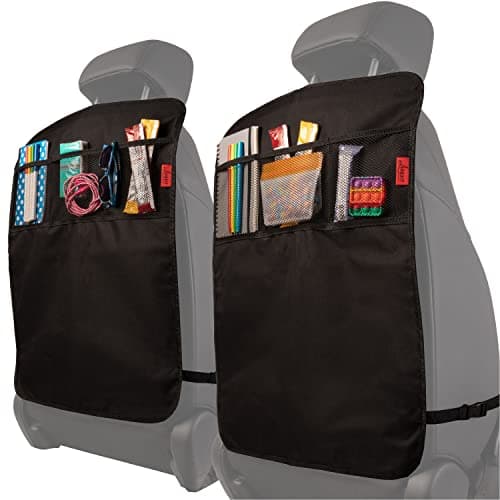
| 1 | Lusso Gear Backseat Organizer Kick Mat The back of a front seat with a child behind it | Drops in | 9.5/10 | $19.99 - view on Amazon |
| 2 | Tryone Car Headrest Tablet Holder Publishing the measurement that decides whether it fits | Clips on | 8.1/10 | $18.99 - view on Amazon |
| 3 | LISEN Car Headrest Tablet Mount A telescopic frame rather than a single arm | Clips on | 7.5/10 | $17.99 - view on Amazon |
Prices last verified October 26, 2026. They move constantly; the figure on Amazon when you click is the real one.
The measurement nobody checks
Headrest posts are the two metal stalks the headrest slides down into the seat on. A headrest mount clamps to one or both of them.
The spacing between those posts varies by manufacturer, by model and sometimes between front seats and rear. There is no standard. A mount built for a 4.7 to 5.9 inch gap will not fit a car whose posts sit wider or narrower, no matter how good the mount is.
Tryone publishes that range. LISEN does not publish one at all, which on a product whose fitment depends on it is a real gap.
What the two publish
| Tryone | LISEN | |
|---|---|---|
| Device size range | 4.7-12.9 in | 4.7-12.9 in |
| Headrest post spacing | 4.7-5.9 in | Not published |
| Stated load | 5 lb | 40 lb |
| Arm extension | Up to 10.6 in | Retractable, no figure |
| Structure | Single arm, 360 rotation | Triangular telescopic frame |
| Folds away | Foldable | Foldable |
| Warranty | Not published | Not published |
Tryone's 5 lb figure is plausible for a clamp on a headrest post, and it is generous for the job — a 12.9 inch tablet in a case is around 1.5 lb.
LISEN's 40 lb is eight times that on comparable hardware. Nothing about the physical construction supports a figure that size, and no test method is published. Treat it as marketing rather than as a load rating; the frame is the reason to consider the product, not the number.
The part that deserves a clear statement
Anything mounted behind a seat is an unrestrained object in the cabin, and a tablet is not a light one.
In a collision, loose objects continue at the speed the car was doing. A 1.5 lb tablet at highway speed carries a great deal of energy, and it is mounted directly in front of a passenger's face — usually a child's, since that is who these are bought for.
This is not a reason never to use one. It is a reason to be deliberate:
- Take it down when it is not in use. Both mounts here fold; use that. An empty mount is a much smaller object than a mounted tablet
- Check the clamp is actually tight before every trip, not just after fitting. Vibration loosens clamps
- Keep the arm short. Extending it fully puts the mass furthest from the clamp, which is worse both for sag and for what happens in a stop
- Do not mount anything on a front headrest facing forward. That is an object between a passenger and the airbag
The same logic applies to everything carried loose in a cabin, and it is the argument behind how to stop things sliding in your trunk.
Single arm against frame
The two products here take genuinely different structural approaches and the trade is real.
- Single arm clamps to one post and cantilevers the tablet out on a gooseneck or jointed arm. Very adjustable — Tryone publishes 360 degree rotation and up to 10.6 inches of extension — and it sags over time, because all the load is on one clamp at the end of a lever
- Triangular frame spans both posts and braces against them. Far more rigid and much less prone to sag. It also blocks more of the rear view and offers less positioning freedom
For one child watching one screen, the frame is the better engineering. For a mount that gets moved between positions and cars, the arm is more practical.
What it costs you out of the back window
A tablet on a headrest sits directly in the line between your center mirror and the rear window. A frame mount blocks more of it than an arm.
On a car where the center mirror is already doing limited work — a packed trunk, a load above the parcel shelf, a rear headrest up — this can be the thing that removes your rearward view entirely.
Two mitigations. Fold the mount away when it is not in use, which solves it completely. Or accept that the mirror is compromised and lean harder on door mirrors, which have their own setup problem — best blind spot mirrors has the free adjustment that fixes most of it.
The rest of the back-seat problem
A tablet mount solves one thing. Families buying one usually have three other problems in the same footwell.
Kicked seat backs, which a kick mat solves for a few dollars — best backseat organizers and kick mats. Charging, because a tablet on a long drive needs power and the rear sockets are usually nonexistent — best multi-port car chargers. And everything else that makes a back seat survivable with children in it — best car accessories for families.
For a phone rather than a tablet, and for the driver rather than the passengers, the field is in best car phone mounts.
If what you actually want is a surface rather than a screen holder, the folding trays clamp to the same posts and publish their own set of load figures — which vary by a factor of two across identical hardware — best car seat back tables.
Every pick, with the working
Each entry lists the specifications the maker publishes, the axis scores those specifications produce, and what you give up. Rows that read “Not published” are not omissions on our side: they are things the maker will not commit to in writing, and they cost the product points on the transparency axis. Specifications compiled September 4, 2026.
Our pickThe back of a front seat with a child behind it
Lusso Gear Backseat Organizer Kick Mat
The only product in this section with a lifetime warranty attached to it, which on a fabric item that lives under a child's shoes is the specification that matters. Waterproof Oxford, machine washable, and it covers the seat back rather than hanging a pouch on it.
- Dimensions
- 19 x 25 in
- Material
- Waterproof Oxford fabric
- Pockets
- 3 or 4 mesh depending on model
- Washable
- Machine washable
- Warranty
- Lifetime (published as a brand-wide term)
- Pack size
- 2
- List price
- Not published
What it gets right
- Lifetime warranty published on every Lusso Gear accessory — nothing else in this category commits in writing
- Waterproof Oxford fabric and machine washable, which is the actual failure mode for a kick mat
- Reinforced corners specifically to stop the sag that makes cheap kick mats useless
- Sold as a pair, which is what a car with two front seats needs
Flaws
- 19 x 25 in covers a typical seat back and no more — a tall SUV seat back will show a gap
- Mesh pockets hold light items; a full water bottle in a mesh pocket sags into a knee
- Straps go around the headrest, so a seat with fixed headrests is awkward
The working behind the 9.5
- Heat headroom: not scored (weight 22%)
- The maker publishes no operating-temperature ceiling, so this axis is dropped and the other weights are re-normalized.
- Install effort: 10.0 (weight 24%)
- Drops in and sits there. No fixing of any kind, and it comes out again when you sell the car.
- Price against the ceiling: not scored (weight 24%)
- No published list price we could cite on the compile date, so this axis is dropped and the other weights are re-normalized.
- Written commitment: not scored (weight 15%)
- No warranty term published, so this axis is dropped and the other weights are re-normalized.
- Spec transparency: 8.6 (weight 15%)
- 6 of the 7 specifications we went looking for are published by the maker (86%). A blank row is never a guess here: it prints “Not published” and it costs the product points, because a figure nobody will commit to in writing is a figure you cannot check.
Axes with no published input are dropped and the remaining weights re-normalized, so a product is not punished for a category where an axis does not apply. Specifications compiled September 4, 2026 from Lusso Gear kick mat published specifications.
2Publishing the measurement that decides whether it fits
Tryone Car Headrest Tablet Holder
Publishes the headrest post spacing it fits — and that, not the tablet size, is the number that determines whether this mount works in your car. It also publishes a 5 lb device limit, which is a believable figure for a clamp on a headrest arm.
- Device size range
- 4.7 to 12.9 in
- Device weight limit
- 5 lb
- Headrest post spacing
- 4.7 to 5.9 in
- Arm extension
- Up to 10.6 in
- Warranty
- Not published
- List price
- Not published
What it gets right
- Publishes headrest post spacing: fits 4.7 to 5.9 in between the two metal posts
- Publishes a device weight limit of 5 lb, which is a plausible number rather than a fantasy one
- Published device range of 4.7 to 12.9 in covers every mainstream tablet and phone
- Arm extends to a stated 10.6 in and rotates 360 degrees
Flaws
- Headrest post spacing is not standard between cars — measure before buying, because this is the failure mode
- Anything mounted to a headrest is a loose object in a collision; a tablet is not a light one
- Extending the arm fully puts the load furthest from the clamp, which is where sag starts
- No warranty published
The working behind the 8.1
- Heat headroom: not scored (weight 22%)
- The maker publishes no operating-temperature ceiling, so this axis is dropped and the other weights are re-normalized.
- Install effort: 9.0 (weight 24%)
- Clips onto a vent blade or a headrest post. Two minutes, no tools, no adhesive, no residue.
- Price against the ceiling: not scored (weight 24%)
- No published list price we could cite on the compile date, so this axis is dropped and the other weights are re-normalized.
- Written commitment: not scored (weight 15%)
- No warranty term published, so this axis is dropped and the other weights are re-normalized.
- Spec transparency: 6.7 (weight 15%)
- 4 of the 6 specifications we went looking for are published by the maker (67%). A blank row is never a guess here: it prints “Not published” and it costs the product points, because a figure nobody will commit to in writing is a figure you cannot check.
Axes with no published input are dropped and the remaining weights re-normalized, so a product is not punished for a category where an axis does not apply. Specifications compiled September 4, 2026 from Tryone published device range, weight limit and headrest spacing.
3A telescopic frame rather than a single arm
LISEN Car Headrest Tablet Mount
Skip this one. The triangular frame is genuinely a better geometry than a single arm and it resists sag. The published 40 lb load rating is the problem — that is eight times the figure Tryone publishes for a comparable headrest clamp, on hardware doing the same job. A capacity claim that far out of line with the category, on a product that will hold a 1 lb tablet, tells you the number was not measured. Buy it for the frame, discount the rating entirely.
A triangular telescopic structure that braces against both headrest posts instead of hanging off one, which is a genuinely better geometry for holding a tablet steady. The published 40 lb load figure, on the other hand, is not a number to take seriously on a headrest clamp.
- Device size range
- 4.7 to 12.9 in
- Stated load
- 40 lb (manufacturer claim)
- Headrest post spacing
- Not published
- Structure
- Triangular telescopic, spans both posts
- Warranty
- Not published
- List price
- Not published
What it gets right
- Triangular telescopic frame spans both posts, which resists the sag a single-arm mount develops
- Published device range of 4.7 to 12.9 in, the same span as the competition
- Retractable length adjusts to different post spacings rather than fitting one range
- Folds flat when not in use rather than living permanently in the passenger's view
Flaws
- The published 40 lb capacity is eight times the competition's figure for a similar clamp — treat it as marketing, not as a load rating
- No published headrest post spacing range, which is the measurement that actually decides fitment
- Frame mounts block more of the rear view than a single arm does
- No warranty published
The working behind the 7.5
- Heat headroom: not scored (weight 22%)
- The maker publishes no operating-temperature ceiling, so this axis is dropped and the other weights are re-normalized.
- Install effort: 9.0 (weight 24%)
- Clips onto a vent blade or a headrest post. Two minutes, no tools, no adhesive, no residue.
- Price against the ceiling: not scored (weight 24%)
- No published list price we could cite on the compile date, so this axis is dropped and the other weights are re-normalized.
- Written commitment: not scored (weight 15%)
- No warranty term published, so this axis is dropped and the other weights are re-normalized.
- Spec transparency: 5.0 (weight 15%)
- 3 of the 6 specifications we went looking for are published by the maker (50%). A blank row is never a guess here: it prints “Not published” and it costs the product points, because a figure nobody will commit to in writing is a figure you cannot check.
Axes with no published input are dropped and the remaining weights re-normalized, so a product is not punished for a category where an axis does not apply. Specifications compiled September 4, 2026 from LISEN published device range, structure and stated load.
Prices last verified October 26, 2026. They move constantly; the figure on Amazon when you click is the real one.
Questions people actually ask
Will a headrest tablet mount fit my car?
Measure center-to-center between your headrest posts first. Tryone publishes a fit range of 4.7 to 5.9 inches; spacing is not standardized between cars. Also check the posts are exposed — integrated headrests with no visible posts take no clamp mount.
Are headrest tablet mounts safe in a crash?
A mounted tablet is an unrestrained object directly in front of a passenger, usually a child. Fold the mount away when it is not in use, keep the arm short, check the clamp regularly, and never mount anything on a front headrest facing forward into an airbag zone.
Can a headrest mount really hold 40 lb?
Treat that claim with caution. It is eight times the figure Tryone publishes for comparable hardware, with no test method stated. The tablet you are mounting weighs around 1.5 lb, so the rating is not the deciding factor either way.
Single arm or frame mount?
A frame spanning both posts is more rigid and sags less; a single arm is far more adjustable and blocks less of the rear window. For one fixed viewing position the frame is better engineering, for flexibility the arm wins.