The best blind spot mirrors
There is a federal standard defining what a convex car mirror must be. Nothing you can stick onto one is built to it, and none of them publish the number.
By Sawyer V. · Published · How we research
We have not tested any of this. Everything below is compiled from published manufacturer specifications, and the arithmetic is printed so you can check it. This page carries affiliate links: if you buy through one we earn a commission at no extra cost to you, and it does not change the order of the picks. Full disclosure.
The short answer
Adjust your existing mirrors properly before buying anything. Most blind spots are a mirror-aiming problem, not a mirror-size problem, and the fix is free. If you still want a convex add-on, know what you are buying: FMVSS 111 requires the driver's-side mirror on a US passenger car to be flat, specifies a radius of curvature of 889 to 1651 mm for factory convex mirrors, and requires them to carry the "objects are closer than they appear" marking. No stick-on mirror publishes a curvature figure at all.
| # | Pick | Install | Score | Price |
|---|---|---|---|---|
| 1 | WeatherTech Side Window Deflectors Cracking the windows in the rain | Clips on | 8.3/10 | $136.95 - view on Amazon |
| 2 | Ampper 2 in. Round Blind Spot Mirror An adjustable swivel rather than a fixed stick-on | Adhesive | 5.9/10 | $6.99 - view on Amazon |
| 3 | Utopicar Frameless Blind Spot Mirror More glass, which is the only lever that actually helps | Adhesive | 5.3/10 | $12.99 - view on Amazon |
Prices last verified October 26, 2026. They move constantly; the figure on Amazon when you click is the real one.
The free fix, first
Most drivers set their door mirrors so they can see the side of their own car. That feels correct and it is the cause of the blind spot, because the side of your car is the one thing you never need to look at while driving.
Aimed outward, the door mirrors pick up the lane beside you and hand off to peripheral vision as a vehicle passes. Done properly, a car moving up your side goes from the center mirror, into the door mirror, and into your peripheral view without ever fully disappearing.
- Set the center mirror first, framing the rear window
- Lean your head against the driver's window, then set the left mirror outward until you can just barely see the side of your car
- Lean the same distance to the right, over the console, and set the right mirror the same way
- Sit normally. You will see almost none of your own car, which is correct and will feel wrong for about a week
- Test it in traffic. Watch a car overtake and confirm it never vanishes between mirrors
This is free, reversible, and fixes the problem for a large proportion of people who come looking for a stick-on mirror. Do it first.
What the federal standard actually says
FMVSS 111 governs rear visibility on US vehicles, and what it specifies is directly relevant to anything you stick onto a mirror.
- The driver's-side outside mirror must be unit magnification — that is, a plane or flat mirror. FMVSS 111 does not permit a convex mirror as the driver's-side outside mirror on a passenger car
- The passenger side may be convex, and if it is, it must be permanently marked "Objects in Mirror Are Closer Than They Appear" in letters not less than 4.8 mm nor more than 6.4 mm high
- A factory convex mirror's average radius of curvature must be not less than 889 mm and not more than 1651 mm
What the products do publish
| Utopicar frameless | Ampper 2 in round | |
|---|---|---|
| Size | 2.75 x 1.75 in | 2 in diameter |
| Radius of curvature | Not published | Not published |
| Field of view | Not published | Not published |
| Construction | Frameless | Frameless, ultra-thin |
| Adjustment | Fixed once stuck | 360 degree swivel |
| Ingress rating | Not published | IP65 |
| Adhesive | Outdoor-rated | 3M |
Utopicar states images appear "three times larger" than the average blind spot mirror. That is a comparison against unnamed products rather than a measurement, and it is the closest anything in this category comes to quantifying what it does.
The one genuinely useful lever is glass area, and Utopicar has more of it — 2.75 by 1.75 inches against a 2 inch circle. On a device whose job is showing you more, that is the specification that survives.
Where to stick it, and what it costs you
A stick-on mirror does not add glass to your door mirror. It covers part of it. That trade is the thing to get right.
- Outer top corner is the usual placement — the part of the mirror showing the most sky and the least useful road
- Aim it at the lane you cannot see, roughly rearward and outward, before the adhesive sets. Ampper's swivel bracket is genuinely useful here because it lets you correct the aim afterwards; a fixed frameless mirror does not
- Sit in your normal driving position to aim it. Aiming a mirror while standing beside the car produces an aim that is wrong from the seat
- Clean and degrease the glass first. Adhesive on a waxed or dirty mirror releases in the first cold snap
And accept the interference: a convex element on a mirror the federal standard requires to be flat means your driver's-side mirror now has two magnifications in it. Some drivers adapt quickly. Some find the discontinuity worse than the blind spot, and the honest answer is that you will not know which you are until you try it.
Reading a convex image
The reason factory convex mirrors carry a legally mandated warning is that the distortion is not intuitive.
A convex mirror compresses a wide view into a small area, so everything in it appears smaller and therefore further away than it is. A car that looks comfortably back in a convex mirror can be alongside you.
The practical rule: use the convex section to detect that something is there, and use the flat section or a shoulder check to judge where it is. Detection and distance are two different jobs and the convex element is only good at one of them.
The alternatives worth knowing
Blind spot monitoring systems — the ones with a light in the door mirror — are radar-based and factory fitted. Aftermarket versions exist and are a real installation job well outside what this site covers.
What else actually helps, cheaply:
A clean rear window and clean mirrors, because most visibility complaints are a film problem rather than a geometry one — how to clean car windows without streaks. A clear view out of the back, which for most cars means not stacking luggage above the parcel shelf — how to pack a car for a road trip. And for reversing specifically, a camera does far more than any mirror — best backup cameras.
Glare is the other thing people mistake for a visibility problem, and it has its own set of fixes — how to stop glare while driving.
Every pick, with the working
Each entry lists the specifications the maker publishes, the axis scores those specifications produce, and what you give up. Rows that read “Not published” are not omissions on our side: they are things the maker will not commit to in writing, and they cost the product points on the transparency axis. Specifications compiled September 4, 2026.
Our pickCracking the windows in the rain
WeatherTech Side Window Deflectors
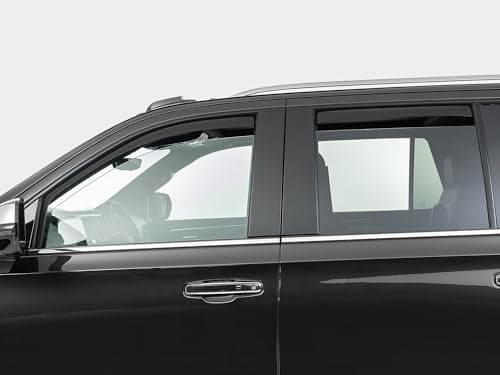
Skip this one. Not a mirror, and on this page because it is the other thing people add to a door mirror area — and because it demonstrates the contrast. WeatherTech publishes a material, a thickness and a stated DOT-approved glazing material for its deflectors. The blind spot mirror category, sitting on the same door, publishes no curvature and no field of view at all.
The only deflector that states it uses a DOT-approved glazing material, in 3 mm UV-treated acrylic cut to the specific vehicle. On a part that sits in your side vision permanently, the glazing claim is the one worth having.
- Material
- 3 mm lightly tinted acrylic
- Glazing
- US DOT-approved glazing material
- UV
- UV treated against fading
- Fit
- Vehicle-specific, in-channel
- Tint options
- Light or dark smoke
- Warranty
- Not published
- List price
- Not published
What it gets right
- The only deflectors stated to use a US DOT-approved glazing material
- 3 mm acrylic with a UV treatment, so it does not haze and yellow the way cheap film-thin deflectors do
- Cut to the vehicle's exact window channel rather than taped to the outside of the door
- Lets you leave windows cracked in rain, which is the single most useful thing they do for cabin heat
Flaws
- In-channel fitment means they sit in the window run — if fitted badly they can affect how the glass seats
- Vehicle-specific, so worthless when you change cars
- They are in your side field of view permanently, and a dark tint option makes that worse
- No published warranty term
The working behind the 8.3
- Heat headroom: not scored (weight 22%)
- The maker publishes no operating-temperature ceiling, so this axis is dropped and the other weights are re-normalized.
- Install effort: 9.0 (weight 24%)
- Clips onto a vent blade or a headrest post. Two minutes, no tools, no adhesive, no residue.
- Price against the ceiling: not scored (weight 24%)
- No published list price we could cite on the compile date, so this axis is dropped and the other weights are re-normalized.
- Written commitment: not scored (weight 15%)
- No warranty term published, so this axis is dropped and the other weights are re-normalized.
- Spec transparency: 7.1 (weight 15%)
- 5 of the 7 specifications we went looking for are published by the maker (71%). A blank row is never a guess here: it prints “Not published” and it costs the product points, because a figure nobody will commit to in writing is a figure you cannot check.
Axes with no published input are dropped and the remaining weights re-normalized, so a product is not punished for a category where an axis does not apply. Specifications compiled September 4, 2026 from WeatherTech Side Window Deflectors published specifications.
2An adjustable swivel rather than a fixed stick-on
Ampper 2 in. Round Blind Spot Mirror
Publishes a diameter, an ingress rating and an adjustment mechanism, which is more than most of this category manages. What it does not publish — and nor does anyone else — is a radius of curvature, which is the number the federal standard uses to define a legal convex mirror.
- Size
- 2 in diameter, round
- Adjustment
- 360 degree swivel bracket
- Ingress rating
- IP65
- Adhesive
- 3M
- Radius of curvature
- Not published
- Field of view
- Not published
- List price
- Not published
What it gets right
- Published 2 in diameter and a frameless, ultra-thin profile that sits close to the host mirror
- Adjustable swivel bracket with 360 degree rotation, so the aim can be corrected after sticking it down
- Published IP65 rating and stated rust-resistant, non-hazing glass
- 3M adhesive base rather than an unbranded pad
Flaws
- No published radius of curvature, so its magnification cannot be compared with anything, including the federal 889-1651 mm range for factory convex mirrors
- No published field-of-view figure — the entire reason the product exists is unquantified
- Adhesive mounting on a heated, vibrating, ice-scraped surface is a wear item
- 2 in is small; the whole image lives in a circle the size of a bottle cap
The working behind the 5.9
- Heat headroom: not scored (weight 22%)
- The maker publishes no operating-temperature ceiling, so this axis is dropped and the other weights are re-normalized.
- Install effort: 6.0 (weight 24%)
- Adhesive pad onto the dashboard. Permanent in practice: repositioning means a new pad, and the pad is the part that fails first.
- Price against the ceiling: not scored (weight 24%)
- No published list price we could cite on the compile date, so this axis is dropped and the other weights are re-normalized.
- Written commitment: not scored (weight 15%)
- No warranty term published, so this axis is dropped and the other weights are re-normalized.
- Spec transparency: 5.7 (weight 15%)
- 4 of the 7 specifications we went looking for are published by the maker (57%). A blank row is never a guess here: it prints “Not published” and it costs the product points, because a figure nobody will commit to in writing is a figure you cannot check.
Axes with no published input are dropped and the remaining weights re-normalized, so a product is not punished for a category where an axis does not apply. Specifications compiled September 4, 2026 from Ampper published diameter, adjustment and ingress rating.
3More glass, which is the only lever that actually helps
Utopicar Frameless Blind Spot Mirror
Bigger than the round stick-ons at a published 2.75 by 1.75 inches, and frameless so it sits flush against the host mirror. Utopicar's '3x larger reflection' is a comparative claim against unnamed products rather than a measurement, which is the honest caveat on the one figure that sells this product.
- Size
- 2.75 x 1.75 in
- Construction
- Frameless
- Adhesive
- Outdoor-rated, weather resistant
- Radius of curvature
- Not published
- Field of view
- Not published
- Warranty
- Not published
- List price
- Not published
What it gets right
- Published dimensions of 2.75 x 1.75 in — meaningfully more glass than a 2 in circle
- Frameless, so it sits flat rather than standing proud of the host mirror on a plastic bezel
- Weather-resistant outdoor-rated adhesive, which is the correct spec for something on an exterior mirror
- Also sold in a 2.5 in circular and a 2.6 x 1.8 in semi-oval, so the shape can suit the mirror
Flaws
- 'Images appear three times larger' is a comparison with unnamed products, not a published magnification
- No published radius of curvature, the same gap as everything else in the category
- More glass on a small mirror means more of the host mirror's flat view is covered up
- No warranty published
The working behind the 5.3
- Heat headroom: not scored (weight 22%)
- The maker publishes no operating-temperature ceiling, so this axis is dropped and the other weights are re-normalized.
- Install effort: 6.0 (weight 24%)
- Adhesive pad onto the dashboard. Permanent in practice: repositioning means a new pad, and the pad is the part that fails first.
- Price against the ceiling: not scored (weight 24%)
- No published list price we could cite on the compile date, so this axis is dropped and the other weights are re-normalized.
- Written commitment: not scored (weight 15%)
- No warranty term published, so this axis is dropped and the other weights are re-normalized.
- Spec transparency: 4.3 (weight 15%)
- 3 of the 7 specifications we went looking for are published by the maker (43%). A blank row is never a guess here: it prints “Not published” and it costs the product points, because a figure nobody will commit to in writing is a figure you cannot check.
Axes with no published input are dropped and the remaining weights re-normalized, so a product is not punished for a category where an axis does not apply. Specifications compiled September 4, 2026 from Utopicar published dimensions, construction and adhesive.
Prices last verified October 26, 2026. They move constantly; the figure on Amazon when you click is the real one.
Questions people actually ask
Are stick-on blind spot mirrors legal?
FMVSS 111 governs mirrors as fitted by the manufacturer and requires the driver's-side outside mirror on a passenger car to be flat. Aftermarket add-ons are not covered by that standard, and rules on modifying mirrors vary by state. This is general information, not legal advice — check your state's rules.
Why do objects look further away in a convex mirror?
A convex mirror compresses a wide view into a small area, so everything appears smaller and therefore further away. That is why FMVSS 111 requires factory convex mirrors to carry the "objects are closer than they appear" warning in letters 4.8 to 6.4 mm high.
Do I actually need a blind spot mirror?
Often not. Most blind spots come from door mirrors aimed to show the side of your own car. Set them outward — leaning your head to the window to set each one — and a passing car moves from the center mirror to the door mirror to your peripheral vision without disappearing.
What size blind spot mirror is best?
More glass shows more, and it is the only lever with a published number behind it — Utopicar states 2.75 by 1.75 inches against Ampper's 2 inch circle. The trade is that a bigger add-on covers more of the flat mirror underneath.