The best car seat back tables
A tray that clamps to two headrest posts and cantilevers a laptop off the back of a seat. The published numbers deserve some scepticism and the folding matters more.
By Sawyer V. · Published · How we research
We have not tested any of this. Everything below is compiled from published manufacturer specifications, and the arithmetic is printed so you can check it. This page carries affiliate links: if you buy through one we earn a commission at no extra cost to you, and it does not change the order of the picks. Full disclosure.
The short answer
Read the folded thickness, and treat the load rating as approximate. Better listings publish around 10 kg / 22 lb, but figures across near-identical hardware range from 10 to 20 kg with no test method stated anywhere. The specification that actually matters day to day is how flat it folds, because a tray left deployed is a hard object behind a seat — fold it away when nobody is using it.
| # | Pick | Install | Score | Price |
|---|---|---|---|---|
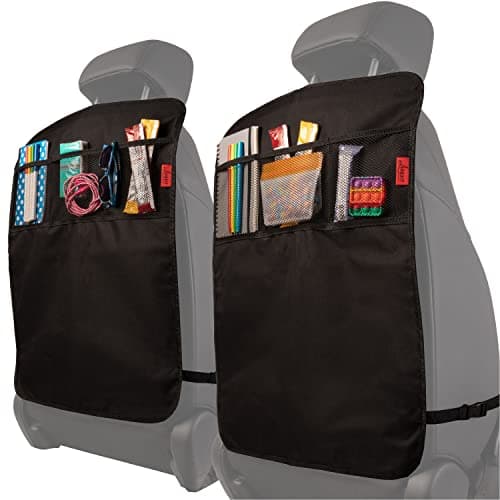
| 1 | Lusso Gear Backseat Organizer Kick Mat The back of a front seat with a child behind it | Drops in | 9.5/10 | $19.99 - view on Amazon |
| 2 | Tryone Car Headrest Tablet Holder Publishing the measurement that decides whether it fits | Clips on | 8.1/10 | $18.99 - view on Amazon |
| 3 | Folding Car Back Seat Tray Table A published load figure on a headrest clamp | Clips on | 7.7/10 | $89.99 - view on Amazon |
Prices last verified October 26, 2026. They move constantly; the figure on Amazon when you click is the real one.
The load figures do not mean much
Across this category, near-identical trays clamping to the same two headrest posts publish load capacities of 10 kg, 15 kg and 20 kg. None publishes a test method.
The pattern is familiar from elsewhere on this site: headrest tablet mounts show the same spread, with one maker publishing 5 lb and another claiming 40 lb on comparable hardware. When a figure varies by that much across the same physical design, it is a marketing number rather than a measurement.
Practically it does not matter much, because what you are putting on it is a laptop and a drink — call it 6 lb — and every tray here clears that comfortably. It matters because it tells you how much of the rest of the listing to believe.
Post spacing decides it, again
Same as every headrest-mounted product: the measurement that determines fit is the gap between the two metal posts, and it is not standardized between cars.
Tryone publishes a fit range of 4.7 to 5.9 inches for its headrest mounts, which is a useful benchmark for the category. Measure center to center between your posts before ordering, and check they are exposed at all — cars with deeply recessed or integrated headrests take no clamp mount of any kind.
| Folding tray table | Tryone tablet mount | |
|---|---|---|
| Load | Commonly 10 kg / 22 lb, varies | 5 lb |
| Test method for load | Not published | Not published |
| Folded thickness | Around 1.5-3 in | Foldable, no figure |
| Post spacing published | Not published | 4.7-5.9 in |
| Device size | Laptops to around 15.6 in | 4.7-12.9 in devices |
| Cup holders | Yes, stated base diameter | No |
The part that needs saying
A rigid tray on the back of a front seat is an unrestrained hard object directly in front of a rear passenger's face and chest.
In a collision, loose objects continue at the speed the car was traveling. A folding steel and plastic tray is heavier than the tablet somebody was watching on it, and it is positioned at exactly head height for a seated passenger.
- Fold it away when it is not in use. This is the whole mitigation and it costs two seconds
- Never leave it deployed with nobody in that seat. An empty deployed tray is all risk and no benefit
- Do not load it and then drive. A laptop on a tray at highway speed is a separate projectile
- Check the clamp before each trip. Vibration loosens clamps and a tray that drops onto a child's knees is the mild version of the failure
The same reasoning applies to everything mounted behind a seat, and it is covered alongside the mounts themselves in best headrest tablet mounts.
The use case that actually works
These are at their best in a parked car, and that is not a criticism.
Eating lunch in the car between jobs, working for twenty minutes before an appointment, letting a child eat something at a rest stop without it ending up in the seat rails — all parked, all genuinely improved by a flat surface, and none of them carrying the collision concern at all.
If the requirement is a work surface for a parked car rather than a tray for a passenger, the seat-belted desks are a sturdier answer — best car storage for work vehicles.
The cup holder detail worth checking
Most trays include cup holders and most publish a base diameter — commonly around 2.75 inches.
That is the same problem the car's own cup holders have. Insulated bottles designed after car cup holders were standardized routinely exceed it, and a bottle that does not seat properly in a tray holder on a cantilevered arm is worse than no holder at all.
Measure the base of the bottle you actually carry. The same arithmetic, and the expanders that solve it in the car's own holders, is in best cup holder organizers and expanders.
Cheaper things that solve the same complaint
The closest alternative is a hanging organizer, which does storage rather than surface and works while the car is moving — backseat organizer against seat back tray compares them on fit and use.
- The complaint is children making a mess: a kick mat and a trash can, not a tray — best backseat organizers and kick mats and best car trash cans
- The complaint is nowhere to put a screen: a headrest tablet mount is lighter, folds smaller and holds the device rather than supporting it
- The complaint is working from the car regularly: a belted desk in the front passenger seat, used parked
- The complaint is things rolling around: a crate — best collapsible trunk crates
The whole-car version of this decision is in how to organize your car.
Every pick, with the working
Each entry lists the specifications the maker publishes, the axis scores those specifications produce, and what you give up. Rows that read “Not published” are not omissions on our side: they are things the maker will not commit to in writing, and they cost the product points on the transparency axis. Specifications compiled September 4, 2026.
Our pickThe back of a front seat with a child behind it
Lusso Gear Backseat Organizer Kick Mat
Skip this one. Not a table, and the thing to buy first if children are the reason you are here. A tray gives a child somewhere to put a drink; a kick mat stops the seat back being destroyed by shoes, which happens on every single trip. One addresses an occasional want and the other addresses continuous damage.
The only product in this section with a lifetime warranty attached to it, which on a fabric item that lives under a child's shoes is the specification that matters. Waterproof Oxford, machine washable, and it covers the seat back rather than hanging a pouch on it.
- Dimensions
- 19 x 25 in
- Material
- Waterproof Oxford fabric
- Pockets
- 3 or 4 mesh depending on model
- Washable
- Machine washable
- Warranty
- Lifetime (published as a brand-wide term)
- Pack size
- 2
- List price
- Not published
What it gets right
- Lifetime warranty published on every Lusso Gear accessory — nothing else in this category commits in writing
- Waterproof Oxford fabric and machine washable, which is the actual failure mode for a kick mat
- Reinforced corners specifically to stop the sag that makes cheap kick mats useless
- Sold as a pair, which is what a car with two front seats needs
Flaws
- 19 x 25 in covers a typical seat back and no more — a tall SUV seat back will show a gap
- Mesh pockets hold light items; a full water bottle in a mesh pocket sags into a knee
- Straps go around the headrest, so a seat with fixed headrests is awkward
The working behind the 9.5
- Heat headroom: not scored (weight 22%)
- The maker publishes no operating-temperature ceiling, so this axis is dropped and the other weights are re-normalized.
- Install effort: 10.0 (weight 24%)
- Drops in and sits there. No fixing of any kind, and it comes out again when you sell the car.
- Price against the ceiling: not scored (weight 24%)
- No published list price we could cite on the compile date, so this axis is dropped and the other weights are re-normalized.
- Written commitment: not scored (weight 15%)
- No warranty term published, so this axis is dropped and the other weights are re-normalized.
- Spec transparency: 8.6 (weight 15%)
- 6 of the 7 specifications we went looking for are published by the maker (86%). A blank row is never a guess here: it prints “Not published” and it costs the product points, because a figure nobody will commit to in writing is a figure you cannot check.
Axes with no published input are dropped and the remaining weights re-normalized, so a product is not punished for a category where an axis does not apply. Specifications compiled September 4, 2026 from Lusso Gear kick mat published specifications.
2Publishing the measurement that decides whether it fits
Tryone Car Headrest Tablet Holder
Publishes the headrest post spacing it fits — and that, not the tablet size, is the number that determines whether this mount works in your car. It also publishes a 5 lb device limit, which is a believable figure for a clamp on a headrest arm.
- Device size range
- 4.7 to 12.9 in
- Device weight limit
- 5 lb
- Headrest post spacing
- 4.7 to 5.9 in
- Arm extension
- Up to 10.6 in
- Warranty
- Not published
- List price
- Not published
What it gets right
- Publishes headrest post spacing: fits 4.7 to 5.9 in between the two metal posts
- Publishes a device weight limit of 5 lb, which is a plausible number rather than a fantasy one
- Published device range of 4.7 to 12.9 in covers every mainstream tablet and phone
- Arm extends to a stated 10.6 in and rotates 360 degrees
Flaws
- Headrest post spacing is not standard between cars — measure before buying, because this is the failure mode
- Anything mounted to a headrest is a loose object in a collision; a tablet is not a light one
- Extending the arm fully puts the load furthest from the clamp, which is where sag starts
- No warranty published
The working behind the 8.1
- Heat headroom: not scored (weight 22%)
- The maker publishes no operating-temperature ceiling, so this axis is dropped and the other weights are re-normalized.
- Install effort: 9.0 (weight 24%)
- Clips onto a vent blade or a headrest post. Two minutes, no tools, no adhesive, no residue.
- Price against the ceiling: not scored (weight 24%)
- No published list price we could cite on the compile date, so this axis is dropped and the other weights are re-normalized.
- Written commitment: not scored (weight 15%)
- No warranty term published, so this axis is dropped and the other weights are re-normalized.
- Spec transparency: 6.7 (weight 15%)
- 4 of the 6 specifications we went looking for are published by the maker (67%). A blank row is never a guess here: it prints “Not published” and it costs the product points, because a figure nobody will commit to in writing is a figure you cannot check.
Axes with no published input are dropped and the remaining weights re-normalized, so a product is not punished for a category where an axis does not apply. Specifications compiled September 4, 2026 from Tryone published device range, weight limit and headrest spacing.
3A published load figure on a headrest clamp
Folding Car Back Seat Tray Table
The folding tray that clamps to the front headrest posts, and the better listings publish a load figure — commonly around 22 lb — plus a folded thickness. Both numbers matter more than the surface area, because this is a cantilever hanging off two posts.
- Load capacity
- Commonly 10 kg / 22 lb (varies by listing)
- Folded thickness
- Around 1.5-3 in
- Laptop size
- Up to around 15.6 in
- Mounting
- Front headrest posts
- Test method for load
- Not published
- Warranty
- Not published
- List price
- Not published
What it gets right
- Published load capacity on better listings, commonly 10 kg / 22 lb
- Published folded thickness, often around 1.5 to 3 in, so it stows behind the seat
- Accommodates laptops up to around 15.6 in on typical listings, with cup holders sized to a stated base diameter
- Folds away completely, which is the right behavior for anything mounted behind a seat
Flaws
- Load figures vary from 10 kg to 20 kg across near-identical hardware with no test method published anywhere
- Anything hard mounted behind a seat is an unrestrained object in a collision — fold it away when not in use
- Needs exposed headrest posts, and post spacing is not standardized between cars
- No warranty published
The working behind the 7.7
- Heat headroom: not scored (weight 22%)
- The maker publishes no operating-temperature ceiling, so this axis is dropped and the other weights are re-normalized.
- Install effort: 9.0 (weight 24%)
- Clips onto a vent blade or a headrest post. Two minutes, no tools, no adhesive, no residue.
- Price against the ceiling: not scored (weight 24%)
- No published list price we could cite on the compile date, so this axis is dropped and the other weights are re-normalized.
- Written commitment: not scored (weight 15%)
- No warranty term published, so this axis is dropped and the other weights are re-normalized.
- Spec transparency: 5.7 (weight 15%)
- 4 of the 7 specifications we went looking for are published by the maker (57%). A blank row is never a guess here: it prints “Not published” and it costs the product points, because a figure nobody will commit to in writing is a figure you cannot check.
Axes with no published input are dropped and the remaining weights re-normalized, so a product is not punished for a category where an axis does not apply. Specifications compiled September 4, 2026 from Published load capacity, folded thickness and laptop size.
Prices last verified October 26, 2026. They move constantly; the figure on Amazon when you click is the real one.
Questions people actually ask
How much weight can a car seat back table hold?
Published figures run from 10 to 20 kg across near-identical hardware with no test method stated. Everything here clears the laptop and drink people actually put on them; treat the specific number as marketing.
Are seat back tables safe while driving?
A deployed rigid tray is an unrestrained hard object at head height for a rear passenger. Fold it away when not in use, never leave it deployed with nobody in the seat, and do not drive with a laptop sitting on it.
Will a seat back table fit my car?
Measure center to center between the headrest posts — Tryone publishes a 4.7 to 5.9 in range as a category benchmark. Cars with integrated or deeply recessed headrests take no clamp mount at all.
Table or headrest tablet mount?
A mount if the job is holding a screen — lighter, folds smaller, holds the device rather than supporting it. A table if the job is eating, writing or working, which is mostly a parked-car activity anyway.