The best 12V socket splitters
Three sockets where there was one does not mean three times the power. Your car's fuse did not change, and that is the number that matters.
By Sawyer V. · Published · How we research
We have not tested any of this. Everything below is compiled from published manufacturer specifications, and the arithmetic is printed so you can check it. This page carries affiliate links: if you buy through one we earn a commission at no extra cost to you, and it does not change the order of the picks. Full disclosure.
The short answer
A splitter divides the capacity your socket already has; it does not add any. Your car's accessory socket is typically fused at 10 to 20A, which is roughly 120 to 240W at 12V, and that fuse is the real ceiling regardless of how many sockets you hang off it. Buy one that publishes its wire gauge and inline fuse — the RIIEYOCA states 16AWG and a 15A fuse — and add up what you are plugging in.
| # | Pick | Install | Score | Price |
|---|---|---|---|---|
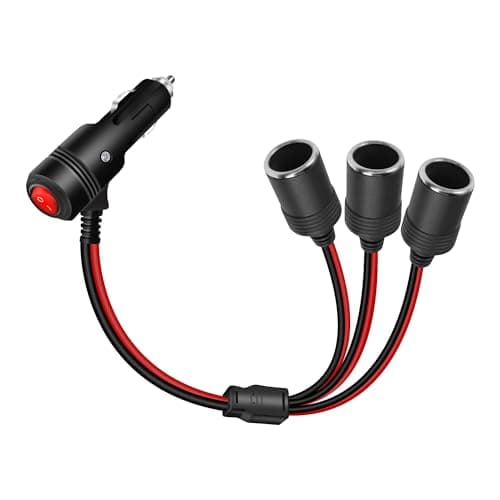
| 1 | RIIEYOCA 3-Way 12V Socket Splitter Publishing the wire gauge and the fuse | Plugs in | 8.3/10 | $8.99 - view on Amazon |
| 2 | Anker 535 Car Charger (67W) Charging a laptop in the car | Plugs in | 8.6/10 | $42.99 - view on Amazon |
| 3 | BESTEK 300W Power Inverter Running a mains plug from the 12V socket | Plugs in | 9.2/10 | $28.49 - view on Amazon |
Prices last verified October 26, 2026. They move constantly; the figure on Amazon when you click is the real one.
The arithmetic, which takes thirty seconds
This is the whole page and almost nobody does it.
Find your car's accessory socket fuse in the owner's manual or the fuse box diagram. It is typically 10, 15 or 20A. At 12V nominal that is a budget of roughly 120, 180 or 240W across everything plugged into that circuit, and often several sockets in the car share one fuse.
Then add up the draw of what you want to run. A 65W USB-C charger, a 12V tire inflator pulling 120W or more while running, a dash cam at a few watts, a cooler at 45W. Two of those at once will exceed a 10A fuse.
The two specifications to look for
Most splitters publish neither. The RIIEYOCA publishes both, which is the entire reason it leads here.
- Wire gauge. 16AWG copper, stated UL certified. Lower AWG is thicker wire and carries more current with less heating. A splitter with thin aluminum-clad wire and no published gauge is a splitter whose conductors are the unknown in the circuit
- Its own inline fuse. A published, replaceable 15A fuse means the accessory protects itself before the car's fuse blows — and means you replace a cheap fuse rather than crawling into a footwell
What nothing in this category publishes any more is a jacket temperature rating. On a cable that lives in a footwell or under a seat in summer that is a real specification, and its absence is the one figure we would most like back.
| RIIEYOCA 3-way | Typical unbranded splitter | |
|---|---|---|
| Wire gauge | 16AWG pure copper | Not published |
| Inline fuse | 15A, in the male plug | Often none |
| Jacket rating | Not published | Not published |
| Sockets | 3 | 2 or 3 |
| Cable length | 12 in | Varies |
| Continuous wattage | Not published | Not published |
Note the blank at the bottom of both columns. Nobody in this category publishes a continuous wattage rating for the unit as a whole, which would be the single most useful figure. The wire gauge and fuse are proxies for it.
Splitter or multi-port charger?
Worth asking before buying either, because the answer is usually the charger.
If everything you want to plug in is USB, a splitter is the wrong product. You would be using one socket to create three sockets so you can plug in three separate USB adapters, each with its own conversion losses and its own thing to fall out.
A single multi-port USB-C charger does the same job in one device, more efficiently, with published per-port power ceilings — best multi-port car chargers. The per-port point matters: a charger advertising a big total figure may cap each port well below it, which is covered in Anker 335 vs 535.
A splitter is the right product when you need actual 12V sockets — for a tire inflator, a cooler, a 12V heated cushion, a tire pump — devices with a cigarette-lighter plug and no USB option.
Using one without causing problems
- Check whether your socket is live with the ignition off. Many are. Leaving a splitter loaded on an always-on socket is a parasitic draw that flattens the battery over a week of not driving
- Do not run high-draw devices simultaneously. An inflator alone is fine; an inflator and a cooler together will find your fuse
- Route the cable so it cannot reach the pedals. A 12 inch extension hanging out of a dash socket is a snag hazard in a footwell
- Check it does not get hot. Warm is normal, hot is not. Hot means the conductors are undersized for what you are drawing
- Keep a spare fuse. Both the splitter's and the car's. They are pennies and the alternative is a dead circuit for a week
If the car is short of sockets
A splitter is the no-tools answer to a car with one socket and three things to plug in. It is not the only answer and it is not always the best one.
Adding a proper USB port to an older car is a genuinely achievable job and gives you a clean fixed outlet rather than a hanging adapter — how to add USB ports to an older car. For a dash cam specifically, hardwiring removes the socket from the equation entirely and frees it up — how to hardwire a dash cam.
And if the reason you are here is a battery that keeps going flat, the socket may be the cause rather than the symptom — does a car charger drain your battery.
Every pick, with the working
Each entry lists the specifications the maker publishes, the axis scores those specifications produce, and what you give up. Rows that read “Not published” are not omissions on our side: they are things the maker will not commit to in writing, and they cost the product points on the transparency axis. Specifications compiled September 4, 2026.
Our pickPublishing the wire gauge and the fuse
RIIEYOCA 3-Way 12V Socket Splitter
The two numbers that decide whether a splitter is safe are the wire gauge and the inline fuse, and this one publishes both — 16AWG pure copper and a 15A fuse in the male plug. Almost everything else in this category publishes neither, which on a device drawing current through a 12V socket is not a detail.
- Sockets
- 3
- Wire gauge
- 16AWG pure copper
- Fuse
- 15A, in the male plug
- Jacket rating
- Not published
- Cable length
- 12 in (30 cm)
- Continuous wattage
- Not published
- List price
- Not published
What it gets right
- Publishes wire gauge: 16AWG pure copper
- Publishes a 15A safety fuse, fitted in the male plug
- Three sockets on a 12 inch cord, so the hub sits where you want it rather than dangling
- An on/off switch, so you can cut the whole hub without unplugging anything
Flaws
- A splitter divides the socket's existing capacity; it does not add any. Your car's socket fuse is typically 10-20A and that is the real ceiling
- Three sockets invites three loads, which is exactly how the car's own fuse gets blown
- No published continuous wattage rating for the unit as a whole
- No published jacket temperature rating, which a footwell in summer makes relevant
- No warranty published
The working behind the 8.3
- Heat headroom: not scored (weight 22%)
- The maker publishes no operating-temperature ceiling, so this axis is dropped and the other weights are re-normalized.
- Install effort: 10.0 (weight 24%)
- Plugs into a 12V socket or a USB port. Nothing to mount, nothing to route, reversible in a second.
- Price against the ceiling: not scored (weight 24%)
- No published list price we could cite on the compile date, so this axis is dropped and the other weights are re-normalized.
- Written commitment: not scored (weight 15%)
- No warranty term published, so this axis is dropped and the other weights are re-normalized.
- Spec transparency: 5.7 (weight 15%)
- 4 of the 7 specifications we went looking for are published by the maker (57%). A blank row is never a guess here: it prints “Not published” and it costs the product points, because a figure nobody will commit to in writing is a figure you cannot check.
Axes with no published input are dropped and the remaining weights re-normalized, so a product is not punished for a category where an axis does not apply. Specifications compiled September 4, 2026 from RIIEYOCA 3-way splitter published wire gauge, fuse and cable length.
2Charging a laptop in the car
Anker 535 Car Charger (67W)
Skip this one. If you only ever charge phones, this is the wrong one. Nothing with a phone battery in it can take more than 35W, so the 335 does the identical job for less.
Same three ports and same 67W total as the 335, but one USB-C port will deliver the whole 67W on its own at 20V and 3.35A. That is a real laptop charge rather than a trickle, and it is the only reason to pay more than the 335 costs. If nothing you own draws more than 35W, this is money spent on a number you will never see.
- Ports
- 2 x USB-C, 1 x USB-A
- Total output
- 67 W
- USB-C output
- 5V/3A, 9V/3A, 12V/3A, 15V/3A, 20V/3.35A (67 W max)
- USB-A output
- 5V/3A, 9V/2A, 10V/2.25A, 12V/1.5A (22.5 W max)
- Input
- 12V to 24V, 7.2 A
- Safety
- ActiveShield 2.0
- Model
- A2731
- List price
- Not published
- Operating range
- Not published
What it gets right
- Full 67W from a single USB-C port at 20V 3.35A, published as an explicit voltage table
- Anker publishes the complete PDO table rather than a headline wattage, which almost nobody does
- Input rated 12V to 24V, so it works in a truck as well as a car
- ActiveShield 2.0 thermal management
Flaws
- Pointless unless something you charge actually draws more than 35W
- The USB-A port tops out at 22.5W, so it is the slow port whichever charger you pick
- Frequently out of stock at Anker directly
The working behind the 8.6
- Heat headroom: not scored (weight 22%)
- The maker publishes no operating-temperature ceiling, so this axis is dropped and the other weights are re-normalized.
- Install effort: 10.0 (weight 24%)
- Plugs into a 12V socket or a USB port. Nothing to mount, nothing to route, reversible in a second.
- Price against the ceiling: not scored (weight 24%)
- No published list price we could cite on the compile date, so this axis is dropped and the other weights are re-normalized.
- Written commitment: 7.0 (weight 15%)
- 18-month warranty. This is the only promise in the entire listing that a court would read, which is why it is scored and the marketing copy is not.
- Spec transparency: 7.8 (weight 15%)
- 7 of the 9 specifications we went looking for are published by the maker (78%). A blank row is never a guess here: it prints “Not published” and it costs the product points, because a figure nobody will commit to in writing is a figure you cannot check.
Axes with no published input are dropped and the remaining weights re-normalized, so a product is not punished for a category where an axis does not apply. Specifications compiled September 4, 2026 from Anker's 535 Car Charger product page.
3Running a mains plug from the 12V socket
BESTEK 300W Power Inverter
Skip this one. On this page because people reach for a splitter when what they actually want is an inverter, and the two solve different problems. A splitter gives you more 12V sockets sharing the same fuse. An inverter converts 12V to household AC for a device that has no car adapter. If you are plugging in a laptop charger, you want the inverter and you want to read its limits first.
300 W continuous and 700 W peak from the 12V socket, through two AC outlets and two USB ports, with a 40 A fuse built in. It is the answer when something you need to run has a mains plug and no USB option — a CPAP machine, a camera battery charger, an older laptop brick. It is not a way to run a kettle.
- Continuous output
- 300 W
- Peak output
- 700 W
- Input
- 12 V DC
- Output
- 110-120 V AC
- AC outlets
- 2
- USB output
- 2 ports, 2.4 A each, 4.8 A total
- Fuse
- 40 A built in
- Protection
- Overheat, over/under voltage, short circuit, overload
- List price
- Not published
- Warranty
- Not published
What it gets right
- Published continuous AND peak ratings (300 W / 700 W), which is the pair of numbers that actually tells you what it will run
- Two AC outlets plus 4.8 A of USB, so it replaces a charger as well
- 40 A fuse and published protection against overheat, over/under voltage, short circuit and overload
- Pure sine wave on the model that states it, which matters for anything with a motor or a medical device
Flaws
- 300 W continuous is a laptop and a camera charger. It is not a kettle, a hair dryer or a fridge
- Drawing 300 W at 12 V is roughly 25 amps, which is well past what many 12V sockets are fused for — check yours
- Inverters are inefficient and get warm; run the engine if you are drawing anything substantial
The working behind the 9.2
- Heat headroom: not scored (weight 22%)
- The maker publishes no operating-temperature ceiling, so this axis is dropped and the other weights are re-normalized.
- Install effort: 10.0 (weight 24%)
- Plugs into a 12V socket or a USB port. Nothing to mount, nothing to route, reversible in a second.
- Price against the ceiling: not scored (weight 24%)
- No published list price we could cite on the compile date, so this axis is dropped and the other weights are re-normalized.
- Written commitment: not scored (weight 15%)
- No warranty term published, so this axis is dropped and the other weights are re-normalized.
- Spec transparency: 8.0 (weight 15%)
- 8 of the 10 specifications we went looking for are published by the maker (80%). A blank row is never a guess here: it prints “Not published” and it costs the product points, because a figure nobody will commit to in writing is a figure you cannot check.
Axes with no published input are dropped and the remaining weights re-normalized, so a product is not punished for a category where an axis does not apply. Specifications compiled September 4, 2026 from BESTEK's 300W power inverter page.
Prices last verified October 26, 2026. They move constantly; the figure on Amazon when you click is the real one.
Questions people actually ask
Does a 12V splitter give me more power?
No. It divides the capacity the socket already has. Your car's accessory fuse — typically 10 to 20A, or roughly 120 to 240W — is the ceiling no matter how many sockets you add, and several sockets often share one fuse.
Are cigarette lighter splitters safe?
A splitter that publishes its wire gauge and carries its own replaceable inline fuse is. One with no published gauge and no fuse is an unknown conductor in the circuit — the car's fuse protects the car's wiring, not the accessory's.
Can I run a tire inflator and a phone charger at the same time?
Probably not on a 10A circuit. A 12V inflator can pull 120W or more while running, which uses most of the budget on its own. Run high-draw devices one at a time.
Should I buy a splitter or a multi-port USB charger?
If everything is USB, buy the multi-port charger — it is one device rather than three adapters in three sockets. A splitter is for actual 12V devices like inflators, coolers and heated cushions that have no USB option.