The best car chargers for a laptop
Every listing in this category leads with a total: 130 W, 165 W, 200 W. A laptop plugs into one port, and the number that matters is what that one port delivers on its own.
By Sawyer V. · Published · How we research
We have not tested any of this. Everything below is compiled from published manufacturer specifications, and the arithmetic is printed so you can check it. This page carries affiliate links: if you buy through one we earn a commission at no extra cost to you, and it does not change the order of the picks. Full disclosure.
The verdict
Buy the AOHI 165W at about $40. It publishes 140 W of PD 3.1 on the first USB-C port and states it holds that under full load rather than tapering, and it is the only charger here that publishes why: two independent PD circuits, so a phone on the second port cannot take power from the laptop on the first. Eighteen-month warranty. Prices as of November 7, 2026.
If you want the numbers checkable, buy the Coolgear 145W at about $70. It is the only charger in this ledger that publishes its input limit - 15 A - along with a 5 V to 28 V output range, a ripple figure and a UL94-V1 housing. It is also the only one whose headline total is smaller than its rivals' because it is honest about what a socket can pass.
| # | Pick | Install | Score | Price |
|---|---|---|---|---|
| 1 | AOHI 165W Laptop Car Charger 140 W on one port, stated as constant | Plugs in | 9.1/10 | $39.99 - view on Amazon |
| 2 | Coolgear 145W Dual USB-C Car Charger The only charger here that publishes its input limit | Plugs in | 8.5/10 | $69.95 - view on Amazon |
| 3 | LISEN 200W GaN Car Charger 140 W and a 240 W cable for thirty-five dollars | Plugs in | 9.1/10 | $34.99 - view on Amazon |
| 4 | Anker 167.5W 3-Port Car Charger A named brand that publishes the port split | Plugs in | 8.6/10 | $37.79 - view on Amazon |
| 5 | Anker 535 Car Charger (67W) Charging a laptop in the car | Plugs in | 8.6/10 | $43.99 - view on Amazon |
| 6 | UGREEN 130W 3-Port Car Charger A laptop and two phones at once | Plugs in | 9.5/10 | $18.97 - view on Amazon |
Prices last verified November 7, 2026. They move constantly; the figure on Amazon when you click is the real one.
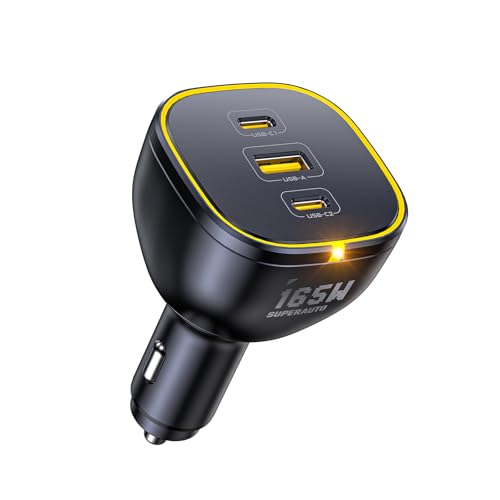
The headline is a sum, and your laptop plugs into one port
Six chargers on this page advertise 67, 130, 145, 165, 167.5 and 200 W. Not one of those figures is what a single device receives. They are the total across two or three ports with everything plugged in at once, which is a situation in which the laptop gets the least.
So the useful specification is the single-port maximum, and whether the maker publishes it at all is the first filter.
| Charger | Headline total | Single-port maximum | Published input limit | Price |
|---|---|---|---|---|
| AOHI 165W | 165 W, 3 ports | 140 W, PD 3.1 | Not published | $39.99 |
| Coolgear 145W | 145 W, 2 ports | 140 W, PD 3.1 EPR | 12-24 V, 15 A max | $69.95 |
| LISEN 200W | 200 W, 3 ports | 140 W, PD 3.1 | Not published | $34.99 |
| Anker 167.5W | 167.5 W, 3 ports | 100 W | Not published | $37.79 |
| Anker 535 | 67 W, 3 ports | 67 W | Not published | $43.99 |
| UGREEN 130W | 130 W, 3 ports | Not published | Not published | $18.97 |
Four publish it. Two do not, and one of those two - the UGREEN - is this site's standing pick for phones precisely because for a phone the total is the relevant figure. For a laptop it is the wrong listing to read.
The arithmetic nobody except Coolgear shows you
A 12 V accessory socket is a circuit with a fuse on it. Coolgear is the only maker on this page that publishes an input limit for its charger: 12 V to 24 V DC, 15 A maximum, with a stated 9 V to 32 V tolerance.
Fifteen amps at twelve volts is 180 W going in, before any conversion loss at all. Which is why Coolgear's headline is 145 W and not two hundred: it is describing what the socket can actually pass. The chargers claiming 165, 167.5 and 200 W publish no input figure, so there is nothing to check their total against.
Who each one is for
- AOHI 165W - for a 14 or 16 inch laptop and a phone at the same time. Publishes 140 W PD 3.1 on port one and states it is constant rather than peak, and publishes the architecture behind the claim: two independent PD circuits, one PD 3.1 and one PD 3.0. That is the detail that stops your laptop slowing down when somebody plugs a phone in. 18-month warranty. Skip it if you want a MagSafe 3 cable in the box, because it is not
- Coolgear 145W - for anyone who needs to be sure. The most completely specified charger in this ledger: input limit, output range, ripple under 100 mV, flame-retardant UL94-V1 housing, CE, FCC and REACH compliance, mounting flanges so it can live in a console instead of a lighter socket. Its listing also states the category fact outright - most car chargers cap at 45 to 90 W and cannot run a laptop at full speed. Skip it on price and on the 1-year warranty, which is the shortest of the four laptop-capable units here
- LISEN 200W - for the lowest price with a real 140 W port. Thirty-five dollars, 140 W PD 3.1 published, all three port figures published, a 240 W cable in the box and a 2-year warranty - the longest here. On the one specification a laptop cares about it matches chargers at twice the money. Skip it if the headline bothers you, and it should a little: 140 + 30 + 30 is exactly 200 W, which is more than a 12 V socket circuit is wired to pass
- Anker 167.5W - for a brand with a phone number. Publishes the full split - 100 / 45 / 22.5 W - and quotes a real figure, a MacBook Pro 16 from 0 to 50% in 47 minutes. 100 W runs every mainstream USB-C laptop. Skip it for a 16-inch machine under sustained load, and note the listing publishes its warranty twice and the two figures disagree: 12 months in the warranty field, 18 in the description
- Anker 535 - for a MacBook Air, and nothing bigger. 67 W on a single USB-C port, which Anker states provides full-speed charging to a MacBook Pro 14. It is compact, it comes with a cable, and the 18-month warranty is published. Skip it if the laptop is a 16-inch or a gaming machine: when all three ports are in use the first one drops to 45 W
- UGREEN 130W - no, not for a laptop. See the skip note above
The two things people buy instead, and when they are right
A USB-C car charger is the right answer for a modern laptop. It is not the only answer, and two others come up constantly.
- An AC inverter, if your laptop charges from a barrel plug rather than USB-C. There is no PD negotiation to be had with an old Dell brick, and an inverter plus the original charger is the only route. Car power inverters explained covers the sizing, and the short version is that the socket limit above applies there too
- A laptop power bank, if you work in the car with the engine off. Every charger on this page draws from the car, which means the engine running or the battery going down - see does a car charger drain your battery. Best power banks for car travel is the right page for a parked office
One last note on the physical fit. A 140 W charger in a 12 V socket is a hot object in a plastic hole, and the sockets in most cars were designed for a cigarette lighter. The Coolgear's mounting flanges exist for exactly this reason. For a car with one socket and several demands on it, best 12V socket splitters is the next problem, and best USB-C car chargers is the page to read if the device you are charging is a phone.
Every pick, with the working
Each entry lists the specifications the maker publishes, the axis scores those specifications produce, and what you give up. Rows that read “Not published” are not omissions on our side: they are things the maker will not commit to in writing, and they cost the product points on the transparency axis. Specifications compiled September 4, 2026.
Our pick140 W on one port, stated as constant
AOHI 165W Laptop Car Charger
The only charger here that publishes 140 W PD 3.1 on a single port AND claims to hold it under load rather than tapering, and it backs that up with the only architectural detail anyone publishes in this category: two independent PD circuits, one PD 3.1 and one PD 3.0, so a phone on the second port does not steal from the laptop on the first. Eighteen-month warranty, forty dollars.
- Single-port maximum
- 140 W, USB-C1, PD 3.1
- Second USB-C port
- 100 W PD 3.0 / 45 W PPS
- Headline total
- 165 W across 3 ports
- Port layout
- 2 x USB-C, 1 x USB-A
- Circuit design
- Two independent PD circuits (PD 3.1 and PD 3.0)
- Protocols
- PD 3.1, PD 3.0, QC 4.0, QC 3.0, PPS 2.0
- Input
- 12 V to 24 V
- Warranty
- 18 months
- Cable included
- No MagSafe 3 cable
- Input current limit
- Not published
List price $39.99 per Amazon listing, November 7, 2026, captured on the compile date below. Not a live price and not what you will pay — the button is where the real number is.
What it gets right
- 140 W PD 3.1 on USB-C1, stated as constant full load rather than peak
- Two independent PD circuits published - the reason the second port does not rob the first
- PD 3.1, PD 3.0, QC 4.0, QC 3.0 and PPS 2.0 all named
- 18-month warranty
- 12 V to 24 V input published, so it works in a truck as well as a car
Flaws
- 140 W on a MacBook Pro 16 needs a USB-C to MagSafe 3 cable, which is not in the box
- The 165 W headline is the three-port sum, not something one device will ever draw
- No input current limit published, so there is no way to check the total against your socket fuse
- AOHI is a specification-forward brand with no service network behind it
The working behind the 9.1
- Heat headroom: not scored (weight 22%)
- The maker publishes no operating-temperature ceiling, so this axis is dropped and the other weights are re-normalized.
- Install effort: 10.0 (weight 24%)
- Plugs into a 12V socket or a USB port. Nothing to mount, nothing to route, reversible in a second.
- Price against the ceiling: 9.5 (weight 24%)
- Listed at $39.99 on the compile date. This site's buyer has a practical ceiling around $150 for a single upgrade, so the scale rewards everything under $100 and falls away sharply past $150. The live price is very often different, and that is what the button is for.
- Written commitment: 7.0 (weight 15%)
- 18-month warranty. This is the only promise in the entire listing that a court would read, which is why it is scored and the marketing copy is not.
- Spec transparency: 9.0 (weight 15%)
- 9 of the 10 specifications we went looking for are published by the maker (90%). A blank row is never a guess here: it prints “Not published” and it costs the product points, because a figure nobody will commit to in writing is a figure you cannot check.
Axes with no published input are dropped and the remaining weights re-normalized, so a product is not punished for a category where an axis does not apply. Specifications compiled September 4, 2026 from the AOHI 165W listing.
2The only charger here that publishes its input limit
Coolgear 145W Dual USB-C Car Charger
The most completely specified charger in this ledger, and the only one that publishes the number that caps the entire category: 15 A maximum input. At 12 V that is 180 W going in before any conversion loss, which is why its honest headline is 145 W and not 200. It also publishes 140 W on a single port, a 5 V to 28 V output range, under 100 mV of ripple, a UL94-V1 housing and CE, FCC and REACH compliance. It costs seventy dollars and it is the only one you can actually check.
- Single-port maximum
- 140 W, USB-C1, PD 3.1 EPR
- Second USB-C port
- 45 W
- Headline total
- 145 W across 2 ports
- Input
- 12 V to 24 V DC, 15 A max, 9 V to 32 V tolerance
- Output range
- 5 V to 28 V
- Ripple
- Under 100 mV
- Housing
- Flame-retardant UL94-V1
- Compliance
- CE, FCC, REACH
- Mounting
- Surface-mount flanges
- Warranty
- 1 year
List price $69.95 per Amazon listing, November 7, 2026, captured on the compile date below. Not a live price and not what you will pay — the button is where the real number is.
What it gets right
- Publishes an input current limit: 12 V to 24 V DC, 15 A max, with 9 V to 32 V tolerance
- 140 W on a single USB-C port, PD 3.1 EPR, with the output range published as 5 V to 28 V
- Publishes a ripple figure (under 100 mV) - nothing else in this ledger publishes one
- Flame-retardant UL94-V1 housing, CE, FCC and REACH compliance named
- Mountable flanges and a long cable, so it can live in a console instead of a lighter socket
- States the category fact outright: most car chargers cap at 45 W to 90 W and cannot run a laptop at full speed
Flaws
- $69.95 - nearly twice the AOHI and four times the UGREEN
- 1-year warranty, the shortest of the four laptop-capable chargers here
- Two ports only, so a third device needs a splitter
- Built for fleet vans and mobile workstations, which is why it looks like it
The working behind the 8.5
- Heat headroom: not scored (weight 22%)
- The maker publishes no operating-temperature ceiling, so this axis is dropped and the other weights are re-normalized.
- Install effort: 10.0 (weight 24%)
- Plugs into a 12V socket or a USB port. Nothing to mount, nothing to route, reversible in a second.
- Price against the ceiling: 8.0 (weight 24%)
- Listed at $69.95 on the compile date. This site's buyer has a practical ceiling around $150 for a single upgrade, so the scale rewards everything under $100 and falls away sharply past $150. The live price is very often different, and that is what the button is for.
- Written commitment: 5.5 (weight 15%)
- 12-month warranty. This is the only promise in the entire listing that a court would read, which is why it is scored and the marketing copy is not.
- Spec transparency: 10.0 (weight 15%)
- 10 of the 10 specifications we went looking for are published by the maker (100%). A blank row is never a guess here: it prints “Not published” and it costs the product points, because a figure nobody will commit to in writing is a figure you cannot check.
Axes with no published input are dropped and the remaining weights re-normalized, so a product is not punished for a category where an axis does not apply. Specifications compiled September 4, 2026 from the Coolgear 145W listing.
3140 W and a 240 W cable for thirty-five dollars
LISEN 200W GaN Car Charger
140 W PD 3.1 on the first port, 30 W on each of the other two, a GaN full-metal body, a 240 W 6.6 ft cable in the box and a two-year warranty, for thirty-five dollars. On the specification that matters for a laptop it matches chargers costing twice as much. The 200 W headline is the problem: add the three published port figures and you get exactly 200 W, which is more power than a 12 V accessory socket is wired to pass.
- Single-port maximum
- 140 W, USB-C1, PD 3.1
- Second USB-C port
- 30 W
- USB-A port
- 30 W
- Headline total
- 200 W across 3 ports
- Semiconductor
- GaN
- Cable included
- 240 W, 6.6 ft
- Protocols
- PD 3.1, QC 4.0, PPS, Samsung SFC 3.0 at 60 W
- Warranty
- 2 years
- Input current limit
- Not published
- Ripple
- Not published
List price $34.99 per Amazon listing, November 7, 2026, captured on the compile date below. Not a live price and not what you will pay — the button is where the real number is.
What it gets right
- 140 W PD 3.1 on USB-C1, published
- Publishes all three port figures: 140 W + 30 W + 30 W
- 240 W 6.6 ft USB-C cable included, which is the cable a 140 W laptop actually needs
- 2-year warranty, the longest of the laptop-capable chargers here
- 60 W Samsung Super Fast Charging 3.0 named, plus QC 4.0 and PPS
Flaws
- The 200 W headline is the sum of all three ports, and more than a typical 12 V socket circuit will pass
- No input current limit published, so the total cannot be checked against your fuse
- No ripple figure, no compliance marks beyond UL, FCC and CE named generically
- LISEN is a listing brand - the warranty is a replacement promise from a seller
The working behind the 9.1
- Heat headroom: not scored (weight 22%)
- The maker publishes no operating-temperature ceiling, so this axis is dropped and the other weights are re-normalized.
- Install effort: 10.0 (weight 24%)
- Plugs into a 12V socket or a USB port. Nothing to mount, nothing to route, reversible in a second.
- Price against the ceiling: 9.5 (weight 24%)
- Listed at $34.99 on the compile date. This site's buyer has a practical ceiling around $150 for a single upgrade, so the scale rewards everything under $100 and falls away sharply past $150. The live price is very often different, and that is what the button is for.
- Written commitment: 8.0 (weight 15%)
- 24-month warranty. This is the only promise in the entire listing that a court would read, which is why it is scored and the marketing copy is not.
- Spec transparency: 8.0 (weight 15%)
- 8 of the 10 specifications we went looking for are published by the maker (80%). A blank row is never a guess here: it prints “Not published” and it costs the product points, because a figure nobody will commit to in writing is a figure you cannot check.
Axes with no published input are dropped and the remaining weights re-normalized, so a product is not punished for a category where an axis does not apply. Specifications compiled September 4, 2026 from the LISEN 200W listing.
4A named brand that publishes the port split
Anker 167.5W 3-Port Car Charger
Anker publishes exactly how the 167.5 W divides - 100 W on USB-C1, 45 W on USB-C2, 22.5 W on USB-A - which makes it one of only four chargers here where you can tell what a laptop actually gets. 100 W runs any USB-C laptop short of a MacBook Pro 16 at full tilt, and Anker quotes that machine at 0 to 50% in 47 minutes. The irritation is in the listing itself: the warranty field says 12 months and the bullet beneath it says 18.
- Single-port maximum
- 100 W, USB-C1
- Second USB-C port
- 45 W
- USB-A port
- 22.5 W
- Headline total
- 167.5 W across 3 ports
- Quoted charge rate
- MacBook Pro 16: 0 to 50% in 47 minutes
- Cable included
- 3.3 ft USB-C to USB-C
- Warranty
- Warranty field states 12 months; the description states 18
- PD 3.1 / EPR
- Not published
- Input current limit
- Not published
List price $37.79 per Amazon listing, November 7, 2026, captured on the compile date below. Not a live price and not what you will pay — the button is where the real number is.
What it gets right
- Publishes the full port split: 100 W / 45 W / 22.5 W
- 100 W single-port output, enough for every mainstream USB-C laptop
- Quotes a real charge figure: MacBook Pro 16 from 0 to 50% in 47 minutes
- 3.3 ft USB-C to USB-C cable in the box
- An actual service channel behind it, which no other brand on this page has
Flaws
- The listing states the warranty twice and the figures disagree: 12 months in the warranty field, 18 months in the description
- 100 W, not 140 W. A MacBook Pro 16 under load wants more
- No PD 3.1 or EPR claim anywhere in the listing
- No input current limit published
The working behind the 8.6
- Heat headroom: not scored (weight 22%)
- The maker publishes no operating-temperature ceiling, so this axis is dropped and the other weights are re-normalized.
- Install effort: 10.0 (weight 24%)
- Plugs into a 12V socket or a USB port. Nothing to mount, nothing to route, reversible in a second.
- Price against the ceiling: 9.5 (weight 24%)
- Listed at $37.79 on the compile date. This site's buyer has a practical ceiling around $150 for a single upgrade, so the scale rewards everything under $100 and falls away sharply past $150. The live price is very often different, and that is what the button is for.
- Written commitment: 5.5 (weight 15%)
- 12-month warranty. This is the only promise in the entire listing that a court would read, which is why it is scored and the marketing copy is not.
- Spec transparency: 7.8 (weight 15%)
- 7 of the 9 specifications we went looking for are published by the maker (78%). A blank row is never a guess here: it prints “Not published” and it costs the product points, because a figure nobody will commit to in writing is a figure you cannot check.
Axes with no published input are dropped and the remaining weights re-normalized, so a product is not punished for a category where an axis does not apply. Specifications compiled September 4, 2026 from the Anker 167.5W listing.
5Charging a laptop in the car
Anker 535 Car Charger (67W)
Skip this one. If you only ever charge phones, this is the wrong one. Nothing with a phone battery in it can take more than 35W, so the 335 does the identical job for less.
Same three ports and same 67W total as the 335, but one USB-C port will deliver the whole 67W on its own at 20V and 3.35A. That is a real laptop charge rather than a trickle, and it is the only reason to pay more than the 335 costs. If nothing you own draws more than 35W, this is money spent on a number you will never see.
- Ports
- 2 x USB-C, 1 x USB-A
- Total output
- 67 W
- USB-C output
- 5V/3A, 9V/3A, 12V/3A, 15V/3A, 20V/3.35A (67 W max)
- USB-A output
- 5V/3A, 9V/2A, 10V/2.25A, 12V/1.5A (22.5 W max)
- Input
- 12V to 24V, 7.2 A
- Safety
- ActiveShield 2.0
- Model
- A2731
- List price
- Not published
- Operating range
- Not published
What it gets right
- Full 67W from a single USB-C port at 20V 3.35A, published as an explicit voltage table
- Anker publishes the complete PDO table rather than a headline wattage, which almost nobody does
- Input rated 12V to 24V, so it works in a truck as well as a car
- ActiveShield 2.0 thermal management
Flaws
- Pointless unless something you charge actually draws more than 35W
- The USB-A port tops out at 22.5W, so it is the slow port whichever charger you pick
- Frequently out of stock at Anker directly
The working behind the 8.6
- Heat headroom: not scored (weight 22%)
- The maker publishes no operating-temperature ceiling, so this axis is dropped and the other weights are re-normalized.
- Install effort: 10.0 (weight 24%)
- Plugs into a 12V socket or a USB port. Nothing to mount, nothing to route, reversible in a second.
- Price against the ceiling: not scored (weight 24%)
- No published list price we could cite on the compile date, so this axis is dropped and the other weights are re-normalized.
- Written commitment: 7.0 (weight 15%)
- 18-month warranty. This is the only promise in the entire listing that a court would read, which is why it is scored and the marketing copy is not.
- Spec transparency: 7.8 (weight 15%)
- 7 of the 9 specifications we went looking for are published by the maker (78%). A blank row is never a guess here: it prints “Not published” and it costs the product points, because a figure nobody will commit to in writing is a figure you cannot check.
Axes with no published input are dropped and the remaining weights re-normalized, so a product is not punished for a category where an axis does not apply. Specifications compiled September 4, 2026 from Anker's 535 Car Charger product page.
6A laptop and two phones at once
UGREEN 130W 3-Port Car Charger
Skip this one. An excellent phone charger and unusable evidence for a laptop. UGREEN publishes a 130 W total and a 45 W PPS figure for the second USB-C port, and never states what the first port delivers on its own - which is the only number a laptop cares about. It stays this site's pick for phones; for a laptop, buy from a listing that tells you.
Three ports totaling 130W with one USB-C rated at 100W on its own, a 100W E-marked cable in the box, and a published 45-gram weight. It is the only charger here that will genuinely run a laptop at full speed, and it costs less than the 67W chargers do because UGREEN prices aggressively.
- Ports
- 2 x USB-C, 1 x USB-A
- Total output
- 130 W
- USB-C 1 maximum
- 30 W
- USB-C 2 maximum
- 100 W
- USB-A maximum
- 22.5 W (SCP) / 18 W (QC 3.0)
- Protocols
- PD 3.0, QC 4.0, QC 3.0, SCP, AFC, PPS
- In the box
- 100 W E-marked USB-C to USB-C cable
- Weight
- 45 g
- Warranty
- Not published
- Operating range
- Not published
List price $22.49 per UGREEN's own store, sale price (regular $39.99), captured on the compile date below. Not a live price and not what you will pay — the button is where the real number is.
What it gets right
- 100 W on a single USB-C port, which is a real laptop charge rather than a trickle
- A 100 W E-marked USB-C cable is included, and that cable alone is often $15
- Publishes both per-port ceilings separately (30 W and 100 W) instead of one combined figure
- Broad protocol support: PD 3.0, QC 4.0, QC 3.0, SCP, AFC and PPS
Flaws
- 130 W in a 12V socket is close to what many car circuits are fused for; check your fuse rating
- The second USB-C port is only 30 W, so it is not two laptop ports
- UGREEN publishes no warranty term and no operating-temperature range
The working behind the 9.5
- Heat headroom: not scored (weight 22%)
- The maker publishes no operating-temperature ceiling, so this axis is dropped and the other weights are re-normalized.
- Install effort: 10.0 (weight 24%)
- Plugs into a 12V socket or a USB port. Nothing to mount, nothing to route, reversible in a second.
- Price against the ceiling: 10.0 (weight 24%)
- Listed at $22.49 on the compile date. This site's buyer has a practical ceiling around $150 for a single upgrade, so the scale rewards everything under $100 and falls away sharply past $150. The live price is very often different, and that is what the button is for.
- Written commitment: not scored (weight 15%)
- No warranty term published, so this axis is dropped and the other weights are re-normalized.
- Spec transparency: 8.0 (weight 15%)
- 8 of the 10 specifications we went looking for are published by the maker (80%). A blank row is never a guess here: it prints “Not published” and it costs the product points, because a figure nobody will commit to in writing is a figure you cannot check.
Axes with no published input are dropped and the remaining weights re-normalized, so a product is not punished for a category where an axis does not apply. Specifications compiled September 4, 2026 from UGREEN's 130W car charger product page.
Prices last verified November 7, 2026. They move constantly; the figure on Amazon when you click is the real one.
Questions people actually ask
Can you charge a laptop with a car charger?
Yes, if the laptop charges over USB-C and the charger publishes enough power on a single port. A MacBook Air or a 13-inch ultrabook is happy on 65 W; a 14-inch MacBook Pro needs around 70 to 96 W; a 16-inch wants 140 W, which requires USB-C PD 3.1 Extended Power Range. If your laptop charges from a barrel plug instead, you need an inverter and the original brick.
How many watts does a car charger need for a laptop?
Match the single-port figure, not the headline total. 65 W covers most thin-and-light laptops, 100 W covers almost everything short of a 16-inch MacBook Pro under load, and 140 W is the current ceiling and needs PD 3.1 plus a cable rated for it. The headline wattage on the box is the sum of every port at once and is not what any one device receives.
Is a 200W car charger really 200W?
Not through a single port, and probably not in total. The LISEN 200W publishes its split as 140 W plus 30 W plus 30 W, which sums to exactly 200 W. The only charger on this page that publishes an input limit is the Coolgear, at 15 A - which is 180 W going in at 12 V before conversion losses. Treat any total above about 150 W from a 12 V socket as a headline rather than a deliverable figure.
Do I need a special cable to charge a laptop in the car?
For anything above 100 W, yes. PD 3.1 Extended Power Range raises the voltage above 20 V and the cable has to be rated for the current - LISEN includes a 240 W cable for this reason. AOHI also states that 140 W into a MacBook Pro 16 requires a USB-C to MagSafe 3 cable, which is not supplied with the charger.
Will charging a laptop in my car drain the battery?
With the engine running, no - the alternator covers it comfortably. With the engine off it is a real draw, and a 140 W charger working hard is a far bigger load than a phone. If you work in a parked car regularly, a laptop power bank is the better tool; if you only top up while driving, a car charger is the right answer.
Sources
- Published single-port output, circuit design and warranty for the AOHI 165W
- Published input limit, output range, ripple and compliance for the Coolgear 145W
- Published port split, cable rating and warranty for the LISEN 200W
- Published port split and quoted charge rate for the Anker 167.5W
- Published single-port output and laptop claim for the Anker 535
- Published total output and PPS figure for the UGREEN 130W