The best retractable car chargers
No loose cable to tangle, fall into a footwell or get shut in a door. In exchange, the cable and the charger now fail together.
By Sawyer V. · Published · How we research
We have not tested any of this. Everything below is compiled from published manufacturer specifications, and the arithmetic is printed so you can check it. This page carries affiliate links: if you buy through one we earn a commission at no extra cost to you, and it does not change the order of the picks. Full disclosure.
The short answer
Read the shared-power split, not the headline. Anker publishes 45W from the retractable cable plus 30W from the second port when both are in use — a 75W total that is actually allocated. Baseus publishes 163W as a sum, of which 67W is on one cable and 33W is shared across three more ports. The retractable cable itself is the trade: nothing to tangle, and one more thing that can fail permanently.
| # | Pick | Install | Score | Price |
|---|---|---|---|---|
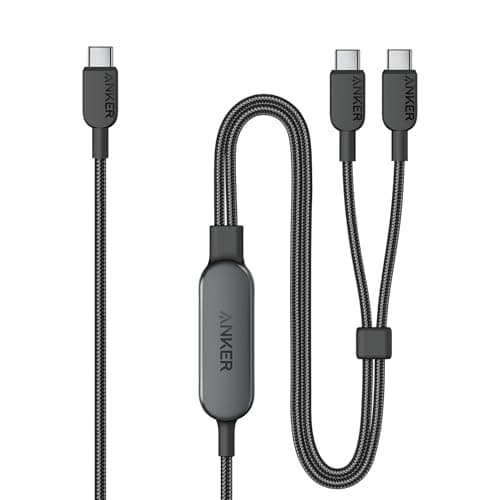
| 1 | Anker 765 USB-C to USB-C Cable (140W) The component that silently caps your charger | Plugs in | 8.6/10 | $15.99 - view on Amazon |
| 2 | Anker Nano Car Charger, 75W Retractable Publishing what each port gets when both are in use | Plugs in | 8.3/10 | $21.37 - view on Amazon |
| 3 | Baseus PrimeTrip VR2 Max 163W Four devices, if you read the split | Plugs in | 8.3/10 | Check price on Amazon |
Prices last verified October 26, 2026. They move constantly; the figure on Amazon when you click is the real one.
The split is the specification
This site has said it before about multi-port chargers and it applies double here: a headline wattage without a per-port breakdown describes nothing.
A charger advertising 67W that caps every port at 35W is a different product from one that gives a single port 65W, and the listings look identical. Anker's 335 and 535 share a headline figure and differ entirely on per-port ceiling, which is the comparison this site already ran — Anker 335 vs 535.
| Anker Nano 75W | Baseus PrimeTrip VR2 Max | |
|---|---|---|
| Headline figure | 75 W | 163 W |
| Retractable cable output | 45 W | 67 W |
| Remaining ports | 30 W on second port | 33 W shared across three |
| Cable lengths | 7.9 / 15.7 / 23.6 / 29.5 in | 31.5 in, dual cables |
| Cable cycle rating | Not published | Stated over 10,000 pulls |
| Ports total | 2 | 4 |
| Operating temperature | Not published | Not published |
Both makers publish the split, which is to their credit and is not universal. The arithmetic that follows is yours: 33W across three ports is around 11W each with all three occupied, which is slower than a basic single-port charger.
Four preset lengths is a real feature
Anker publishes the retractable cable locking at 7.9, 15.7, 23.6 and 29.5 inches.
That matters more than it sounds because cable length in a car is a genuine annoyance in both directions. Too short and the phone cannot reach the mount. Too long and the slack ends up looped around the gear selector or on the floor where your foot finds it.
A cable that locks at a length and stays there removes the daily fiddling that a loose cable creates. It is the actual reason to buy one of these, rather than the wattage.
The trade nobody mentions
A tethered cable means the cable and the charger are now one product with one lifespan.
Retraction mechanisms are the wearing part. Baseus publishes a figure for it — over 10,000 pull and retract cycles — which is a genuinely useful spec and one Anker does not publish. At a couple of cycles a day that is over a decade, so the number is reassuring rather than limiting.
The real consequence is different: when the retractor does jam, or the cable fails internally at the retraction point, you replace the whole charger. With a loose cable you replace a cable. That is the trade, and it is worth knowing rather than discovering.
For context on how much difference a good separate cable makes, Anker publishes 140W, a 35,000-bend lifespan and a 175 lb pull tolerance on the 765 — figures no tethered cable in this category comes near publishing — best USB-C cables for car.
One connector, and what that rules out
The retractable cable is USB-C on both units here. If you carry a Lightning device, or a passenger does, that device is going on the second port with its own cable — which partly defeats the purpose.
- All-USB-C household: a retractable charger is straightforwardly good
- Mixed connectors: you still carry a cable, so the benefit halves
- Passengers who charge: the second port and a loose cable, as before
The broader connector question, including what an E-marker chip does and why a cable without one caps at 3A regardless of the charger, is in USB-A vs USB-C in the car.
What the car can actually supply
A 163W charger plugged into a socket on a circuit fused at 10A has a problem the listing does not mention.
Twelve volts at 10A is roughly 120W before any conversion losses. At 15A it is around 180W. The charger's headline figure can exceed what your car's accessory circuit is designed to deliver, and the fuse is what finds out first.
In practice this rarely bites, because you are never drawing the headline figure. It bites when a high-output charger shares a circuit with something else substantial — best 12V socket splitters has the arithmetic, and how many watts you need covers what your devices actually draw.
If charging is slower than you expect for reasons unrelated to any of this, the usual causes are in why your phone charges slowly in the car.
Every pick, with the working
Each entry lists the specifications the maker publishes, the axis scores those specifications produce, and what you give up. Rows that read “Not published” are not omissions on our side: they are things the maker will not commit to in writing, and they cost the product points on the transparency axis. Specifications compiled September 4, 2026.
Our pickThe component that silently caps your charger
Anker 765 USB-C to USB-C Cable (140W)
Rated to 140W over USB Power Delivery 3.1, with a published 35,000-bend lifespan and a stated 175 lb pull tolerance. Those two durability numbers are the reason to buy a named cable rather than a bundled one: in a car the cable is yanked, trodden on and shut in a door, and it is the part of the charging chain that fails first.
- Power rating
- 140 W
- Standard
- USB Power Delivery 3.1
- Data rate
- 480 Mbps
- Lengths
- 3 ft and 6 ft
- Bend lifespan
- 35,000 bends
- Pull tolerance
- 175 lb
- Jacket
- Nylon braid
- List price
- Not published
- Operating range
- Not published
What it gets right
- 140 W rating means it will never be the bottleneck behind any car charger on this site
- Published 35,000-bend lifespan and 175 lb pull strength — real durability figures, which almost no cable maker gives
- Nylon braid, and available in 3 ft and 6 ft so you can actually reach the back seat
- USB PD 3.1, so it negotiates the higher voltages properly rather than falling back to 5V
Flaws
- 480 Mbps data only. It is a charging cable, not a display or transfer cable
- 140 W is far more than a phone will ever draw — the rating matters for durability and headroom, not speed
- Costs several times a bundled cable, which is the whole objection and the whole point
The working behind the 8.6
- Heat headroom: not scored (weight 22%)
- The maker publishes no operating-temperature ceiling, so this axis is dropped and the other weights are re-normalized.
- Install effort: 10.0 (weight 24%)
- Plugs into a 12V socket or a USB port. Nothing to mount, nothing to route, reversible in a second.
- Price against the ceiling: not scored (weight 24%)
- No published list price we could cite on the compile date, so this axis is dropped and the other weights are re-normalized.
- Written commitment: 7.0 (weight 15%)
- 18-month warranty. This is the only promise in the entire listing that a court would read, which is why it is scored and the marketing copy is not.
- Spec transparency: 7.8 (weight 15%)
- 7 of the 9 specifications we went looking for are published by the maker (78%). A blank row is never a guess here: it prints “Not published” and it costs the product points, because a figure nobody will commit to in writing is a figure you cannot check.
Axes with no published input are dropped and the remaining weights re-normalized, so a product is not punished for a category where an axis does not apply. Specifications compiled September 4, 2026 from Anker's 765 cable specification page.
2Publishing what each port gets when both are in use
Anker Nano Car Charger, 75W Retractable
A built-in retractable USB-C cable with four preset lengths, and — the part that matters — Anker publishes the split: 45W from the retractable cable and 30W from the second port when both are working. A headline wattage without that split tells you nothing.
- Total output
- 75 W
- Shared split
- 45 W retractable + 30 W second port
- Cable lengths
- 7.9 / 15.7 / 23.6 / 29.5 in
- Ports
- Retractable USB-C plus USB-C
- Operating temperature
- Not published
- Warranty
- Not published
- List price
- Not published
What it gets right
- Publishes the shared-power split: 45 W on the retractable cable plus 30 W on the second port
- Retractable cable locks at four published lengths — 7.9, 15.7, 23.6 and 29.5 in
- No loose cable to tangle, fall into a footwell or get shut in a door
- 75 W total is enough to charge a laptop slowly as well as a phone quickly
Flaws
- A tethered cable is a single point of failure — when the retractor wears out, the charger is finished
- The retractable cable is USB-C only, so a Lightning device needs an adapter or the second port
- Fixed maximum length of 29.5 in, which may not reach a rear passenger
- No published operating temperature range
The working behind the 8.3
- Heat headroom: not scored (weight 22%)
- The maker publishes no operating-temperature ceiling, so this axis is dropped and the other weights are re-normalized.
- Install effort: 10.0 (weight 24%)
- Plugs into a 12V socket or a USB port. Nothing to mount, nothing to route, reversible in a second.
- Price against the ceiling: not scored (weight 24%)
- No published list price we could cite on the compile date, so this axis is dropped and the other weights are re-normalized.
- Written commitment: not scored (weight 15%)
- No warranty term published, so this axis is dropped and the other weights are re-normalized.
- Spec transparency: 5.7 (weight 15%)
- 4 of the 7 specifications we went looking for are published by the maker (57%). A blank row is never a guess here: it prints “Not published” and it costs the product points, because a figure nobody will commit to in writing is a figure you cannot check.
Axes with no published input are dropped and the remaining weights re-normalized, so a product is not punished for a category where an axis does not apply. Specifications compiled September 4, 2026 from Anker published output split and cable lengths.
3Four devices, if you read the split
Baseus PrimeTrip VR2 Max 163W
Skip this one. The 163W headline is the sum of every port at once and no device sees anything close to it. Baseus does publish the split — 67W on the first cable and 33W shared across the remaining three — which is more honest than most, and reading it tells you three simultaneous devices get around 11W each. Buy it if you genuinely need four outputs. Do not buy it for the number on the box.
Two retractable cables and two more ports, with a 163W headline that is the sum of everything. The published detail is what matters: 67W on the first cable and 33W shared across the other three ports — so the headline figure is not available to any single device.
- Total output
- 163 W (sum of all ports)
- Per-port split
- 67 W USB-C1, 33 W shared across 3
- Cable length
- 31.5 in, dual retractable
- Cable cycle rating
- Stated over 10,000 pulls
- Operating temperature
- Not published
- Warranty
- Not published
- List price
- Not published
What it gets right
- Publishes the per-port split rather than only the total: 67 W on USB-C1, 33 W shared across the remaining three
- Two retractable USB-C cables at a published 31.5 in, stated tested to over 10,000 pull cycles
- Four outputs from one socket, which removes the need for a splitter
- A published cycle-life figure on the retractor is unusual and directly addresses the category's weak point
Flaws
- 163 W is a sum, not an output — no single device sees anything close to it
- 33 W shared across three ports is about 11 W each if all are in use, which is slow
- Four devices on one 12V socket is a real load against your car's accessory fuse
- No published operating temperature range
The working behind the 8.3
- Heat headroom: not scored (weight 22%)
- The maker publishes no operating-temperature ceiling, so this axis is dropped and the other weights are re-normalized.
- Install effort: 10.0 (weight 24%)
- Plugs into a 12V socket or a USB port. Nothing to mount, nothing to route, reversible in a second.
- Price against the ceiling: not scored (weight 24%)
- No published list price we could cite on the compile date, so this axis is dropped and the other weights are re-normalized.
- Written commitment: not scored (weight 15%)
- No warranty term published, so this axis is dropped and the other weights are re-normalized.
- Spec transparency: 5.7 (weight 15%)
- 4 of the 7 specifications we went looking for are published by the maker (57%). A blank row is never a guess here: it prints “Not published” and it costs the product points, because a figure nobody will commit to in writing is a figure you cannot check.
Axes with no published input are dropped and the remaining weights re-normalized, so a product is not punished for a category where an axis does not apply. Specifications compiled September 4, 2026 from Baseus published per-port output and cable cycle testing.
Prices last verified October 26, 2026. They move constantly; the figure on Amazon when you click is the real one.
Questions people actually ask
Is a 163W car charger really 163 watts?
It is the sum of all ports at once. Baseus publishes the split: 67W on the first cable and 33W shared across three more ports. No single device sees anything close to the headline.
How long is the cable on a retractable car charger?
Anker publishes four locking lengths — 7.9, 15.7, 23.6 and 29.5 inches. Measure from your 12V socket to where the phone sits, because the maximum is fixed and cannot be extended.
Do retractable cables wear out?
Baseus publishes a rating of over 10,000 pull and retract cycles, which is over a decade at normal use. The real consequence is that when it does fail you replace the whole charger rather than a cable.
Can my car supply a high-wattage charger?
The accessory circuit is typically fused at 10 to 20A — roughly 120-240W before conversion losses. A high-output charger can exceed that on paper, though in practice you rarely draw the headline. It matters when the circuit is shared.