The best USB-C cables for a car
The cheapest component in the charging chain, the one most likely to be the bottleneck, and the only one nobody researches. A cable rated below your charger silently caps it, and no warning appears anywhere.
By Sawyer V. · Published · How we research
We have not tested any of this. Everything below is compiled from published manufacturer specifications, and the arithmetic is printed so you can check it. This page carries affiliate links: if you buy through one we earn a commission at no extra cost to you, and it does not change the order of the picks. Full disclosure.
The short answer
The cable is the part of the chain nobody checks, and it caps everything silently. A cable rated for 60 W carries 60 W whatever the charger can supply — above that a cable needs an E-marker chip, and cheap cables do not have one. The Anker 765 publishes 140 W, a 35,000-bend lifespan and a 175 lb pull tolerance, which are the three numbers that matter in a car specifically: it will never be the bottleneck, and it survives being trodden on, yanked and shut in a door. Cheaper route: the UGREEN 130 W charger includes a 100 W E-marked cable in the box.
| # | Pick | Install | Score | Price |
|---|---|---|---|---|
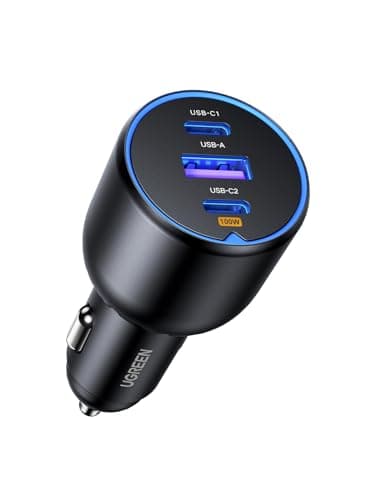
| 1 | UGREEN 130W 3-Port Car Charger A laptop and two phones at once | Plugs in | 9.5/10 | $21.99 - view on Amazon |
| 2 | Anker 323 Car Charger (52.5W) The one most people should actually buy | Plugs in | 9.2/10 | $14.99 - view on Amazon |
| 3 | Anker 765 USB-C to USB-C Cable (140W) The component that silently caps your charger | Plugs in | 8.6/10 | $19.99 - view on Amazon |
Prices last verified October 19, 2026. They move constantly; the figure on Amazon when you click is the real one.
The chain, and its weakest link
Charging speed is decided by the lowest of three ceilings, and only two of them are ever advertised:
| Link | Typical ceiling | Advertised? |
|---|---|---|
| Charger port | 30 W to 100 W | Yes, prominently |
| Cable | 60 W without an E-marker, up to 240 W with | Rarely |
| Device | 20 W to 45 W for phones, 45 W to 100 W for laptops | Sometimes |
This is why buying a 100 W car charger and using the cable that came with your phone is the most common way people spend money on charging and change nothing at all.
The E-marker, in one paragraph
USB-C cables carry a small chip that tells the charger what the cable can handle. Without one, the standard caps the cable at 3 A — which at 20 V is 60 W and is where every unmarked cable stops. With one, the cable can declare 5 A, and 5 A at 20 V is the 100 W that a laptop actually wants.
You cannot see an E-marker. It is not printed on the cable, it is not visible in the connector, and there is no indicator anywhere in the charging process telling you the cable just limited you. The only way to know is that the maker published it — which is why this page exists at all.
The four things worth checking
- Published wattage. Match or exceed your charger's best port. Anker publishes 140 W on the 765, which comfortably exceeds every charger on this site.
- Bend lifespan. Anker publishes 35,000 bends. Almost nobody else publishes any durability figure, which is exactly the transparency gap this site scores on.
- Length, chosen for the seat you charge in. Three feet reaches the console. Six feet reaches the back seat. A three-port charger with three short cables is, in practice, a one-port charger.
- Jacket. Nylon braid resists the abrasion of being dragged across a seat rail. Bare TPE does not, and it is where the splits start.
Ignore the data rate
The Anker 765 publishes 480 Mbps, which is USB 2.0 speed and sounds bad next to a modern transfer cable. In a car it is completely irrelevant: you are charging, not moving files.
Buying a high-data-rate cable for a car is paying for a specification that has no effect on anything you will do with it. Charging wattage and physical durability are the whole purchase.
How many cables, and where
Three, and this is the arrangement that ends most charging complaints:
- One short cable that lives in the car permanently. Never leaves, never gets borrowed for the house, never goes missing on the day you need it. This is the one on the permanent-items list.
- One long cable for the back seat. Six feet. Passengers stop asking.
- One in the trunk with the rest of the kit, because the day the permanent one fails is a day you did not plan for.
Do not leave a cable on the dashboard
The top of a dashboard in direct sun is the hottest accessible surface in the car — the same environment that softens the adhesive on phone mounts. Cable jackets and the strain relief at the connector both age faster there.
Route the cable down and into the console rather than across the dash. It is free, it looks tidier, and it is the difference between replacing a cable every year and not thinking about it.
What we cannot tell you
Whether Anker's 35,000-bend figure holds up, because we have not bent one 35,000 times. It is the maker's own published number, it is more than anyone else in this category publishes, and it is labeled as their claim rather than our finding. The method is here.
Every pick, with the working
Each entry lists the specifications the maker publishes, the axis scores those specifications produce, and what you give up. Rows that read “Not published” are not omissions on our side: they are things the maker will not commit to in writing, and they cost the product points on the transparency axis. Specifications compiled September 4, 2026.
Our pickA laptop and two phones at once
UGREEN 130W 3-Port Car Charger
Three ports totaling 130W with one USB-C rated at 100W on its own, a 100W E-marked cable in the box, and a published 45-gram weight. It is the only charger here that will genuinely run a laptop at full speed, and it costs less than the 67W chargers do because UGREEN prices aggressively.
- Ports
- 2 x USB-C, 1 x USB-A
- Total output
- 130 W
- USB-C 1 maximum
- 30 W
- USB-C 2 maximum
- 100 W
- USB-A maximum
- 22.5 W (SCP) / 18 W (QC 3.0)
- Protocols
- PD 3.0, QC 4.0, QC 3.0, SCP, AFC, PPS
- In the box
- 100 W E-marked USB-C to USB-C cable
- Weight
- 45 g
- Warranty
- Not published
- Operating range
- Not published
List price $22.49 per UGREEN's own store, sale price (regular $39.99), captured on the compile date below. Not a live price and not what you will pay — the button is where the real number is.
What it gets right
- 100 W on a single USB-C port, which is a real laptop charge rather than a trickle
- A 100 W E-marked USB-C cable is included, and that cable alone is often $15
- Publishes both per-port ceilings separately (30 W and 100 W) instead of one combined figure
- Broad protocol support: PD 3.0, QC 4.0, QC 3.0, SCP, AFC and PPS
Flaws
- 130 W in a 12V socket is close to what many car circuits are fused for; check your fuse rating
- The second USB-C port is only 30 W, so it is not two laptop ports
- UGREEN publishes no warranty term and no operating-temperature range
The working behind the 9.5
- Heat headroom: not scored (weight 22%)
- The maker publishes no operating-temperature ceiling, so this axis is dropped and the other weights are re-normalized.
- Install effort: 10.0 (weight 24%)
- Plugs into a 12V socket or a USB port. Nothing to mount, nothing to route, reversible in a second.
- Price against the ceiling: 10.0 (weight 24%)
- Listed at $22.49 on the compile date. This site's buyer has a practical ceiling around $150 for a single upgrade, so the scale rewards everything under $100 and falls away sharply past $150. The live price is very often different, and that is what the button is for.
- Written commitment: not scored (weight 15%)
- No warranty term published, so this axis is dropped and the other weights are re-normalized.
- Spec transparency: 8.0 (weight 15%)
- 8 of the 10 specifications we went looking for are published by the maker (80%). A blank row is never a guess here: it prints “Not published” and it costs the product points, because a figure nobody will commit to in writing is a figure you cannot check.
Axes with no published input are dropped and the remaining weights re-normalized, so a product is not punished for a category where an axis does not apply. Specifications compiled September 4, 2026 from UGREEN's 130W car charger product page.
2The one most people should actually buy
Anker 323 Car Charger (52.5W)
Skip this one. It is a charger, not a cable, and it is on this page as the reality check: at 30 W on USB-C it will never out-run even a cheap cable. If this is your charger, the expensive cable is solving a problem you do not have — spend the money on the charger instead.
Two ports, 52.5W total, and a published voltage table showing 30W maximum on the USB-C port. Thirty watts charges any phone at or near its own ceiling, which means the 67W chargers above it are selling you headroom nothing in your pocket can use. At $19.99 this is the honest default.
- Ports
- 1 x USB-C, 1 x USB-A
- Total output
- 52.5 W
- USB-C output
- 5V/3A, 9V/3A, 12V/2.5A, 15V/2A, 20V/1.5A (30 W max)
- USB-A output
- 5V/3A, 9V/2A, 10V/2.25A (22.5 W max)
- Input
- 12V at 5.6 A, 24V at 3.6 A
- Safety
- ActiveShield 2.0
- Model
- A2735
- Warranty
- 18 months
- Operating range
- Not published
List price $19.99 per Anker's own store, captured on the compile date below. Not a live price and not what you will pay — the button is where the real number is.
What it gets right
- Anker publishes the full PDO table — 5V/3A, 9V/3A, 12V/2.5A, 15V/2A, 20V/1.5A — rather than a headline number
- 30 W on USB-C is at or above what almost every phone will accept
- Input rated 12V and 24V, so it works in a truck as well as a car
- $19.99 list and physically small, which matters in a tight console
Flaws
- Two ports, not three. A second passenger and a tablet is one device too many
- 30 W will not charge a laptop at any useful speed
- The USB-A port tops out at 22.5 W, so it is the slow one
The working behind the 9.2
- Heat headroom: not scored (weight 22%)
- The maker publishes no operating-temperature ceiling, so this axis is dropped and the other weights are re-normalized.
- Install effort: 10.0 (weight 24%)
- Plugs into a 12V socket or a USB port. Nothing to mount, nothing to route, reversible in a second.
- Price against the ceiling: 10.0 (weight 24%)
- Listed at $19.99 on the compile date. This site's buyer has a practical ceiling around $150 for a single upgrade, so the scale rewards everything under $100 and falls away sharply past $150. The live price is very often different, and that is what the button is for.
- Written commitment: 7.0 (weight 15%)
- 18-month warranty. This is the only promise in the entire listing that a court would read, which is why it is scored and the marketing copy is not.
- Spec transparency: 8.9 (weight 15%)
- 8 of the 9 specifications we went looking for are published by the maker (89%). A blank row is never a guess here: it prints “Not published” and it costs the product points, because a figure nobody will commit to in writing is a figure you cannot check.
Axes with no published input are dropped and the remaining weights re-normalized, so a product is not punished for a category where an axis does not apply. Specifications compiled September 4, 2026 from Anker's 323 Car Charger product page.
3The component that silently caps your charger
Anker 765 USB-C to USB-C Cable (140W)
Rated to 140W over USB Power Delivery 3.1, with a published 35,000-bend lifespan and a stated 175 lb pull tolerance. Those two durability numbers are the reason to buy a named cable rather than a bundled one: in a car the cable is yanked, trodden on and shut in a door, and it is the part of the charging chain that fails first.
- Power rating
- 140 W
- Standard
- USB Power Delivery 3.1
- Data rate
- 480 Mbps
- Lengths
- 3 ft and 6 ft
- Bend lifespan
- 35,000 bends
- Pull tolerance
- 175 lb
- Jacket
- Nylon braid
- List price
- Not published
- Operating range
- Not published
What it gets right
- 140 W rating means it will never be the bottleneck behind any car charger on this site
- Published 35,000-bend lifespan and 175 lb pull strength — real durability figures, which almost no cable maker gives
- Nylon braid, and available in 3 ft and 6 ft so you can actually reach the back seat
- USB PD 3.1, so it negotiates the higher voltages properly rather than falling back to 5V
Flaws
- 480 Mbps data only. It is a charging cable, not a display or transfer cable
- 140 W is far more than a phone will ever draw — the rating matters for durability and headroom, not speed
- Costs several times a bundled cable, which is the whole objection and the whole point
The working behind the 8.6
- Heat headroom: not scored (weight 22%)
- The maker publishes no operating-temperature ceiling, so this axis is dropped and the other weights are re-normalized.
- Install effort: 10.0 (weight 24%)
- Plugs into a 12V socket or a USB port. Nothing to mount, nothing to route, reversible in a second.
- Price against the ceiling: not scored (weight 24%)
- No published list price we could cite on the compile date, so this axis is dropped and the other weights are re-normalized.
- Written commitment: 7.0 (weight 15%)
- 18-month warranty. This is the only promise in the entire listing that a court would read, which is why it is scored and the marketing copy is not.
- Spec transparency: 7.8 (weight 15%)
- 7 of the 9 specifications we went looking for are published by the maker (78%). A blank row is never a guess here: it prints “Not published” and it costs the product points, because a figure nobody will commit to in writing is a figure you cannot check.
Axes with no published input are dropped and the remaining weights re-normalized, so a product is not punished for a category where an axis does not apply. Specifications compiled September 4, 2026 from Anker's 765 cable specification page.
Prices last verified October 19, 2026. They move constantly; the figure on Amazon when you click is the real one.
Questions people actually ask
Does the USB-C cable really affect charging speed?
Yes, and silently. Without an E-marker chip a cable is capped at 3 A — 60 W at 20 V — no matter what the charger can supply. Nothing warns you; the phone just charges more slowly than it should.
How do I tell if a cable has an E-marker?
You cannot see it. It is not printed on the cable or visible in the connector. The only reliable signal is the maker publishing a wattage above 60 W, which is why buying a named cable with a published rating is the whole point.
Do I need a 140W cable for a phone?
No — phones cap between about 20 and 45 W, so any decent cable covers it. You buy the higher rating for headroom and, more usefully in a car, for the durability figures that tend to come with it.
What length should I get?
Three feet if the phone lives on a mount by the console, six feet if anyone charges from the back seat. A multi-port charger with only short cables is functionally a single-port charger.