The best 12V car heaters and defrosters
A socket-powered heater has one tenth the power of the fan heater in your bathroom. That arithmetic decides what these can honestly do — and it is not heating a cabin.
By Sawyer V. · Published · How we research
We have not tested any of this. Everything below is compiled from published manufacturer specifications, and the arithmetic is printed so you can check it. This page carries affiliate links: if you buy through one we earn a commission at no extra cost to you, and it does not change the order of the picks. Full disclosure.
The verdict
Buy the 120W 2-in-1 unit at around $20 if your socket is on a 10 amp fuse, and the 150W unit at around $24 if it is on 15 amps. Then expect a clear patch of windshield, not a warm car. A 12V socket is fused at 10 to 15 amps, which caps you at roughly 120 to 180 watts. The fan heater in your bathroom is 1500 watts. These devices have under a tenth of the power and cannot heat a cabin — anything claiming otherwise is claiming something the wiring cannot supply. Prices as of October 11, 2026.
Who should skip the whole category: anyone who wants a warm car. Your engine's heater produces several kilowatts once warm, and nothing you plug into a cigarette lighter competes with it. Buy one of these only as a targeted demister for the patch of glass in front of you.
| # | Pick | Install | Score | Price |
|---|---|---|---|---|
| 1 | 120W 2-in-1 Car Heater and Cooler Fan The one that fits a 10A fuse, and works year round | Plugs in | 9.1/10 | $19.99 - view on Amazon |
| 2 | 12V 150W Portable Car Heater and Demister The highest wattage a 12V socket can honestly carry | Plugs in | 9.0/10 | $23.99 - view on Amazon |
| 3 | 12V 200W Portable Car Heater and Defroster Skip it — 200W is more than the socket can supply | Plugs in | 9.0/10 | $23.99 - view on Amazon |
| 4 | 12V 200W Car Heater and Defroster, budget listing Skip it — the same arithmetic problem, four dollars cheaper | Plugs in | 9.0/10 | $19.99 - view on Amazon |
Prices last verified October 11, 2026. They move constantly; the figure on Amazon when you click is the real one.
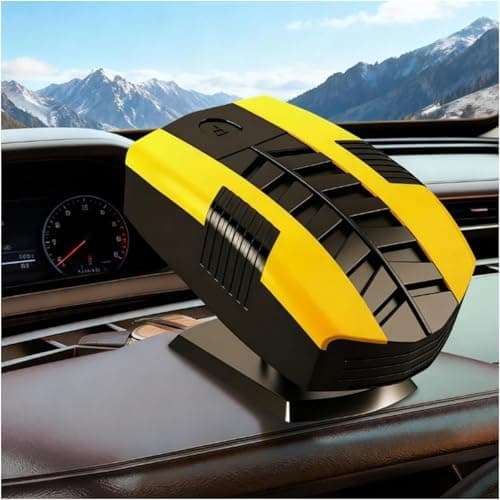
The arithmetic, which settles the whole category
Watts divided by volts gives amps. That one line explains everything about what a socket-powered heater can and cannot do.
| Claimed wattage | Current at 12V | On a 10 A fuse | On a 15 A fuse |
|---|---|---|---|
| 120 W | 10 A | At the limit | Fine |
| 150 W | 12.5 A | Blows it | Fine |
| 200 W | 16.7 A | Blows it | Blows it |
| 1500 W (home fan heater) | 125 A | Not possible | Not possible |
The last row is the one worth sitting with. A domestic fan heater that struggles to warm a small bathroom draws more than a hundred amps at 12 volts — roughly what a starter motor pulls. A cigarette-lighter socket is not in the same conversation, and no product can argue its way around that.
What 150 watts genuinely achieves
Pointed at a cabin, almost nothing. Pointed at twelve inches of windshield from six inches away, quite a lot — and that is the honest use case.
- Clearing a patch of interior fog while the engine warms up. This is the job these do best, and on a short commute the engine heater may never fully arrive
- Keeping a cleared patch clear after you have scraped, by moving dry air across it
- Taking the edge off your hands at a standstill
What they cannot do: melt ice from the outside of a windshield at any useful rate, warm a back seat, or heat a parked car. For exterior ice, a windshield cover fitted the night before removes the problem entirely and costs about the same.
Who each one is for
- 120W 2-in-1 — most cars, and the only one plausible on a 10 amp fuse. Exactly 10 A at its claimed wattage, and it switches to a plain fan in summer so it is not dead weight eight months of the year. Skip it if your socket is shared with a charger, because 10 A is the whole budget
- 150W — the honest ceiling, if your fuse is 15 amps. 12.5 A, comfortably inside a 15 A circuit and over a 10 A one. The most heat you can legitimately draw from a cigarette lighter. Skip it without checking your fuse rating first
- Both 200W units — nobody. See the skip notes
Check your fuse before you buy
This takes two minutes and decides which of these you can use at all.
- The owner's manual lists it, usually as “accessory socket”, “cigar lighter” or “power outlet”, with an amp rating
- The fuse itself is color-coded. Red is 10 A, blue is 15 A, yellow is 20 A on standard blade fuses
- Check whether sockets share a circuit. On many cars the front and rear outlets are on one fuse, so a heater in front and anything at all in the back are drawing from the same budget
If you are running several accessories at once, the sharing problem is covered in best 12V socket splitters, and the general arithmetic is in how many watts do you need. Never run one of these with the engine off: a heating element is among the highest-draw accessories there is, and a car battery is sized to start an engine rather than run a heater.
Three things that work better for the same money
If the real complaint is being cold in the car, these all do more per dollar than a 150 watt fan.
A heated seat cushion puts its power directly into the surface you are touching instead of into the air, which is a far more efficient way to feel warm. A heated wheel cover does the same for your hands, which are the part that actually hurts. And for a passenger or the back seat, a 12V heated blanket covers far more of a person than a fan ever reaches.
If fogging rather than cold is the real problem, the technique beats the product — how to defog your windshield — and an anti-fog treatment keeps the glass clear for weeks for about six dollars.
Every pick, with the working
Each entry lists the specifications the maker publishes, the axis scores those specifications produce, and what you give up. Rows that read “Not published” are not omissions on our side: they are things the maker will not commit to in writing, and they cost the product points on the transparency axis. Specifications compiled September 4, 2026.
Our pickThe one that fits a 10A fuse, and works year round
120W 2-in-1 Car Heater and Cooler Fan
One hundred and twenty watts is 10 amps at 12 volts, which is the only unit here that has a chance on a 10 A socket circuit — and it switches to a plain fan in summer, which doubles its useful months. Lower wattage means less heat, but a heater that trips your fuse produces no heat at all, so the arithmetic favors this one in most cars.
- Power
- 120 W
- Current at 12V
- 10 A, calculated from the published 120 W
- Modes
- Heating and cooling
- Function
- Windshield defroster and defogger
- Power source
- 12V socket
- Airflow
- Not published
- Cable length
- Not published
- Warranty
- Not published
List price $19.99 per Amazon listing, October 11, 2026, captured on the compile date below. Not a live price and not what you will pay — the button is where the real number is.
What it gets right
- 120 W, the lowest draw here at 10 A — the only one plausible on a 10 A fuse
- Switches to cooling-fan mode, so it is not dead weight for eight months of the year
- Cheapest of the four at the price captured
- Sold as a windshield defroster and defogger, which is the realistic use
Flaws
- 10 A is still the entire budget of a 10 A circuit, with nothing left for a charger
- 120 W is the least heat of the four
- No published airflow, dimensions or cable length
- As a cooling fan it has no blade-size figure, so it cannot be compared to a real car fan
The working behind the 9.1
- Heat headroom: not scored (weight 22%)
- The maker publishes no operating-temperature ceiling, so this axis is dropped and the other weights are re-normalized.
- Install effort: 10.0 (weight 24%)
- Plugs into a 12V socket or a USB port. Nothing to mount, nothing to route, reversible in a second.
- Price against the ceiling: 10.0 (weight 24%)
- Listed at $19.99 on the compile date. This site's buyer has a practical ceiling around $150 for a single upgrade, so the scale rewards everything under $100 and falls away sharply past $150. The live price is very often different, and that is what the button is for.
- Written commitment: not scored (weight 15%)
- No warranty term published, so this axis is dropped and the other weights are re-normalized.
- Spec transparency: 6.3 (weight 15%)
- 5 of the 8 specifications we went looking for are published by the maker (63%). A blank row is never a guess here: it prints “Not published” and it costs the product points, because a figure nobody will commit to in writing is a figure you cannot check.
Axes with no published input are dropped and the remaining weights re-normalized, so a product is not punished for a category where an axis does not apply. Specifications compiled September 4, 2026 from the 120W 2-in-1 car heater and cooler fan listing.
2The highest wattage a 12V socket can honestly carry
12V 150W Portable Car Heater and Demister
One hundred and fifty watts is 12.5 amps at 12 volts, which is inside a 15 A socket fuse and over a 10 A one. That makes this about the ceiling of what a cigarette-lighter heater can legitimately draw, and anything claiming much more on the same plug is claiming something the socket cannot deliver. Treat it as a demister for a patch of windshield, not as cabin heating.
- Power
- 150 W
- Current at 12V
- 12.5 A, calculated from the published 150 W
- Function
- Windshield demister and defroster
- Power source
- 12V socket
- Airflow
- Not published
- Cable length
- Not published
- Warranty
- Not published
List price $23.99 per Amazon listing, October 11, 2026, captured on the compile date below. Not a live price and not what you will pay — the button is where the real number is.
What it gets right
- 150 W published, which is at the honest limit of a 15 A socket circuit
- Sold as a windshield demister and defroster, which is the job it can actually do
- Plugs straight into the 12V socket with no installation
Flaws
- 12.5 A at 12 V will blow a 10 A socket fuse — check yours first
- 150 W cannot heat a cabin; a domestic fan heater is ten times this
- No published airflow, dimensions, cable length or operating range
- Needs the engine running, so it does nothing for a parked car
The working behind the 9.0
- Heat headroom: not scored (weight 22%)
- The maker publishes no operating-temperature ceiling, so this axis is dropped and the other weights are re-normalized.
- Install effort: 10.0 (weight 24%)
- Plugs into a 12V socket or a USB port. Nothing to mount, nothing to route, reversible in a second.
- Price against the ceiling: 10.0 (weight 24%)
- Listed at $23.99 on the compile date. This site's buyer has a practical ceiling around $150 for a single upgrade, so the scale rewards everything under $100 and falls away sharply past $150. The live price is very often different, and that is what the button is for.
- Written commitment: not scored (weight 15%)
- No warranty term published, so this axis is dropped and the other weights are re-normalized.
- Spec transparency: 5.7 (weight 15%)
- 4 of the 7 specifications we went looking for are published by the maker (57%). A blank row is never a guess here: it prints “Not published” and it costs the product points, because a figure nobody will commit to in writing is a figure you cannot check.
Axes with no published input are dropped and the remaining weights re-normalized, so a product is not punished for a category where an axis does not apply. Specifications compiled September 4, 2026 from the 12V 150W portable car heater listing.
3Skip it — 200W is more than the socket can supply
12V 200W Portable Car Heater and Defroster
Skip this one. 200 W at 12 V is 16.7 amps, and a 12V accessory socket is typically fused at 10 to 15 amps. Either the unit does not draw what it claims, or it trips your fuse. A headline the circuit cannot supply is not a feature.
Two hundred watts at 12 volts is 16.7 amps. A 12V accessory socket is typically fused at 10 to 15 amps, so this unit asks for more current than the circuit it plugs into is rated to give. Either it does not actually draw its claimed 200 W, or it blows your fuse. Neither outcome is a reason to buy it over the 150 W unit.
- Power
- 200 W, claimed
- Current at 12V
- 16.7 A, calculated from the claimed 200 W
- Function
- Windshield defroster, fast heating
- Power source
- 12V socket
- Airflow
- Not published
- Cable length
- Not published
- Warranty
- Not published
List price $23.99 per Amazon listing, October 11, 2026, captured on the compile date below. Not a live price and not what you will pay — the button is where the real number is.
What it gets right
- Highest claimed wattage in this group
- Sold with fast heating and a defroster function
Flaws
- 16.7 A exceeds the fuse on essentially every standard 12V accessory socket
- The claim and the socket cannot both be true, and the listing does not resolve it
- No published airflow, dimensions, cable length or current draw of its own
The working behind the 9.0
- Heat headroom: not scored (weight 22%)
- The maker publishes no operating-temperature ceiling, so this axis is dropped and the other weights are re-normalized.
- Install effort: 10.0 (weight 24%)
- Plugs into a 12V socket or a USB port. Nothing to mount, nothing to route, reversible in a second.
- Price against the ceiling: 10.0 (weight 24%)
- Listed at $23.99 on the compile date. This site's buyer has a practical ceiling around $150 for a single upgrade, so the scale rewards everything under $100 and falls away sharply past $150. The live price is very often different, and that is what the button is for.
- Written commitment: not scored (weight 15%)
- No warranty term published, so this axis is dropped and the other weights are re-normalized.
- Spec transparency: 5.7 (weight 15%)
- 4 of the 7 specifications we went looking for are published by the maker (57%). A blank row is never a guess here: it prints “Not published” and it costs the product points, because a figure nobody will commit to in writing is a figure you cannot check.
Axes with no published input are dropped and the remaining weights re-normalized, so a product is not punished for a category where an axis does not apply. Specifications compiled September 4, 2026 from the 12V 200W car heater listing.
4Skip it — the same arithmetic problem, four dollars cheaper
12V 200W Car Heater and Defroster, budget listing
Skip this one. The same impossible 200 W claim on the same 12V plug, four dollars cheaper. A lower price on a specification the socket cannot deliver is still a specification the socket cannot deliver.
The same claimed 200 W on the same 12V plug as the unit above, four dollars cheaper. The same objection applies: 16.7 amps is more than a 10 to 15 amp socket circuit is fused for. A lower price on an impossible specification is still an impossible specification.
- Power
- 200 W, claimed
- Current at 12V
- 16.7 A, calculated from the claimed 200 W
- Function
- Heating and defrosting
- Power source
- 12V socket
- Airflow
- Not published
- Cable length
- Not published
- Warranty
- Not published
List price $19.99 per Amazon listing, October 11, 2026, captured on the compile date below. Not a live price and not what you will pay — the button is where the real number is.
What it gets right
- Cheapest of the two 200 W claims
- Plug-and-play from the 12V socket
Flaws
- 16.7 A at the claimed wattage, against a 10 to 15 A socket fuse
- Nothing published beyond the wattage claim and the plug type
- No brand, no product page, no warranty
The working behind the 9.0
- Heat headroom: not scored (weight 22%)
- The maker publishes no operating-temperature ceiling, so this axis is dropped and the other weights are re-normalized.
- Install effort: 10.0 (weight 24%)
- Plugs into a 12V socket or a USB port. Nothing to mount, nothing to route, reversible in a second.
- Price against the ceiling: 10.0 (weight 24%)
- Listed at $19.99 on the compile date. This site's buyer has a practical ceiling around $150 for a single upgrade, so the scale rewards everything under $100 and falls away sharply past $150. The live price is very often different, and that is what the button is for.
- Written commitment: not scored (weight 15%)
- No warranty term published, so this axis is dropped and the other weights are re-normalized.
- Spec transparency: 5.7 (weight 15%)
- 4 of the 7 specifications we went looking for are published by the maker (57%). A blank row is never a guess here: it prints “Not published” and it costs the product points, because a figure nobody will commit to in writing is a figure you cannot check.
Axes with no published input are dropped and the remaining weights re-normalized, so a product is not punished for a category where an axis does not apply. Specifications compiled September 4, 2026 from the budget 12V 200W car heater listing.
Prices last verified October 11, 2026. They move constantly; the figure on Amazon when you click is the real one.
Questions people actually ask
Do 12V car heaters actually work?
As windshield demisters, yes, in a limited way. As cabin heaters, no. A 12V socket is fused at 10 to 15 amps, which caps these at roughly 120 to 180 watts, against the 1500 watts of a domestic fan heater. Expect a clear patch of glass, not a warm car.
How many watts can a car cigarette lighter socket supply?
Roughly 120 to 180 watts, depending on whether the circuit is fused at 10 or 15 amps. Watts divided by volts gives amps, so a 150 W heater draws 12.5 A and a 200 W one draws 16.7 A — more than any standard accessory socket is rated for.
Will a 12V car heater drain my battery?
With the engine running, no — the alternator covers it. With the engine off, very quickly. A heating element is one of the highest-draw things you can plug into a car, and a battery is sized to start an engine, not to run a heater. Never leave one running in a parked car.
Can a 12V heater defrost ice on the outside of my windshield?
Not at any useful rate. These move a small volume of warm air against the inside of the glass; exterior ice needs either the car's own defroster running on a warm engine or mechanical removal. A windshield cover fitted the night before avoids the problem for about the same money.
Heated seat cushion or 12V car heater?
A cushion, if the goal is to feel warm. It puts its wattage into the surface against your body rather than into cabin air that is constantly leaking out of the car. The fan heater only wins if your actual problem is a fogged windshield rather than being cold.