The best dash cams for night driving
4K does not help after dark and can actively hurt. The two figures that decide a night image are the aperture and the sensor generation, and almost nobody prints the first one.
By Sawyer V. · Published · How we research
We have not tested any of this. Everything below is compiled from published manufacturer specifications, and the arithmetic is printed so you can check it. This page carries affiliate links: if you buy through one we earn a commission at no extra cost to you, and it does not change the order of the picks. Full disclosure.
The short answer
Buy the VIOFO A119 Mini 2. It publishes an f/1.6 aperture and a Sony STARVIS 2 IMX675 sensor, and it is one of only three products in this entire ledger that state an aperture at all. The Rove R2-4K publishes a wider f/1.5 and is the better buy on that figure alone — but it publishes no operating-temperature range, which is a real gap on a windshield device. Resolution is not the night specification: a 4K sensor the same physical size as a 1440p one has smaller pixels, and smaller pixels gather less light.
| # | Pick | Install | Score | Price |
|---|---|---|---|---|
| 1 | VIOFO A119 Mini 2 The one to buy if you only buy one | Adhesive | 6.7/10 | $129.99 - view on Amazon |
| 2 | Vantrue N4 Three channels, including the cabin | Adhesive | 6.6/10 | $169.99 - view on Amazon |
| 3 | ROVE R2-4K The most sensor for the money | Adhesive | 6.3/10 | $99.99 - view on Amazon |
| 4 | Garmin Dash Cam X110 The current Garmin at the bottom of the range | Adhesive | 5.5/10 | $189.99 - view on Amazon |
Prices last verified September 27, 2026. They move constantly; the figure on Amazon when you click is the real one.
What to look for, before any product
Night performance comes down to how much light reaches the sensor and how well that sensor handles a small amount of it. Four things decide it, in order of how much they matter.
- Aperture. The f-number, and a lower number is a wider opening letting in more light. This is the single most relevant figure for a night image and three products in this whole ledger publish it: the Rove R2-4K at f/1.5, the VIOFO A119 Mini 2 at f/1.6 and the AUTO-VOX V5PRO at F/1.8. Everyone else says “night vision”.
- Sensor generation. Sony STARVIS was designed for low light, and STARVIS 2 is the newer version. A published sensor part number is a checkable claim; the phrase “super night vision” is not.
- HDR. Night driving is not uniformly dark — it is a dark road punctuated by oncoming headlights. HDR is what stops those headlights blowing out the frame and hiding the plate behind them.
- Resolution, last and sometimes backwards. See below.
Why 4K can be worse at night
This is the counterintuitive part and it is straightforward optics. A sensor has a fixed physical area. Divide that area into more pixels and each individual pixel is smaller, which means each one collects fewer photons in a given moment. In good light that does not matter and you get more detail. In low light it does matter, and a 1440p sensor of the same size can produce a cleaner night image than a 4K one.
Which is why the VIOFO’s 2560 x 1440 at 60 fps is not a compromise against a 4K camera at night — the extra frame rate also helps, because a plate on a moving car is a motion-blur problem as much as a brightness one. The full argument about resolution claims is on dash cam resolution explained.
The published figures
| Aperture | Sensor | Front resolution | Operating range | |
|---|---|---|---|---|
| VIOFO A119 Mini 2 | f/1.6 | Sony STARVIS 2 IMX675, 5MP | 2560 x 1440 at 60fps | -20 C to 65 C |
| Rove R2-4K | f/1.5 | Not published here | 3840 x 2160 | Not published |
| Garmin Dash Cam X110 | Not published | Not published | 1920 x 1080 at 30fps | Not published |
| Vantrue N4 | Not published | Sony STARVIS with IR cabin | 1440p, or 4K front only | -10 C to 70 C |
The other half of night driving is glare
A camera problem and a driver problem share a cause here: light scattering off the inside of the windshield. Garmin is the only maker on this page that addresses it in the product, publishing a built-in Clarity polarizer — which reduces the windshield reflections that otherwise appear in night footage as a ghost image of your own dashboard.
For the driver, the fix is free and almost nobody does it: clean the inside of the glass. The film that off-gasses onto a windshield is the single biggest contributor to oncoming headlight starbursts — how to stop glare while driving covers it, and how to clean car windows without streaks covers the method.
If you need to see inside the car at night
A forward camera sees nothing of the cabin, and no amount of aperture changes that. Infrared is a separate capability, and the Vantrue N4 is the only camera here that has it — a third channel pointed inward with IR illumination so it works in complete darkness.
That is a rideshare and supervised-driver feature rather than a night-driving one, and whether the third channel earns its place is worked through on dual channel against three channel.
Three settings that matter more than the purchase
- Mount high and central, behind the mirror. Low on the glass puts more dashboard in frame, and a lit dashboard reflecting into the lens is the most common cause of a washed-out night image.
- Turn the screen off or on a timer. A bright camera display at night both distracts you and reflects in the windshield.
- Keep the windshield clean on the inside — see above. It is free and it does more for night footage than a spec upgrade.
- Use a high-endurance card. Night driving is when you most want the footage to actually be there — SD cards for dash cams covers why a consumer card fails.
Every pick, with the working
Each entry lists the specifications the maker publishes, the axis scores those specifications produce, and what you give up. Rows that read “Not published” are not omissions on our side: they are things the maker will not commit to in writing, and they cost the product points on the transparency axis. Specifications compiled September 4, 2026.
Our pickThe one to buy if you only buy one
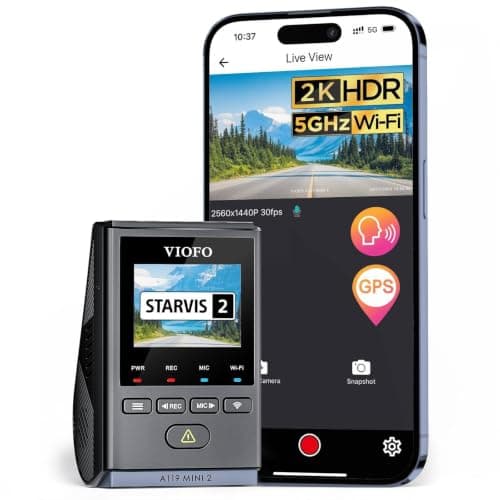
VIOFO A119 Mini 2
A Sony STARVIS 2 IMX675 sensor at 2K 60fps, a supercapacitor, a published 65 C ceiling, an 18-month warranty and three named parking modes including buffered recording. VIOFO publishes more about this camera than anyone else here publishes about anything, and that is the reason it wins: every claim on the page is one you can check.
- Front resolution
- 2560 x 1440 at 60fps
- Image sensor
- Sony STARVIS 2 IMX675, 5MP
- Field of view
- 140 degrees
- Aperture
- f/1.6
- Power store
- Supercapacitor, no battery
- Operating range
- -20 C to 65 C (-4 F to 149 F)
- Storage temperature
- -20 C to 70 C
- Max microSD
- 512 GB
- Wi-Fi
- 2.4 GHz and 5 GHz
- Parking modes
- Auto event detection, time lapse, low bitrate
- Dimensions
- 1.81 x 1.77 x 2.94 in
- Published current draw
- Not published
List price $159.99 per VIOFO's own store, captured on the compile date below. Not a live price and not what you will pay — the button is where the real number is.
What it gets right
- Sony STARVIS 2 IMX675 with an f/1.6 lens — the best published low-light hardware in this ledger
- 2K at 60fps, which reads plates on moving cars better than 4K at 30fps does
- Published 65 C ceiling and a supercapacitor, so summer is designed for rather than hoped about
- Three named parking modes, including buffered recording that keeps the seconds before a trigger
- 18-month warranty, longer than most of this category
Flaws
- Front only, and adding the rear camera means a different model entirely
- The list price is well above the sub-$100 bracket most people start in
- Parking mode needs the HK4 hardwire kit, which is a separate purchase and a separate afternoon
The working behind the 6.7
- Heat headroom: 9.0 (weight 22%)
- Published operating ceiling 65 C (149 F). A car parked in summer sun runs roughly 60-70 C inside, so 65 C and up is real headroom, 60 C is living at the limit, and anything under 55 C is a summer problem waiting to happen.
- Install effort: 6.0 (weight 24%)
- Adhesive pad onto the dashboard. Permanent in practice: repositioning means a new pad, and the pad is the part that fails first.
- Price against the ceiling: 3.5 (weight 24%)
- Listed at $159.99 on the compile date. This site's buyer has a practical ceiling around $150 for a single upgrade, so the scale rewards everything under $100 and falls away sharply past $150. The live price is very often different, and that is what the button is for.
- Written commitment: 7.0 (weight 15%)
- 18-month warranty. This is the only promise in the entire listing that a court would read, which is why it is scored and the marketing copy is not.
- Spec transparency: 9.2 (weight 15%)
- 11 of the 12 specifications we went looking for are published by the maker (92%). A blank row is never a guess here: it prints “Not published” and it costs the product points, because a figure nobody will commit to in writing is a figure you cannot check.
Axes with no published input are dropped and the remaining weights re-normalized, so a product is not punished for a category where an axis does not apply. Specifications compiled September 4, 2026 from VIOFO's A119 Mini 2 product page.
2Three channels, including the cabin
Vantrue N4
Skip this one. Unless you drive rideshare or carry passengers you do not know, the cabin channel is a cost with no benefit. A front camera plus a rear camera does the commuter job for less.
Front, cabin and rear on one camera with infrared night vision on the interior channel and the same 70 C published ceiling as the rest of Vantrue's supercapacitor line. It is the camera for somebody who drives for a living or carries passengers they do not know. For a plain commute it is two channels more than you need and $170 more than you need to spend.
- Channels
- Three: front, interior, rear
- Resolution
- 1440p + 1080p + 1080p at 30fps, or 4K front only
- Night vision
- Sony STARVIS with infrared on the cabin channel
- Power store
- Supercapacitor
- Operating range
- -10 C to 70 C (14 F to 158 F)
- Max microSD
- 512 GB
- Parking mode
- 24-hour, motion and collision detection
- GPS
- Supported
- Published current draw
- Not published
List price $259.99 per Vantrue's own store, captured on the compile date below. Not a live price and not what you will pay — the button is where the real number is.
What it gets right
- Three channels recording at once, with IR illumination on the cabin camera
- 70 C published ceiling and a supercapacitor
- 512GB card support, which three channels genuinely need
- 24-hour parking mode with motion and collision detection
Flaws
- $259.99 list is far outside this site's usual bracket
- Three channels fill a card fast, so the running cost is a bigger card sooner
- The interior camera is pointless for most private drivers and creates a privacy question for passengers
The working behind the 6.6
- Heat headroom: 10.0 (weight 22%)
- Published operating ceiling 70 C (158 F). A car parked in summer sun runs roughly 60-70 C inside, so 65 C and up is real headroom, 60 C is living at the limit, and anything under 55 C is a summer problem waiting to happen.
- Install effort: 6.0 (weight 24%)
- Adhesive pad onto the dashboard. Permanent in practice: repositioning means a new pad, and the pad is the part that fails first.
- Price against the ceiling: 2.5 (weight 24%)
- Listed at $259.99 on the compile date. This site's buyer has a practical ceiling around $150 for a single upgrade, so the scale rewards everything under $100 and falls away sharply past $150. The live price is very often different, and that is what the button is for.
- Written commitment: 7.0 (weight 15%)
- 18-month warranty. This is the only promise in the entire listing that a court would read, which is why it is scored and the marketing copy is not.
- Spec transparency: 8.9 (weight 15%)
- 8 of the 9 specifications we went looking for are published by the maker (89%). A blank row is never a guess here: it prints “Not published” and it costs the product points, because a figure nobody will commit to in writing is a figure you cannot check.
Axes with no published input are dropped and the remaining weights re-normalized, so a product is not punished for a category where an axis does not apply. Specifications compiled September 4, 2026 from Vantrue's N4 product page.
3The most sensor for the money
ROVE R2-4K
Skip this one. If you are buying this specifically because it is a supercapacitor camera and you park in the sun, note that ROVE publishes no temperature ceiling at all. The Vantrue E1 publishes 70 C for less money.
4K, a 150-degree lens, an f/1.5 aperture and a supercapacitor at a list price close to $100. On paper it is the most camera per dollar in this ledger. What ROVE does not publish is an operating-temperature range, and on a camera whose whole selling point is that it uses a supercapacitor for heat tolerance, that omission is strange enough to cost it the top spot.
- Front resolution
- 3840 x 2160 (4K UHD)
- Field of view
- 150 degrees
- Aperture
- f/1.5
- Power store
- Supercapacitor
- Max microSD
- 512 GB
- GPS
- Built in
- Wi-Fi
- Dual band
- Parking mode
- 24-hour parking mode
- Operating range
- Not published
- Published current draw
- Not published
List price $119.99 per ROVE's own store, captured on the compile date below. Not a live price and not what you will pay — the button is where the real number is.
What it gets right
- 4K UHD with a 150-degree lens and an f/1.5 aperture, all published
- Supercapacitor rather than a lithium cell
- Dual-band Wi-Fi and GPS included at this price
- Takes a 512GB card
Flaws
- No published operating-temperature range, which is the one number a supercapacitor camera should be shouting about
- 4K on a small sensor is not automatically better than 2K on a good one; the bitrate matters more than the pixel count
- Parking mode needs a hardwire kit
The working behind the 6.3
- Heat headroom: not scored (weight 22%)
- The maker publishes no operating-temperature ceiling, so this axis is dropped and the other weights are re-normalized.
- Install effort: 6.0 (weight 24%)
- Adhesive pad onto the dashboard. Permanent in practice: repositioning means a new pad, and the pad is the part that fails first.
- Price against the ceiling: 6.0 (weight 24%)
- Listed at $119.99 on the compile date. This site's buyer has a practical ceiling around $150 for a single upgrade, so the scale rewards everything under $100 and falls away sharply past $150. The live price is very often different, and that is what the button is for.
- Written commitment: 5.5 (weight 15%)
- 12-month warranty. This is the only promise in the entire listing that a court would read, which is why it is scored and the marketing copy is not.
- Spec transparency: 8.0 (weight 15%)
- 8 of the 10 specifications we went looking for are published by the maker (80%). A blank row is never a guess here: it prints “Not published” and it costs the product points, because a figure nobody will commit to in writing is a figure you cannot check.
Axes with no published input are dropped and the remaining weights re-normalized, so a product is not punished for a category where an axis does not apply. Specifications compiled September 4, 2026 from ROVE's R2-4K product page.
4The current Garmin at the bottom of the range
Garmin Dash Cam X110
Garmin's current compact camera: 1080p, 140 degrees, a 2.41-inch screen, GPS, voice control and a built-in polarizer that the older Mini did not have. The polarizer matters more than the spec sheet suggests, because windshield reflection is what ruins daytime footage more often than resolution does.
- Front resolution
- 1920 x 1080 at up to 30fps
- Field of view
- 140 degrees
- Display
- 2.41 in diagonal, 480 x 272
- Lens
- Built-in Clarity polarizer
- Positioning
- GPS and Galileo
- Battery life
- Up to 20 minutes
- Voice control
- Yes
- Operating range
- Not published
- Max microSD
- Not published
List price $199.99 per Garmin's listed price, captured on the compile date below. Not a live price and not what you will pay — the button is where the real number is.
What it gets right
- Built-in Clarity polarizer, which addresses windshield reflection at the lens rather than in post
- Current product with current firmware support, unlike the 57
- Small screen on the body for aiming, with voice control for everything else
- GPS and Galileo, so the position stamp works in more places
Flaws
- 1080p at a $199.99 list price is a lot of money per pixel
- 20-minute internal battery means this is a lithium camera, not a supercapacitor one
- Garmin does not publish an operating-temperature range for this model
The working behind the 5.5
- Heat headroom: not scored (weight 22%)
- The maker publishes no operating-temperature ceiling, so this axis is dropped and the other weights are re-normalized.
- Install effort: 6.0 (weight 24%)
- Adhesive pad onto the dashboard. Permanent in practice: repositioning means a new pad, and the pad is the part that fails first.
- Price against the ceiling: 3.5 (weight 24%)
- Listed at $199.99 on the compile date. This site's buyer has a practical ceiling around $150 for a single upgrade, so the scale rewards everything under $100 and falls away sharply past $150. The live price is very often different, and that is what the button is for.
- Written commitment: 5.5 (weight 15%)
- 12-month warranty. This is the only promise in the entire listing that a court would read, which is why it is scored and the marketing copy is not.
- Spec transparency: 7.8 (weight 15%)
- 7 of the 9 specifications we went looking for are published by the maker (78%). A blank row is never a guess here: it prints “Not published” and it costs the product points, because a figure nobody will commit to in writing is a figure you cannot check.
Axes with no published input are dropped and the remaining weights re-normalized, so a product is not punished for a category where an axis does not apply. Specifications compiled September 4, 2026 from Garmin Dash Cam X110 published specifications.
Prices last verified September 27, 2026. They move constantly; the figure on Amazon when you click is the real one.
Questions people actually ask
What is the most important spec for night dash cam footage?
The aperture — the f-number, where lower means more light reaching the sensor. It is also the figure almost nobody publishes: three products in this entire ledger state one. After that, the sensor generation, then HDR. Resolution comes last.
Is a 4K dash cam better at night?
Not necessarily, and it can be worse. A 4K sensor the same physical size as a 1440p one has smaller individual pixels, and smaller pixels gather less light. In daylight 4K gives more detail; in low light a lower-resolution sensor of the same size can be cleaner.
Do dash cams see license plates at night?
Sometimes, and no maker publishes a figure for it. A plate is retroreflective, so it often reads better at night than the car around it — but a moving plate is a motion-blur problem, which is why frame rate and aperture both matter more than pixel count.
Will a dash cam record the inside of my car at night?
Only with a dedicated interior channel and infrared. The Vantrue N4 is the only camera on this page with it. A forward-facing camera, however wide its aperture, sees nothing useful of the cabin in the dark.