VIOFO A119 Mini 2 review
This site's most-recommended dash cam, read against its own spec sheet. The headline is 2K at 60fps. The footnote is that switching HDR on takes you back to 30.
By Sawyer V. · Published · How we research
We have not tested any of this. Everything below is compiled from published manufacturer specifications, and the arithmetic is printed so you can check it. This page carries affiliate links: if you buy through one we earn a commission at no extra cost to you, and it does not change the order of the picks. Full disclosure.
The verdict
Still the one to buy, once you have picked a side. The reason this camera leads almost every dash cam page here is that VIOFO publishes figures you can check: a Sony STARVIS 2 IMX675 sensor, an f/1.6 lens, a 65 C operating ceiling, a supercapacitor instead of a battery and three named parking modes. The part nobody quotes is on VIOFO’s own page: enabling HDR drops it from 60fps to 30. You get the sharp-plate frame rate or the headlight-taming dynamic range, not both. For most commuting, choose HDR. Also know it is front-only forever, and the card and the parking kit are separate purchases.
| # | Pick | Install | Score | Price |
|---|---|---|---|---|
| 1 | VIOFO A119 Mini 2 The one to buy if you only buy one | Adhesive | 6.7/10 | $129.99 - view on Amazon |
Prices last verified October 5, 2026. They move constantly; the figure on Amazon when you click is the real one.
What it is
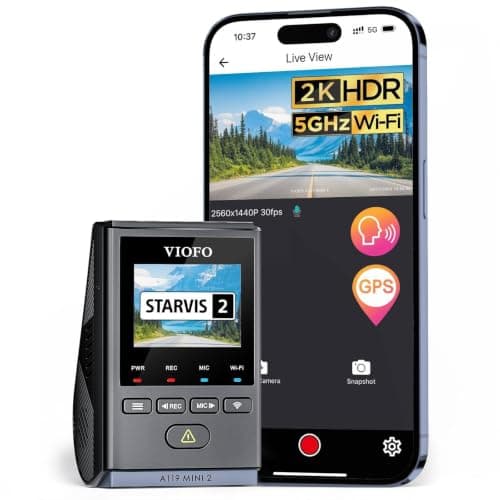
A one-channel front dash cam in a deliberately small body — 1.81 by 1.77 by 2.94 in — designed to sit beside the rear-view mirror rather than announce itself. It mounts on adhesive, stores its power in a supercapacitor rather than a lithium cell, and talks to your phone over 5 GHz Wi-Fi with a built-in GPS logger writing route, speed and time into the file.
It sits in the upper-middle of this site’s price range: more than the sub-$100 bracket most people start in, less than the 4K three-channel units. What you are paying for is sensor and disclosure rather than channels or pixels.
What VIOFO publishes, and where
Two sources matter here, and they are not identical. VIOFO’s own product page is the spec sheet; the Amazon listing is what you actually buy from. Where they disagree, that is worth knowing before you spend.
| Figure | VIOFO's own page | The Amazon listing |
|---|---|---|
| Front resolution | 2K 2560 x 1440 at 60fps | 2K 60fps, plus a maximum 2.7K 2592 x 1944 at 30fps |
| With HDR on | 2K 30fps with HDR | Frame rate drops from 60fps to 30fps |
| Image sensor | Sony STARVIS 2 5MP IMX675 | Sony STARVIS 2 IMX675 |
| Aperture | F1.6 | 7-glass F1.6 |
| Field of view | 140 deg | 140 deg |
| Operating range | -20 C to 65 C | 5 F to 149 F (-15 C to 65 C) |
| Storage range | -20 C to 70 C | Not stated |
| Warranty | 18 months | 18 months, plus 6 months on registration |
| Max microSD | Up to 512 GB | Up to 512 GB, Class 10 or UHS-I |
| Parking mode kit | HK4, optional | HK4, ordered separately |
| Rear channel | Not supported | Does not support a rear cam |
HDR or 60fps. You cannot have both
This is the sentence that changed how we read this camera, and it is VIOFO’s own: “Switch to 2K 30fps with HDR to achieve enhanced dynamic range and balanced exposure in challenging lighting conditions.” The listing puts it even more plainly — with HDR enabled, the frame rate drops from 60fps to 30.
That matters because this site has been recommending both halves separately. Our resolution explainer tells you to prefer HDR over extra pixels, and VIOFO against Garmin credits the 60fps with halving motion blur on a plate moving relative to you. On this camera those are two settings and you pick one. Here is how to pick.
- Choose HDR at 30fps if your problem is light. Night roads, tunnel mouths, parking garages, low winter sun straight down the street. The failure mode there is a blown-out highlight with the plate inside it, and no frame rate recovers detail the sensor clipped.
- Choose 60fps if your problem is speed. Fast daylit roads, highway merges, anything where the plate you need is crossing your field of view rather than sitting in front of you. The failure mode there is smear, and dynamic range does not fix smear.
- If you are a commuter, choose HDR. The unreadable plate you are actually going to meet is lit by a headlight, not blurred by closing speed, and that ordering is what the features page already argues. The 60fps is the better specification. HDR is the better setting.
Where the two sources disagree
Three figures differ between VIOFO’s spec sheet and the listing, and one of them is worth real money to the right reader.
The cold floor, which is the consequential one. VIOFO’s page states an operating range of -20 C to 65 C. The listing states 5 F to 149 F, and 5 F is about -15 C. The ceiling agrees exactly; the floor is five degrees apart. If you park outside somewhere that gets properly cold, that gap is the difference between a camera designed for your winter and one running under spec in it. We treat the maker’s own spec sheet as authoritative and record -20 C, but the page you buy from says something warmer and you should know that.
The warranty. VIOFO’s page says 18 months. The listing says 18 months plus a further 6 on registration, which would make it two years and the longest written commitment in this hub. Registration terms are not published alongside that offer, so this site scores the 18 months that both sources agree on.
The maximum resolution. The listing advertises a maximum of 2.7K, 2592 x 1944 at 30fps. VIOFO’s own page publishes only the 2K modes. Treat 2560 x 1440 at 60fps as the figure to buy on, since it is the one the maker commits to on its own site.
Front only, and it will never be anything else
The listing is blunt about this: it does not have and does not support a rear camera. This is not a camera you expand later, which is a genuinely important limitation given that being hit from behind is the single most common incident a dash cam gets asked to settle.
If there is any chance you will want rear coverage, buy a camera that accepts it. VIOFO sells the A229 Plus as a single front channel with rear available separately, and dual channel against three channel works through who actually needs what. If you are certain one forward camera is enough, this limitation costs you nothing and the money goes into the sensor instead.
The parking mode is real, and it is a separate afternoon
Three named modes, which is more than most cameras in this hub publish: auto event detection, time-lapse recording and low-bitrate recording. The event mode is buffered — the listing states a 15-second pre-record buffer producing a 45-second clip that starts 15 seconds before the trigger and runs 30 after. A buffer is the difference between seeing the impact and seeing the approach.
The cost is that none of it works on the 12V cable. Parking mode needs the HK4 hardwire kit, sold separately, which means a fuse tap and time under the dash — the hardwire guide covers the job and parking mode battery drain covers what it does to a battery overnight. Budget for the kit when you budget for the camera.
The card is not in the box, and it is not a free choice
No memory card is included. VIOFO publishes a ceiling of 512 GB and the listing adds the requirement: Class 10 or UHS-I. It also warns, in the maker’s own words, that some cards cannot meet the demands of continuous long-duration reading and writing, and that a low-quality or incompatible card can cause recording failure.
That is the honest version of a problem this category usually hides. A dash cam rewrites the same card continuously for years, which is the exact workload consumer cards are not built for — SD cards for dash cams explains why a high-endurance card is part of the purchase rather than an accessory to it.
The supercapacitor, and why it is on the spec sheet at all
There is no lithium cell in this camera. A supercapacitor holds just enough charge to close the file on shutdown, and it tolerates heat that degrades a battery. VIOFO publishes 65 C operating and 70 C storage, which is why this camera leads the hot-weather page: a windshield in summer sun is the harshest place in consumer electronics, and most makers publish no ceiling at all.
What nobody publishes
- Current draw. The figure that would let you calculate parking-mode battery life properly is not stated anywhere, by VIOFO or anyone else here. It is the one blank row in this camera’s spec table on this site, and it is blank on purpose.
- Recording bitrate. Resolution and frame rate are published; the bitrate that actually decides file size and how long a card lasts is not.
- The lens glass count. The listing says seven glass elements. VIOFO’s own page does not mention it, so treat it as a listing claim rather than a specification.
- Any expected lifespan. No MTBF, no rated hours, no ingress rating. The supercapacitor and the published temperature range are the closest thing to a durability statement on offer.
Buy it if
- You want one forward camera and the best published low-light hardware you can get for the money — a STARVIS 2 IMX675 at f/1.6 is the strongest sensor-and-aperture pair in this ledger.
- You park outside in summer and want a maker that states a heat ceiling instead of hoping.
- You want parking mode you can actually configure, and you are willing to do the hardwire.
- You value being able to check the claims. This is the most thoroughly documented camera on this site, which is the whole reason it wins.
Buy something else if
- You might ever want a rear camera. It cannot take one — start with the dual channel page instead.
- You carry paying passengers, where the disputes are about the cabin and you need a third interior channel.
- Your budget stops under $100, where the sub-$100 page is the honest starting point and the compromises are named.
- You will not do the hardwire and parking coverage is the reason you are buying. Without the kit this is a very good driving camera and nothing more.
Every pick, with the working
Each entry lists the specifications the maker publishes, the axis scores those specifications produce, and what you give up. Rows that read “Not published” are not omissions on our side: they are things the maker will not commit to in writing, and they cost the product points on the transparency axis. Specifications compiled September 4, 2026.
Our pickThe one to buy if you only buy one
VIOFO A119 Mini 2
A Sony STARVIS 2 IMX675 sensor at 2K 60fps, a supercapacitor, a published 65 C ceiling, an 18-month warranty and three named parking modes including buffered recording. VIOFO publishes more about this camera than anyone else here publishes about anything, and that is the reason it wins: every claim on the page is one you can check.
- Front resolution
- 2560 x 1440 at 60fps
- Image sensor
- Sony STARVIS 2 IMX675, 5MP
- Field of view
- 140 degrees
- Aperture
- f/1.6
- Power store
- Supercapacitor, no battery
- Operating range
- -20 C to 65 C (-4 F to 149 F)
- Storage temperature
- -20 C to 70 C
- Max microSD
- 512 GB
- Wi-Fi
- 2.4 GHz and 5 GHz
- Parking modes
- Auto event detection, time lapse, low bitrate
- Dimensions
- 1.81 x 1.77 x 2.94 in
- Published current draw
- Not published
List price $159.99 per VIOFO's own store, captured on the compile date below. Not a live price and not what you will pay — the button is where the real number is.
What it gets right
- Sony STARVIS 2 IMX675 with an f/1.6 lens — the best published low-light hardware in this ledger
- 2K at 60fps, which reads plates on moving cars better than 4K at 30fps does
- Published 65 C ceiling and a supercapacitor, so summer is designed for rather than hoped about
- Three named parking modes, including buffered recording that keeps the seconds before a trigger
- 18-month warranty, longer than most of this category
Flaws
- Front only, and adding the rear camera means a different model entirely
- The list price is well above the sub-$100 bracket most people start in
- Parking mode needs the HK4 hardwire kit, which is a separate purchase and a separate afternoon
The working behind the 6.7
- Heat headroom: 9.0 (weight 22%)
- Published operating ceiling 65 C (149 F). A car parked in summer sun runs roughly 60-70 C inside, so 65 C and up is real headroom, 60 C is living at the limit, and anything under 55 C is a summer problem waiting to happen.
- Install effort: 6.0 (weight 24%)
- Adhesive pad onto the dashboard. Permanent in practice: repositioning means a new pad, and the pad is the part that fails first.
- Price against the ceiling: 3.5 (weight 24%)
- Listed at $159.99 on the compile date. This site's buyer has a practical ceiling around $150 for a single upgrade, so the scale rewards everything under $100 and falls away sharply past $150. The live price is very often different, and that is what the button is for.
- Written commitment: 7.0 (weight 15%)
- 18-month warranty. This is the only promise in the entire listing that a court would read, which is why it is scored and the marketing copy is not.
- Spec transparency: 9.2 (weight 15%)
- 11 of the 12 specifications we went looking for are published by the maker (92%). A blank row is never a guess here: it prints “Not published” and it costs the product points, because a figure nobody will commit to in writing is a figure you cannot check.
Axes with no published input are dropped and the remaining weights re-normalized, so a product is not punished for a category where an axis does not apply. Specifications compiled September 4, 2026 from VIOFO's A119 Mini 2 product page.
Prices last verified October 5, 2026. They move constantly; the figure on Amazon when you click is the real one.
Questions people actually ask
Does the VIOFO A119 Mini 2 record in 4K?
No. VIOFO publishes 2K, 2560 x 1440 at 60fps, on its own product page. The Amazon listing additionally advertises a 2.7K maximum of 2592 x 1944 at 30fps, which VIOFO’s own page does not state, so buy on the 2K figure. On this site’s reading, 2K at 60fps from a STARVIS 2 sensor beats 4K at 30fps from a lesser one for the job a dash cam exists to do.
Should I turn HDR on?
For most commuting, yes, and accept 30fps — VIOFO states that HDR switches the camera to 2K 30fps. The plate you are most likely to lose is one washed out by a headlight or a tunnel mouth, which is the problem HDR solves. Leave HDR off and keep 60fps if your driving is mostly fast and well lit, where motion blur is the bigger risk.
Can you add a rear camera to the A119 Mini 2?
No. The listing states plainly that it does not have and does not support a rear camera, so there is no upgrade path. If rear coverage is a maybe rather than a no, buy a camera that accepts a second channel instead — being rear-ended is the most common incident a dash cam is asked to settle.
Does it need a hardwire kit?
Only for parking mode. On the supplied 12V cable it records while you drive. All three published parking modes — auto event detection, time-lapse and low bitrate — require VIOFO’s HK4 hardwire kit, which is sold separately and is a fuse-tap job rather than a plug-in.
Sources
- VIOFO A119 Mini 2 product page: published resolutions, the HDR frame-rate note, sensor, aperture, operating and storage ranges, parking modes, HK4 kit, card ceiling, Wi-Fi and GPS
- VIOFO A119 Mini 2 Amazon listing: checked for availability, plus the published card class, buffered parking timings, registered warranty extension and stated temperature range