The best car air purifiers
One number tells you whether an air purifier does anything: clean air delivery rate. Almost nothing sold for cars publishes it, and the cheapest real fix is not a purifier at all.
By Sawyer V. · Published · How we research
We have not tested any of this. Everything below is compiled from published manufacturer specifications, and the arithmetic is printed so you can check it. This page carries affiliate links: if you buy through one we earn a commission at no extra cost to you, and it does not change the order of the picks. Full disclosure.
The short answer
Replace the cabin air filter first — then buy on published CADR. Clean Air Delivery Rate is the only comparable figure in air purification, and almost nothing in the car category states one. Philips publishes 16 m3/hour for the GoPure GP5212, which against a cabin of roughly 3 to 4 cubic meters is several air changes an hour — genuinely meaningful turnover. A purifier that publishes no CADR is a fan in a box you cannot evaluate.
| # | Pick | Install | Score | Price |
|---|---|---|---|---|
| 1 | ThisWorx Car Vacuum Reaching the trunk without an extension lead | Plugs in | 9.2/10 | $20.99 - view on Amazon |
| 2 | Philips GoPure GP5212 Car Air Purifier Actually removing particulates rather than covering them | Plugs in | 7.8/10 | Check price on Amazon |
| 3 | Febreze Car Vent Clip A predictable replacement schedule | Clips on | 7.5/10 | $11.99 - view on Amazon |
Prices last verified October 24, 2026. They move constantly; the figure on Amazon when you click is the real one.
The cheaper fix almost nobody has done
The tell is a musty smell that appears or intensifies with the fan on and is weaker with it off. On most cars the job takes five minutes and needs no tools beyond releasing the glovebox stops.
A purifier added to a car with a clogged cabin filter is treating the symptom of a problem with a five-minute fix. Do that first, always.
CADR, and why its absence matters
Clean Air Delivery Rate is the volume of filtered air a device actually delivers per unit time. It combines the two things that matter — how well the filter captures and how much air the fan moves — into one comparable number.
It matters because those two work against each other. A denser filter captures more per pass and restricts airflow, so a device can carry an impressive filter specification and move almost no air through it. CADR is what stops that being hidden.
Philips publishes 16 m3/hour for the GP5212. Set against a passenger cabin of roughly 3 to 4 cubic meters, that is on the order of four to five air changes per hour, which is real turnover rather than a token.
| Specification | Why it matters | GoPure GP5212 |
|---|---|---|
| CADR | The only comparable performance figure | 16 m3/hour |
| Filter type | What size particle it captures | Published |
| Power | Whether it costs you a 12V socket | 12 V socket |
| Filter replacement interval | The recurring cost nobody budgets | Not published |
| Noise level | It runs beside your head | Not published |
| Operating temperature | It lives in a hot cabin | Not published |
Note the three blanks. Even the best-documented product in this category does not publish a filter replacement interval, a noise figure, or an operating range — and the recurring filter cost is the thing that decides whether you keep using it.
What "HEPA" does and does not tell you
True HEPA is a defined standard: capture of at least 99.97% of particles at 0.3 microns. That is a real specification and worth having.
Two cautions. “HEPA-type”, “HEPA-grade” and “HEPA-style” are not the standard and mean whatever the maker wants. And a true HEPA element in a device that moves very little air through it still cleans very little air — which is exactly why CADR exists and why filter grade alone is not enough.
The other thing HEPA does not do is gases. Particulate filtration captures pollen, dust and soot; it does not remove odor molecules or volatile organic compounds. That needs activated carbon, and it is a separate layer with its own life.
The ozone question
A lot of cheap car purifiers are ionizers rather than filters. They charge particles so they clump and fall out of the air rather than trapping them, which means the particles end up on your interior surfaces instead of in a filter.
Some ionizers also generate ozone as a by-product. Ozone is a respiratory irritant, and a car is a very small sealed space. If a device advertises ozone as a feature — usually framed as sterilizing or deodorizing — that is a reason for caution rather than a selling point, particularly with children or anyone with asthma in the car.
A filter-based purifier physically removes particles and produces nothing. If you cannot tell from the listing which type you are looking at, that is itself informative.
The cost people forget
These run from the 12V socket, permanently. In a car with one socket that is the socket, and it is now unavailable for a charger, a dash cam or an inflator.
A splitter solves it, with the caution that everything still draws through the same fuse and that a heavy rigid splitter levers on socket contacts never designed for sideways load — how to add USB ports to an older car.
The other recurring cost is filters. Nobody publishes an interval, and a purifier running a loaded filter is a fan. Budget for replacements before buying, not after.
Who this is actually for
- Allergy sufferers with a long commute. The clearest case — pollen is exactly what particulate filtration handles, and a commute is sustained exposure
- Heavy traffic or tunnel routes. Fine particulates from surrounding vehicles are drawn straight into a cabin
- Anyone who has already replaced the cabin filter and wants more than the factory system provides
And who it is not for: anyone chasing a smell. A purifier does nothing about a damp carpet, a clogged evaporator or something under a seat — those have physical sources and physical fixes, how to get smells out of your car. If you want the car to smell of something rather than nothing, that is a different product again — best car air fresheners.
Dust that has already settled is a vacuum job, not an air-quality one — best car vacuums.
Every pick, with the working
Each entry lists the specifications the maker publishes, the axis scores those specifications produce, and what you give up. Rows that read “Not published” are not omissions on our side: they are things the maker will not commit to in writing, and they cost the product points on the transparency axis. Specifications compiled September 4, 2026.
Our pickReaching the trunk without an extension lead
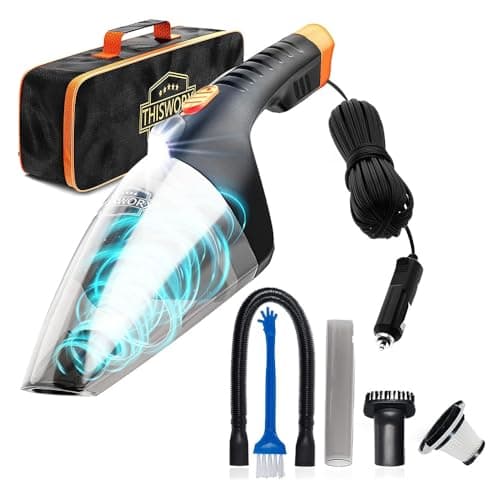
ThisWorx Car Vacuum
A 106 W corded vacuum drawing 8.8 amps from the 12V socket, with a 16-foot cord and a metal turbine. The cord is the reason to buy the corded one: sixteen feet reaches the trunk of most cars from the front socket, and a cordless handheld runs out of battery halfway through the back seat.
- Power
- 106 W
- Current draw
- 8.8 A
- Cord length
- 16 ft
- Weight
- 2.4 lb
- Power source
- 12 V socket
- Filter
- HEPA, spare included
- Attachments
- Flathead, extendable, brush nozzle
- Suction (kPa or air watts)
- Not published
- Warranty
- Not published
What it gets right
- 16 ft cord, published — genuinely reaches every corner of a normal car from one socket
- 106 W and 8.8 A published, which is more useful than the 'high power' every listing in this category claims
- 2.4 lb, so it is easy to hold at an angle under a seat for five minutes
- Ships with three attachments, a spare HEPA filter and a bag, so it is complete out of the box
Flaws
- ThisWorx publishes no suction figure in kPa or air watts, which is the number that would let you compare it to anything
- 8.8 A is a real load on the 12V socket; run the engine
- Corded means the cord is always in the way of what you are vacuuming
The working behind the 9.2
- Heat headroom: not scored (weight 22%)
- The maker publishes no operating-temperature ceiling, so this axis is dropped and the other weights are re-normalized.
- Install effort: 10.0 (weight 24%)
- Plugs into a 12V socket or a USB port. Nothing to mount, nothing to route, reversible in a second.
- Price against the ceiling: not scored (weight 24%)
- No published list price we could cite on the compile date, so this axis is dropped and the other weights are re-normalized.
- Written commitment: not scored (weight 15%)
- No warranty term published, so this axis is dropped and the other weights are re-normalized.
- Spec transparency: 7.8 (weight 15%)
- 7 of the 9 specifications we went looking for are published by the maker (78%). A blank row is never a guess here: it prints “Not published” and it costs the product points, because a figure nobody will commit to in writing is a figure you cannot check.
Axes with no published input are dropped and the remaining weights re-normalized, so a product is not punished for a category where an axis does not apply. Specifications compiled September 4, 2026 from ThisWorx car vacuum published specifications.
2Actually removing particulates rather than covering them
Philips GoPure GP5212 Car Air Purifier
Publishes a CADR figure, which is the only number that means anything in air purification and which almost nothing in the car category states. 16 cubic meters per hour against a cabin of roughly 3 to 4 cubic meters.
- CADR
- 16 m3/hour
- Power
- 12 V socket
- Mechanism
- Filtration, not masking
- Filter replacement interval
- Not published
- Operating temperature
- Not published
- Warranty
- Not published
- List price
- Not published
What it gets right
- Publishes a CADR of 16 m3/hour — a real, comparable figure in a category that otherwise sells on adjectives
- 16 m3/hour against a car cabin of roughly 3-4 m3 means several air changes per hour, which is meaningful turnover
- Filters particulates rather than masking odor, which is a genuinely different mechanism from an air freshener
- Runs from the standard 12 V socket
Flaws
- It occupies the 12 V socket, which in a single-socket car is a real cost
- Filters are consumable and the replacement interval and cost are the ongoing expense nobody budgets for
- It does nothing about a smell with a physical source — a damp carpet needs drying, not filtering
- No published operating temperature range on a device left in a hot cabin
The working behind the 7.8
- Heat headroom: not scored (weight 22%)
- The maker publishes no operating-temperature ceiling, so this axis is dropped and the other weights are re-normalized.
- Install effort: 10.0 (weight 24%)
- Plugs into a 12V socket or a USB port. Nothing to mount, nothing to route, reversible in a second.
- Price against the ceiling: not scored (weight 24%)
- No published list price we could cite on the compile date, so this axis is dropped and the other weights are re-normalized.
- Written commitment: not scored (weight 15%)
- No warranty term published, so this axis is dropped and the other weights are re-normalized.
- Spec transparency: 4.3 (weight 15%)
- 3 of the 7 specifications we went looking for are published by the maker (43%). A blank row is never a guess here: it prints “Not published” and it costs the product points, because a figure nobody will commit to in writing is a figure you cannot check.
Axes with no published input are dropped and the remaining weights re-normalized, so a product is not punished for a category where an axis does not apply. Specifications compiled September 4, 2026 from Philips GoPure GP5212 published CADR.
3A predictable replacement schedule
Febreze Car Vent Clip
Skip this one. Here to draw the line clearly. A freshener adds scent to the air; a purifier removes particles from it. People buy the first expecting the second, and if your problem is pollen, dust or traffic fumes then a freshener achieves precisely nothing about it.
Publishes a duration — up to 30 days — which is the one figure that lets you compare anything in this category. It is a vent clip, so its output tracks how hard your fan is running rather than being constant.
- Stated duration
- Up to 30 days
- Type
- Vent clip
- Output control
- None — tracks fan speed
- Fragrance-free option
- Not published
- Warranty
- Not published
- List price
- Not published
What it gets right
- Publishes a stated duration of up to 30 days, which most of this category does not
- Vent clip design is light enough that the vent still adjusts normally
- Consistent output compared with the wide range across competitor product lines
Flaws
- Duration is heat-dependent. Reported lifespan in hot states is materially shorter than the stated figure
- Output tracks fan speed, so it does almost nothing with the blower off and a lot on full
- It masks. If a smell has a physical source, this covers it rather than removing it
- No fragrance-free option, which is a real problem for anyone sensitive to scent
The working behind the 7.5
- Heat headroom: not scored (weight 22%)
- The maker publishes no operating-temperature ceiling, so this axis is dropped and the other weights are re-normalized.
- Install effort: 9.0 (weight 24%)
- Clips onto a vent blade or a headrest post. Two minutes, no tools, no adhesive, no residue.
- Price against the ceiling: not scored (weight 24%)
- No published list price we could cite on the compile date, so this axis is dropped and the other weights are re-normalized.
- Written commitment: not scored (weight 15%)
- No warranty term published, so this axis is dropped and the other weights are re-normalized.
- Spec transparency: 5.0 (weight 15%)
- 3 of the 6 specifications we went looking for are published by the maker (50%). A blank row is never a guess here: it prints “Not published” and it costs the product points, because a figure nobody will commit to in writing is a figure you cannot check.
Axes with no published input are dropped and the remaining weights re-normalized, so a product is not punished for a category where an axis does not apply. Specifications compiled September 4, 2026 from Febreze car vent clip published duration.
Prices last verified October 24, 2026. They move constantly; the figure on Amazon when you click is the real one.
Questions people actually ask
Do car air purifiers actually work?
A filter-based one with a published CADR does measurable work — 16 m3/hour against a 3-4 cubic meter cabin is several air changes per hour. One that publishes no CADR cannot be evaluated at all.
What should I do before buying an air purifier?
Replace the cabin air filter. It is behind the glovebox on most cars, takes about five minutes, costs far less than a purifier, and is the most neglected service item on most vehicles.
Are ionizer car purifiers safe?
Ionizers make particles clump and settle onto surfaces rather than trapping them, and some generate ozone as a by-product. Ozone is a respiratory irritant and a car is a small sealed space — treat it as a caution rather than a feature.
Will an air purifier get rid of a bad smell in my car?
Not if the smell has a physical source — a damp carpet, a clogged evaporator, something under a seat. Particulate filtration removes particles, not odor molecules. Find and remove the source.