The best windshield wipers
The cheapest visibility upgrade there is, and the one most people replace two seasons late. The beam-versus-framed argument comes down entirely to what happens in ice.
By Sawyer V. · Published · How we research
We have not tested any of this. Everything below is compiled from published manufacturer specifications, and the arithmetic is printed so you can check it. This page carries affiliate links: if you buy through one we earn a commission at no extra cost to you, and it does not change the order of the picks. Full disclosure.
The short answer
Buy beam blades if your winters involve ice, framed blades if they do not. That is genuinely the whole decision. A framed blade has an exposed metal skeleton that packs with snow and ice, which jacks the rubber off the glass and leaves you with streaks you cannot clear. A bracketless beam has nothing to pack. Bosch publishes a 12-month warranty on the ICON, which is unusual on a wear item — and replace both fronts at once, because they age together.
| # | Pick | Install | Score | Price |
|---|---|---|---|---|
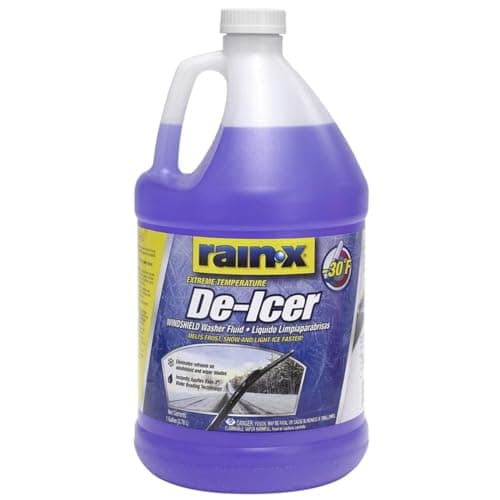
| 1 | Rain-X De-Icer Windshield Washer Fluid A windshield that freezes overnight | Drops in | 9.5/10 | $18.99 - view on Amazon |
| 2 | 3M Ultra Headlight Restoration Kit Yellowed lenses on a car worth keeping | Drops in | 8.7/10 | $14.49 - view on Amazon |
| 3 | Bosch ICON Beam Wiper Blade A windshield that ices up | Clips on | 7.4/10 | $52.45 - view on Amazon |
Prices last verified October 24, 2026. They move constantly; the figure on Amazon when you click is the real one.
Beam versus framed, and the ice problem
A conventional framed blade is a metal skeleton of pivoting arms distributing pressure to a rubber strip at six or eight points. It works, it is cheap, and it has one specific failure.
Snow and freezing rain pack into the frame. Ice forms in the joints, the arms stop pivoting, and the blade goes rigid — so instead of following the curve of the glass it bridges across it, held off the surface by its own frozen skeleton. You get a clear arc in the middle and untouched glass at the edges, in exactly the weather where you need all of it.
A beam blade has no frame at all. Pressure comes from a tensioned steel spring running the length of the blade inside a rubber shell, so there is no structure for ice to pack into and nothing to seize. Bosch describes this as tension spring arcing, pre-curved to the windshield.
| Beam | Framed | |
|---|---|---|
| Ice and snow packing | Nothing to pack into | The main failure mode |
| Pressure distribution | Along the whole length | At 6-8 contact points |
| Cost | Higher | Lower |
| Aerodynamic lift at speed | Lower profile | More frontal area |
| Performance in mild rain | Comparable | Comparable |
The honest conclusion: in a mild climate a framed blade clears rain just as well for less money. If your winters involve real ice, the beam is not a luxury.
The compound, and what actually kills a blade
Wipers do not wear out from use anything like as fast as they degrade from exposure. Two things harden the rubber: ultraviolet light and ozone. Both act on a blade sitting still in the sun, which is most of its life.
Bosch states an FX dual rubber compound formulated to resist heat and ozone deterioration. That is the correct thing to engineer for, because a blade that has gone hard no longer conforms to the glass and chatters and streaks regardless of how much tread is left.
Size is not the only fitment
Two things have to match, and people check only the first.
Length is usually different left and right — a car very often takes a longer driver-side blade than passenger-side. Fitting two of the same length is a common error that leaves an unswept band or has the blades collide.
Connector type is the one that catches people out. Hook, bayonet, pinch tab, side pin, top lock — there are several and they are not interchangeable. Most blades ship with a hook adapter fitted and others in the box, which is why the packaging looks cluttered.
Check the rear wiper separately if you have one. It is usually a different size, frequently a different connector, and it is the one people forget until it smears the reversing view — which matters more if you have added a camera back there, best backup cameras.
The blade is half the system
A perfect blade dragging across a dry or dirty windshield still smears, and washer fluid is one of the few genuinely checkable specifications in car care — the washer fluid page compares published freeze points. A chip in the glass is a separate and more urgent job: a resin kit stops it spreading for about the price of one blade.
Rain-X publishes freeze protection to -30 F on its extreme formula and -25 F on the heavy duty one, plus boiling point, flash point and pH on the technical data. A fluid labeled only “all season” publishes nothing you can check.
Use winter fluid undiluted — topping up over summer fluid dilutes the freeze protection by an unknown amount, and fluid that freezes in the lines is a burst pump. The wider winter kit is in what to keep in your car in winter.
Four habits that double blade life
- Never run them on a dry windshield. Dry glass is an abrasive. Wet first, always — including that first flick at a dusty car
- Clear ice off the glass before switching them on. A motor dragging a frozen blade tears the rubber and can strip the linkage
- Lift the blades in freezing weather if the car sits outside, so they do not freeze to the glass and tear when the wipers next run
- Clean the rubber edge with a damp cloth every few weeks. Most streaking is accumulated road film on the blade, not a worn one
When to replace, and what streaking is telling you
The usual advice is every six to twelve months. That is a reasonable default and the symptoms are better guidance than the calendar.
Streaking in a consistent line means a nick or debris on the edge. Clean it first — this is often not a worn blade.
Chattering means the rubber has hardened and is skipping rather than flexing at the direction change.
An unswept band at one edge means either a wrong-length blade or a tired wiper arm spring rather than the blade itself — new blades will not fix a weak arm.
Smear that only shows at night is the classic one, and it is worth ruling out the glass before blaming the blade: interior film scatters oncoming light and looks exactly like wiper smear — how to clean car windows without streaks.
Blades clear water. A glass treatment reduces how much water there is to clear, which is a different lever and most useful at night in heavy rain — and the published durability figures across that category range from six weeks to eighteen months — best rain repellents for glass.
Every pick, with the working
Each entry lists the specifications the maker publishes, the axis scores those specifications produce, and what you give up. Rows that read “Not published” are not omissions on our side: they are things the maker will not commit to in writing, and they cost the product points on the transparency axis. Specifications compiled September 4, 2026.
Our pickA windshield that freezes overnight
Rain-X De-Icer Windshield Washer Fluid
Publishes an actual freeze point rather than a season name, which is the entire point of buying winter fluid. The -30 F formula is the one to buy if your winter genuinely gets there; anything labeled only 'all season' is a guess.
- Freeze protection
- -30 F (extreme) / -25 F (heavy duty)
- Boiling point
- 186 F (on the -25 F formula)
- Flash point
- 84 F (on the -25 F formula)
- Maximum pH
- 8.5
- Dilution
- Use undiluted
- Extra function
- Water-beading treatment, anti-refreeze
- List price
- Not published
What it gets right
- Publishes a freeze protection figure in degrees — -30 F on the extreme formula, -25 F on the heavy duty
- Also publishes boiling point, flash point and pH on the technical data, which almost no consumer fluid does
- Prevents refreeze on the glass and the wiper blades, which is where summer fluid fails badly
- Applies water-beading treatment as it cleans
Flaws
- Must be used undiluted — topping up over summer fluid dilutes the freeze protection and you will not know by how much
- A winter fluid in a summer climate is money spent on protection you never use
- Fluid does not fix worn wiper blades, which is more often the real cause of poor visibility
The working behind the 9.5
- Heat headroom: not scored (weight 22%)
- The maker publishes no operating-temperature ceiling, so this axis is dropped and the other weights are re-normalized.
- Install effort: 10.0 (weight 24%)
- Drops in and sits there. No fixing of any kind, and it comes out again when you sell the car.
- Price against the ceiling: not scored (weight 24%)
- No published list price we could cite on the compile date, so this axis is dropped and the other weights are re-normalized.
- Written commitment: not scored (weight 15%)
- No warranty term published, so this axis is dropped and the other weights are re-normalized.
- Spec transparency: 8.6 (weight 15%)
- 6 of the 7 specifications we went looking for are published by the maker (86%). A blank row is never a guess here: it prints “Not published” and it costs the product points, because a figure nobody will commit to in writing is a figure you cannot check.
Axes with no published input are dropped and the remaining weights re-normalized, so a product is not punished for a category where an axis does not apply. Specifications compiled September 4, 2026 from Rain-X De-Icer published specifications.
2Yellowed lenses on a car worth keeping
3M Ultra Headlight Restoration Kit
Skip this one. Not a wiper, and on this page for a reason: people replace wipers chasing poor night visibility when the actual cause is a yellowed headlight lens or a filmed windshield. Rule those out first — one is free and the other is an afternoon — before assuming the blades are the problem.
Publishes its exact abrasive sequence by grit, which is the only way to judge a restoration kit — the grit steps are the process. It finishes with a UV clear coat rather than a polish, which is the difference between a fix and a six-week reprieve.
- Abrasive sequence
- 500 grit, 800 grit, 3000 grit Trizact refining
- Finish
- Quick Headlight Clear Coat wipes
- Also included
- 3.25 in disc pad holder, masking tape, instructions
- Reapplication
- 3M states sealant wears; reapply roughly annually
- Warranty
- Not published
- List price
- Not published
What it gets right
- Publishes the full abrasive sequence: 500 grit, 800 grit, then 3000 grit Trizact refining
- Finishes with a clear coat wipe rather than a polish — a polished lens with no UV coat yellows again quickly
- Includes the disc pad holder and masking tape, so the kit is genuinely complete
- Restoring a lens recovers real light output, which is a safety gain rather than a cosmetic one
Flaws
- It is genuine physical work: masking, three wet-sanding stages, then compounding
- 3M states the UV sealant wears and needs reapplying roughly annually — this is maintenance, not a permanent repair
- Sanding a lens removes material. There is a finite number of times a lens can be restored
- Get the masking wrong and you sand the paint next to the lens
The working behind the 8.7
- Heat headroom: not scored (weight 22%)
- The maker publishes no operating-temperature ceiling, so this axis is dropped and the other weights are re-normalized.
- Install effort: 10.0 (weight 24%)
- Drops in and sits there. No fixing of any kind, and it comes out again when you sell the car.
- Price against the ceiling: not scored (weight 24%)
- No published list price we could cite on the compile date, so this axis is dropped and the other weights are re-normalized.
- Written commitment: not scored (weight 15%)
- No warranty term published, so this axis is dropped and the other weights are re-normalized.
- Spec transparency: 6.7 (weight 15%)
- 4 of the 6 specifications we went looking for are published by the maker (67%). A blank row is never a guess here: it prints “Not published” and it costs the product points, because a figure nobody will commit to in writing is a figure you cannot check.
Axes with no published input are dropped and the remaining weights re-normalized, so a product is not punished for a category where an axis does not apply. Specifications compiled September 4, 2026 from 3M headlight restoration kit published contents and process.
3A windshield that ices up
Bosch ICON Beam Wiper Blade
A bracketless beam blade with a published warranty term, which most wiper blades do not carry. The bracketless design is the functional point: no metal frame means nothing for ice to pack into and jack the blade off the glass.
- Construction
- Bracketless beam, no joints or hinges
- Tension
- Dual steel springs, tension spring arcing
- Rubber
- FX dual rubber, stated heat and ozone resistant
- Warranty
- 12 months
- Rated life
- Not published
- List price
- Not published
What it gets right
- Bracketless beam construction — no joints or hinges for ice and snow to build up in, which is why framed blades lift in winter
- Tension spring arcing applies pressure along the whole blade rather than at a few contact points
- Published 12-month warranty, which is rare on a wear item in this category
- FX dual rubber stated to resist heat and ozone deterioration, the two things that harden a wiper
Flaws
- The 'up to 40% longer life' figure is Bosch's own comparative claim, not an independent test
- Beam blades cost noticeably more than framed blades that clear glass adequately in mild climates
- Blade life is not published in months or wipes, only as a relative claim
- Sold singly on many listings, so a pair is two purchases
The working behind the 7.4
- Heat headroom: not scored (weight 22%)
- The maker publishes no operating-temperature ceiling, so this axis is dropped and the other weights are re-normalized.
- Install effort: 9.0 (weight 24%)
- Clips onto a vent blade or a headrest post. Two minutes, no tools, no adhesive, no residue.
- Price against the ceiling: not scored (weight 24%)
- No published list price we could cite on the compile date, so this axis is dropped and the other weights are re-normalized.
- Written commitment: 5.5 (weight 15%)
- 12-month warranty. This is the only promise in the entire listing that a court would read, which is why it is scored and the marketing copy is not.
- Spec transparency: 6.7 (weight 15%)
- 4 of the 6 specifications we went looking for are published by the maker (67%). A blank row is never a guess here: it prints “Not published” and it costs the product points, because a figure nobody will commit to in writing is a figure you cannot check.
Axes with no published input are dropped and the remaining weights re-normalized, so a product is not punished for a category where an axis does not apply. Specifications compiled September 4, 2026 from Bosch ICON published construction and warranty.
Prices last verified October 24, 2026. They move constantly; the figure on Amazon when you click is the real one.
Questions people actually ask
Are beam wiper blades worth the extra money?
In a climate with real ice, yes — a framed blade packs with ice and lifts off the glass, which a bracketless beam cannot do. In mild conditions a framed blade clears rain just as well for less.
How often should I replace wiper blades?
Every six to twelve months as a default, but symptoms beat the calendar. Run a fingertip along the edge: soft and slightly tacky is good, hard or glazed means finished regardless of age.
Why do my new wipers still streak?
Usually road film on the rubber edge, which cleans off with a damp cloth. If it only shows at night it is very often the film on the inside of the windshield rather than the blade at all.
Do I need the same size blade on both sides?
Usually not — most cars take a longer driver-side blade. Check both lengths and the connector type, which varies between hook, bayonet, pinch tab, side pin and top lock and is not interchangeable.