NOCO GENIUS5 review
A 5-amp smart charger that publishes more about itself than anything else in the category. The hard part is not whether to buy it. It is whether you want the 1, the 5 or the 10.
By Sawyer V. · Published · How we research
We have not tested any of this. Everything below is compiled from published manufacturer specifications, and the arithmetic is printed so you can check it. This page carries affiliate links: if you buy through one we earn a commission at no extra cost to you, and it does not change the order of the picks. Full disclosure.
The verdict
Buy it if a car sits for weeks at a time, or if a battery you otherwise trust keeps going flat. At 5 A it is a maintainer first and a slow charger second, and for a car battery that is the right way round. It publishes its supported chemistries by name, a 120 Ah ceiling and a thermal sensor that adjusts charge rate to ambient temperature — three things most of this category will not state.
Two things this review adds to the ranking. First, NOCO publishes a 3-year warranty on this charger, which this site had recorded as not published and has now corrected. Second, the real decision is which GENIUS: the 1, the 5 and the 10 are the same charger at three currents, and the table below is the whole argument.
| # | Pick | Install | Score | Price |
|---|---|---|---|---|
| 1 | NOCO GENIUS5 Battery Charger A car that sits, or a battery that keeps going flat | Plugs in | 9.4/10 | $69.95 - view on Amazon |
Prices last verified November 12, 2026. They move constantly; the figure on Amazon when you click is the real one.
What it is
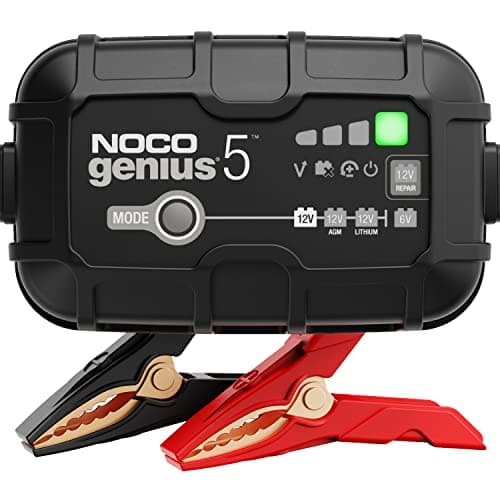
A mains-powered smart charger about the size of a paperback that clips to a battery and decides for itself what to do with it. It charges, it maintains indefinitely once full, and it attempts desulfation on a battery that has been left flat.
It is not a jump starter and the two are constantly confused. The charger roundup opens with that distinction and this page will not re-argue it: a jump pack gets you moving this morning, a charger stops you needing one. If you want the jump pack as well, that is the GB40, a different NOCO product solving the opposite problem.
Which GENIUS: the 1, the 5 or the 10
This is the question people actually arrive with, and the roundup does not answer it because the roundup is about choosing a product type rather than a size.
All three are the same charger. Same chemistries, same thermal sensor, same Force mode down to zero volts, same desulfation, same 3-year warranty. The current is the headline difference, and the contents of the box are the one nobody mentions.
| GENIUS1 | GENIUS5 | GENIUS10 | |
|---|---|---|---|
| Output | 1 A | 5 A | 10 A |
| Voltages | 6 V and 12 V | 6 V and 12 V | 6 V and 12 V |
| Mains connection | Direct wall plug-in | 72 in AC cable | 72 in AC cable |
| DC cable | 110 in with clamps | 80 in with clamps | 80 in with clamps |
| Eyelet terminals included | Yes | Yes | Yes |
| Mounting bracket | Not listed | Yes, with screws | Yes, with screws |
| Warranty | 3 years | 3 years | 3 years |
| Availability when checked | In stock | In stock | Temporarily out of stock |
Read the mains row before the current row. The GENIUS1 plugs straight into a wall socket with no cable between the charger and the outlet, which means the charger hangs off the socket and the battery has to be within reach of its 110 inch DC lead. The GENIUS5 gives you a 72 inch AC cable as well, so the unit can sit on a bench or hang on the wall bracket near the car instead of dangling from a power point. In a garage that is the difference between a tidy permanent setup and an extension lead across the floor.
- A motorcycle, a mower or a classic that sits all winter: the 1 A is enough. Maintaining a charged battery takes almost no current, and the cheaper unit does it with the same electronics.
- A car that sits, or a battery that keeps dying: the 5 A. It maintains like the 1 and will also put a meaningful charge back into a car battery overnight, which the 1 will not.
- A truck, a van, a deep-cycle or several vehicles: the 10 A, when it is back in stock. It was listed as temporarily unavailable when this page was written, which is worth knowing before you set your heart on it.
The warranty, and a correction
NOCO publishes a 3-year warranty on the GENIUS5, and on the GENIUS1 and GENIUS10 alongside it. That is a real figure, stated by the maker, and it is twice the term most of this category commits to in writing.
This site had it recorded as “not published”. That was wrong, it has been corrected in the same change that published this review, and it changes the product’s standing: a written commitment is one of the axes this site ranks on, and the GENIUS5 was being marked down on a blank that should never have been blank.
The eyelet terminals are the part that changes how you use it
Every GENIUS ships with eyelet terminals as well as clamps, and they are the accessory that turns an occasional tool into a permanent one.
The eyelets bolt to the battery terminals and leave a weatherproof connector hanging in the engine bay. Charging becomes plugging one connector together rather than opening the hood, finding the terminals and clipping on in the dark. For the car this charger is actually for — the one that sits unused for weeks — that is the difference between a maintainer you use and one that stays in a drawer.
The GENIUS5 and GENIUS10 add a mounting bracket and screws, which is the other half of the same idea: the charger lives on the garage wall next to where the car parks. The GENIUS1 does not list a bracket. If a permanent setup is the plan, that is a reason to step up beyond the amperage.
How long it takes, which NOCO will not tell you
There is no published charging-time figure for any battery size, on any of the three listings. That is the one number missing from an otherwise unusually well-documented product, and it is the question every buyer has.
So it is arithmetic, and it is worth stating the assumptions out loud because they are doing the work. A typical passenger-car battery is somewhere around 45 to 70 Ah. At a nominal 5 A, replacing half of a 60 Ah battery is 30 Ah divided by 5 A, or about six hours before any losses. Real chargers taper their current as the battery fills, so the last stretch is always slower than the arithmetic suggests.
The practical reading: overnight is the unit of time for this charger. It is not a lunch-break device, and nothing at this size is. If you need a flat battery usable in twenty minutes, that is a jump starter and a drive, not a charger.
Repair mode, Force mode and the manual
NOCO describes the desulfation step as precision pulse charging that detects and reverses sulfation and acid stratification. In plain terms: on a battery that is merely tired from sitting, the charger tries to break down the crystal build-up that is costing it capacity.
It is not a repair in the sense people hope for. It does nothing for a failed cell, and a battery that has sat at zero volts is usually past saving regardless of which mode you select. The roundup sets out when not to use Force mode and that guidance is the important half — it deliberately bypasses a safety check, and the check exists for a reason.
One practical note, because it is the thing people search for after buying: the mode you select has to match the battery. Choosing the 12V lithium mode for a lead-acid battery, or the 6V mode for a 12V one, is the usual cause of a charger that appears not to work. Seven modes is flexibility and it is also seven chances to pick the wrong one.
6 volt and lithium, which most chargers skip
Two capabilities here are worth more than they look because the cheap end of the category does not have them.
- 6 V support. Pre-1960s cars, some tractors and a lot of classic motorcycles are 6 V, and a 12V-only charger is not merely unhelpful on them, it is destructive.
- Lithium (LiFePO4). Lithium batteries need a different voltage profile and no desulfation pulse at all. A charger without a named lithium mode should not be pointed at one.
Neither is likely to matter for a daily driver. Both matter enormously if the second vehicle in the garage is old or if you have already swapped to a lithium battery, and they are the reason this unit outlasts the specific car you bought it for.
Who should skip it
- Anyone whose car is driven most days. A healthy battery in a regularly driven car does not need a charger. If yours goes flat anyway, the three usual causes are worth checking first — a charger treats the symptom.
- Anyone with no mains power where the car parks. This is a garage tool. Street parkers want a solar maintainer instead, which solves a genuinely different problem at a fraction of the current.
- Anyone who wanted roadside rescue. Different product, covered above.
For everyone else — a second car, a weekend car, a commuter doing short hops that never fully recharge the battery — it is the best-documented thing in the category, and now that the warranty is recorded properly it is also the best-backed. If you are laying a car up for the season, the winter storage guide puts the battery step in the right order relative to everything else.
Every pick, with the working
Each entry lists the specifications the maker publishes, the axis scores those specifications produce, and what you give up. Rows that read “Not published” are not omissions on our side: they are things the maker will not commit to in writing, and they cost the product points on the transparency axis. Specifications compiled September 4, 2026.
Our pickA car that sits, or a battery that keeps going flat
NOCO GENIUS5 Battery Charger
Publishes what almost nothing in this category does: the chemistries it supports by name, the capacity ceiling, and the fact that it has a thermal sensor adjusting charge to ambient temperature. Seven modes including a repair mode and a force mode for a battery at 0 V.
- Output
- 5 A
- Voltages
- 6 V and 12 V
- Chemistries
- Wet, gel, MF, CA, EFB, AGM, lithium
- Capacity ceiling
- Up to 120 Ah
- Modes
- 7 — Standby, 12V, 12V AGM, 12V Lithium, 6V, Repair, Force
- Thermal compensation
- Integrated thermal sensor
- Minimum start voltage
- 1 V (0 V in Force mode)
- Warranty
- 3 years
- In the box
- 72 in AC cable, 80 in DC cable with clamps, eyelet terminals, mounting bracket
- List price
- Not published
What it gets right
- Publishes supported chemistries by name — wet, gel, MF, CA, EFB, AGM and lithium — rather than 'all battery types'
- Publishes a capacity ceiling of 120 Ah, so you can check it against your battery
- Integrated thermal sensor adjusts charging to ambient temperature, which prevents overcharging in heat
- Charges from as low as 1 V, with a force mode for a battery that has gone fully to 0 V
- 6 V and 12 V, which covers motorcycles and older vehicles as well as cars
- 3-year warranty published, which is twice the term most of this category states
Flaws
- 5 A is a maintainer and a slow charger, not a fast one. A deeply flat large battery takes many hours
- Force mode bypasses the safety detection that stops it charging a dead battery, and a battery that dead may be scrap
- It is a garage tool that needs mains power — it does nothing at the roadside
- NOCO publishes no charging-time figure for any battery size, so how long a flat battery takes is arithmetic you do yourself
The working behind the 9.4
- Heat headroom: not scored (weight 22%)
- The maker publishes no operating-temperature ceiling, so this axis is dropped and the other weights are re-normalized.
- Install effort: 10.0 (weight 24%)
- Plugs into a 12V socket or a USB port. Nothing to mount, nothing to route, reversible in a second.
- Price against the ceiling: not scored (weight 24%)
- No published list price we could cite on the compile date, so this axis is dropped and the other weights are re-normalized.
- Written commitment: 9.0 (weight 15%)
- 36-month warranty. This is the only promise in the entire listing that a court would read, which is why it is scored and the marketing copy is not.
- Spec transparency: 9.0 (weight 15%)
- 9 of the 10 specifications we went looking for are published by the maker (90%). A blank row is never a guess here: it prints “Not published” and it costs the product points, because a figure nobody will commit to in writing is a figure you cannot check.
Axes with no published input are dropped and the remaining weights re-normalized, so a product is not punished for a category where an axis does not apply. Specifications compiled September 4, 2026 from NOCO GENIUS5 published specifications.
Prices last verified November 12, 2026. They move constantly; the figure on Amazon when you click is the real one.
Questions people actually ask
Should I buy the NOCO GENIUS5 or the GENIUS10?
The 5 for a car, the 10 for a truck, van, deep-cycle battery or several vehicles. They are otherwise the same charger with the same chemistries, the same thermal sensor and the same 3-year warranty. Note that the GENIUS10 was listed as temporarily out of stock when this page was written.
What warranty does the NOCO GENIUS5 have?
NOCO publishes a 3-year warranty, stated on the product listing alongside the box contents. The GENIUS1 and GENIUS10 publish the same term.
Can you leave a NOCO GENIUS5 connected all the time?
Yes — NOCO states it monitors the battery and can be left connected indefinitely without overcharging, which is what separates a maintainer from a plain charger. That is the mode this charger is really for: a car that sits.
How long does the GENIUS5 take to charge a car battery?
NOCO publishes no charging-time figure, so this is arithmetic rather than a quoted number. At a nominal 5 A, putting 30 Ah back into a half-flat 60 Ah battery is roughly six hours before losses, and longer in practice because the charger tapers as the battery fills. Treat overnight as the unit.
Does the GENIUS5 work on lithium batteries?
Yes, it publishes a named lithium (LiFePO4) mode as one of its seven. Select it deliberately — lithium needs a different voltage profile and none of the desulfation pulsing a lead-acid battery gets, and picking the wrong mode is the usual reason one of these appears not to work.
Sources
- NOCO GENIUS5 listing, the source of the 3-year warranty, box contents and desulfation description, checked for availability
- NOCO GENIUS1 listing, the source of its 1 A output, wall plug-in design and 110 in DC cable
- NOCO GENIUS10 listing, the source of its 10 A output and its availability at the time of writing
- NOCO's own GENIUS5 page, the source of the chemistries by name, the 120 Ah ceiling and the seven modes