NOCO Boost Plus GB40 review
It was released in December 2015. Eleven years later it is still the default recommendation here, while losing on every headline number to packs that cost half as much.
By Sawyer V. · Published · How we research
We have not tested any of this. Everything below is compiled from published manufacturer specifications, and the arithmetic is printed so you can check it. This page carries affiliate links: if you buy through one we earn a commission at no extra cost to you, and it does not change the order of the picks. Full disclosure.
The verdict
Buy it, and understand that you are not buying the spec sheet. The GB40 publishes 1,000 peak amps in a category where sixty-dollar packs claim 3,000, and it carries a 1-year warranty where several rivals publish two. What you are paying for is the part that actually goes wrong at six in the morning: a patented spark-proof and reverse-polarity interlock that makes the connection impossible to get wrong, from a company that has been around long enough to still honor the warranty.
Where it is genuinely behind: twelve months is the shortest written term of any jump starter in this ledger, and NOCO publishes no operating-temperature range — on a product most people buy for winter.
| # | Pick | Install | Score | Price |
|---|---|---|---|---|
| 1 | NOCO Boost Plus GB40 Not needing anybody else's car | Plugs in | 8.1/10 | $99.95 - view on Amazon |
Prices last verified November 2, 2026. They move constantly; the figure on Amazon when you click is the real one.
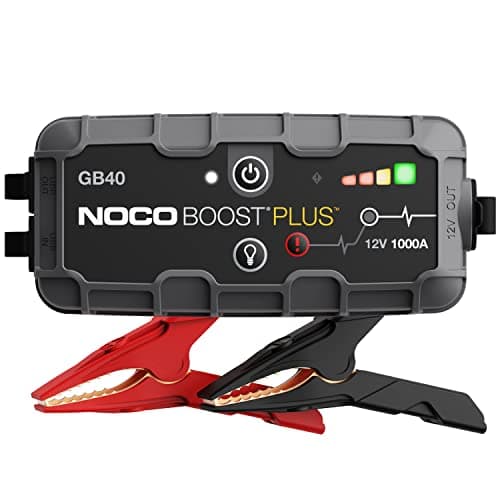
Eleven years, and still the answer
The retail listing dates the GB40 to December 2015. In consumer electronics that is close to geological. The phone in your pocket has been replaced five times over; this pack is still on the shelf at close to its original price, and it is still the pick on the jump starter page and referenced on sixteen pages across this site.
That is worth examining rather than assuming. A product that survives a decade unchanged is either genuinely finished, or it is coasting on a reputation the market has quietly moved past. The way to tell is to put it next to what else you can buy today and see where it actually loses.
Where it loses, honestly
Against the packs ranked on best jump starters for cold weather, the GB40 is beaten on nearly every published figure.
| Pack | Peak amps published | Warranty | Cold rating published |
|---|---|---|---|
| NOCO Boost Plus GB40 | 1,000 A | 1 year | None |
| GOOLOO GP3000 | 3,000 A claimed | 18 months | -4 F to 140 F |
| Hulkman Alpha 85S | 2,000 A | 2 years | Pre-heat, stated -40 F start |
| Hulkman Alpha Pro | 1,500 A, stated at the clamps | 2 years | None |
| AstroAI S8 | 1,500 A | 2 years | Listing warns against use in extreme cold |
Read that row by row and the GB40 looks like a bad buy. It is the weakest headline figure, the shortest commitment, and it is not the cheapest. Two of those three deserve an answer and one of them does not have a good one.
The amp figure, which is the one not to worry about
A sixty-dollar pack publishing three times the peak amps of a hundred-dollar one should make you suspicious rather than impressed. There is no standard governing how a consumer jump-starter peak-amp figure is measured, which is why the numbers in that column are not comparable with each other — a point the cold-weather page sets out in full, including one maker that advertises its figure is measured at the clamps precisely because the industry's usually are not.
The figure that answers your actual question is the engine-size ceiling, and NOCO publishes it plainly: gasoline up to 6.0 liters, diesel up to 3.0. That covers the overwhelming majority of cars on an American road. If your engine is inside it, a bigger peak-amp number buys you nothing at all.
So of the three columns the GB40 loses, one is not a real loss. The other two are.
What it wins on, and why it is the right trade
Every bullet NOCO leads with is about the connection rather than the power. “Patented spark-proof and reverse polarity protection for foolproof connections to any 12V vehicle - no sparks, no wrong connections.”
The rest of what NOCO publishes is consistent with a product built to sit unused for years and then work: an IP65 housing with rubberized over-molding against water, dust and impact; a 100-lumen light with seven modes including SOS, because the other thing you need at the roadside is to be seen; and a 3-hour recharge over USB-C so topping it up is not a chore.
And there is the thing no spec sheet captures: the company is still here. A two-year warranty from a brand that may not exist in eighteen months is worth less than a one-year warranty from one that has been selling the same product since 2015. That is not a figure, and it is the honest reason this pack keeps its place.
Where it is genuinely behind
- Twelve months is the shortest warranty in this category on this site. Hulkman publishes two years on both its packs, AstroAI publishes two, GOOLOO eighteen months. NOCO publishes one, on the most expensive pack of the five. There is no reading of that which favors NOCO, and it is the clearest argument against buying one
- No operating-temperature range is published. On a product most people buy because of winter, NOCO publishes no cold figure at all — where GOOLOO publishes a full -4 F to 140 F range and Hulkman publishes a pre-heat system rated to start at -40 F. The GB40 may well work fine in the cold; NOCO simply does not say so
- The listing cannot agree with itself about the weight. One bullet describes a “compact 2.5 lb form factor” while the listing’s own dimension field reads 0.496 lb. A jump starter is not half a pound. It is a small thing, and it is the kind of small thing that tells you how much weight the rest of that data block can carry
- “Engineered in the USA” is doing careful work. Engineered is not manufactured, and the listing does not say where it is made
One figure this site quotes that could not be re-verified
This site states a battery capacity of 24 Wh for the GB40, and that figure does real work — it is what power bank vs jump starter is built on, and what explains the published “up to 20 starts per charge”.
Checking it for this review, two things turned up. The capacity does not appear on the retail listing at all, which publishes peak amps and starts-per-charge but no watt-hour figure. And NOCO’s own site could not be read: the product URL returns HTTP 403 to an automated request and the alternative paths tried returned 404.
So the 24 Wh is recorded here as what it is — a figure this site has carried from a third-party specification aggregator rather than from NOCO, which could not be confirmed at the maker today. The product record has been updated to say so rather than implying NOCO published it. It is very likely correct; it is not currently verifiable, and this site prefers saying that to quietly keeping the attribution.
Using it, and the habit that decides whether it works
- Charge it before you need it, on a schedule. A lithium pack sitting in a hot trunk self-discharges, and the morning it matters is not the morning to find out. Twice a year, when the clocks change, is the habit the roundup recommends and it is the single biggest determinant of whether you own a jump starter or a brick
- Check your engine against the ceiling now, not then. 6.0 L gas, 3.0 L diesel. Diesels need far more cranking current for the same displacement
- Read the procedure once while it is warm and daylight. How to jump start a car covers the order of operations; doing it for the first time in the dark is how people get it wrong
- Do not charge it when it is freezing. Charging a lithium cell below freezing damages it permanently — bring it indoors first. NOCO does not print this; AstroAI does, and it applies to every pack in the category
- Keep it where you can reach it from the driver's seat. Where to store emergency gear covers why the trunk is not always the right answer
Who should buy something else
- Anyone with a diesel over 3.0 L or a big gas engine. The ceiling is a real limit, and the GB50 and GB70 exist for exactly this
- Anyone whose winters are genuinely severe. If the car lives outside somewhere that reaches -20 F, a pack that publishes a cold figure is worth more than one that does not — see the cold-weather page
- Anyone who wants the pack to inflate tires too. That is a different product class — jump starter and inflator combos
- Anyone whose battery is the actual problem. A jump starter rescues; it does not fix. If you are jumping the car more than once, test the battery
The verdict
It stays the recommendation, with the reasoning stated more plainly than before. You are buying the lowest peak-amp figure and the shortest warranty in its category, and getting in exchange an interlock that makes the one dangerous step foolproof, a housing built to survive years of neglect, and a brand that has been selling this exact product since 2015.
For a thing you buy hoping never to use it, the second list matters more than the first. But the twelve-month warranty is a real weakness rather than a quirk, and if two of NOCO’s competitors can publish two years and a cold rating, there is no good reason NOCO cannot.
Every pick, with the working
Each entry lists the specifications the maker publishes, the axis scores those specifications produce, and what you give up. Rows that read “Not published” are not omissions on our side: they are things the maker will not commit to in writing, and they cost the product points on the transparency axis. Specifications compiled September 4, 2026.
Our pickNot needing anybody else's car
NOCO Boost Plus GB40
1,000 peak amps out of a 24 watt-hour lithium pack that weighs 2.4 pounds, rated for gasoline engines to 6.0 liters and diesel to 3.0, with spark-proof clamps and reverse-polarity protection. It is the single accessory here that changes what happens on the worst morning of your year, and it fits in a glovebox.
- Peak amps
- 1,000 A
- Battery
- 24 Wh lithium-ion, per a third-party aggregator; not on the listing and not confirmable at NOCO
- Engine ceiling
- Gasoline to 6.0 L, diesel to 3.0 L
- Starts per charge
- Up to 20
- Dimensions
- 7.7 x 3.2 x 1.7 in
- Weight
- Listing states a 2.5 lb form factor in copy and 0.496 lb in its dimension field
- Light
- 100 lumens
- Safety
- Patented spark-proof and reverse-polarity protection
- Ingress rating
- IP65
- Recharge
- 3 hours, USB-C
- Warranty
- 1 year limited — the shortest in this category here
- Operating range
- Not published
List price $99.95 per NOCO's listed price, captured on the compile date below. Not a live price and not what you will pay — the button is where the real number is.
What it gets right
- 1,000 peak amps and up to 20 starts on one charge, both published
- Spark-proof and reverse-polarity protected, which matters when you are doing this in the dark
- 2.4 lb and 7.7 inches long — it genuinely lives in the car rather than the garage
- USB port and a 100-lumen light, so it is also the thing you reach for in a power cut
Flaws
- Lithium, so it self-discharges and needs topping up every few months or it is a brick when you need it
- 6.0 L gasoline and 3.0 L diesel is the published ceiling — a big diesel needs the bigger model
- $99.95 for something you hope never to use
The working behind the 8.1
- Heat headroom: not scored (weight 22%)
- The maker publishes no operating-temperature ceiling, so this axis is dropped and the other weights are re-normalized.
- Install effort: 10.0 (weight 24%)
- Plugs into a 12V socket or a USB port. Nothing to mount, nothing to route, reversible in a second.
- Price against the ceiling: 7.0 (weight 24%)
- Listed at $99.95 on the compile date. This site's buyer has a practical ceiling around $150 for a single upgrade, so the scale rewards everything under $100 and falls away sharply past $150. The live price is very often different, and that is what the button is for.
- Written commitment: 5.5 (weight 15%)
- 12-month warranty. This is the only promise in the entire listing that a court would read, which is why it is scored and the marketing copy is not.
- Spec transparency: 9.2 (weight 15%)
- 11 of the 12 specifications we went looking for are published by the maker (92%). A blank row is never a guess here: it prints “Not published” and it costs the product points, because a figure nobody will commit to in writing is a figure you cannot check.
Axes with no published input are dropped and the remaining weights re-normalized, so a product is not punished for a category where an axis does not apply. Specifications compiled September 4, 2026 from a third-party specification aggregator — NOCO's own GB40 page returns 403 to an automated request.
Prices last verified November 2, 2026. They move constantly; the figure on Amazon when you click is the real one.
Questions people actually ask
Is the NOCO GB40 powerful enough for my car?
NOCO publishes an engine-size ceiling of gasoline up to 6.0 liters and diesel up to 3.0 liters, which covers the large majority of cars on an American road. That figure answers the question better than the 1,000 peak amps does — if your engine is inside the ceiling, a pack claiming three times the amps buys you nothing.
Why does the GB40 only publish 1,000 amps when cheaper packs claim 3,000?
Because no standard governs how a consumer jump-starter peak-amp figure is measured, so the numbers are not comparable between brands. One maker in this category advertises that its figure is measured at the clamps, which tells you what the industry's figures usually are. Compare engine-size ceilings instead.
Does the NOCO GB40 work in cold weather?
NOCO publishes no operating-temperature range for it, so there is no maker figure to rely on. That is a genuine gap on a product bought largely for winter — GOOLOO publishes a -4 F to 140 F range and Hulkman publishes a pre-heat system rated to start at -40 F. Whatever pack you own, do not charge it while it is freezing: that damages lithium cells permanently.
What is the NOCO GB40 warranty?
One year, published as a 1-Year Limited Warranty. That is the shortest written term of any jump starter covered on this site — Hulkman and AstroAI publish two years and GOOLOO publishes eighteen months — and it is the clearest argument against buying one.
How often should I charge a jump starter that lives in the car?
Twice a year is a workable habit — tie it to the clocks changing so it actually happens. Lithium packs self-discharge and heat speeds it up, so a pack that has spent summers in a hot trunk will not be at the charge level it reports. This is the most common way the product fails, and it has nothing to do with which brand you bought.
Sources
- Published peak amps, starts per charge, engine-size ceiling, spark-proof and reverse-polarity protection, IP65 rating, 100-lumen light, 3-hour recharge and 1-Year Limited Warranty on the NOCO GB40 retail listing
- The third-party specification aggregator this site has carried the 24 Wh capacity figure from; NOCO's own product page returned HTTP 403 to an automated request on November 2, 2026