Backseat organizer or seat back tray?
They mount the same way and get bought for the same complaint. One of them only works properly when the car is parked, which is the thing to settle before you buy.
By Sawyer V. · Published · How we research
We have not tested any of this. Everything below is compiled from published manufacturer specifications, and the arithmetic is printed so you can check it. This page carries affiliate links: if you buy through one we earn a commission at no extra cost to you, and it does not change the order of the picks. Full disclosure.
The short answer
Measure your headrest posts before you buy either. Post spacing decides fit for both products and it varies enough between cars to be the main reason these get returned. Then choose by what the back seat is for: an organizer if the problem is clutter and scuffed seat backs, which is the everyday case and works while moving. A tray only if somebody genuinely needs a flat surface — and be honest that a tray holding a drink is a projectile in a hard stop, so it is for a parked or stationary car.
| # | Pick | Install | Score | Price |
|---|---|---|---|---|
| 1 | Lusso Gear Backseat Organizer Kick Mat The back of a front seat with a child behind it | Drops in | 9.5/10 | $19.95 - view on Amazon |
| 2 | Fortem Collapsible Car Organizer (50L) Stopping groceries rolling around the back seat | Drops in | 8.7/10 | $27.99 - view on Amazon |
| 3 | Folding Car Back Seat Tray Table A published load figure on a headrest clamp | Clips on | 7.7/10 | $89.99 - view on Amazon |
Prices last verified September 28, 2026. They move constantly; the figure on Amazon when you click is the real one.
Measure the posts first
Both products hang from the two headrest posts on the front seat back, and the distance between those posts is not standard. It is the specification that decides whether either thing fits your car, and it is the one most listings state loosely or not at all.
- Measure center to center between the two posts with the headrest in its normal position.
- Check the headrest actually removes or lifts. Some cars have fixed or integrated headrests, which rules out every strap-over-the-post product.
- Check what is behind the seat back. A seat-back screen, a map pocket or rear air vents all change what can hang there.
- Note the seat back angle. A steeply raked seat makes a tray useless before anything is on it.
The seat back table page makes post spacing its central point for the same reason, and the organizer page covers the fitment variations on that side.
What each one is actually for
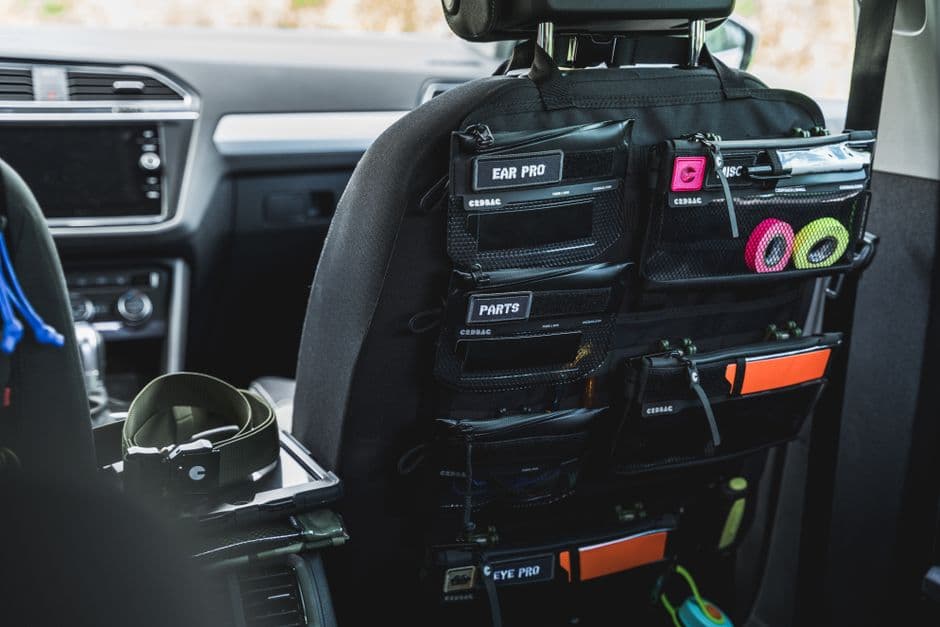
An organizer is storage and protection. Pockets for the things that otherwise live on the seat, and — in the kick mat form — a panel that stops children’s shoes destroying the back of your front seats. That second job is the one people underrate and it is the one with resale consequences.
A tray is a surface. A flat, usually folding platform with a cup recess and sometimes a tablet slot. It is there so somebody can eat, write or work, which is a real need on a long trip and a non-need on a commute.
| Backseat organizer | Seat back tray | |
|---|---|---|
| Primary job | Storage and seat-back protection | A flat surface |
| Useful while moving | Yes | Limited — see below |
| Protects the seat back from shoes | Yes, kick mat versions | Partly, by covering it |
| Holds a drink securely | In a pocket, low down | In a recess, high up |
| Folds away | Stays in place | Yes, usually flat |
| Fit determined by | Post spacing and seat width | Post spacing and seat rake |
| Published load rating | Rarely meaningful | Rarely meaningful |
The part that needs saying about trays
A tray puts objects at chest height, unrestrained, directly in front of a passenger. In a hard stop those objects continue forward at the speed the car was doing. A hot drink in a tray recess is the specific case worth thinking about, and it is why this page will not recommend a tray as a general-purpose accessory for a moving car.
That does not make trays useless. Parked at a trailhead, waiting at a school gate, working from the car between appointments, or stationary on a long break — these are real and the tray is genuinely good at them. The distinction is simply whether the car is moving, and the tray page is explicit about the use case that actually works.
Buy the organizer when
- Children ride in the back. Kick mats pay for themselves against the cost of a scuffed or torn seat back.
- The complaint is clutter — bottles, wipes, tissues, toys migrating around the cabin.
- You want something that works while the car is moving, which is most of the time.
- You are also dealing with rubbish, in which case pair it with a bin rather than expecting pockets to do that job.
Who should skip it: anyone with nobody in the back seat. An empty rear bench does not need pockets, and the organizer just blocks your rear view of the seat.
Buy the tray when
- Somebody genuinely needs to eat, write or use a tablet in a stationary car.
- You work from the car between stops — though a front-seat desk is the better tool for that, covered on work vehicle storage.
- Long trips with older children who will use a surface rather than hold things.
- Your seat backs are steep enough that pockets sag but a rigid tray sits level.
Who should skip it: commuters, anyone whose back seat is usually empty, and anyone expecting to use it at speed. For a tablet specifically, a headrest mount holds the device securely rather than resting it on a shelf, which is the better answer for a moving car.
Every pick, with the working
Each entry lists the specifications the maker publishes, the axis scores those specifications produce, and what you give up. Rows that read “Not published” are not omissions on our side: they are things the maker will not commit to in writing, and they cost the product points on the transparency axis. Specifications compiled September 4, 2026.
Our pickThe back of a front seat with a child behind it
Lusso Gear Backseat Organizer Kick Mat
The only product in this section with a lifetime warranty attached to it, which on a fabric item that lives under a child's shoes is the specification that matters. Waterproof Oxford, machine washable, and it covers the seat back rather than hanging a pouch on it.
- Dimensions
- 19 x 25 in
- Material
- Waterproof Oxford fabric
- Pockets
- 3 or 4 mesh depending on model
- Washable
- Machine washable
- Warranty
- Lifetime (published as a brand-wide term)
- Pack size
- 2
- List price
- Not published
What it gets right
- Lifetime warranty published on every Lusso Gear accessory — nothing else in this category commits in writing
- Waterproof Oxford fabric and machine washable, which is the actual failure mode for a kick mat
- Reinforced corners specifically to stop the sag that makes cheap kick mats useless
- Sold as a pair, which is what a car with two front seats needs
Flaws
- 19 x 25 in covers a typical seat back and no more — a tall SUV seat back will show a gap
- Mesh pockets hold light items; a full water bottle in a mesh pocket sags into a knee
- Straps go around the headrest, so a seat with fixed headrests is awkward
The working behind the 9.5
- Heat headroom: not scored (weight 22%)
- The maker publishes no operating-temperature ceiling, so this axis is dropped and the other weights are re-normalized.
- Install effort: 10.0 (weight 24%)
- Drops in and sits there. No fixing of any kind, and it comes out again when you sell the car.
- Price against the ceiling: not scored (weight 24%)
- No published list price we could cite on the compile date, so this axis is dropped and the other weights are re-normalized.
- Written commitment: not scored (weight 15%)
- No warranty term published, so this axis is dropped and the other weights are re-normalized.
- Spec transparency: 8.6 (weight 15%)
- 6 of the 7 specifications we went looking for are published by the maker (86%). A blank row is never a guess here: it prints “Not published” and it costs the product points, because a figure nobody will commit to in writing is a figure you cannot check.
Axes with no published input are dropped and the remaining weights re-normalized, so a product is not punished for a category where an axis does not apply. Specifications compiled September 4, 2026 from Lusso Gear kick mat published specifications.
2Stopping groceries rolling around the back seat
Fortem Collapsible Car Organizer (50L)
A rigid-based collapsible box rather than a hanging pouch, so it works on the back seat or in the trunk and collapses flat when you need the space back. 600D Oxford with a stated 50 L capacity and securing straps.
- Capacity
- 50 L (45 L, 65 L and 90 L also offered)
- Material
- 600D Oxford (1680D on larger sizes)
- Compartments
- 3 plus side pockets
- Base
- Rigid base plates, non-slip bottom
- Securing
- Adjustable straps
- Collapsible
- Yes, with removable lid
- Exterior dimensions
- Not published
- List price
- Not published
- Warranty
- Not published
What it gets right
- Rigid base plates and sturdy side walls, so it stands up empty — the failure mode of every soft organizer
- Published capacity in liters, which almost nothing in this category states
- Non-slip bottom plus securing straps, so it stays where you put it
- Collapses flat, which is the difference between an organizer and a permanent passenger
Flaws
- 600D Oxford on the standard model; the heavier 1680D fabric is only on the larger sizes
- Exterior dimensions are not published, only capacity, so fit in a specific trunk is a guess
- No published warranty term
The working behind the 8.7
- Heat headroom: not scored (weight 22%)
- The maker publishes no operating-temperature ceiling, so this axis is dropped and the other weights are re-normalized.
- Install effort: 10.0 (weight 24%)
- Drops in and sits there. No fixing of any kind, and it comes out again when you sell the car.
- Price against the ceiling: not scored (weight 24%)
- No published list price we could cite on the compile date, so this axis is dropped and the other weights are re-normalized.
- Written commitment: not scored (weight 15%)
- No warranty term published, so this axis is dropped and the other weights are re-normalized.
- Spec transparency: 6.7 (weight 15%)
- 6 of the 9 specifications we went looking for are published by the maker (67%). A blank row is never a guess here: it prints “Not published” and it costs the product points, because a figure nobody will commit to in writing is a figure you cannot check.
Axes with no published input are dropped and the remaining weights re-normalized, so a product is not punished for a category where an axis does not apply. Specifications compiled September 4, 2026 from Fortem organizer published specifications.
3A published load figure on a headrest clamp
Folding Car Back Seat Tray Table
The folding tray that clamps to the front headrest posts, and the better listings publish a load figure — commonly around 22 lb — plus a folded thickness. Both numbers matter more than the surface area, because this is a cantilever hanging off two posts.
- Load capacity
- Commonly 10 kg / 22 lb (varies by listing)
- Folded thickness
- Around 1.5-3 in
- Laptop size
- Up to around 15.6 in
- Mounting
- Front headrest posts
- Test method for load
- Not published
- Warranty
- Not published
- List price
- Not published
What it gets right
- Published load capacity on better listings, commonly 10 kg / 22 lb
- Published folded thickness, often around 1.5 to 3 in, so it stows behind the seat
- Accommodates laptops up to around 15.6 in on typical listings, with cup holders sized to a stated base diameter
- Folds away completely, which is the right behavior for anything mounted behind a seat
Flaws
- Load figures vary from 10 kg to 20 kg across near-identical hardware with no test method published anywhere
- Anything hard mounted behind a seat is an unrestrained object in a collision — fold it away when not in use
- Needs exposed headrest posts, and post spacing is not standardized between cars
- No warranty published
The working behind the 7.7
- Heat headroom: not scored (weight 22%)
- The maker publishes no operating-temperature ceiling, so this axis is dropped and the other weights are re-normalized.
- Install effort: 9.0 (weight 24%)
- Clips onto a vent blade or a headrest post. Two minutes, no tools, no adhesive, no residue.
- Price against the ceiling: not scored (weight 24%)
- No published list price we could cite on the compile date, so this axis is dropped and the other weights are re-normalized.
- Written commitment: not scored (weight 15%)
- No warranty term published, so this axis is dropped and the other weights are re-normalized.
- Spec transparency: 5.7 (weight 15%)
- 4 of the 7 specifications we went looking for are published by the maker (57%). A blank row is never a guess here: it prints “Not published” and it costs the product points, because a figure nobody will commit to in writing is a figure you cannot check.
Axes with no published input are dropped and the remaining weights re-normalized, so a product is not punished for a category where an axis does not apply. Specifications compiled September 4, 2026 from Published load capacity, folded thickness and laptop size.
Prices last verified September 28, 2026. They move constantly; the figure on Amazon when you click is the real one.
Questions people actually ask
Can you use a seat back tray while driving?
Anything on it is unrestrained at chest height in front of a passenger, and in a hard stop it keeps going. Treat a tray as a stationary-car product — parked, waiting, or on a break. For a tablet in a moving car, a headrest mount holds the device rather than resting it on a surface.
Will a backseat organizer fit my car?
Measure center to center between the two headrest posts first, and check the headrest actually lifts or removes — integrated headrests rule out most strap-over designs. Also check for a seat-back screen or rear vents that the organizer would cover.
Do kick mats actually protect the seat?
Yes, and it is the most underrated reason to buy one. Children’s shoes against the back of a front seat cause wear that shows on resale, and a panel over it is far cheaper than the alternative.
Can I have both?
Not on the same seat back in most cars — they compete for the same two posts. A common arrangement is an organizer behind the front passenger seat and a tray behind the driver, used only when parked.