The best car escape tools
Two things decide whether an escape tool is any use: whether you can reach it, and whether your side windows are laminated. Check the second one before you buy.
By Sawyer V. · Published · How we research
We have not tested any of this. Everything below is compiled from published manufacturer specifications, and the arithmetic is printed so you can check it. This page carries affiliate links: if you buy through one we earn a commission at no extra cost to you, and it does not change the order of the picks. Full disclosure.
The short answer
Buy the resqme, and check your glass first. These tools break tempered side glass. They do not work on laminated side glass, which an increasing number of newer cars use on the front doors for security and noise. Look at the etching in the corner of your window before you buy. The resqme wins on the one thing that matters most — at 2.93 inches on a keyring it is on you rather than in a compartment you may not be able to reach.
| # | Pick | Install | Score | Price |
|---|---|---|---|---|
| 1 | resqme Car Escape Tool Keeping an escape tool actually within reach | Drops in | 9.2/10 | $17.15 - view on Amazon |
| 2 | Anker Bolder LC90 Flashlight A light that is not your phone | Drops in | 8.8/10 | Check price on Amazon |
| 3 | Lifehammer Safety Hammer Evolution A mount you can find in the dark | Adhesive | 6.7/10 | $36.95 - view on Amazon |
Prices last verified October 20, 2026. They move constantly; the figure on Amazon when you click is the real one.
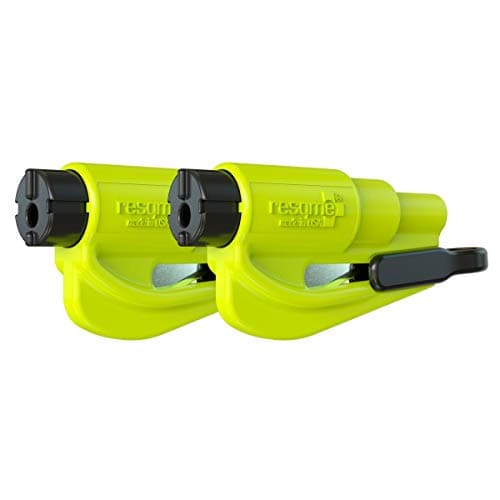
Reach is the specification nobody lists
Picture the actual scenario. You are belted in, possibly after an impact, possibly with the car on its side or filling with water. The tool has to be somewhere you can get to with one hand from a seated, restrained position.
A glovebox fails that test. So does a center console on the far side of the car, a door pocket you are lying against, and the trunk. The number of escape tools sold that end up in a glovebox is the central problem with the category, and it is not a manufacturing problem.
This is why the resqme wins despite being the less capable tool. At 2.93 inches on a keyring it is attached to the keys, which are in the ignition or the console cup holder, or in your pocket. The Lifehammer is a better instrument that is more likely to be out of reach.
The seatbelt cutter is the half people forget
Both tools here do two jobs, and the belt cutter is arguably the more likely to be needed. A belt that will not release is a genuine failure mode — a jammed buckle, a damaged mechanism, or a tensioner that has fired and locked.
The cutter is a recessed blade in a channel: you hook the belt into the channel and pull. The recess is deliberate, so you cannot cut yourself with it and cannot use it as a knife.
resqme publishes a figure that is genuinely unusual for this category — one tool cuts up to 100 individual seat belts, and states a cut time of under 2 seconds. Nobody will ever use a hundred, but publishing a service life at all says something about how the blade was specified.
Certification, which is rarer than it should be
This is a product whose entire value is that it works on the one occasion you need it, and most of the category publishes nothing verifiable at all.
| resqme | Lifehammer Evolution | |
|---|---|---|
| Certification | TUV tested and certified | GS certified (German authority) |
| Size | 2.93 in | 8.5 x 6 x 1.5 in |
| Carry | Keyring | Door bracket |
| Breaker | Spring-loaded steel spike | Spring-loaded ceramic head |
| Resets after use | Yes | Yes |
| Belt cutter life | Up to 100 belts | Not published |
| Works on laminated glass | No | No |
TUV and GS are both German third-party marks. They do not tell you the tool will break your specific window, but they do mean someone independent tested the mechanism, which puts both of these ahead of the unbranded alternatives.
Where to hit, and why the corner
Tempered glass is under engineered tension. Break the surface at any point and the whole pane crumbles, which is why a small spring-loaded punch works where a fist does not.
The center of a window is the most flexible part and absorbs energy. A corner is supported on two sides and cannot flex away from the impact, so the punch delivers its energy into the glass instead. resqme specifically advises aiming for a corner.
- Side windows only. The windshield is laminated on every car and will not break out
- A corner, not the middle
- Turn your face away and shield your eyes as it goes
- Belt first, then glass if both are needed — you cannot get through a window while strapped to the seat
- Clear the remaining glass from the frame before going through it
The scenario these are actually sold for
Water submersion is the case that sells escape tools, and it is worth being accurate about it. Electric windows generally continue working for a period after entering water, so the first action is to try the window switch — it very often works, and it is faster and safer than breaking glass.
The tool is the backup for when the switch does not respond. The consistent guidance from vehicle-submersion research is to deal with belts and windows immediately rather than waiting or calling first, which is the argument for the tool being on your person rather than in a compartment.
We are describing what the manufacturers publish and the physical properties of the glass. We are not emergency responders and this is not rescue training.
What else belongs within reach
An escape tool is one item in a small set that only matters at the worst moment. A flashlight is the other one people underrate — Anker publishes 900 lumens and IPX5 for the Bolder LC90, and an incident at night without light is materially harder. See best flashlights for a car.
For the rest of it — triangles, gloves, a blanket, jumper leads — the pre-packed option is covered in best emergency car kits, and the medical side in best car first aid kits.
Every pick, with the working
Each entry lists the specifications the maker publishes, the axis scores those specifications produce, and what you give up. Rows that read “Not published” are not omissions on our side: they are things the maker will not commit to in writing, and they cost the product points on the transparency axis. Specifications compiled September 4, 2026.
Our pickKeeping an escape tool actually within reach
resqme Car Escape Tool
The one escape tool small enough to live on your keyring, which is the only place an escape tool is any use — a hammer in the glovebox is a hammer you cannot reach with a jammed belt across your chest. Spring-loaded, so it needs no swing.
- Height
- 2.93 in
- Materials
- ABS plastic and stainless steel
- Window breaker
- Spring-loaded stainless spike, resets after each use
- Belt cutter
- Stainless blade, rated for up to 100 seat belts
- Cut time
- Under 2 seconds (manufacturer figure)
- Certification
- TUV tested and certified
- Origin
- Made in USA
- Works on laminated glass
- No — tempered side glass only
- List price
- Not published
- Warranty
- Not published
What it gets right
- 2.93 inches tall and keyring-mounted, so it is on you rather than in a compartment you cannot reach
- Spring-loaded spike needs no room to swing, which matters when you are belted in
- Publishes a service life: one unit cuts up to 100 seat belts, and the spike resets after each use
- TUV tested and certified, and made in the USA
Flaws
- Breaks tempered side glass only. It will not touch a laminated side window, which is increasingly common on newer cars
- Small enough to lose, and a lost escape tool is no escape tool
- No published warranty term
The working behind the 9.2
- Heat headroom: not scored (weight 22%)
- The maker publishes no operating-temperature ceiling, so this axis is dropped and the other weights are re-normalized.
- Install effort: 10.0 (weight 24%)
- Drops in and sits there. No fixing of any kind, and it comes out again when you sell the car.
- Price against the ceiling: not scored (weight 24%)
- No published list price we could cite on the compile date, so this axis is dropped and the other weights are re-normalized.
- Written commitment: not scored (weight 15%)
- No warranty term published, so this axis is dropped and the other weights are re-normalized.
- Spec transparency: 8.0 (weight 15%)
- 8 of the 10 specifications we went looking for are published by the maker (80%). A blank row is never a guess here: it prints “Not published” and it costs the product points, because a figure nobody will commit to in writing is a figure you cannot check.
Axes with no published input are dropped and the remaining weights re-normalized, so a product is not punished for a category where an axis does not apply. Specifications compiled September 4, 2026 from resqme published specifications and certification.
2A light that is not your phone
Anker Bolder LC90 Flashlight
900 lumens from a CREE LED, a published 6-hour runtime, IPX5 water resistance and five modes including strobe and SOS, on a rechargeable 18650. Using a phone as a flashlight at the roadside drains the one device you need to call for help, which is the entire argument for keeping a real one in the car.
- Output
- 900 lumens, CREE LED
- Runtime
- Up to 6 hours
- Ingress rating
- IPX5
- Modes
- High, medium, low, strobe, SOS
- Beam
- Zoomable
- Battery
- Rechargeable 18650, included
- Stated beam distance
- Over 660 ft
- Operating range
- Not published
What it gets right
- Published lumens (900), runtime (6 h) and ingress rating (IPX5) — all three, which is rare at this price
- Rechargeable 18650 included, so there is no scramble for AAs
- Zoomable from flood to spot, which covers both 'find the dropped bolt' and 'signal from the shoulder'
- SOS and strobe modes, which are exactly the modes a roadside light needs
Flaws
- IPX5 is rain resistance, not submersion. Fine for a breakdown, not for dropping in a puddle
- A lithium cell in a hot trunk self-discharges, so it needs charging on a schedule like the jump starter does
- 900 lumens on high for 6 hours is not the same as 900 lumens for 6 hours; brightness steps down between modes
The working behind the 8.8
- Heat headroom: not scored (weight 22%)
- The maker publishes no operating-temperature ceiling, so this axis is dropped and the other weights are re-normalized.
- Install effort: 10.0 (weight 24%)
- Drops in and sits there. No fixing of any kind, and it comes out again when you sell the car.
- Price against the ceiling: not scored (weight 24%)
- No published list price we could cite on the compile date, so this axis is dropped and the other weights are re-normalized.
- Written commitment: 7.0 (weight 15%)
- 18-month warranty. This is the only promise in the entire listing that a court would read, which is why it is scored and the marketing copy is not.
- Spec transparency: 8.8 (weight 15%)
- 7 of the 8 specifications we went looking for are published by the maker (88%). A blank row is never a guess here: it prints “Not published” and it costs the product points, because a figure nobody will commit to in writing is a figure you cannot check.
Axes with no published input are dropped and the remaining weights re-normalized, so a product is not punished for a category where an axis does not apply. Specifications compiled September 4, 2026 from Anker Bolder LC90 published specifications.
3A mount you can find in the dark
Lifehammer Safety Hammer Evolution
Skip this one. It is the better tool and the worse purchase for most people, because it only works if you actually fit the door bracket. A full-size hammer loose in a glovebox is worse than a keyring tool, since the entire scenario involves not being able to reach the glovebox. Buy it only if you will mount it today.
A full-size automatic hammer with a ceramic head and a door-mounted bracket, GS certified by the German authority. You press it against the glass instead of swinging it, which is the difference between a tool and a hopeful gesture in a footwell full of water.
- Dimensions
- 8.5 x 6 x 1.5 in
- Hammer head
- Ultra-hard ceramic, spring-loaded, self-reloading
- Belt cutter
- Steeply angled ultra-sharp blade
- Operation
- Automatic — press against glass, no swing
- Certification
- GS certified (German authority)
- Mounting
- Quick Click bracket, door mounted
- Works on laminated glass
- No — non-laminated side windows only
- List price
- Not published
- Warranty
- Not published
What it gets right
- Automatic — press the head to the glass and the spring fires. No swing needed and no room required
- Ultra-hard ceramic head, and it reloads itself after each use
- GS certified by the German authority, a real third-party mark
- Quick Click bracket mounts on the door, so its location is fixed and findable
Flaws
- 8.5 x 6 x 1.5 in — this lives in the car, not on your person, and a bracket you did not fit is a tool in the trunk
- Non-laminated side windows only, same limitation as every escape tool
- No published warranty term
The working behind the 6.7
- Heat headroom: not scored (weight 22%)
- The maker publishes no operating-temperature ceiling, so this axis is dropped and the other weights are re-normalized.
- Install effort: 6.0 (weight 24%)
- Adhesive pad onto the dashboard. Permanent in practice: repositioning means a new pad, and the pad is the part that fails first.
- Price against the ceiling: not scored (weight 24%)
- No published list price we could cite on the compile date, so this axis is dropped and the other weights are re-normalized.
- Written commitment: not scored (weight 15%)
- No warranty term published, so this axis is dropped and the other weights are re-normalized.
- Spec transparency: 7.8 (weight 15%)
- 7 of the 9 specifications we went looking for are published by the maker (78%). A blank row is never a guess here: it prints “Not published” and it costs the product points, because a figure nobody will commit to in writing is a figure you cannot check.
Axes with no published input are dropped and the remaining weights re-normalized, so a product is not punished for a category where an axis does not apply. Specifications compiled September 4, 2026 from Lifehammer Safety Hammer Evolution published specifications.
Prices last verified October 20, 2026. They move constantly; the figure on Amazon when you click is the real one.
Questions people actually ask
Will an escape tool break a laminated window?
No. Laminated glass has a plastic interlayer that holds the fragments together — that is its purpose. A spring-loaded punch may crack it without creating an opening. Check the etching in the corner of each window to find out which you have.
Can I break the windshield to get out?
No. Windshields are laminated on every modern car and are bonded into the body. Side and rear glass are the escape routes.
Where should I keep an escape tool?
Somewhere reachable while belted in with one hand. A keyring or a door bracket qualifies. A glovebox or trunk does not — the scenario that needs the tool is frequently one where you cannot reach across the cabin.
Do these work more than once?
Yes. Both use a spring-loaded mechanism that resets automatically after each use. resqme publishes a belt-cutting service life of up to 100 belts; Lifehammer does not publish a figure.