The best car first aid kits
A 300-piece kit can be 250 plasters. The number on the box is the least informative thing about it — the contents standard is what tells you anything.
By Sawyer V. · Published · How we research
We have not tested any of this. Everything below is compiled from published manufacturer specifications, and the arithmetic is printed so you can check it. This page carries affiliate links: if you buy through one we earn a commission at no extra cost to you, and it does not change the order of the picks. Full disclosure.
The short answer
Buy the First Aid Only 335-piece OSHA kit for contents you can audit, or the Surviveware for organization. Ignore the piece count entirely — it is trivially inflated with plasters. What matters is whether the contents were assembled against a published standard: the First Aid Only kit is built to an OSHA-compliant list traceable to ANSI/ISEA Z308.1, and the Surviveware is a registered FDA medical device with labeled compartments. Then set a calendar reminder, because everything in it expires.
| # | Pick | Install | Score | Price |
|---|---|---|---|---|
| 1 | First Aid Only 335-Piece OSHA Kit A kit whose contents are defined by a standard | Drops in | 9.5/10 | $37.44 - view on Amazon |
| 2 | Surviveware Vehicle First Aid Kit A kit organized for finding things fast | Drops in | 8.9/10 | $33.99 - view on Amazon |
| 3 | Anker Bolder LC90 Flashlight A light that is not your phone | Drops in | 8.8/10 | Check price on Amazon |
Prices last verified October 20, 2026. They move constantly; the figure on Amazon when you click is the real one.
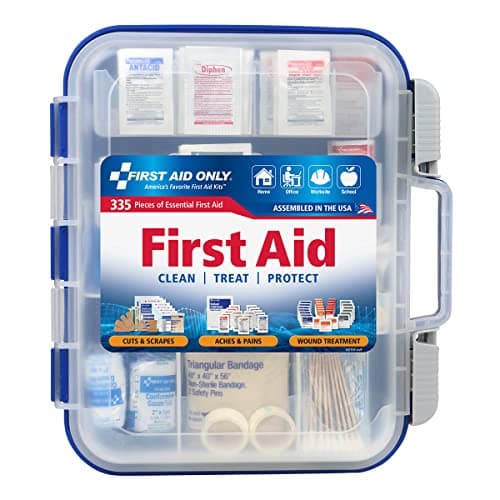
The piece count is close to meaningless
“300 pieces” sounds substantial and is the easiest number in the world to inflate. Individual adhesive bandages count as one piece each. So does each antiseptic wipe, each safety pin, each cotton bud.
A kit can reach three hundred pieces while containing nothing capable of managing a serious bleed, and a much smaller kit with a pressure bandage, a proper dressing and gloves can be considerably more useful. The count measures packaging decisions, not capability.
Standards, which is the actual specification
Two of the products here publish something checkable, which puts them well ahead of the category.
The First Aid Only 335-piece OSHA kit is built to an OSHA-compliant contents list. OSHA's guidance references ANSI/ISEA Z308.1, “Minimum Requirements for Workplace First Aid Kits and Supplies”, as an example of minimal contents. That gives you a defined list rather than a marketing assortment, and it is auditable — the kit is sold for worksites where somebody checks.
The Surviveware kits are registered FDA medical devices. It is worth being precise about what that means: it is a device listing and registration, not an efficacy approval and not a claim about clinical outcomes. It is still more than most of the category offers.
| First Aid Only 335-piece OSHA kit | Surviveware vehicle kit | |
|---|---|---|
| Piece count | 335 | 94 (other sizes sold) |
| Rated for | Up to 100 people | Not stated in persons |
| Standard | OSHA-compliant contents | Registered FDA medical device |
| Reference | ANSI/ISEA Z308.1 | FDA device listing |
| Organization | Compartmented case | Labeled compartments |
| Mounting | Not stated | Hook-and-loop panel for trunk lining |
| Notable contents | Workplace-weighted | CPR mask, pressure bandage, nitrile gloves |
Workplace kits are weighted for the wrong injuries
This is the honest limitation of the OSHA-compliant option. Workplace kits are assembled around what happens in offices and worksites: cuts, abrasions, minor burns, eye irritation. Lots of plasters and wipes, because that is what the setting produces.
Roadside injuries skew differently. What matters is bleeding control, protecting a wound from contamination and having a barrier for resuscitation. The Surviveware's inclusion of a CPR mask, a pressure bandage and nitrile gloves is a more car-appropriate emphasis even at a lower piece count.
A reasonable approach is the standards-based kit as a base and a small number of deliberate additions: a tourniquet if you have been trained to use one, a foil blanket, a decent pair of shears. Nothing on this site should be read as clinical guidance — a kit is only as useful as the person opening it, and a first aid course is worth more than any purchase on this page.
The problem nobody plans for
Everything in a first aid kit expires. Adhesive dries out and bandages stop sticking. Antiseptic wipes evaporate through their packaging. Sterile dressings have a sterility date. Medications have hard expiry dates.
A car makes all of it worse. A kit in a trunk goes through a full temperature cycle every day, reaching roughly 60-70 C in summer and below freezing in winter, and that accelerates the degradation of adhesives and pharmaceuticals considerably.
- Put a reminder in your calendar for an annual check. Neither maker publishes a replacement interval, and nothing in the kit will tell you
- Write the purchase date on the case in marker, so a future you knows
- Check the adhesive first. Bandages that will not stick are the earliest and most common failure
- Replace, do not top up. Adding new items to a degraded kit gives you a kit you cannot trust
Where it lives, and the case it lives in
A kit sliding loose around a trunk is a kit whose contents are being ground against each other, and it is also an unrestrained object. The Surviveware's hook-and-loop panel that attaches to the trunk lining is a genuinely practical answer to both, and is more useful than it sounds.
The First Aid Only kit's case is built for a wall or a shelf rather than a wet trunk, which is its weakest point in this application. If you buy it, consider what it sits in.
For securing it along with everything else back there, a cargo net or tie-downs do the job cheaply — see cargo nets and tie-downs.
What goes with it
A first aid kit is one component. The others that matter at the same moment are light, a way out, and a way to make yourself visible.
A flashlight because this happens at night. An escape tool because a belt that will not release and a window that will not open are the problems a medical kit cannot solve. And a pre-packed kit with triangles, a vest and jumper leads covers the rest — best emergency car kits.
In winter the list changes and gets longer: what to keep in your car in winter.
Every pick, with the working
Each entry lists the specifications the maker publishes, the axis scores those specifications produce, and what you give up. Rows that read “Not published” are not omissions on our side: they are things the maker will not commit to in writing, and they cost the product points on the transparency axis. Specifications compiled September 4, 2026.
Our pickA kit whose contents are defined by a standard
First Aid Only 335-Piece OSHA Kit
335 pieces built to an OSHA-compliant contents list rather than to a number on the box. That is the only meaningful way to judge a first aid kit: the piece count tells you nothing, the standard the contents are drawn from tells you everything. First Aid Only states supplies adequate for up to 100 people, which is generous for one car.
- Piece count
- 335
- Rated for
- Up to 100 people
- Standard
- OSHA-compliant contents
- Reference standard
- ANSI/ISEA Z308.1 minimum workplace requirements
- Intended use
- Home, car, travel and office
- Case
- Wall-mountable plastic, clear cover, compartments
- Warranty
- Not published
List price $37.44 per Amazon listing, September 27, 2026, captured on the compile date below. Not a live price and not what you will pay — the button is where the real number is.
What it gets right
- Contents built against an OSHA-compliant list, which traces to ANSI/ISEA Z308.1 minimum requirements
- Stated adequate for up to 100 people, so the quantities are generous for one car
- Published piece count of 335 alongside the standard, not instead of it
- Clear cover and individual compartments, so you can find one item under pressure
Flaws
- Workplace kits are weighted toward cuts and abrasions, not roadside trauma
- The case is wall-mountable and built for a shelf, not for a trunk that gets wet
- No published warranty, and consumables have expiry dates you have to track yourself
The working behind the 9.5
- Heat headroom: not scored (weight 22%)
- The maker publishes no operating-temperature ceiling, so this axis is dropped and the other weights are re-normalized.
- Install effort: 10.0 (weight 24%)
- Drops in and sits there. No fixing of any kind, and it comes out again when you sell the car.
- Price against the ceiling: 9.5 (weight 24%)
- Listed at $37.44 on the compile date. This site's buyer has a practical ceiling around $150 for a single upgrade, so the scale rewards everything under $100 and falls away sharply past $150. The live price is very often different, and that is what the button is for.
- Written commitment: not scored (weight 15%)
- No warranty term published, so this axis is dropped and the other weights are re-normalized.
- Spec transparency: 8.6 (weight 15%)
- 6 of the 7 specifications we went looking for are published by the maker (86%). A blank row is never a guess here: it prints “Not published” and it costs the product points, because a figure nobody will commit to in writing is a figure you cannot check.
Axes with no published input are dropped and the remaining weights re-normalized, so a product is not punished for a category where an axis does not apply. Specifications compiled September 4, 2026 from the First Aid Only 335-piece OSHA kit listing.
2A kit organized for finding things fast
Surviveware Vehicle First Aid Kit
A registered FDA medical device with labeled compartments and a hook-and-loop panel that attaches to the trunk lining. The organization is the feature: in an emergency, a bag you have to empty is a bag that costs you a minute.
- Piece count
- 94 on the vehicle kit (180, 200 and 238 variants also sold)
- Registration
- Registered FDA medical device
- Organization
- Labeled compartments
- Mounting
- Hook-and-loop panel for trunk lining
- Notable contents
- CPR mask, pressure bandage, nitrile gloves, eyepatches, whistle
- Warranty
- Not published
- List price
- Not published
What it gets right
- Registered FDA medical device, which is a real registration rather than a marketing line
- Labeled compartments, so the thing you need is findable by someone who did not pack it
- Hook-and-loop panel attaches to trunk lining rather than sliding around
- Contents include a CPR mask, pressure bandage and nitrile gloves — beyond the plaster-and-wipe level
Flaws
- Sold in several piece counts (94, 180, 200, 238) under similar names, so it is easy to buy a different kit than you meant to
- FDA registration covers the device listing, not any claim about clinical outcomes
- No published warranty term
The working behind the 8.9
- Heat headroom: not scored (weight 22%)
- The maker publishes no operating-temperature ceiling, so this axis is dropped and the other weights are re-normalized.
- Install effort: 10.0 (weight 24%)
- Drops in and sits there. No fixing of any kind, and it comes out again when you sell the car.
- Price against the ceiling: not scored (weight 24%)
- No published list price we could cite on the compile date, so this axis is dropped and the other weights are re-normalized.
- Written commitment: not scored (weight 15%)
- No warranty term published, so this axis is dropped and the other weights are re-normalized.
- Spec transparency: 7.1 (weight 15%)
- 5 of the 7 specifications we went looking for are published by the maker (71%). A blank row is never a guess here: it prints “Not published” and it costs the product points, because a figure nobody will commit to in writing is a figure you cannot check.
Axes with no published input are dropped and the remaining weights re-normalized, so a product is not punished for a category where an axis does not apply. Specifications compiled September 4, 2026 from Surviveware vehicle kit published specifications.
3A light that is not your phone
Anker Bolder LC90 Flashlight
Skip this one. It is not a first aid kit and it is in this list on purpose. Almost every roadside incident that needs a first aid kit happens in poor light or at night, and a kit you cannot see into is a kit you cannot use. If you own one and not the other, the light is the more frequently useful object.
900 lumens from a CREE LED, a published 6-hour runtime, IPX5 water resistance and five modes including strobe and SOS, on a rechargeable 18650. Using a phone as a flashlight at the roadside drains the one device you need to call for help, which is the entire argument for keeping a real one in the car.
- Output
- 900 lumens, CREE LED
- Runtime
- Up to 6 hours
- Ingress rating
- IPX5
- Modes
- High, medium, low, strobe, SOS
- Beam
- Zoomable
- Battery
- Rechargeable 18650, included
- Stated beam distance
- Over 660 ft
- Operating range
- Not published
What it gets right
- Published lumens (900), runtime (6 h) and ingress rating (IPX5) — all three, which is rare at this price
- Rechargeable 18650 included, so there is no scramble for AAs
- Zoomable from flood to spot, which covers both 'find the dropped bolt' and 'signal from the shoulder'
- SOS and strobe modes, which are exactly the modes a roadside light needs
Flaws
- IPX5 is rain resistance, not submersion. Fine for a breakdown, not for dropping in a puddle
- A lithium cell in a hot trunk self-discharges, so it needs charging on a schedule like the jump starter does
- 900 lumens on high for 6 hours is not the same as 900 lumens for 6 hours; brightness steps down between modes
The working behind the 8.8
- Heat headroom: not scored (weight 22%)
- The maker publishes no operating-temperature ceiling, so this axis is dropped and the other weights are re-normalized.
- Install effort: 10.0 (weight 24%)
- Drops in and sits there. No fixing of any kind, and it comes out again when you sell the car.
- Price against the ceiling: not scored (weight 24%)
- No published list price we could cite on the compile date, so this axis is dropped and the other weights are re-normalized.
- Written commitment: 7.0 (weight 15%)
- 18-month warranty. This is the only promise in the entire listing that a court would read, which is why it is scored and the marketing copy is not.
- Spec transparency: 8.8 (weight 15%)
- 7 of the 8 specifications we went looking for are published by the maker (88%). A blank row is never a guess here: it prints “Not published” and it costs the product points, because a figure nobody will commit to in writing is a figure you cannot check.
Axes with no published input are dropped and the remaining weights re-normalized, so a product is not punished for a category where an axis does not apply. Specifications compiled September 4, 2026 from Anker Bolder LC90 published specifications.
Prices last verified October 20, 2026. They move constantly; the figure on Amazon when you click is the real one.
Questions people actually ask
How many pieces should a car first aid kit have?
It is the wrong question. A kit built to a published contents standard with 100 pieces is more useful than an unstructured 300-piece assortment. Ask what the kit can handle, not how many objects are in it.
How often should I replace a car first aid kit?
Neither maker here publishes an interval, so we are not going to invent one. Check it annually — adhesives and sterile dressings are the first things to go, and a car's temperature cycling accelerates both.
Is a bigger kit better for a family car?
More of the same consumables, mostly. What actually helps with more people in the car is more of the bleeding-control items and more gloves, rather than a higher headline count.
Should I add a tourniquet?
Only if you have been trained to use one. A tourniquet applied incorrectly can do harm, and the training is the useful part rather than the object. We describe what is in these kits; we do not give clinical advice.