How to jump start a car
The order matters, and the reason the final clamp goes on the engine block rather than the battery is the one thing worth understanding before you start.
By Sawyer V. · Published · How we research
We have not tested any of this. Everything below is compiled from published manufacturer specifications, and the arithmetic is printed so you can check it. This page carries affiliate links: if you buy through one we earn a commission at no extra cost to you, and it does not change the order of the picks. Full disclosure.
The short version
Red to dead positive, red to good positive, black to good negative, and the last black clamp to bare metal on the dead car's engine — never to its battery. A charging battery vents hydrogen, and the final connection is the one that sparks. Making that spark on an engine bracket a foot away from the battery instead of on the battery terminal is the entire safety principle. Disconnect in exactly the reverse order.
| # | Pick | Install | Score | Price |
|---|---|---|---|---|
| 1 | Anker Bolder LC90 Flashlight A light that is not your phone | Drops in | 8.8/10 | Check price on Amazon |
| 2 | AstroAI Digital Tire Gauge (150 PSI) Knowing what your tires are actually at | Drops in | 8.4/10 | $6.99 - view on Amazon |
| 3 | NOCO Boost Plus GB40 Not needing anybody else's car | Plugs in | 8.0/10 | Check price on Amazon |
Prices last verified October 20, 2026. They move constantly; the figure on Amazon when you click is the real one.
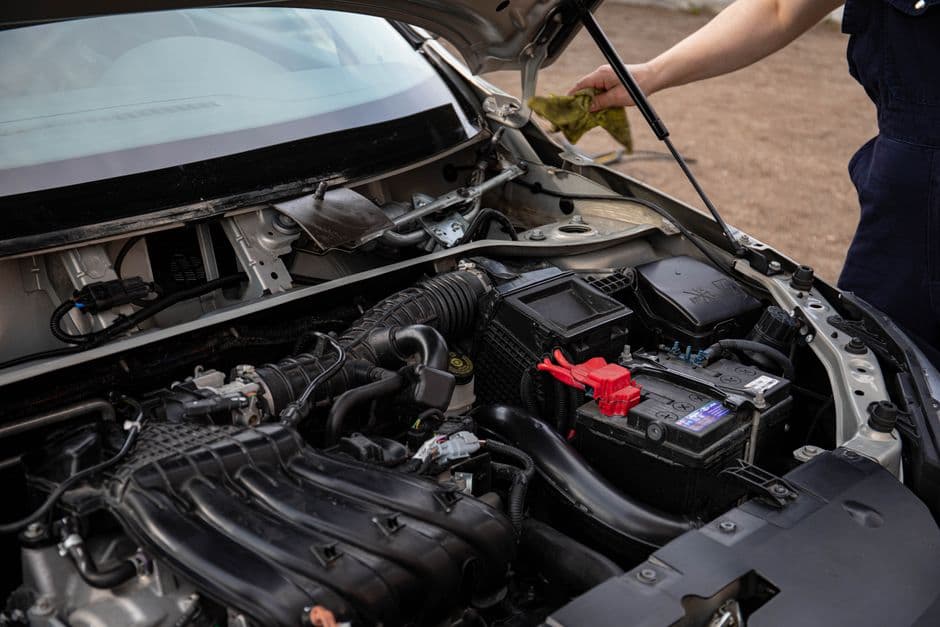
Why the last clamp does not go on the battery
A lead-acid battery under charge produces hydrogen gas, and it vents it. That gas accumulates around the battery, particularly under a hood in still air.
The last connection you make in any jump start completes the circuit, and completing a circuit with current available produces a spark. Small, brief, and entirely normal — unless it happens in a pocket of hydrogen, in which case the outcome is a battery that ruptures and sprays sulphuric acid.
Grounding the final clamp to an engine bracket or unpainted bolt puts that spark well away from where the gas is. The circuit is electrically identical — the engine block is connected to the battery negative through the ground strap — but the spark happens somewhere safe.
This is why the disconnection order is also specified. Removing that same clamp first means the circuit is broken before you go anywhere near the battery.
Using jumper cables and another car
The classic method, and it needs a second vehicle, a willing driver and cables long enough to reach — which in a parking structure with cars nose-in is not always possible.
- Park close enough for the cables to reach, but do not let the cars touch
- Both engines off, keys out, both in park or neutral, parking brakes on
- Red to dead positive
- Red to good positive
- Black to good negative
- Black to bare metal on the dead car's engine, away from the battery
- Start the donor. Let it run a few minutes
- Start the dead car. If it does not go within about five seconds, stop and wait
- Disconnect in exact reverse order
Two things people get wrong. Cranking repeatedly overheats the starter and drains the donor; wait a minute between attempts. And letting the clamps touch each other while connected at the other end is a direct short across a battery, which is how cables get welded together.
Using a lithium jump pack
A pack removes the second car from the equation entirely, which is the reason to own one. The NOCO GB40 is the one we cover in best portable jump starters.
The connection order is the same principle with one difference: modern packs have reverse polarity protection and spark-proof clamps, and many will simply refuse to deliver current until they detect a correct connection. That is a safety net, not a license to be careless — connect in the same order and ground the final clamp to the engine.
- Check the charge before you need it. A pack that has sat in a glovebox for two years is a brick. Charge it every few months
- Temperature matters. Lithium packs lose capacity in cold, which is precisely when batteries fail. A pack stored in a freezing car is a weaker pack
- Respect the duty cycle. Packs specify a rest period between attempts. Ignoring it overheats the cells
- Most double as a USB power bank and a light, which is genuinely useful and is also how the charge gets used up before you need it
What to do after it starts
A jump start puts almost nothing back into the battery. The engine started on current from the donor; your battery is still flat, and the alternator now has to refill it.
That takes sustained running — twenty minutes minimum, and driving is better than idling because alternator output is low at idle speed. Switching the engine off at the end of a five-minute drive means doing the whole thing again.
And treat a flat battery as information. A healthy battery in a car driven regularly does not go flat on its own. Either something drained it — lights left on, a door not shut, an accessory on a permanently live socket, which we cover in does a car charger drain your battery — or the battery is at the end of its life. If it happens twice, it is the battery.
Doing this at night, which is when it happens
Batteries fail on cold mornings and dark evenings, and terminal covers, polarity markings and the ground point are all things you have to see to get right.
A headlamp or a decent flashlight is genuinely part of this job — Anker publishes 900 lumens, up to 6 hours runtime and IPX5 for the Bolder LC90, and having both hands free matters when you are holding a clamp. See best flashlights for a car.
If you are on a roadside rather than a driveway, position matters more than speed: get the car as far off the carriageway as you can, hazards on, and stand on the side away from traffic. What else belongs in the car for this is in best emergency car kits and, seasonally, what to keep in your car in winter.
Every pick, with the working
Each entry lists the specifications the maker publishes, the axis scores those specifications produce, and what you give up. Rows that read “Not published” are not omissions on our side: they are things the maker will not commit to in writing, and they cost the product points on the transparency axis. Specifications compiled September 4, 2026.
Our pickA light that is not your phone
Anker Bolder LC90 Flashlight
900 lumens from a CREE LED, a published 6-hour runtime, IPX5 water resistance and five modes including strobe and SOS, on a rechargeable 18650. Using a phone as a flashlight at the roadside drains the one device you need to call for help, which is the entire argument for keeping a real one in the car.
- Output
- 900 lumens, CREE LED
- Runtime
- Up to 6 hours
- Ingress rating
- IPX5
- Modes
- High, medium, low, strobe, SOS
- Beam
- Zoomable
- Battery
- Rechargeable 18650, included
- Stated beam distance
- Over 660 ft
- Operating range
- Not published
What it gets right
- Published lumens (900), runtime (6 h) and ingress rating (IPX5) — all three, which is rare at this price
- Rechargeable 18650 included, so there is no scramble for AAs
- Zoomable from flood to spot, which covers both 'find the dropped bolt' and 'signal from the shoulder'
- SOS and strobe modes, which are exactly the modes a roadside light needs
Flaws
- IPX5 is rain resistance, not submersion. Fine for a breakdown, not for dropping in a puddle
- A lithium cell in a hot trunk self-discharges, so it needs charging on a schedule like the jump starter does
- 900 lumens on high for 6 hours is not the same as 900 lumens for 6 hours; brightness steps down between modes
The working behind the 8.8
- Heat headroom: not scored (weight 22%)
- The maker publishes no operating-temperature ceiling, so this axis is dropped and the other weights are re-normalized.
- Install effort: 10.0 (weight 24%)
- Drops in and sits there. No fixing of any kind, and it comes out again when you sell the car.
- Price against the ceiling: not scored (weight 24%)
- No published list price we could cite on the compile date, so this axis is dropped and the other weights are re-normalized.
- Written commitment: 7.0 (weight 15%)
- 18-month warranty. This is the only promise in the entire listing that a court would read, which is why it is scored and the marketing copy is not.
- Spec transparency: 8.8 (weight 15%)
- 7 of the 8 specifications we went looking for are published by the maker (88%). A blank row is never a guess here: it prints “Not published” and it costs the product points, because a figure nobody will commit to in writing is a figure you cannot check.
Axes with no published input are dropped and the remaining weights re-normalized, so a product is not punished for a category where an axis does not apply. Specifications compiled September 4, 2026 from Anker Bolder LC90 published specifications.
2Knowing what your tires are actually at
AstroAI Digital Tire Gauge (150 PSI)
0 to 150 PSI, factory calibrated to plus or minus 1 PSI, reading in 0.1 increments across four units with a backlit screen. The gas-station gauge you have been trusting is almost certainly worse than this, and this costs about the same as one tank of fuel.
- Range
- 0-150 PSI / 0-10 Bar / 0-10 Kgf/cm2 / 0-1000 kPa
- Accuracy
- Plus or minus 1 PSI
- Calibration standard
- ANSI B40.7, AstroAI UK listing only
- Resolution
- 0.1 PSI
- Display
- Backlit LCD, 4 selectable units
- Auto shut-off
- 30 seconds
- List price
- Not published
- Warranty
- 1 year, stated
What it gets right
- Published accuracy of plus or minus 1 PSI, stated in the listing title — almost nothing else in this category states an accuracy figure at all
- Reads to 0.1 PSI, which matters because a 3 PSI error is the difference between correct and noticeably underinflated
- Backlit screen, because tire pressures get checked in the dark more often than not
- Auto shut-off after 30 seconds, so the battery lasts
Flaws
- 150 PSI range is far beyond a passenger car, so the useful part of the scale is the bottom fifth
- A digital gauge has a battery, and a battery in a glovebox is a battery you will find dead
- It measures. It does not inflate — that is a separate tool
The working behind the 8.4
- Heat headroom: not scored (weight 22%)
- The maker publishes no operating-temperature ceiling, so this axis is dropped and the other weights are re-normalized.
- Install effort: 10.0 (weight 24%)
- Drops in and sits there. No fixing of any kind, and it comes out again when you sell the car.
- Price against the ceiling: not scored (weight 24%)
- No published list price we could cite on the compile date, so this axis is dropped and the other weights are re-normalized.
- Written commitment: 5.5 (weight 15%)
- 12-month warranty. This is the only promise in the entire listing that a court would read, which is why it is scored and the marketing copy is not.
- Spec transparency: 8.8 (weight 15%)
- 7 of the 8 specifications we went looking for are published by the maker (88%). A blank row is never a guess here: it prints “Not published” and it costs the product points, because a figure nobody will commit to in writing is a figure you cannot check.
Axes with no published input are dropped and the remaining weights re-normalized, so a product is not punished for a category where an axis does not apply. Specifications compiled September 4, 2026 from AstroAI 150 PSI gauge published specifications.
3Not needing anybody else's car
NOCO Boost Plus GB40
1,000 peak amps out of a 24 watt-hour lithium pack that weighs 2.4 pounds, rated for gasoline engines to 6.0 liters and diesel to 3.0, with spark-proof clamps and reverse-polarity protection. It is the single accessory here that changes what happens on the worst morning of your year, and it fits in a glovebox.
- Peak amps
- 1,000 A
- Battery
- 24 Wh lithium-ion
- Engine ceiling
- Gasoline to 6.0 L, diesel to 3.0 L
- Starts per charge
- Up to 20
- Dimensions
- 7.7 x 3.2 x 1.7 in
- Weight
- 2.4 lb with clamps
- Light
- 100 lumens
- Safety
- Spark proof, reverse polarity protected
- Operating range
- Not published
List price $99.95 per NOCO's listed price, captured on the compile date below. Not a live price and not what you will pay — the button is where the real number is.
What it gets right
- 1,000 peak amps and up to 20 starts on one charge, both published
- Spark-proof and reverse-polarity protected, which matters when you are doing this in the dark
- 2.4 lb and 7.7 inches long — it genuinely lives in the car rather than the garage
- USB port and a 100-lumen light, so it is also the thing you reach for in a power cut
Flaws
- Lithium, so it self-discharges and needs topping up every few months or it is a brick when you need it
- 6.0 L gasoline and 3.0 L diesel is the published ceiling — a big diesel needs the bigger model
- $99.95 for something you hope never to use
The working behind the 8.0
- Heat headroom: not scored (weight 22%)
- The maker publishes no operating-temperature ceiling, so this axis is dropped and the other weights are re-normalized.
- Install effort: 10.0 (weight 24%)
- Plugs into a 12V socket or a USB port. Nothing to mount, nothing to route, reversible in a second.
- Price against the ceiling: 7.0 (weight 24%)
- Listed at $99.95 on the compile date. This site's buyer has a practical ceiling around $150 for a single upgrade, so the scale rewards everything under $100 and falls away sharply past $150. The live price is very often different, and that is what the button is for.
- Written commitment: 5.5 (weight 15%)
- 12-month warranty. This is the only promise in the entire listing that a court would read, which is why it is scored and the marketing copy is not.
- Spec transparency: 8.9 (weight 15%)
- 8 of the 9 specifications we went looking for are published by the maker (89%). A blank row is never a guess here: it prints “Not published” and it costs the product points, because a figure nobody will commit to in writing is a figure you cannot check.
Axes with no published input are dropped and the remaining weights re-normalized, so a product is not punished for a category where an axis does not apply. Specifications compiled September 4, 2026 from NOCO Boost Plus GB40 published specifications.
Prices last verified October 20, 2026. They move constantly; the figure on Amazon when you click is the real one.
Questions people actually ask
Can I jump start a modern car with lots of electronics?
Generally yes, following the correct order. Some manufacturers specify a dedicated jump-start point under the hood rather than the battery itself, particularly where the battery lives in the trunk or under a seat. Check the owner's manual — it will say.
How long should I run the engine afterwards?
At least twenty minutes, and driving beats idling because the alternator produces more at road speed. A jump start starts the engine; it does not charge the battery.
What if the car will not start even with a jump?
If it does not crank at all, check the clamp connections and the terminals for corrosion. If it cranks strongly but does not fire, the battery is not the problem — that is fuel, spark or something else, and more cranking will not fix it.
Can I jump start an electric or hybrid car?
Hybrids and EVs have a conventional 12V battery for their electronics that can go flat and can usually be jumped from a designated point. Never connect anything to the high-voltage traction system. The manual is the authority here, not general advice.