Anker 323 Car Charger review
The number on the box is 52.5W. The number that charges your phone is 30W. Anker is one of the few makers that publishes enough detail for you to work that out before buying.
By Sawyer V. · Published · How we research
We have not tested any of this. Everything below is compiled from published manufacturer specifications, and the arithmetic is printed so you can check it. This page carries affiliate links: if you buy through one we earn a commission at no extra cost to you, and it does not change the order of the picks. Full disclosure.
The verdict
Buy it, and ignore the 52.5W on the box. The 323 is a two-port charger whose USB-C port tops out at 30 W and whose USB-A port tops out at 22.5 W; add them up and you get the headline. Thirty watts is at or above what almost every phone will accept, so for one or two phones this does everything a 67 W charger does for a third of the price. Buy something else if you need three ports, or if you are charging a laptop — 30 W will not do that at any useful speed.
| # | Pick | Install | Score | Price |
|---|---|---|---|---|
| 1 | Anker 323 Car Charger (52.5W) The one most people should actually buy | Plugs in | 9.2/10 | $15.19 - view on Amazon |
Prices last verified September 24, 2026. They move constantly; the figure on Amazon when you click is the real one.
What it is
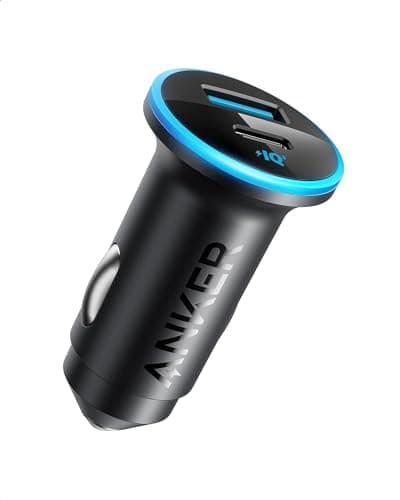
Anker model A2735, sold as the 323 Car Charger (52.5W). Two ports — one USB-C, one USB-A — in a body Anker publishes as 2.2 x 1.18 x 1.18 inches and 0.8 ounces. It plugs into a 12V socket, it has no cable in the box, and it does nothing else. No wireless pad, no display, no app.
That is the entire product, and the reason it is worth a page of its own is not the hardware. It is that Anker publishes the full voltage and current table for both ports, which almost nobody in this category does, and that table answers the question the category is built on obscuring: how fast will this actually charge my phone.
What Anker publishes, in full
Every figure below comes from Anker’s own product page. Nothing here is measured by us, and this site does not claim to have tested it.
| Specification | Published value |
|---|---|
| Total output | 52.5 W |
| USB-C | 5V/3A, 9V/3A, 12V/2.5A, 15V/2A, 20V/1.5A — 30 W max |
| USB-A | 5V/3A, 9V/2A, 10V/2.25A — 22.5 W max |
| Input | 12V at 5.6 A, 24V at 3.6 A |
| Dimensions | 2.2 x 1.18 x 1.18 in |
| Weight | 0.8 oz |
| Safety system | ActiveShield 2.0 |
| Operating temperature | Not published |
What 30W actually means for your phone
The USB-C port negotiates one of five profiles: 5V, 9V, 12V, 15V or 20V. The highest power combination is 20V at 1.5A, which is 30 W. Your phone requests the profile it wants and takes what it can use, which for almost every current handset is somewhere between 20 W and 30 W.
That is the whole case for this charger over the expensive ones. A 67 W or 130 W car charger is not charging your phone faster than a 30W port, because the phone, not the charger, sets the ceiling. What the bigger units buy you is the ability to run several devices at full speed simultaneously, or to charge a laptop. If you are not doing either, the extra watts are headroom nothing in your pocket can draw.
Two honest caveats on that. Anker publishes fixed PDO profiles here rather than PPS, the variable-voltage extension some phones prefer for their fastest charging mode — so a handset that wants PPS may charge slightly slower than its absolute peak. And a bad cable will cost you more speed than the charger ever will, which is covered on USB-C cables for the car.
The second port is the compromise
The USB-A port is the older standard and it is the slower one: 22.5 W maximum, against the USB-C port’s 30. That is fine for a passenger’s phone, a dash cam or anything with a USB-A cable already attached to it. It is not where you plug the phone you are navigating with.
It also means the 323 is a slightly awkward fit if both of your cables are USB-C, because you will need a USB-A to USB-C cable for the second device. Whether USB-A still earns its place on a charger in 2026 is a real argument, and it is the subject of USB-A vs USB-C in the car.
Where two ports stops being enough
- Two people, two phones. Fine. This is the case the 323 is built for and it handles it without either port dropping below a useful rate.
- Two phones and a tablet. One device too many. You need three ports, which is a different purchase — see best multi-port car chargers.
- A phone and a hardwired dash cam. Fine, but consider whether the camera should be on the socket at all. A camera that needs parking mode wants a fuse-box feed instead — the hardwire install guide covers it.
- A laptop. No. Thirty watts will slow the battery drain on a modern ultrabook and not much more. That question has its own page: can you charge a laptop in your car.
Size, and why it is on the spec list
At 2.2 inches long and 0.8 ounces this is among the smaller two-port chargers made, and in a car that is a functional specification rather than a cosmetic one. A 12V socket in a recessed console, behind a sliding door, or under an armrest lid will physically refuse a tall charger. A short one also puts less leverage on the socket contacts, which is what causes the intermittent connection people blame on the charger.
Anker publishes both figures. Most makers in this category publish neither, which is why “will it fit my console” is usually answered by buying it and finding out.
The 24V input nobody mentions
Input is rated 12V at 5.6 A and 24V at 3.6 A. The second figure is the interesting one: 24V is commercial-vehicle territory, so this charger is rated for a truck electrical system as well as a car. If you drive something with a 24V system, that single published line rules out most of the consumer chargers you would otherwise compare it against.
What we cannot tell you
Two gaps, and this site records them rather than filling them in.
- No published operating-temperature range. This is the specification this site scores hardest on, because a parked car in summer sun is the harshest environment in consumer electronics, and Anker does not publish a ceiling for the 323. ActiveShield 2.0 is named as a safety system that monitors temperature, but a named system is not a number.
- The warranty term is not on the product page. Anker’s page says “Hassle-Free Warranty” without printing a term; the 18-month figure this site records for it comes from Anker’s warranty policy for this category rather than from the listing. Worth knowing the difference if you are relying on it.
We have also not tested this charger. No thermal measurements, no charge-curve traces, no long-term failure data — the whole review above is an interpretation of published figures, which is what how we research commits to and the limit of what it claims.
Buy it if
- You are charging one or two phones, which is most people.
- Your 12V socket is recessed or awkward and a tall charger will not seat properly.
- You want the per-port figure published rather than a headline sum.
- You drive a 24V vehicle and need a charger rated for it.
Buy something else if
- You need three or more ports — go to multi-port chargers.
- You are charging a laptop, where 30W is not a serious answer.
- Both your cables are USB-C and you do not want to carry a USB-A cable for the second device.
- You want the charger to also hold the phone. That is a wireless charging mount, a different and more expensive product.
Every pick, with the working
Each entry lists the specifications the maker publishes, the axis scores those specifications produce, and what you give up. Rows that read “Not published” are not omissions on our side: they are things the maker will not commit to in writing, and they cost the product points on the transparency axis. Specifications compiled September 4, 2026.
Our pickThe one most people should actually buy
Anker 323 Car Charger (52.5W)
Two ports, 52.5W total, and a published voltage table showing 30W maximum on the USB-C port. Thirty watts charges any phone at or near its own ceiling, which means the 67W chargers above it are selling you headroom nothing in your pocket can use. At $19.99 this is the honest default.
- Ports
- 1 x USB-C, 1 x USB-A
- Total output
- 52.5 W
- USB-C output
- 5V/3A, 9V/3A, 12V/2.5A, 15V/2A, 20V/1.5A (30 W max)
- USB-A output
- 5V/3A, 9V/2A, 10V/2.25A (22.5 W max)
- Input
- 12V at 5.6 A, 24V at 3.6 A
- Safety
- ActiveShield 2.0
- Model
- A2735
- Warranty
- 18 months
- Operating range
- Not published
List price $19.99 per Anker's own store, captured on the compile date below. Not a live price and not what you will pay — the button is where the real number is.
What it gets right
- Anker publishes the full PDO table — 5V/3A, 9V/3A, 12V/2.5A, 15V/2A, 20V/1.5A — rather than a headline number
- 30 W on USB-C is at or above what almost every phone will accept
- Input rated 12V and 24V, so it works in a truck as well as a car
- $19.99 list and physically small, which matters in a tight console
Flaws
- Two ports, not three. A second passenger and a tablet is one device too many
- 30 W will not charge a laptop at any useful speed
- The USB-A port tops out at 22.5 W, so it is the slow one
The working behind the 9.2
- Heat headroom: not scored (weight 22%)
- The maker publishes no operating-temperature ceiling, so this axis is dropped and the other weights are re-normalized.
- Install effort: 10.0 (weight 24%)
- Plugs into a 12V socket or a USB port. Nothing to mount, nothing to route, reversible in a second.
- Price against the ceiling: 10.0 (weight 24%)
- Listed at $19.99 on the compile date. This site's buyer has a practical ceiling around $150 for a single upgrade, so the scale rewards everything under $100 and falls away sharply past $150. The live price is very often different, and that is what the button is for.
- Written commitment: 7.0 (weight 15%)
- 18-month warranty. This is the only promise in the entire listing that a court would read, which is why it is scored and the marketing copy is not.
- Spec transparency: 8.9 (weight 15%)
- 8 of the 9 specifications we went looking for are published by the maker (89%). A blank row is never a guess here: it prints “Not published” and it costs the product points, because a figure nobody will commit to in writing is a figure you cannot check.
Axes with no published input are dropped and the remaining weights re-normalized, so a product is not punished for a category where an axis does not apply. Specifications compiled September 4, 2026 from Anker's 323 Car Charger product page.
Prices last verified September 24, 2026. They move constantly; the figure on Amazon when you click is the real one.
Questions people actually ask
Is the Anker 323 really 52.5W?
Yes, as a total across both ports. Anker publishes 30 W maximum on USB-C and 22.5 W maximum on USB-A, which sum to the headline figure. No single device gets 52.5W, and that is true of essentially every multi-port charger sold on a total.
Will 30W charge my phone at full speed?
For almost every current phone, yes or close to it — most handsets cap somewhere between 20 W and 30 W. The caveat is PPS: Anker publishes fixed voltage profiles for the 323 rather than the variable-voltage mode some phones prefer for their absolute peak, so a PPS-capable handset may charge slightly below its fastest possible rate.
Is the Anker 323 better than a 67W car charger?
For one or two phones it is equivalent, because the phone sets the ceiling rather than the charger. A 67W unit earns its price when you need several devices at full speed at once, or a laptop. Paying for watts no device in the car can draw is the most common mistake in this category.
Does the Anker 323 come with a cable?
No. It is the charger only, and the cable matters more than people expect — a poor one costs more charging speed than any difference between chargers. The USB-A port also needs a USB-A to USB-C cable rather than the USB-C to USB-C cable you may already carry.
Does it work in a 24V truck?
Anker publishes an input rating of 12V at 5.6 A and 24V at 3.6 A, so yes. That published 24V line is unusual among consumer car chargers and is the main reason to pick this one for a commercial vehicle.
How hot does it get in a parked car?
Unknown. Anker does not publish an operating-temperature range for the 323, and this site will not estimate one. ActiveShield 2.0 is named as a temperature-monitoring safety system, but a system name is not a ceiling you can check.