The best car power inverters
BESTEK's own 500 W listing tells you to keep a cigarette-lighter inverter under 150 watts. BESTEK also sells 300 W and 400 W cigarette-lighter inverters. Both statements are published; only one of them is advice.
By Sawyer V. · Published · How we research
We have not tested any of this. Everything below is compiled from published manufacturer specifications, and the arithmetic is printed so you can check it. This page carries affiliate links: if you buy through one we earn a commission at no extra cost to you, and it does not change the order of the picks. Full disclosure.
The verdict
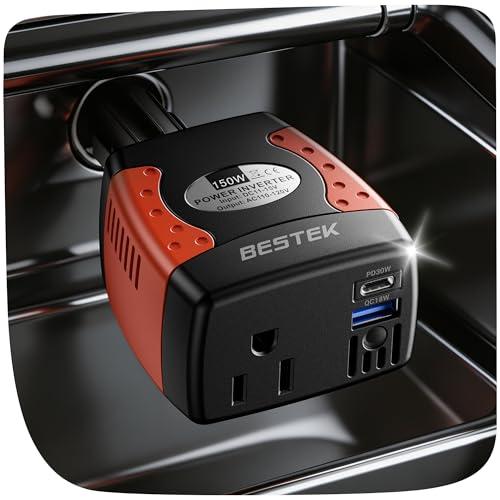
Buy the BESTEK 150W, about $23. It is the only inverter here whose rating a 12V accessory socket can actually supply: 150 W at 12 V is about 12.5 amps, inside the 15 A those sockets are typically fused for. It is ETL-listed, it carries an 18-month warranty, and its 30 W USB-C and 18 W USB-A ports run at full speed at the same time. Prices as of November 21, 2026.
If you genuinely need more than 150 watts, you need battery clamps, not a bigger plug. The Ampeak 750W at about $60 is the first unit here that ships them, states which cable to use for which load, and protects itself with two replaceable 50 A external fuses.
| # | Pick | Install | Score | Price |
|---|---|---|---|---|
| 1 | BESTEK 150W Power Inverter (MRI1511U-PD) The only wattage a 12V socket can actually supply | Plugs in | 8.6/10 | $22.79 - view on Amazon |
| 2 | Ampeak 750W Power Inverter Real wattage, with the honest wiring instruction | Plugs in | 8.9/10 | $59.99 - view on Amazon |
| 3 | BESTEK 500W Pure Sine Wave Inverter (MRZ5011BU) Pure sine with the clamps actually in the box | Plugs in | 9.7/10 | $59.99 - view on Amazon |
| 4 | BESTEK 300W Pure Sine Wave Inverter (MRZ3011HU) Pure sine for a CPAP or anything with a motor | Plugs in | 8.9/10 | $38.93 - view on Amazon |
| 5 | BESTEK 300W Power Inverter Running a mains plug from the 12V socket | Plugs in | 9.2/10 | $25.64 - view on Amazon |
| 6 | Ampeak 400W Power Inverter A rating the socket it plugs into cannot deliver | Plugs in | 9.2/10 | $45.99 - view on Amazon |
Prices last verified November 21, 2026. They move constantly; the figure on Amazon when you click is the real one.
The socket is the ceiling, and one maker says so
Every number in this category describes the inverter. None of them describes the car. Work the arithmetic once and the whole shelf sorts itself out: power is volts times amps, so 150 W at 12 V is 12.5 A, 300 W is 25 A and 400 W is 33 A, all before conversion losses which add roughly another 10 to 15%. A car’s accessory socket is normally fused between 10 and 20 A.
You do not have to take our word for it. BESTEK’s own listing for its 500 W pure sine inverter says, in plain text: you cannot get 500 watts from a 12-volt cigarette lighter plug, you need the alligator clips, and if you are going to plug into the cigarette lighter you should keep the wattage under 150, since that is what most car fuses are set for. BESTEK also sells 200 W, 300 W and 400 W cigarette-lighter inverters.
| Inverter | Continuous output | Amps at 12 V | How it connects | Waveform | Price checked Nov 21 |
|---|---|---|---|---|---|
| BESTEK 150W | 150 W | ~12.5 A | 12V socket | Not published | $22.79 |
| Ampeak 750W | 750 W | ~62.5 A | Battery clamps, or socket for low power | Not published | $59.99 |
| BESTEK 500W pure sine | 500 W | ~41.7 A | Battery clamps, or socket under 150 W | Pure sine | $59.99 |
| BESTEK 300W pure sine | 300 W | ~25 A | 12V socket only | Pure sine | $38.93 |
| BESTEK 300W | 300 W | ~25 A | 12V socket only | Not published | $25.64 |
| Ampeak 400W | 400 W | ~33.3 A | 12V socket only, 26 in lead | Modified sine | $45.99 |
Three of these six publish a continuous rating their only connection method cannot supply. That is not a defect in any single product - it is how the whole category is sold, and it is the reason the cheapest inverter on this page is also the one we would buy.
What 150 watts actually runs
More than it sounds, because almost nothing a commuter carries is a heating element.
- Yes. A laptop brick (45 to 100 W), a camera battery charger, a CPAP machine, a nebulizer, a games console in handheld mode, a string of lights, a cordless tool charger
- No, and not at 300 W either. A kettle, a hair dryer, a toaster, a microwave, a coffee maker, a space heater. Anything that makes heat starts at 700 W and goes up, and no 12V socket in any car will run one
- Check first. A compact fridge or cooler draws little when running and a great deal at start-up, which is what the peak rating is for. BESTEK publishes 700 W peak against 300 W continuous; Ampeak publishes 1,500 W against 750 W
Pure sine against modified sine, and the three loads that care
A modified sine wave is a stepped approximation of mains AC. Most things do not notice. Three categories do, and they are exactly the things people buy a car inverter for.
- Medical devices. A CPAP machine is the single commonest reason a commuter buys an inverter, and it is the load most often specified for pure sine. If this is your use, buy pure sine and check the device’s own manual
- Anything with a motor. Motors run hotter and noisier on a modified wave and draw more current doing the same work
- Cordless tool chargers. BESTEK states that most cordless tool makers recommend a pure sine inverter to protect battery life
Two of the six here publish pure sine. Two publish nothing about waveform at all, which in this category almost always means modified.
Where the fuse lives tells you how seriously it was designed
An inverter failing is a short across a car battery, so the fuse arrangement is the safety specification. The pattern across this page is clean and worth reading as a tier list.
- External, replaceable, accessible. The BESTEK 500W publishes two 40 A / 32 V fuses reachable from the back of the case; the Ampeak 750W publishes two replaceable 50 A fuses. You can fix these in a driveway
- External but small. The Ampeak 400W publishes two 35 A mini blade fuses - the same arrangement at a third of the current
- Internal and single. Both 300 W BESTEKs publish one 40 A fuse built in. Fine in use, not user-serviceable
Who each one is for
- BESTEK 150W - for almost every commuter. Inside what the socket can supply, ETL-listed, 30 W PD and 18 W QC that run independently, 18-month warranty and a stated 180-day refund window. Skip it if you need two AC outlets, because it has one
- Ampeak 750W - for a real load, wired properly. 750 W continuous and 1,500 W peak with the battery clip cable in the box, eleven named protections, a published 11 to 15 V input range and two replaceable 50 A fuses. Skip it if you will not route cable to the battery, and note that at this draw you run the engine or you flatten the car
- BESTEK 500W pure sine - for a CPAP on a road trip. Pure sine with both cable sets supplied, two accessible 40 A fuses, automatic shutdown above 500 W and published under-voltage protection so it will not drain the battery flat. Skip it on the warranty: BESTEK publishes 18 months on its smaller inverters and no term at all on this one
- BESTEK 300W pure sine - for a higher-voltage socket. Pure sine, 300 W continuous and 700 W peak, and an input range to 17 V that suits vehicles whose socket sits above the usual 12 to 14. Skip it on the same arithmetic as everything else here: 25 A through a socket is optimistic
- BESTEK 300W - the cheapest way to find out. The same ratings and the same 40 A internal fuse as its pure-sine sibling for about thirteen dollars less, with two AC outlets and 4.8 A of USB. Skip it if anything you plan to run is medical or has a motor
- Ampeak 400W - careful. See the skip note above
Two checks before you spend anything
First, find your socket’s fuse rating. It is printed in the owner’s manual and on the fuse box lid, usually as 10, 15 or 20 A next to something labeled ACC, CIG or PWR OUTLET. Multiply it by 12 and subtract about fifteen percent for losses: that is the largest inverter your socket will run, and for most cars it lands between 100 and 200 W.
Second, work out whether you need AC at all. Our explainer on car inverters walks through the cases where the answer is no, and charging a laptop in the car covers the commonest one. A multi-port USB charger or a power bank solves more real problems than an inverter does, with no fuse arithmetic involved. And if the socket itself is the bottleneck, 12V socket splitters is the page on what one outlet can be made to do.
Every pick, with the working
Each entry lists the specifications the maker publishes, the axis scores those specifications produce, and what you give up. Rows that read “Not published” are not omissions on our side: they are things the maker will not commit to in writing, and they cost the product points on the transparency axis. Specifications compiled September 4, 2026.
Our pickThe only wattage a 12V socket can actually supply
BESTEK 150W Power Inverter (MRI1511U-PD)
150 W continuous from a cigarette-lighter plug, which is the figure BESTEK itself tells you to stay under when you are plugged into a socket rather than clamped to the battery. It is ETL-listed, it carries an 18-month warranty, and the 30 W USB-C and 18 W USB-A ports run independently - so the laptop charges at full speed on the AC outlet while the phone fast-charges beside it.
- Continuous output
- 150 W
- Connection
- 12V accessory socket
- AC outlets
- 1
- USB output
- 30 W USB-C PD and 18 W USB-A QC, independent
- Certification
- ETL listed
- Protection
- Overheat, overload, short circuit, low voltage, overvoltage, auto shutdown
- Cooling
- Fan speed varies with load and temperature
- Warranty
- 18 months, with a stated 180-day refund window
- Peak output
- Not published
- Efficiency
- Not published
What it gets right
- 150 W continuous, which is inside what a 12V socket fused at 15 A can supply
- ETL-listed, a named external certification almost nothing else at this price states
- 30 W USB-C PD and 18 W USB-A QC that run at full speed simultaneously
- Published 18-month replacement and a stated 180-day refund window
- Load-and-temperature-sensing fan, so it is quiet at low draw
Flaws
- 150 W is a laptop brick and a camera charger. It is not a kettle, a hair dryer or a power tool
- One AC outlet only
- Still a double conversion: 12 V DC up to 110 V AC so a wall wart can take it back down. A USB-C charger skips both steps
- BESTEK publishes no efficiency figure for it
The working behind the 8.6
- Heat headroom: not scored (weight 22%)
- The maker publishes no operating-temperature ceiling, so this axis is dropped and the other weights are re-normalized.
- Install effort: 10.0 (weight 24%)
- Plugs into a 12V socket or a USB port. Nothing to mount, nothing to route, reversible in a second.
- Price against the ceiling: not scored (weight 24%)
- No published list price we could cite on the compile date, so this axis is dropped and the other weights are re-normalized.
- Written commitment: 7.0 (weight 15%)
- 18-month warranty. This is the only promise in the entire listing that a court would read, which is why it is scored and the marketing copy is not.
- Spec transparency: 8.0 (weight 15%)
- 8 of the 10 specifications we went looking for are published by the maker (80%). A blank row is never a guess here: it prints “Not published” and it costs the product points, because a figure nobody will commit to in writing is a figure you cannot check.
Axes with no published input are dropped and the remaining weights re-normalized, so a product is not punished for a category where an axis does not apply. Specifications compiled September 4, 2026 from BESTEK's 150W inverter product page.
2Real wattage, with the honest wiring instruction
Ampeak 750W Power Inverter
750 W continuous and 1,500 W peak, and Ampeak publishes the thing that makes that figure true: use the battery clip cable for high-power work and the cigarette plug only for low-power needs. It carries two replaceable 50 A external fuses, a fan that starts on load or temperature, and an 18-month support term. This is the point where a car inverter stops being an accessory and becomes a small installation.
- Continuous output
- 750 W
- Peak output
- 1,500 W
- DC input range
- 11 to 15 V
- Connection
- Battery clip cable for full output, 12V plug for low power
- AC outlets
- 2
- USB output
- 2 ports, 2.4 A each
- Fuses
- 2 x 50 A external, replaceable
- Cooling
- Fan on load or temperature; 104 F per Ampeak's page, 122 F per the listing
- Protections
- 11 named
- Weight
- 2.2 lb
- Warranty
- 18 months support, 30-day return
- Waveform
- Not published
What it gets right
- Published 750 W continuous and 1,500 W peak, with the battery clip cable included
- Ampeak states which cable to use for which load rather than leaving you to work it out
- Two replaceable 50 A external fuses rather than one sealed internal one
- Published DC input range of 11 to 15 V, and eleven named protections
- 18-month support with a stated 30-day no-risk return
Flaws
- Ampeak's product page says the fan starts at 104 F and the retail listing says 122 F for the same unit
- Running it at its rating means clamping to the battery, which means routing cable to the engine bay
- At 750 W you are pulling over 60 A from the battery - run the engine or you will flatten it quickly
- 2.2 lb and a hard body that needs somewhere to live
The working behind the 8.9
- Heat headroom: not scored (weight 22%)
- The maker publishes no operating-temperature ceiling, so this axis is dropped and the other weights are re-normalized.
- Install effort: 10.0 (weight 24%)
- Plugs into a 12V socket or a USB port. Nothing to mount, nothing to route, reversible in a second.
- Price against the ceiling: not scored (weight 24%)
- No published list price we could cite on the compile date, so this axis is dropped and the other weights are re-normalized.
- Written commitment: 7.0 (weight 15%)
- 18-month warranty. This is the only promise in the entire listing that a court would read, which is why it is scored and the marketing copy is not.
- Spec transparency: 9.2 (weight 15%)
- 11 of the 12 specifications we went looking for are published by the maker (92%). A blank row is never a guess here: it prints “Not published” and it costs the product points, because a figure nobody will commit to in writing is a figure you cannot check.
Axes with no published input are dropped and the remaining weights re-normalized, so a product is not punished for a category where an axis does not apply. Specifications compiled September 4, 2026 from Ampeak's 750W inverter product page.
3Pure sine with the clamps actually in the box
BESTEK 500W Pure Sine Wave Inverter (MRZ5011BU)
Pure sine at 500 W, and the only unit in this group whose own listing tells you the truth about sockets in plain words: you cannot get 500 watts from a cigarette lighter plug, you need the alligator clips, and if you are going to use the socket you should keep the load under 150 W because that is what most car fuses are set for. It ships both cables, two 40 A external fuses and an automatic shutdown above 500 W.
- Waveform
- Pure sine wave
- Continuous output
- 500 W
- Connection
- Battery clamps for rated output; 12V plug for 150 W or less, stated
- AC outlets
- 2
- USB output
- 2 ports, 2.4 A each, 4.2 A max
- Fuses
- 2 x 40 A / 32 V external, replaceable from the rear
- Overload behavior
- Automatic AC shutdown above 500 W, flashing red, manual reset
- Protection
- Over and under voltage, overheat, overload, reverse polarity, short circuit
- Casing
- Aluminum alloy with thermal sensors and fan
- Weight
- 2.2 lb
- Warranty
- Not published
What it gets right
- Both connection methods in the box: 12V plug cable and battery clamp cable, plus two spare fuses
- Two 40 A / 32 V external replaceable fuses, accessible from the back rather than sealed inside
- Automatic overload shutdown above 500 W, indicated by a flashing red light, with a published reset procedure
- Published under-voltage protection so it will not flatten the car battery
- Aluminum alloy casing with thermal sensors and a built-in fan, at 2.2 lb
Flaws
- You cannot use its rated output through the socket, which BESTEK states outright
- Modified-sine alternatives at this price run more watts; pure sine costs capacity
- The on-off switch is stated to work only for the 3-prong outlets
- No published warranty term on the listing, where BESTEK's smaller inverters publish 18 months
The working behind the 9.7
- Heat headroom: not scored (weight 22%)
- The maker publishes no operating-temperature ceiling, so this axis is dropped and the other weights are re-normalized.
- Install effort: 10.0 (weight 24%)
- Plugs into a 12V socket or a USB port. Nothing to mount, nothing to route, reversible in a second.
- Price against the ceiling: not scored (weight 24%)
- No published list price we could cite on the compile date, so this axis is dropped and the other weights are re-normalized.
- Written commitment: not scored (weight 15%)
- No warranty term published, so this axis is dropped and the other weights are re-normalized.
- Spec transparency: 9.1 (weight 15%)
- 10 of the 11 specifications we went looking for are published by the maker (91%). A blank row is never a guess here: it prints “Not published” and it costs the product points, because a figure nobody will commit to in writing is a figure you cannot check.
Axes with no published input are dropped and the remaining weights re-normalized, so a product is not punished for a category where an axis does not apply. Specifications compiled September 4, 2026 from BESTEK's 500W pure sine wave inverter page.
4Pure sine for a CPAP or anything with a motor
BESTEK 300W Pure Sine Wave Inverter (MRZ3011HU)
A genuine pure sine wave output at 300 W continuous and 700 W peak, which matters for exactly three kinds of load: medical devices like a CPAP, anything with a motor, and a cordless tool charger. Its input range runs to 17 V, so it works in vehicles whose accessory socket sits above the usual 12 to 14 V. The caveat is the same one BESTEK publishes elsewhere - 300 W is more than a socket should be asked for.
- Waveform
- Pure sine wave
- Continuous output
- 300 W
- Peak output
- 700 W
- Input
- 11 to 17 V DC
- AC outlets
- 2
- USB output
- 2 ports, 2.4 A each, 4.8 A total
- Fuse
- 40 A built in
- Connection
- 12V accessory socket only, no battery clamps
- Weight
- 1.4 lb
- Warranty
- 18 months
- Efficiency
- Not published
What it gets right
- True pure sine wave, not modified - the waveform that medical devices and motors want
- Published 300 W continuous and 700 W peak, which is the pair of figures that tells you what it runs
- Built-in 40 A fuse plus published protection against overheat, over and under voltage, short circuit, overload and overcharge
- 11 to 17 V input range, so it suits vehicles with a higher socket voltage
- Published 18-month warranty and 1.4 lb with two AC outlets and 4.8 A of USB
Flaws
- 300 W from a 12V socket is roughly 25 A before losses, and BESTEK's own 500 W listing says to keep socket use under 150 W
- No battery clamps in the box, so there is no compliant way to run it at its rated output
- The patent in the listing - US D818,853 S - is a design patent, which covers appearance rather than circuitry
- No published efficiency figure
The working behind the 8.9
- Heat headroom: not scored (weight 22%)
- The maker publishes no operating-temperature ceiling, so this axis is dropped and the other weights are re-normalized.
- Install effort: 10.0 (weight 24%)
- Plugs into a 12V socket or a USB port. Nothing to mount, nothing to route, reversible in a second.
- Price against the ceiling: not scored (weight 24%)
- No published list price we could cite on the compile date, so this axis is dropped and the other weights are re-normalized.
- Written commitment: 7.0 (weight 15%)
- 18-month warranty. This is the only promise in the entire listing that a court would read, which is why it is scored and the marketing copy is not.
- Spec transparency: 9.1 (weight 15%)
- 10 of the 11 specifications we went looking for are published by the maker (91%). A blank row is never a guess here: it prints “Not published” and it costs the product points, because a figure nobody will commit to in writing is a figure you cannot check.
Axes with no published input are dropped and the remaining weights re-normalized, so a product is not punished for a category where an axis does not apply. Specifications compiled September 4, 2026 from BESTEK's 300W pure sine wave inverter page.
5Running a mains plug from the 12V socket
BESTEK 300W Power Inverter
Skip this one. If everything you want to charge has a USB-C option, skip this entirely and buy a proper USB-C charger. An inverter converts 12V DC up to 110V AC so a wall wart can convert it back down — two conversions and two lots of losses to arrive where a USB-C charger starts.
300 W continuous and 700 W peak from the 12V socket, through two AC outlets and two USB ports, with a 40 A fuse built in. It is the answer when something you need to run has a mains plug and no USB option — a CPAP machine, a camera battery charger, an older laptop brick. It is not a way to run a kettle.
- Continuous output
- 300 W
- Peak output
- 700 W
- Input
- 12 V DC
- Output
- 110-120 V AC
- AC outlets
- 2
- USB output
- 2 ports, 2.4 A each, 4.8 A total
- Fuse
- 40 A built in
- Protection
- Overheat, over/under voltage, short circuit, overload
- List price
- Not published
- Warranty
- Not published
What it gets right
- Published continuous AND peak ratings (300 W / 700 W), which is the pair of numbers that actually tells you what it will run
- Two AC outlets plus 4.8 A of USB, so it replaces a charger as well
- 40 A fuse and published protection against overheat, over/under voltage, short circuit and overload
- Pure sine wave on the model that states it, which matters for anything with a motor or a medical device
Flaws
- 300 W continuous is a laptop and a camera charger. It is not a kettle, a hair dryer or a fridge
- Drawing 300 W at 12 V is roughly 25 amps, which is well past what many 12V sockets are fused for — check yours
- Inverters are inefficient and get warm; run the engine if you are drawing anything substantial
The working behind the 9.2
- Heat headroom: not scored (weight 22%)
- The maker publishes no operating-temperature ceiling, so this axis is dropped and the other weights are re-normalized.
- Install effort: 10.0 (weight 24%)
- Plugs into a 12V socket or a USB port. Nothing to mount, nothing to route, reversible in a second.
- Price against the ceiling: not scored (weight 24%)
- No published list price we could cite on the compile date, so this axis is dropped and the other weights are re-normalized.
- Written commitment: not scored (weight 15%)
- No warranty term published, so this axis is dropped and the other weights are re-normalized.
- Spec transparency: 8.0 (weight 15%)
- 8 of the 10 specifications we went looking for are published by the maker (80%). A blank row is never a guess here: it prints “Not published” and it costs the product points, because a figure nobody will commit to in writing is a figure you cannot check.
Axes with no published input are dropped and the remaining weights re-normalized, so a product is not punished for a category where an axis does not apply. Specifications compiled September 4, 2026 from BESTEK's 300W power inverter page.
6A rating the socket it plugs into cannot deliver
Ampeak 400W Power Inverter
Skip this one. Four hundred watts at 12 volts is more than 33 amps before you count conversion losses, and this unit ships with a 26-inch cigarette-lighter lead and no battery clamps. There is no compliant way to draw its rated output. BESTEK, selling into the same category, publishes the honest version of this: keep socket use under 150 W, because that is what most car fuses are set for. Buy the 150 W for a socket or the 750 W for the battery, and skip the number that fits neither.
400 W continuous and 800 W peak from a unit that weighs 368 g, measures 3.3 x 2.5 x 1.45 in and connects through a 26-inch cigarette-lighter lead with no battery clamps supplied. Four hundred watts at 12 V is more than 33 amps. Almost no car's accessory socket is fused for that, and the inverter ships no other way to connect.
- Continuous output
- 400 W
- Peak output
- 800 W
- Waveform
- Modified sine wave
- Connection
- 12V accessory socket on a 26 in lead, no battery clamps
- AC outlets
- 2
- USB output
- 2 x 2.4 A per one Ampeak page; 3.1 A shared per another
- Fuses
- 2 x 35 A mini blade
- Cooling
- Dual fans, stated to start at 50 C or 280 W
- Weight
- 368 g
- Dimensions
- 3.3 x 2.5 x 1.45 in
- Warranty
- 18 months support
What it gets right
- Published 400 W continuous and 800 W peak with two AC outlets and two USB ports
- Dual fans that Ampeak states start at 50 C or 280 W, and eleven named protections
- Two 35 A mini blade fuses, replaceable
- Genuinely small at 368 g and 3.3 x 2.5 x 1.45 in
- 18-month support term with a 30-day return
Flaws
- No battery clamps in the box, so the only connection is a socket that cannot supply the rated current
- Ampeak's own pages give conflicting USB figures for it: 2 x 2.4 A on one, 3.1 A shared on another
- One Ampeak listing for this model is marked as a coming-soon release, so which revision you receive is unclear
- Modified sine wave, so it is the wrong waveform for a CPAP or a motor
The working behind the 9.2
- Heat headroom: not scored (weight 22%)
- The maker publishes no operating-temperature ceiling, so this axis is dropped and the other weights are re-normalized.
- Install effort: 10.0 (weight 24%)
- Plugs into a 12V socket or a USB port. Nothing to mount, nothing to route, reversible in a second.
- Price against the ceiling: not scored (weight 24%)
- No published list price we could cite on the compile date, so this axis is dropped and the other weights are re-normalized.
- Written commitment: 7.0 (weight 15%)
- 18-month warranty. This is the only promise in the entire listing that a court would read, which is why it is scored and the marketing copy is not.
- Spec transparency: 10.0 (weight 15%)
- 11 of the 11 specifications we went looking for are published by the maker (100%). A blank row is never a guess here: it prints “Not published” and it costs the product points, because a figure nobody will commit to in writing is a figure you cannot check.
Axes with no published input are dropped and the remaining weights re-normalized, so a product is not punished for a category where an axis does not apply. Specifications compiled September 4, 2026 from Ampeak's 400W inverter product page.
Prices last verified November 21, 2026. They move constantly; the figure on Amazon when you click is the real one.
Questions people actually ask
What size power inverter can I plug into a car cigarette lighter?
About 150 watts in most cars, and BESTEK publishes exactly that figure on its own listing: keep socket use under 150 W because that is what most car fuses are set for. The arithmetic is simple - 150 W at 12 V is 12.5 amps, inside the 15 A those sockets are usually fused for, while 300 W is 25 A and 400 W is 33 A. Check your fuse box lid for the rating next to the accessory socket.
Will a 300W inverter blow my car's fuse?
It can, and whether it does depends on your car rather than the inverter. A 300 W continuous draw is about 25 amps at 12 V before losses. A socket fused at 20 A will trip; one fused at 10 or 15 A certainly will. It may run fine at a 100 W load and blow the moment you plug in something bigger, which is the failure people find confusing. Above about 150 W, connect to the battery with clamps instead.
Do I need a pure sine wave inverter for a car?
For three kinds of load, yes: medical devices like a CPAP, anything with a motor, and cordless tool chargers - BESTEK states that most tool makers recommend pure sine to protect battery life. For a laptop brick, a phone charger or a camera charger, a modified sine wave is fine. Two of the six inverters on this page publish pure sine; two publish no waveform at all, which almost always means modified.
Can a car inverter run a kettle or a hair dryer?
No, and not with a bigger inverter either. Anything that makes heat starts at about 700 W and a kettle is commonly 1,500 W, which at 12 V is 125 amps from the battery - more than most alternators produce. Inverters that can supply that exist, but they are hardwired installations with heavy cable, not something that plugs into a socket.
Will an inverter drain my car battery?
With the engine off, yes, and faster than people expect: 150 W is about 12.5 amps, and a typical car battery holds roughly 50 amp-hours of usable charge, so a few hours of use takes a real bite out of it. Run the engine for anything sustained. Two inverters here publish under-voltage protection that shuts them off before the battery is too flat to start the car, which is the feature to look for if you will use one while parked.
Sources
- Published output, certification, USB ratings and warranty for the BESTEK 150W inverter
- Published continuous and peak output, fusing, connection methods and the under-150W socket statement for the BESTEK 500W pure sine inverter
- Published waveform, output, input range and fuse rating for the BESTEK 300W pure sine inverter
- Published continuous and peak output, DC input range, fusing and cable options for the Ampeak 750W inverter
- Published output, waveform, fusing, dimensions and fan behavior for the Ampeak 400W inverter