The best backup cameras
This is an electrical component bolted to the outside of a vehicle. Two published figures decide whether it survives, and neither of them is resolution.
By Sawyer V. · Published · How we research
We have not tested any of this. Everything below is compiled from published manufacturer specifications, and the arithmetic is printed so you can check it. This page carries affiliate links: if you buy through one we earn a commission at no extra cost to you, and it does not change the order of the picks. Full disclosure.
The short answer
Buy the LeeKooLuu 7 in wireless camera if you want a standalone unit, or a mirror dash cam if you also want recording. The LeeKooLuu publishes the two figures that decide whether an exterior camera survives: IP69 ingress protection and an operating range of -22 F to 176 F. Most competitors publish neither. Wireless removes the video cable and not the power cable — the camera still needs a feed, usually spliced into the reverse light.
| # | Pick | Install | Score | Price |
|---|---|---|---|---|
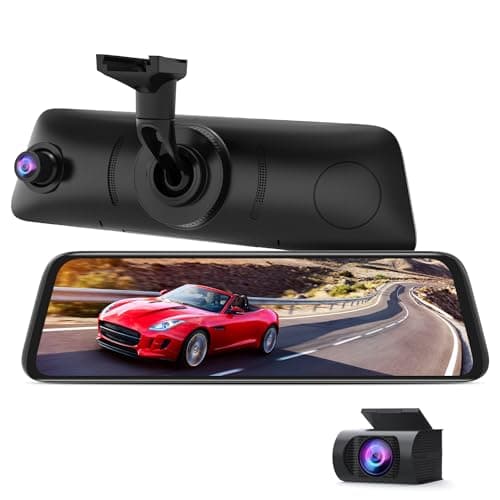
| 1 | AUTO-VOX V5PRO Mirror Dash Cam A car whose windshield is already crowded | Clips on | 8.3/10 | $209.99 - view on Amazon |
| 2 | LeeKooLuu 7 in Wireless Backup Camera Adding reversing vision without running a video cable | Hardwire | 7.2/10 | $79.98 - view on Amazon |
| 3 | VIOFO A229 Plus 1CH A screen, voice control and room to add a rear camera | Adhesive | 5.5/10 | $189.99 - view on Amazon |
Prices last verified October 24, 2026. They move constantly; the figure on Amazon when you click is the real one.
What we ranked on
A backup camera is unusual among car accessories: most of it lives outside the vehicle, exposed to road spray, salt, pressure washing and the full temperature range. So the criteria are survival criteria first.
- Published ingress rating. IP68 means dust-tight and rated for immersion. An exterior camera without a published rating is an unknown bolted to a bumper
- Published operating range. A bumper goes from below freezing to well over 60 C on hot asphalt
- Signal type. Digital or analog, which decides how it behaves near interference
- Field of view. Wide enough to see a bollard beside the bumper rather than only what is directly behind
| LeeKooLuu 7 in | AUTO-VOX V5PRO (mirror) | |
|---|---|---|
| Type | Standalone camera + 7 in monitor | Mirror replacement, records too |
| Ingress rating | IP69 | Not published |
| Operating range | -22 F to 176 F (-30 C to 80 C) | Not published |
| Resolution | 1080p | 1080p front / 1080p rear |
| Sensor published | Not published | Sony IMX307 STARVIS |
| Field of view | Not published | 145 front / 150 rear |
| Link | Bluetooth, pre-paired | Wired |
| Records | No | Yes |
What wireless actually means here
That is a genuine saving. A video cable run means pulling trim, threading through a tailgate or hatch grommet, and leaving a service loop at the hinge — the same job as a dual-channel dash cam rear camera, described in best dual channel dash cams.
The trade is latency and reliability. Any digital link — the LeeKooLuu uses a pre-paired Bluetooth pairing, others use 2.4 GHz — is far better than the analog kits that dominated this category, because analog picks up interference as rolling bars and snow. But any wireless link can drop, and a picture that stutters at the moment you are reversing toward something is worse than a slightly harder install.
Resolution is not the specification that decides this
Backup cameras are sold on pixel count, and it is close to the least important number in the category. Kits from 720p up to 1080p all do this job, and the reason is what you are asking the image to do.
A dash cam has to resolve a license plate on a moving car — fine, high-contrast detail at distance, which is genuinely demanding. A backup camera has to show you that there is a bollard, a child's bike or a wall within a few feet of your bumper. That is a large-object, short-range task.
What matters more than pixel count is low-light behavior, because reversing happens in driveways at night and in dark parking structures. That is the one place the LeeKooLuu is weaker than its specification sheet suggests: it says “night vision” and publishes no image sensor part number, which is a word where a figure would be more useful. AUTO-VOX publishes the sensor on the V5PRO. The same argument runs through dash cam resolution explained.
The alternative: a mirror cam that also records
If you want a reversing view and a dash cam, a mirror unit does both from one install. Its rear camera doubles as a live backup display, which no conventional dash cam offers.
The trades are real. AUTO-VOX states card support up to 64 GB on the V5PRO, which across two channels is a short footage window. It publishes no operating-temperature ceiling on a device sitting at the top of the cabin against the glass. And one failure takes both your mirror and your camera.
Full comparison in best mirror dash cams. The short version: buy a mirror cam for the backup display, buy a conventional camera for the footage.
Installing it, and the two cautions
The camera mounts above the plate, on the plate bracket, or in a tailgate handle recess depending on the kit. The power feed splices into the reverse light circuit so the system wakes when you select reverse.
- Splice properly. A twisted-and-taped joint in a tailgate is a joint in a wet, flexing environment. Use a proper connector and seal it
- Leave a service loop at the hinge. A tailgate flexes its wiring every time it opens, and that is where these fail
- Aim it before you tidy the cable. Enough bumper in frame to judge distance, enough ground to see a low obstacle. Check the actual picture, not the mount angle
- Mount the monitor out of your forward view. The same obstruction reasoning as any windshield device — where to mount your phone in a car
Anything requiring you to remove pillar trim on a car with curtain airbags is not casual trim removal — the tiers are set out in what car accessories can you install yourself.
What a backup camera does not replace
It is an aid, not a substitute for looking. A camera has a fixed field of view and shows you nothing approaching from the side until it is already behind you, which is exactly the scenario in a parking lot. It also will not beep at you when your eyes are over your shoulder rather than on the screen, which is what ultrasonic parking sensors are for.
It also does nothing about the rear view while driving. If your rear visibility is poor because the trunk is loaded above the parcel shelf, that is a packing problem — how to pack a car for a road trip.
And a camera lens on a bumper gets filthy faster than any other glass on the car, because it sits directly in the road spray thrown up behind you. A picture that has gradually gone milky is usually a dirty lens rather than a failing camera — wipe it when you do the windows, how to clean car windows without streaks.
Every pick, with the working
Each entry lists the specifications the maker publishes, the axis scores those specifications produce, and what you give up. Rows that read “Not published” are not omissions on our side: they are things the maker will not commit to in writing, and they cost the product points on the transparency axis. Specifications compiled September 4, 2026.
Our pickA car whose windshield is already crowded
AUTO-VOX V5PRO Mirror Dash Cam
Skip this one. If your only goal is footage, a conventional camera does it better for less: a 64 GB card ceiling on two channels is a short recording window, and putting your mirror and your camera in the same device means one failure takes both.
A 9.35 inch laminated touchscreen that replaces the rear view mirror, recording front and rear while doubling as a backup camera display. It publishes the sensor — a Sony IMX307 STARVIS — which is the one specification that tells you how it behaves at night.
- Screen
- 9.35 in full-laminated touchscreen
- Front recording
- 1080p at 30 fps
- Rear recording
- 1080p at 25 fps
- Sensor
- Sony IMX307 STARVIS CMOS
- Aperture
- F/1.8
- Field of view
- 145 degrees front, 150 degrees rear
- Card support
- Class 10 microSD up to 64 GB
- Other
- GPS, G-sensor, parking mode
- Operating temperature
- Not published
- Warranty
- Not published
- List price
- Not published
What it gets right
- Publishes the actual image sensor (Sony IMX307 STARVIS) and aperture (F/1.8), which most mirror cams do not
- Full-laminated screen specifically to kill the glare that ruins cheaper mirror units in daylight
- Occupies the mirror position, so nothing new is stuck to the windshield
- The rear camera doubles as a live backup display — a real second function, unlike a normal dash cam rear channel
Flaws
- Card support is stated at Class 10 up to 64 GB, which is small for two channels and shortens your footage window considerably
- It replaces your mirror. If the screen fails you have lost a mirror as well as a camera
- No published operating-temperature ceiling, on a device that sits in the hottest part of the cabin
- Rear channel is 1080p at 25 fps rather than 30
The working behind the 8.3
- Heat headroom: not scored (weight 22%)
- The maker publishes no operating-temperature ceiling, so this axis is dropped and the other weights are re-normalized.
- Install effort: 9.0 (weight 24%)
- Clips onto a vent blade or a headrest post. Two minutes, no tools, no adhesive, no residue.
- Price against the ceiling: not scored (weight 24%)
- No published list price we could cite on the compile date, so this axis is dropped and the other weights are re-normalized.
- Written commitment: not scored (weight 15%)
- No warranty term published, so this axis is dropped and the other weights are re-normalized.
- Spec transparency: 7.3 (weight 15%)
- 8 of the 11 specifications we went looking for are published by the maker (73%). A blank row is never a guess here: it prints “Not published” and it costs the product points, because a figure nobody will commit to in writing is a figure you cannot check.
Axes with no published input are dropped and the remaining weights re-normalized, so a product is not punished for a category where an axis does not apply. Specifications compiled September 4, 2026 from AUTO-VOX V5PRO published specifications.
2Adding reversing vision without running a video cable
LeeKooLuu 7 in Wireless Backup Camera
Publishes an ingress rating and an operating-temperature range, which on a camera bolted to the outside of a vehicle are the two specifications that actually decide whether it survives. IP69 and a stated -22 F to 176 F, which is a wider range than most of this category will commit to. The monitor is a 7 in suction-mount screen and the link is pre-paired Bluetooth.
- Resolution
- 1080p
- Ingress protection
- IP69
- Operating temperature
- -22 F to 176 F (-30 C to 80 C)
- Monitor
- 7 in, windshield suction mount
- Link
- Bluetooth, pre-paired
- Cameras supported
- 2, with split screen
- Sensor
- Not published
- Field of view
- Not published
- Warranty
- Not published
List price $79.98 per Amazon listing, September 24, 2026, captured on the compile date below. Not a live price and not what you will pay — the button is where the real number is.
What it gets right
- Publishes IP69 ingress protection — this is an exterior component and most competitors publish nothing
- Publishes an operating range of -22 F to 176 F (-30 C to 80 C), which brackets what a bumper actually sees
- Pre-paired out of the box, so there is no pairing step during a 15-minute install
- Supports a second camera with split-screen on the same monitor, front or rear
Flaws
- Publishes no image sensor part number and no field of view, so 'night vision' is a word rather than a figure
- Wireless removes the video cable and not the power cable — the camera still needs a feed, usually the reverse light
- A 7 in monitor on the windshield is a large object in the cabin, and it is not integrated with the car
- No published warranty term
The working behind the 7.2
- Heat headroom: 10.0 (weight 22%)
- Published operating ceiling 80 C (176 F). A car parked in summer sun runs roughly 60-70 C inside, so 65 C and up is real headroom, 60 C is living at the limit, and anything under 55 C is a summer problem waiting to happen.
- Install effort: 4.0 (weight 24%)
- Wires into the fuse box. Half an hour, a fuse tap, a trim tool and a willingness to be upside down under the dash. This is the real cost of parking mode.
- Price against the ceiling: 8.0 (weight 24%)
- Listed at $79.98 on the compile date. This site's buyer has a practical ceiling around $150 for a single upgrade, so the scale rewards everything under $100 and falls away sharply past $150. The live price is very often different, and that is what the button is for.
- Written commitment: not scored (weight 15%)
- No warranty term published, so this axis is dropped and the other weights are re-normalized.
- Spec transparency: 6.7 (weight 15%)
- 6 of the 9 specifications we went looking for are published by the maker (67%). A blank row is never a guess here: it prints “Not published” and it costs the product points, because a figure nobody will commit to in writing is a figure you cannot check.
Axes with no published input are dropped and the remaining weights re-normalized, so a product is not punished for a category where an axis does not apply. Specifications compiled September 4, 2026 from the LeeKooLuu 7 in wireless backup camera listing.
3A screen, voice control and room to add a rear camera
VIOFO A229 Plus 1CH
Skip this one. A dual-channel dash cam's rear camera records; it has no live feed. People buy one expecting a reversing view and discover it only plays footage back afterwards. Excellent at its own job, and it is not a backup camera.
The same STARVIS 2 IMX675 sensor as the Mini 2 in a body with a screen, voice control and the option to add rear and interior channels later. You are paying roughly $40 over the Mini 2 for a display and an upgrade path, which is worth it if you expect to want a rear camera and not if you do not.
- Front resolution
- 2K HDR
- Image sensor
- Sony STARVIS 2 IMX675
- GPS
- Built in
- Voice control
- Yes
- Expandable
- Rear and interior channels available
- Operating range
- Not published
- Max microSD
- Not published
- Field of view
- Not published
List price $199.99 per VIOFO's own store, captured on the compile date below. Not a live price and not what you will pay — the button is where the real number is.
What it gets right
- Same STARVIS 2 IMX675 sensor as the Mini 2
- Screen on the body, so aiming and reviewing does not need the phone app
- Expandable to two and three channels without buying a whole new camera
- Voice control, which is the only genuinely safe way to lock a clip while moving
Flaws
- $200 list is well past this site's usual ceiling for a single upgrade
- A screen in the windshield is a screen in your eyeline; the Mini 2 hides behind the mirror
- Same hardwire requirement for parking mode as every other VIOFO
The working behind the 5.5
- Heat headroom: not scored (weight 22%)
- The maker publishes no operating-temperature ceiling, so this axis is dropped and the other weights are re-normalized.
- Install effort: 6.0 (weight 24%)
- Adhesive pad onto the dashboard. Permanent in practice: repositioning means a new pad, and the pad is the part that fails first.
- Price against the ceiling: 3.5 (weight 24%)
- Listed at $199.99 on the compile date. This site's buyer has a practical ceiling around $150 for a single upgrade, so the scale rewards everything under $100 and falls away sharply past $150. The live price is very often different, and that is what the button is for.
- Written commitment: 7.0 (weight 15%)
- 18-month warranty. This is the only promise in the entire listing that a court would read, which is why it is scored and the marketing copy is not.
- Spec transparency: 6.3 (weight 15%)
- 5 of the 8 specifications we went looking for are published by the maker (63%). A blank row is never a guess here: it prints “Not published” and it costs the product points, because a figure nobody will commit to in writing is a figure you cannot check.
Axes with no published input are dropped and the remaining weights re-normalized, so a product is not punished for a category where an axis does not apply. Specifications compiled September 4, 2026 from VIOFO's 1-channel range page.
Prices last verified October 24, 2026. They move constantly; the figure on Amazon when you click is the real one.
Questions people actually ask
Does a wireless backup camera need any wiring?
Yes. Wireless refers to the video signal. The camera still needs power, normally spliced into the reverse light circuit so the system switches on when you select reverse. What you avoid is a video cable run the length of the car.
Can my dash cam's rear camera work as a backup camera?
Not on a conventional dash cam — the rear channel records and has no live feed. A mirror dash cam does provide a live reversing display, which is the main reason to choose that format.
Is 720p enough for a backup camera?
For judging distance to large nearby objects, yes. It is a short-range, large-object task rather than the plate-reading job a dash cam does. Low-light behavior matters more than pixel count here.
What IP rating should a backup camera have?
IP68 — dust-tight and rated for immersion — is what you want on something bolted to a bumper and pressure-washed. An exterior camera publishing no ingress rating at all is the thing to avoid.