The best parking sensor kits
Every kit here needs holes drilled in your bumper and a wire run to the reverse light. That work is identical whichever one you buy, so buy the one with a warranty.
By Sawyer V. · Published · How we research
We have not tested any of this. Everything below is compiled from published manufacturer specifications, and the arithmetic is printed so you can check it. This page carries affiliate links: if you buy through one we earn a commission at no extra cost to you, and it does not change the order of the picks. Full disclosure.
The short answer
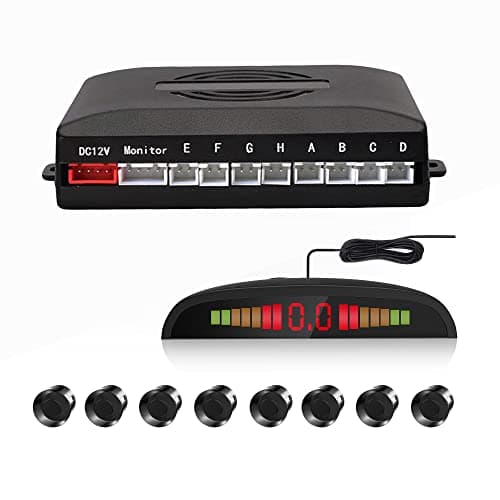
Buy the EKYLIN 8-sensor kit. It is the only kit on this page that publishes a warranty — a stated 3 years — and it shows a numeric distance as well as beeping, which is the difference between knowing you are close and knowing how close. Eight sensors cover front and rear. If you are fitting this to a trailer or a truck and will not run cable through it, the Promata is wireless and runs on 12V or 24V.
| # | Pick | Install | Score | Price |
|---|---|---|---|---|
| 1 | EKYLIN 8-Sensor Parking Radar with LED Display The only parking sensor kit here with a published warranty | Hardwire | 7.5/10 | $32.99 - view on Amazon |
| 2 | 4-Sensor Reverse Parking Kit with LED Display The cheapest working rear sensor set | Hardwire | 7.0/10 | $13.90 - view on Amazon |
| 3 | ELSNU 8-Sensor Parking Sensor Kit Knowing which corner the obstacle is on | Hardwire | 6.6/10 | $47.00 - view on Amazon |
| 4 | Promata PSW-81 Wireless Parking Sensor Kit A trailer, a truck, or any vehicle you will not run cable through | Hardwire | 5.6/10 | $103.55 - view on Amazon |
Prices last verified September 24, 2026. They move constantly; the figure on Amazon when you click is the real one.
First: this is not dash cam parking mode
Your car probably already has a camera. That is not the same thing.
The US Department of Transportation’s final rule on rear visibility technology requires it in new vehicles under 10,000 pounds from May 2018. If your car is newer than that, you have a rear view image by law and you may reasonably wonder what sensors add.
Three things, and they are the three that cause low-speed damage:
- They work when you are not looking at the screen. A beep reaches you when your eyes are over your shoulder or on the mirror, which is where they should be.
- They see thin vertical objects. A bollard, a post, a tow hitch on the car behind — all of which a wide-angle camera renders small, distant and easy to miss.
- Front sensors exist. No regulation requires a forward camera, and curbs, walls and the car in front of you in a tight space are where the expensive scrapes happen.
Sensors and a camera are complementary, not alternatives. If you have neither, the camera is the better first purchase because it shows you what is there rather than that something is.
The honest part: you are drilling your bumper
Every wired kit on this page requires the same work. Mark the sensor positions on the bumper, drill with the supplied hole saw, push the sensors through, route four to eight cables to a control box, and wire that box to the reverse light circuit so the system knows when you are in reverse. Then find somewhere for the display.
- It is not reversible. Holes in a bumper are permanent. If you lease the car, this is not your modification to make.
- Height and spacing matter. Sensors mounted too low read the ground and alarm constantly; too high and they miss a low wall. Measure against an existing factory-fitted car before you drill.
- The reverse light tap is the fiddly part. It means getting into the rear light housing and identifying the right wire, which is a multimeter job rather than a guess.
- Budget an afternoon. This is the most involved install of anything on this site apart from a dash cam hardwire.
Because that work is identical across all four kits, the price of the parts is the least important part of the decision. Which is why a kit with a published three-year warranty at thirty-three dollars is a much better buy than one with no warranty at fourteen.
What each kit publishes
| Kit | Sensors | Display | Alert options | Warranty |
|---|---|---|---|---|
| EKYLIN | 8, weatherproof | LED with distance | Beep, faster when closer | 3 years |
| ELSNU | 8 | 8 light bars plus numeric | Voice / beep / mute, 7 volumes | Not published |
| Promata PSW-81 | 4, rear, wireless | Digital, invertible | 3 volume levels | Not published |
| Budget 4-sensor kit | 4, rear | LED | Buzzer | Not published |
Not one of the four publishes a detection range in feet or meters, which is the specification you would most expect a proximity sensor to state. That is a gap across the entire category rather than a failing of one product, and it is why the ranking here leans on warranty, alert control and sensor count.
The alert is the part you live with
A parking sensor beeps at you several times a day, every day, forever. How much control you have over that noise is the difference between a useful device and one you disconnect in six months.
ELSNU offers the most: three modes — real voice, beep or mute — and seven volume steps. It also puts eight light bars on the display, one per sensor, so the system tells you which corner the obstacle is on rather than just how close the nearest thing is. Promata offers three volume levels and a display you can invert for awkward mounting positions. The budget kit offers a buzzer.
False alarms, and the one kit that thinks about them
An ultrasonic sensor reflects off whatever is behind the car, including parts of your own car. A tow bar sits directly in the beam path of a rear sensor and a spare tire on a tailgate does the same, and the result is a system that alarms permanently and gets ignored.
Promata is the only kit here that addresses it, stating the system recognizes and ignores tow bars and spare tires. It also has a self-test that reports a failed sensor rather than going quiet — which matters, because a proximity alarm that silently stops working is worse than no alarm at all, since you have already learned to trust it.
If your car has a tow bar and you buy one of the wired kits, plan the sensor positions around it rather than symmetrically.
Every pick, with the working
Each entry lists the specifications the maker publishes, the axis scores those specifications produce, and what you give up. Rows that read “Not published” are not omissions on our side: they are things the maker will not commit to in writing, and they cost the product points on the transparency axis. Specifications compiled September 4, 2026.
Our pickThe only parking sensor kit here with a published warranty
EKYLIN 8-Sensor Parking Radar with LED Display
Eight weatherproof ultrasonic sensors, an LED distance display and a control box, and the only kit on this page that publishes a warranty term: three years. It shows a distance figure as well as beeping, which is the difference between knowing you are close and knowing you have eleven inches left.
- Sensors
- 8, ultrasonic, weatherproof
- Display
- LED with numeric distance
- Alert
- Beep, frequency increases with proximity
- Install
- Bumper drilling plus wiring, hole saw included
- Warranty
- 3 years, stated
- Detection range
- Not published
List price $32.99 per Amazon listing, September 24, 2026, captured on the compile date below. Not a live price and not what you will pay — the button is where the real number is.
What it gets right
- Publishes a 3-year warranty, which nothing else in this category does
- Shows a numeric distance as well as an accelerating beep
- 8 weatherproof sensors, covering front and rear rather than rear only
- Ships with a hole saw and an English manual, which is not a given here
Flaws
- Installation means drilling eight holes in your bumpers, which is not reversible
- Wiring to the reverse light circuit is a real job, not a plug-in
- No published detection range in feet or meters
The working behind the 7.5
- Heat headroom: not scored (weight 22%)
- The maker publishes no operating-temperature ceiling, so this axis is dropped and the other weights are re-normalized.
- Install effort: 4.0 (weight 24%)
- Wires into the fuse box. Half an hour, a fuse tap, a trim tool and a willingness to be upside down under the dash. This is the real cost of parking mode.
- Price against the ceiling: 9.5 (weight 24%)
- Listed at $32.99 on the compile date. This site's buyer has a practical ceiling around $150 for a single upgrade, so the scale rewards everything under $100 and falls away sharply past $150. The live price is very often different, and that is what the button is for.
- Written commitment: 9.0 (weight 15%)
- 36-month warranty. This is the only promise in the entire listing that a court would read, which is why it is scored and the marketing copy is not.
- Spec transparency: 8.3 (weight 15%)
- 5 of the 6 specifications we went looking for are published by the maker (83%). A blank row is never a guess here: it prints “Not published” and it costs the product points, because a figure nobody will commit to in writing is a figure you cannot check.
Axes with no published input are dropped and the remaining weights re-normalized, so a product is not punished for a category where an axis does not apply. Specifications compiled September 4, 2026 from the EKYLIN 8-sensor parking radar listing.
2The cheapest working rear sensor set
4-Sensor Reverse Parking Kit with LED Display
Skip this one. Skip it unless the budget is the constraint. The work is identical to the better kits here, because all four of them require drilling the bumper and wiring into the reverse light circuit, and that labor does not get cheaper because the parts did. Spend the extra on the EKYLIN and get a published three-year warranty on the thing you just drilled holes for.
Fourteen dollars for four rear sensors, an LED display and a buzzer that switches on automatically with reverse gear, with 2.5 m of sensor cable. It publishes almost nothing beyond that, which at this price is the deal rather than a surprise.
- Sensors
- 4, rear
- Display
- LED
- Alert
- Audio buzzer
- Activation
- Automatic with reverse gear
- Sensor wire
- 2.5 m
- Detection range
- Not published
- Warranty
- Not published
List price $13.90 per Amazon listing, September 24, 2026, captured on the compile date below. Not a live price and not what you will pay — the button is where the real number is.
What it gets right
- Cheapest parking sensor kit here by a wide margin
- Switches on automatically with reverse gear
- 2.5 m sensor wire, long enough to route to a rear bumper on most cars
- LED display plus an audible buzzer
Flaws
- Almost no published specification beyond the cable length
- Four rear sensors only, with nothing covering the front
- No published warranty, detection range or sensor specification
The working behind the 7.0
- Heat headroom: not scored (weight 22%)
- The maker publishes no operating-temperature ceiling, so this axis is dropped and the other weights are re-normalized.
- Install effort: 4.0 (weight 24%)
- Wires into the fuse box. Half an hour, a fuse tap, a trim tool and a willingness to be upside down under the dash. This is the real cost of parking mode.
- Price against the ceiling: 10.0 (weight 24%)
- Listed at $13.9 on the compile date. This site's buyer has a practical ceiling around $150 for a single upgrade, so the scale rewards everything under $100 and falls away sharply past $150. The live price is very often different, and that is what the button is for.
- Written commitment: not scored (weight 15%)
- No warranty term published, so this axis is dropped and the other weights are re-normalized.
- Spec transparency: 7.1 (weight 15%)
- 5 of the 7 specifications we went looking for are published by the maker (71%). A blank row is never a guess here: it prints “Not published” and it costs the product points, because a figure nobody will commit to in writing is a figure you cannot check.
Axes with no published input are dropped and the remaining weights re-normalized, so a product is not punished for a category where an axis does not apply. Specifications compiled September 4, 2026 from the 4-sensor reverse parking kit listing.
3Knowing which corner the obstacle is on
ELSNU 8-Sensor Parking Sensor Kit
Eight light bars on the display, one per sensor, so the system tells you where the obstacle is rather than just how close it is. It also runs the front sensors under braking during normal driving, not only in reverse. Three alarm modes including a real voice, and seven volume steps.
- Sensors
- 8, ultrasonic
- Display
- 8 light bars plus numeric
- Alert modes
- 3, real voice / beep / mute
- Volume steps
- 7
- Front sensors
- Active under braking in normal driving
- Detection range
- Not published
- Warranty
- Not published
List price $47.00 per Amazon listing, September 24, 2026, captured on the compile date below. Not a live price and not what you will pay — the button is where the real number is.
What it gets right
- Eight light bars, one per sensor, so direction is shown as well as distance
- Front sensors activate under braking in normal driving, not only in reverse
- Three alert modes including real voice, beep and mute
- Seven-step volume adjustment, so it can be made livable rather than shrill
Flaws
- Most expensive wired kit here
- Eight bumper holes to drill, front and rear
- No published warranty term and no published detection range
The working behind the 6.6
- Heat headroom: not scored (weight 22%)
- The maker publishes no operating-temperature ceiling, so this axis is dropped and the other weights are re-normalized.
- Install effort: 4.0 (weight 24%)
- Wires into the fuse box. Half an hour, a fuse tap, a trim tool and a willingness to be upside down under the dash. This is the real cost of parking mode.
- Price against the ceiling: 9.0 (weight 24%)
- Listed at $47 on the compile date. This site's buyer has a practical ceiling around $150 for a single upgrade, so the scale rewards everything under $100 and falls away sharply past $150. The live price is very often different, and that is what the button is for.
- Written commitment: not scored (weight 15%)
- No warranty term published, so this axis is dropped and the other weights are re-normalized.
- Spec transparency: 7.1 (weight 15%)
- 5 of the 7 specifications we went looking for are published by the maker (71%). A blank row is never a guess here: it prints “Not published” and it costs the product points, because a figure nobody will commit to in writing is a figure you cannot check.
Axes with no published input are dropped and the remaining weights re-normalized, so a product is not punished for a category where an axis does not apply. Specifications compiled September 4, 2026 from the ELSNU 8-sensor kit listing.
4A trailer, a truck, or any vehicle you will not run cable through
Promata PSW-81 Wireless Parking Sensor Kit
Wireless between the sensor module and the display, and rated for both 12V and 24V systems, which is what puts it on a truck or a trailer rather than only a car. It has a self-test that reports a failed sensor instead of silently going quiet, and it is stated to recognize and ignore a tow bar or a spare tire so it does not alarm at its own vehicle.
- Sensors
- 4, rear
- Display link
- Wireless
- Voltage
- 12V and 24V
- Self-test
- Reports faulty sensors
- False alarm handling
- Ignores tow bars and spare tires
- Volume
- Low, medium, high
- Detection range
- Not published
- Warranty
- Not published
List price $103.55 per Amazon listing, September 24, 2026, captured on the compile date below. Not a live price and not what you will pay — the button is where the real number is.
What it gets right
- Wireless display, so there is no cable run from the bumper to the dash
- 12V and 24V compatible, which covers trucks and trailers
- Self-test function that reports a faulty sensor rather than failing silently
- Stated to recognize and ignore tow bars and spare tires, avoiding permanent false alarms
Flaws
- By far the most expensive kit on this page
- Four sensors covering the rear only, against eight on the wired kits
- No published warranty term and no published detection range
The working behind the 5.6
- Heat headroom: not scored (weight 22%)
- The maker publishes no operating-temperature ceiling, so this axis is dropped and the other weights are re-normalized.
- Install effort: 4.0 (weight 24%)
- Wires into the fuse box. Half an hour, a fuse tap, a trim tool and a willingness to be upside down under the dash. This is the real cost of parking mode.
- Price against the ceiling: 6.0 (weight 24%)
- Listed at $103.55 on the compile date. This site's buyer has a practical ceiling around $150 for a single upgrade, so the scale rewards everything under $100 and falls away sharply past $150. The live price is very often different, and that is what the button is for.
- Written commitment: not scored (weight 15%)
- No warranty term published, so this axis is dropped and the other weights are re-normalized.
- Spec transparency: 7.5 (weight 15%)
- 6 of the 8 specifications we went looking for are published by the maker (75%). A blank row is never a guess here: it prints “Not published” and it costs the product points, because a figure nobody will commit to in writing is a figure you cannot check.
Axes with no published input are dropped and the remaining weights re-normalized, so a product is not punished for a category where an axis does not apply. Specifications compiled September 4, 2026 from the Promata PSW-81 listing.
Prices last verified September 24, 2026. They move constantly; the figure on Amazon when you click is the real one.
Questions people actually ask
Do I need parking sensors if my car has a backup camera?
They do different jobs. A camera shows you what is behind; sensors tell you how close without you looking at a screen, and they see thin vertical objects such as bollards and posts that a wide-angle camera renders small and easy to miss. Front sensors also cover something no regulation requires at all.
Do parking sensors require drilling into the bumper?
The three wired kits here do, and the Promata does too — the wireless part is the link between the sensor module and the display, not the sensors themselves. Holes in a bumper are permanent, so this is not a modification to make on a leased car.
How far do parking sensors detect?
None of the four kits on this page publishes a detection range in feet or meters, so this page will not state one. That gap runs across the category. What is published is sensor count, display type and alert behavior, and that is what these rankings use.
Why do my parking sensors beep constantly?
Usually a tow bar, a spare tire on the tailgate, or sensors mounted too low and reading the road surface. Promata is the only kit here stating it recognizes and ignores tow bars and spare tires. On the others, plan sensor placement around any rear-mounted hardware before drilling.
Are parking sensors the same as dash cam parking mode?
No. Parking sensors are ultrasonic transducers that warn you while you are maneuvering. Parking mode is a dash cam feature that records the car while it is parked and you are elsewhere. Different products, different purposes, similar names.
Sources
- US DOT, NHTSA final rule requiring rear visibility technology
- EKYLIN published 8-sensor configuration, LED distance display and 3-year warranty
- ELSNU published light-bar display, alert modes and volume steps
- Promata PSW-81 published wireless operation, self-test and false-alarm handling
- Budget 4-sensor reverse parking kit published cable length and activation