How to pack a car for a road trip
Everything you put in a car keeps moving at whatever speed the car was going. Packing well is mostly about deciding, in advance, where things go when that happens.
By Sawyer V. · Published · How we research
We have not tested any of this. Everything below is compiled from published manufacturer specifications, and the arithmetic is printed so you can check it. This page carries affiliate links: if you buy through one we earn a commission at no extra cost to you, and it does not change the order of the picks. Full disclosure.
The short version
Heavy low and forward, soft items filling the gaps, nothing hard loose in the cabin. The organizing principle is that everything in the car keeps moving at whatever speed the car was doing until something stops it — so packing is really about deciding in advance what stops each thing. Look up your vehicle's payload and, if you are using a roof bag, its roof load limit. Both are in the owner's manual and both are lower than people assume.
| # | Pick | Install | Score | Price |
|---|---|---|---|---|
| 1 | WeatherTech Cargo/Trunk Liner A trunk that carries things that leak | Drops in | 9.2/10 | $126.95 - view on Amazon |
| 2 | Fortem Collapsible Car Organizer (50L) Stopping groceries rolling around the back seat | Drops in | 8.7/10 | $27.99 - view on Amazon |
| 3 | Rightline Gear Bungee Cargo Net Stopping the trunk redistributing itself | Drops in | 8.6/10 | $46.70 - view on Amazon |
| 4 | Rightline Gear Sport 2 Car Top Carrier A car with no roof rack | Clips on | 7.6/10 | $65.99 - view on Amazon |
Prices last verified October 22, 2026. They move constantly; the figure on Amazon when you click is the real one.
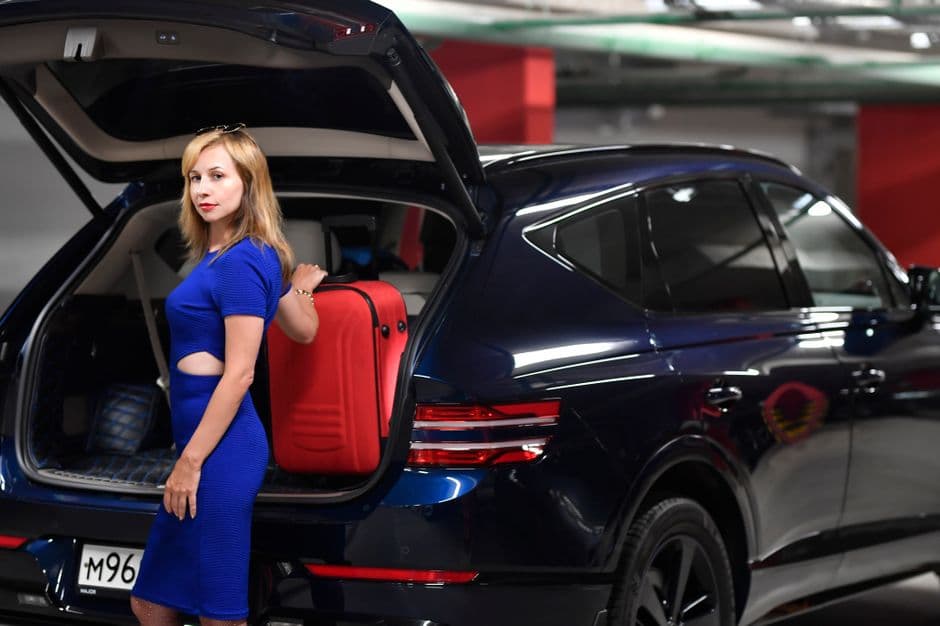
The principle everything else follows from
An unrestrained object in a car is traveling at the same speed as the car. In a hard stop it keeps going until something stops it, and that something is whatever is in front of it — which, for anything in the cabin, is a person.
This is not an argument for anxiety. It is an argument for a five-minute decision at loading time: for each item, what stops this? Something with a good answer can go anywhere. Something with no answer belongs in the trunk under a net.
Two numbers in your owner's manual
Payload is the total weight of people plus luggage the vehicle is rated for. It is easier to exceed than people expect — five adults and a full trunk is close to the limit on many cars before anything goes on the roof.
Roof load is a separate figure, commonly in the region of 100 to 165 lb for a passenger car, and it is a dynamic limit — it accounts for the forces of cornering and braking, not just static weight. The bag and the straps count toward it as well as the contents.
We are not going to guess your car's figures. The manual has them, and looking them up takes two minutes. If you are considering a roof bag, the full picture including the fuel economy cost is in best roof cargo bags.
Loading order
- Empty the car. Including the spare wheel well, which usually contains things nobody remembers putting there
- Heaviest items first, on the trunk floor against the rear seat backs. Low and as far forward as the trunk allows. Weight high or behind the rear axle has the largest effect on handling
- Build a flat, gap-free base layer. Gaps are where things move. Soft bags fill voids between hard cases
- Lighter and softer items on top, keeping the whole load below the parcel shelf line if you have one. A load above that line can be thrown forward into the cabin
- Restrain the top layer with a net or tie-downs
- Day bag last, where you can reach it without unpacking
Restraint versus friction
A skid-resistant surface is not restraint. A molded cargo liner's textured surface stops a box creeping under gentle acceleration and does nothing whatsoever in a hard stop — that is friction, and friction is easily overcome.
Restraint means something mechanical: a cargo net anchored to the vehicle's tie-down points, or straps. It is genuinely cheap and it is the difference between a load that stays put and a load that redistributes itself.
One honest gap: no cargo net in this ledger publishes a load rating, on a product whose entire function is restraint. That is worth knowing rather than assuming a net will hold anything you put under it — see best cargo nets and tie-downs.
A liner is still worth having for the other reason: containing whatever leaks. That is what a raised lip does, and it is covered in best cargo liners.
Do not pack away your visibility
A load stacked above the rear window line costs you the rear view entirely, and on a car without a backup camera that is a real reduction in what you can see.
Keep the load below the parcel shelf, or accept that you are driving on mirrors and adjust accordingly. Also check that a full trunk has not blocked the rear demister or a rear speaker against the parcel shelf, which produces a mystery buzz for the whole trip.
And leave the spare wheel accessible if you have one. A puncture with the spare buried under everything you own means unloading the car on a hard shoulder — see how to change a tire.
The cabin, and the day bag
The cabin should carry people, soft items, and nothing else. What you want within reach is a single soft bag containing the things you would otherwise stop and unpack for.
- Water and snacks, so a stop is a choice rather than a necessity
- Chargers and a good cable — best multi-port car chargers
- Documents, medication, wipes, a rubbish bag
- A phone mount so navigation is not in someone's hand — best vent mounts
For a car with children, kick-mat pockets put the child's own things at their eye level, which removes the reaching-behind-the-seat problem entirely — best car accessories for families.
What must stay reachable
Packing a trunk to the roof frequently buries the things that matter most in the rare case they are needed. Keep these accessible rather than at the bottom:
The spare wheel and jack. A first aid kit — best car first aid kits. Warning triangles, which are useless in a packed trunk you cannot open safely on a hard shoulder — best warning triangles and road flares. A flashlight, and a jump starter if you carry one.
The escape tool is the exception that should not be in the trunk at all — it belongs on your keys or a door bracket, for reasons set out in best car escape tools.
One thing worth understanding before it goes in the trunk: a 12V cooler cools relative to ambient rather than to a set temperature, so in a hot car it is keeping drinks cool rather than keeping food safe — best car coolers.
Every pick, with the working
Each entry lists the specifications the maker publishes, the axis scores those specifications produce, and what you give up. Rows that read “Not published” are not omissions on our side: they are things the maker will not commit to in writing, and they cost the product points on the transparency axis. Specifications compiled September 4, 2026.
Our pickA trunk that carries things that leak
WeatherTech Cargo/Trunk Liner
Custom-molded per vehicle in the same TPE as the floor liners, with a raised lip that turns the trunk floor into a tray. It publishes a flammability standard, which nothing else in this category does.
- Material
- Custom blended thermoplastic elastomer (TPE)
- Fit
- Custom molded per vehicle
- Edge
- Raised outside lip to contain spills
- Surface
- Skid-resistant
- Standard met
- FMVSS302
- Material content
- No PVC, phthalates, BPA, cadmium or lead; 100% recyclable
- Manufacture
- USA
- Warranty
- Not published
- List price
- Not published
What it gets right
- Custom molded to the specific vehicle rather than trimmed to fit, so the raised lip actually seals the floor
- Meets FMVSS302 flammability standard — a published, named standard in a category with none
- TPE with no PVC, phthalates, BPA, cadmium or lead, and 100% recyclable
- Designed, engineered and manufactured in the USA on American-made tooling
Flaws
- Vehicle-specific, so it is worthless if you change cars
- The raised lip is a containment lip, not a wall — a gallon of anything will still find the edge
- The most expensive way to protect a trunk floor
The working behind the 9.2
- Heat headroom: not scored (weight 22%)
- The maker publishes no operating-temperature ceiling, so this axis is dropped and the other weights are re-normalized.
- Install effort: 10.0 (weight 24%)
- Drops in and sits there. No fixing of any kind, and it comes out again when you sell the car.
- Price against the ceiling: not scored (weight 24%)
- No published list price we could cite on the compile date, so this axis is dropped and the other weights are re-normalized.
- Written commitment: not scored (weight 15%)
- No warranty term published, so this axis is dropped and the other weights are re-normalized.
- Spec transparency: 7.8 (weight 15%)
- 7 of the 9 specifications we went looking for are published by the maker (78%). A blank row is never a guess here: it prints “Not published” and it costs the product points, because a figure nobody will commit to in writing is a figure you cannot check.
Axes with no published input are dropped and the remaining weights re-normalized, so a product is not punished for a category where an axis does not apply. Specifications compiled September 4, 2026 from WeatherTech Cargo Liner published specifications.
2Stopping groceries rolling around the back seat
Fortem Collapsible Car Organizer (50L)
A rigid-based collapsible box rather than a hanging pouch, so it works on the back seat or in the trunk and collapses flat when you need the space back. 600D Oxford with a stated 50 L capacity and securing straps.
- Capacity
- 50 L (45 L, 65 L and 90 L also offered)
- Material
- 600D Oxford (1680D on larger sizes)
- Compartments
- 3 plus side pockets
- Base
- Rigid base plates, non-slip bottom
- Securing
- Adjustable straps
- Collapsible
- Yes, with removable lid
- Exterior dimensions
- Not published
- List price
- Not published
- Warranty
- Not published
What it gets right
- Rigid base plates and sturdy side walls, so it stands up empty — the failure mode of every soft organizer
- Published capacity in liters, which almost nothing in this category states
- Non-slip bottom plus securing straps, so it stays where you put it
- Collapses flat, which is the difference between an organizer and a permanent passenger
Flaws
- 600D Oxford on the standard model; the heavier 1680D fabric is only on the larger sizes
- Exterior dimensions are not published, only capacity, so fit in a specific trunk is a guess
- No published warranty term
The working behind the 8.7
- Heat headroom: not scored (weight 22%)
- The maker publishes no operating-temperature ceiling, so this axis is dropped and the other weights are re-normalized.
- Install effort: 10.0 (weight 24%)
- Drops in and sits there. No fixing of any kind, and it comes out again when you sell the car.
- Price against the ceiling: not scored (weight 24%)
- No published list price we could cite on the compile date, so this axis is dropped and the other weights are re-normalized.
- Written commitment: not scored (weight 15%)
- No warranty term published, so this axis is dropped and the other weights are re-normalized.
- Spec transparency: 6.7 (weight 15%)
- 6 of the 9 specifications we went looking for are published by the maker (67%). A blank row is never a guess here: it prints “Not published” and it costs the product points, because a figure nobody will commit to in writing is a figure you cannot check.
Axes with no published input are dropped and the remaining weights re-normalized, so a product is not punished for a category where an axis does not apply. Specifications compiled September 4, 2026 from Fortem organizer published specifications.
3Stopping the trunk redistributing itself
Rightline Gear Bungee Cargo Net
Five by six feet unstretched and nine by ten stretched, with twelve rigid hooks and a perimeter bungee that tightens the edges around whatever is under it. Rightline states the hooks are rigid specifically so they hold shape under load — which is the failure mode of every cheap net, where the hooks straighten and let go one at a time.
- Dimensions unstretched
- 5 ft x 6 ft
- Dimensions stretched
- 9 ft x 10 ft
- Hooks
- 12, rigid, relocatable
- Edge
- Adjustable perimeter bungee
- UV protection
- Stated, to preserve elasticity
- Load rating
- Not published
- List price
- Not published
- Warranty
- Not published
What it gets right
- Published stretched and unstretched dimensions, so you can work out whether it covers your load
- Rigid hooks stated not to bend or break, which is the whole difference between nets in this category
- Relocatable hooks and an adjustable perimeter bungee, so one net handles very different loads
- UV protected to keep elasticity, which is what stops it going brittle after two summers
Flaws
- It needs anchor points. Many hatchbacks and sedans have very few, and a net with nothing to hook to is useless
- Sized for a truck bed, so in a car trunk you will have a lot of net and not much load
- A net contains; it does not organize. For that you want a box
The working behind the 8.6
- Heat headroom: not scored (weight 22%)
- The maker publishes no operating-temperature ceiling, so this axis is dropped and the other weights are re-normalized.
- Install effort: 10.0 (weight 24%)
- Drops in and sits there. No fixing of any kind, and it comes out again when you sell the car.
- Price against the ceiling: not scored (weight 24%)
- No published list price we could cite on the compile date, so this axis is dropped and the other weights are re-normalized.
- Written commitment: not scored (weight 15%)
- No warranty term published, so this axis is dropped and the other weights are re-normalized.
- Spec transparency: 6.3 (weight 15%)
- 5 of the 8 specifications we went looking for are published by the maker (63%). A blank row is never a guess here: it prints “Not published” and it costs the product points, because a figure nobody will commit to in writing is a figure you cannot check.
Axes with no published input are dropped and the remaining weights re-normalized, so a product is not punished for a category where an axis does not apply. Specifications compiled September 4, 2026 from Rightline Gear bungee cargo net published specifications.
4A car with no roof rack
Rightline Gear Sport 2 Car Top Carrier
15 cubic feet that attaches with or without a roof rack, which is the whole reason to buy a bag instead of a box. The car-clip system straps to the door frame weather molding on a bare roof.
- Capacity
- 15 cubic feet
- Shell
- UV-protected PVC semi-coated mesh XT
- Closure
- Waterproof zipper
- Attachment
- Roof rack straps or included car clips (no rack needed)
- Included
- 4 straps, 4 car clips, stuff sack with sewn-in guide
- Warranty
- 12 months
- Load rating
- Not published
- List price
- Not published
What it gets right
- Attaches with OR without a roof rack — the included car clips grip the door frame molding
- Published 15 cubic feet capacity
- UV-protected PVC semi-coated mesh shell with a waterproof zipper, so the closure is not the weak point
- 1-year manufacturer warranty published brand-wide
Flaws
- On a bare roof the straps run through the door openings, so the doors have to open past the straps every time
- A roof bag is a parachute. Expect a real fuel economy penalty at highway speed
- No published load rating in pounds, only volume
The working behind the 7.6
- Heat headroom: not scored (weight 22%)
- The maker publishes no operating-temperature ceiling, so this axis is dropped and the other weights are re-normalized.
- Install effort: 9.0 (weight 24%)
- Clips onto a vent blade or a headrest post. Two minutes, no tools, no adhesive, no residue.
- Price against the ceiling: not scored (weight 24%)
- No published list price we could cite on the compile date, so this axis is dropped and the other weights are re-normalized.
- Written commitment: 5.5 (weight 15%)
- 12-month warranty. This is the only promise in the entire listing that a court would read, which is why it is scored and the marketing copy is not.
- Spec transparency: 7.5 (weight 15%)
- 6 of the 8 specifications we went looking for are published by the maker (75%). A blank row is never a guess here: it prints “Not published” and it costs the product points, because a figure nobody will commit to in writing is a figure you cannot check.
Axes with no published input are dropped and the remaining weights re-normalized, so a product is not punished for a category where an axis does not apply. Specifications compiled September 4, 2026 from Rightline Gear Sport 2 published specifications.
Prices last verified October 22, 2026. They move constantly; the figure on Amazon when you click is the real one.
Questions people actually ask
Where should the heaviest luggage go?
On the trunk floor, as far forward as it will go, against the back of the rear seats. Weight that is high or behind the rear axle has the greatest effect on how the car handles.
Is it safe to stack luggage above the rear seats?
It costs you rear visibility, and anything above the parcel shelf line can be thrown forward into the cabin in a hard stop. Keep the load below that line, or restrain it properly.
How much can I put on the roof?
Check the owner's manual — it is vehicle-specific and it is a dynamic limit accounting for cornering and braking. The carrier and straps count toward it, and neither roof bag in this ledger publishes its own load rating.
Does a cargo liner stop things sliding?
It stops gentle creep. It does nothing in a hard stop — that is friction, not restraint. A cargo net or tie-downs anchored to the vehicle's own points is what actually holds a load.