The best cooling seat cushions
A cooling cushion works by evaporation, not refrigeration. Understand that and it makes sense. Expect air conditioning in a cushion and it will disappoint you every time.
By Sawyer V. · Published · How we research
We have not tested any of this. Everything below is compiled from published manufacturer specifications, and the arithmetic is printed so you can check it. This page carries affiliate links: if you buy through one we earn a commission at no extra cost to you, and it does not change the order of the picks. Full disclosure.
The short answer
Understand the mechanism before you buy. A ventilated cushion has fans that push air through a mesh layer between you and the seat. That air lets sweat evaporate, and evaporation is what makes you feel cooler — it does not chill the air and it cannot beat a working air conditioner. Worth knowing: no maker in this category publishes airflow in CFM, fan wattage, or a noise figure, so there is nothing to compare between products.
| # | Pick | Install | Score | Price |
|---|---|---|---|---|
| 1 | ComfiLife Gel Enhanced Seat Cushion The standard answer for a long drive | Drops in | 9.3/10 | $41.36 - view on Amazon |
| 2 | EcoNour Windshield Sun Shade The cheapest real temperature drop in the car | Drops in | 9.3/10 | $11.99 - view on Amazon |
| 3 | Sojoy 12V Heated Seat Cushion A car with no factory heated seats | Plugs in | 9.2/10 | $99.99 - view on Amazon |
| 4 | Zone Tech 12V Cooling Seat Cushion A car with cloth seats and no ventilation | Plugs in | 8.1/10 | $45.22 - view on Amazon |
Prices last verified October 22, 2026. They move constantly; the figure on Amazon when you click is the real one.
What a cooling cushion actually does
A car seat is an insulator. You sit against a surface that does not conduct heat away and does not let air move, so heat and moisture build up between you and the upholstery. That trapped humidity is what makes a seat feel unbearable long before the cabin does.
A ventilated cushion attacks the humidity rather than the temperature. Fans push cabin air through a spacer mesh, that air carries moisture away, and evaporation from your skin cools you. It is the same reason a breeze feels cooler than still air at the same temperature.
Two consequences follow, and both are frequently misunderstood:
- It cannot make air colder than the cabin. On a genuinely hot day with the air conditioning off, it is moving hot air over you
- It works far better with the air conditioning on. Feed it cooled cabin air and it distributes that air to the one surface the vents cannot reach — the one you are sitting against
What this category refuses to publish
This is the honest headline and it is why we have named the category winner as our skip pick. Every specification that would let you compare two cooling cushions is absent.
| Specification | Why it matters | Published? |
|---|---|---|
| Airflow (CFM) | The entire function of the product | No |
| Fan wattage | Whether it strains the socket | No |
| Noise level (dB) | It sits directly behind your back | No |
| Fan life expectancy | Fans are the wear item | No |
| Warranty term | Written commitment | No |
Compare that with a category where makers do publish. Sojoy states 2.6 A maximum draw and a 50 C surface ceiling on its heated cushion, and those figures let you reason about socket load and safety — best heated seat cushions. Cooling cushions are marketed on adjectives.
On this site that costs points directly, because spec transparency is one of the five weighted axes. A product with nothing published cannot be ranked against one with figures, and pretending otherwise would be inventing data.
The problem people report most
Fan noise. The fans sit in a cushion immediately behind your back and directly beneath you, which is acoustically about the worst place to put a small high-speed fan.
Nobody publishes a decibel figure, so there is no way to choose a quieter one from a listing. What is predictable is the trade: more airflow means more noise, and the high speed setting on any of these is noticeably louder than the low one.
The practical consequence is that many people use these on the low setting permanently, which is a reasonable outcome — the moisture management still happens, just more slowly.
The things to try before buying one
Two interventions cost nothing or very little and address the same problem more directly.
Shade the car when parked. The single biggest factor in how hot your seat is when you get in is how much sun fell on it. A windshield shade is the highest-impact cheap purchase in this whole area — EcoNour and Kinder Fluff are covered in best windshield sun shades, and the broader method is in how to keep your car cool when parked.
Vent the car before you drive. Opening the windows for the first minute pushes out air that is far hotter than ambient, which the air conditioning then does not have to cool. It is free and it works.
Consider a seat cover in a breathable material. Leather and leatherette are the worst surfaces for this, because they are impermeable — a fabric cover is a permanent improvement with no fan and no power draw. See best car seat covers, and note the airbag-compatible stitching requirement covered there.
The socket cost
A ventilated cushion runs from the 12V socket, which is a socket not available for anything else. In a car with one socket that is a real cost against a phone charger, a dash cam or an inflator.
The draw itself is small — fans are not heaters, and this is nothing like the 2.6 A a heated cushion pulls. But since nobody publishes the wattage, we cannot tell you what it is, which is itself the recurring theme of this page.
If sockets are tight, a splitter with a flexible lead solves it — the caution about rigid splitters levering on socket contacts is in how to add USB ports to an older car.
Who should buy one
Buy one if you have leather or leatherette seats, drive somewhere genuinely hot, and are specifically bothered by a sweat-soaked back rather than by cabin temperature generally. That is the case the product actually addresses, and for it, it works.
Do not buy one expecting it to substitute for air conditioning, and do not buy one before you have a windshield shade — the shade is cheaper, addresses the bigger variable, and needs no power. The full summer kit is in best car accessories for summer.
Every pick, with the working
Each entry lists the specifications the maker publishes, the axis scores those specifications produce, and what you give up. Rows that read “Not published” are not omissions on our side: they are things the maker will not commit to in writing, and they cost the product points on the transparency axis. Specifications compiled September 4, 2026.
Our pickThe standard answer for a long drive
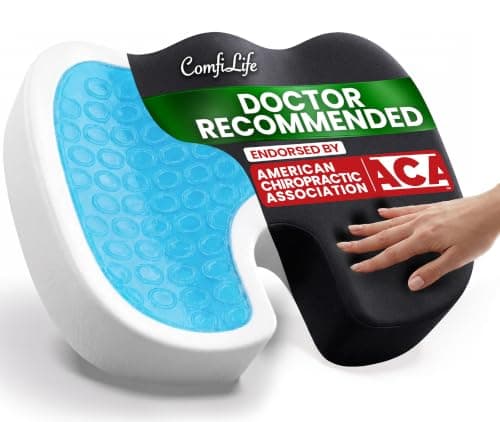
ComfiLife Gel Enhanced Seat Cushion
17.5 by 13.7 by 2.8 inches of high-density memory foam with a gel layer on top, a non-slip rubber base and a washable cover. The published geometry is what matters here: 2.8 inches is enough lift to change your hip angle and not so much that your head moves toward the headliner in a low car. Measure your seat-to-roof clearance before you buy.
- Dimensions
- 17.5 L x 13.7 W x 2.8 H in
- Weight
- 1.45 lb
- Core material
- High-density memory foam
- Top layer
- Cooling gel
- Base
- Non-slip rubber
- Cover
- Machine-washable zippered velour, OEKO-TEX certified
- Foam density figure
- Not published
- Warranty
- Lifetime money back or replacement, stated
List price $59.94 per ComfiLife's own store, captured on the compile date below. Not a live price and not what you will pay — the button is where the real number is.
What it gets right
- Published dimensions, which most cushions in this category do not give you
- 2.8 in of lift changes the hip angle without wrecking your seating position
- Non-slip rubber base, so it stays where you put it when you get in
- Cover comes off and goes in the machine, which after one summer matters
Flaws
- 2.8 in of lift is a real change to your relationship with the roof, the mirrors and the belt path
- ComfiLife does not publish a foam density figure, only the words high density
- $59.94 list is a lot for foam
The working behind the 9.3
- Heat headroom: not scored (weight 22%)
- The maker publishes no operating-temperature ceiling, so this axis is dropped and the other weights are re-normalized.
- Install effort: 10.0 (weight 24%)
- Drops in and sits there. No fixing of any kind, and it comes out again when you sell the car.
- Price against the ceiling: 9.0 (weight 24%)
- Listed at $59.94 on the compile date. This site's buyer has a practical ceiling around $150 for a single upgrade, so the scale rewards everything under $100 and falls away sharply past $150. The live price is very often different, and that is what the button is for.
- Written commitment: not scored (weight 15%)
- No warranty term published, so this axis is dropped and the other weights are re-normalized.
- Spec transparency: 8.8 (weight 15%)
- 7 of the 8 specifications we went looking for are published by the maker (88%). A blank row is never a guess here: it prints “Not published” and it costs the product points, because a figure nobody will commit to in writing is a figure you cannot check.
Axes with no published input are dropped and the remaining weights re-normalized, so a product is not punished for a category where an axis does not apply. Specifications compiled September 4, 2026 from ComfiLife's Gel Enhanced Seat Cushion page.
2The cheapest real temperature drop in the car
EcoNour Windshield Sun Shade
240T polyester with a reflective coating and reinforced steel rings, in sizes from 53 by 30 up to 75 by 37 inches. EcoNour states its shades keep an interior up to 40 F cooler and block 99 percent of heat and UV. Those are the maker's own figures rather than an independent test, and even at half of them this is the best dollar-per-degree in the whole car.
- Material
- 240T polyester with reflective coating
- Frame
- Reinforced steel rings
- Sizes published
- 53x30, 59x29, 64x32, 66x27, 75x37 in
- Maker's temperature claim
- Up to 40 F cooler interior
- Maker's UV claim
- Blocks 99% of heat and UV
- Independent verification
- Not published
- Warranty
- Not published
List price $20.99 per EcoNour's own store, 53 x 30 in umbrella model, captured on the compile date below. Not a live price and not what you will pay — the button is where the real number is.
What it gets right
- Multiple published sizes, so you can actually match your windshield rather than fold a compromise
- Reinforced steel rings, which is what stops the frame collapsing after one summer
- Under $25 across most sizes
- Folds down small enough to live behind a seat rather than in the trunk
Flaws
- The 40 F figure is EcoNour's own claim, not an independent measurement, and the conditions behind it are not published
- You have to actually put it up every time, which is the real reason sun shades fail
- Sizing is on you: too small leaves a gap, too big will not sit flat
The working behind the 9.3
- Heat headroom: not scored (weight 22%)
- The maker publishes no operating-temperature ceiling, so this axis is dropped and the other weights are re-normalized.
- Install effort: 10.0 (weight 24%)
- Drops in and sits there. No fixing of any kind, and it comes out again when you sell the car.
- Price against the ceiling: 10.0 (weight 24%)
- Listed at $20.99 on the compile date. This site's buyer has a practical ceiling around $150 for a single upgrade, so the scale rewards everything under $100 and falls away sharply past $150. The live price is very often different, and that is what the button is for.
- Written commitment: not scored (weight 15%)
- No warranty term published, so this axis is dropped and the other weights are re-normalized.
- Spec transparency: 7.1 (weight 15%)
- 5 of the 7 specifications we went looking for are published by the maker (71%). A blank row is never a guess here: it prints “Not published” and it costs the product points, because a figure nobody will commit to in writing is a figure you cannot check.
Axes with no published input are dropped and the remaining weights re-normalized, so a product is not punished for a category where an axis does not apply. Specifications compiled September 4, 2026 from EcoNour's windshield sunshade range.
3A car with no factory heated seats
Sojoy 12V Heated Seat Cushion
Skip this one. If you have reduced sensation anywhere you would sit on this — for any reason at all — a contact heater you cannot feel getting too hot is the wrong product, and the 50 C ceiling is a design target rather than a guarantee.
Publishes the two figures that decide whether a 12V heater is safe to own: a 2.6 A maximum draw and a surface temperature that tops out at 50 C. It also publishes a timer, which matters more than the heat does.
- Working voltage
- DC 12 V
- Maximum current
- 2.6 A (about 31 W)
- Surface temperature
- Up to 50 C
- Timer
- 30-45 minutes depending on model
- Heat settings
- High / Medium / Low
- Overheat protection
- Thermostat holds the selected temperature
- Size
- About 38 x 19 x 0.5 in
- List price
- Not published
- Warranty
- Not published
What it gets right
- Publishes maximum current draw (2.6 A) — roughly 31 W, which a 12V socket handles without complaint
- Publishes a surface temperature ceiling of 50 C rather than leaving it to the imagination
- Timed shut-off (30 or 45 minutes depending on model) so it cannot cook a parked battery
- Thermostat holds the set temperature instead of climbing indefinitely
Flaws
- It is a heating element you sit on. Anything with a skin-contact heat source and no temperature readout deserves care
- The 12V cord has to run somewhere, and it will be in the way
- No published warranty term
The working behind the 9.2
- Heat headroom: not scored (weight 22%)
- The maker publishes no operating-temperature ceiling, so this axis is dropped and the other weights are re-normalized.
- Install effort: 10.0 (weight 24%)
- Plugs into a 12V socket or a USB port. Nothing to mount, nothing to route, reversible in a second.
- Price against the ceiling: not scored (weight 24%)
- No published list price we could cite on the compile date, so this axis is dropped and the other weights are re-normalized.
- Written commitment: not scored (weight 15%)
- No warranty term published, so this axis is dropped and the other weights are re-normalized.
- Spec transparency: 7.8 (weight 15%)
- 7 of the 9 specifications we went looking for are published by the maker (78%). A blank row is never a guess here: it prints “Not published” and it costs the product points, because a figure nobody will commit to in writing is a figure you cannot check.
Axes with no published input are dropped and the remaining weights re-normalized, so a product is not punished for a category where an axis does not apply. Specifications compiled September 4, 2026 from Sojoy 12V heated cushion published specifications.
4A car with cloth seats and no ventilation
Zone Tech 12V Cooling Seat Cushion
Skip this one. We are naming the category winner as the skip, because the honest answer is that nobody here publishes anything you can check. No maker states airflow in CFM, fan wattage, or a noise figure. If your car has working air conditioning, shade it when parked and aim the vents at yourself before spending on a cushion nobody will quantify.
A fan-driven mesh pad that moves air between you and the seat. It works on a principle that is sound — evaporation, not refrigeration — and the whole category publishes almost nothing you can check, which is the honest headline.
- Power
- 12 V socket
- Fan levels
- Three, on a dial (high / medium / low)
- Construction
- Microfiber and mesh
- Retention
- Straps
- Size
- 19 x 22 x 3 in, 2.5 lb
- Airflow (CFM)
- Not published
- Fan wattage
- Not published
- Noise level
- Not published
- Warranty
- Not published
- List price
- Not published
What it gets right
- Addresses the actual mechanism: a cooling cushion moves air so sweat can evaporate, which is what makes a seat feel cooler
- Runs from the 12V socket, so there is nothing to charge
- A microfiber and mesh layer keeps your back off the seat surface, which helps even with the fan off
- Publishes three fan levels on a dial rather than a single speed
Flaws
- No maker in this category publishes airflow in CFM, fan wattage, or a noise figure — there is nothing to compare
- It does not refrigerate. On a genuinely hot day it moves hot air over you
- Fan noise is real and sits directly behind your back
- No published warranty term
The working behind the 8.1
- Heat headroom: not scored (weight 22%)
- The maker publishes no operating-temperature ceiling, so this axis is dropped and the other weights are re-normalized.
- Install effort: 10.0 (weight 24%)
- Plugs into a 12V socket or a USB port. Nothing to mount, nothing to route, reversible in a second.
- Price against the ceiling: not scored (weight 24%)
- No published list price we could cite on the compile date, so this axis is dropped and the other weights are re-normalized.
- Written commitment: not scored (weight 15%)
- No warranty term published, so this axis is dropped and the other weights are re-normalized.
- Spec transparency: 5.0 (weight 15%)
- 5 of the 10 specifications we went looking for are published by the maker (50%). A blank row is never a guess here: it prints “Not published” and it costs the product points, because a figure nobody will commit to in writing is a figure you cannot check.
Axes with no published input are dropped and the remaining weights re-normalized, so a product is not punished for a category where an axis does not apply. Specifications compiled September 4, 2026 from Zone Tech published 12V cooling cushion information.
Prices last verified October 22, 2026. They move constantly; the figure on Amazon when you click is the real one.
Questions people actually ask
Do cooling seat cushions actually work?
They move air so sweat can evaporate, which does make you feel cooler. They do not chill the air and cannot beat a working air conditioner. Judged as a way of getting airflow to your back, they do something real.
Are cooling cushions noisy?
Yes, and no maker publishes a decibel figure so you cannot compare before buying. The fans sit directly behind and beneath you. Most people end up running them on the low setting.
Will a cooling cushion drain my battery?
Fans draw far less than a heater, so with the engine running it is negligible. Nobody publishes the wattage, so we will not state a figure — but unplug it with the engine off if your socket stays live.
What is cheaper than a cooling cushion?
A windshield sun shade, by a wide margin, and it addresses the larger variable — how hot the seat was before you sat on it. Venting the car for the first minute of a drive is free and also helps.