The best car accessories for summer
Heat is the theme this whole site keeps returning to, and summer is when it stops being theoretical. Some of your accessories are rated below what your car reaches.
By Sawyer V. · Published · How we research
We have not tested any of this. Everything below is compiled from published manufacturer specifications, and the arithmetic is printed so you can check it. This page carries affiliate links: if you buy through one we earn a commission at no extra cost to you, and it does not change the order of the picks. Full disclosure.
The short answer
Buy a windshield shade, then a side shade, then everything else. Shade is the highest-value summer purchase because it addresses the largest glass area and stops heat and UV before they arrive. Then the part nobody thinks about: a parked car reaches roughly 60-70 C, which is above the published ceiling of several things people leave in one — the Anker Soundsync publishes 55 C, the First Alert extinguisher 49 C. Some of your kit should come indoors.
| # | Pick | Install | Score | Price |
|---|---|---|---|---|
| 1 | EcoNour Windshield Sun Shade The cheapest real temperature drop in the car | Drops in | 9.3/10 | $11.99 - view on Amazon |
| 2 | 303 Automotive Protectant A dashboard in permanent sunlight | Drops in | 8.7/10 | $16.98 - view on Amazon |
| 3 | EcoNour Car Side Window Sun Shade (2 pack) A rear passenger in afternoon sun | Drops in | 8.6/10 | $17.99 - view on Amazon |
| 4 | WeatherTech Side Window Deflectors Cracking the windows in the rain | Clips on | 8.3/10 | $136.95 - view on Amazon |
| 5 | Anker Soundsync A3352 Bluetooth Receiver An older car with a working aux socket | Plugs in | 8.1/10 | Check price on Amazon |
| 6 | Zone Tech 12V Cooling Seat Cushion A car with cloth seats and no ventilation | Plugs in | 8.1/10 | $45.22 - view on Amazon |
Prices last verified October 22, 2026. They move constantly; the figure on Amazon when you click is the real one.
The number this whole page is about
A car parked in summer sun reaches roughly 60-70 C inside. That is the figure this site weights its scoring around, and in summer it stops being an abstraction.
Two things follow. First, everything in the cabin is being cooked daily — plastics, coatings, adhesives and lithium cells all degrade faster. Second, several accessories people leave in cars publish operating ceilings below that.
| Item | Published ceiling | Above 60-70 C cabin? |
|---|---|---|
| Ottocast U2-AIR Pro adapter | 75 C | Yes — clears it |
| Vantrue E1 dash cam | 70 C | At the top of the range |
| VIOFO A229 Plus dash cam | 65 C | Marginal |
| Anker Soundsync aux receiver | 55 C | No — below it |
| First Alert AUTO5 extinguisher | 49 C | No — well below it |
| Power banks | Not published | Unknown |
| Cooling cushions | Not published | Unknown |
Shade is the whole strategy
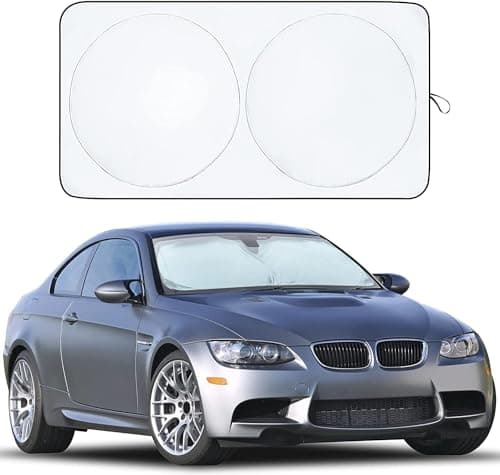
A windshield shade is the highest-value purchase in this entire category and it is not close. The windshield is by a wide margin the largest glass area and the one aimed most directly at the sky, so blocking it addresses most of the heat and most of the UV in one object.
It also costs less than a year of interior protectant, needs no reapplication, and works from the first day. Best windshield sun shades covers the options, and how to keep your car cool when parked covers the method, including the free steps.
Two practical points: press it flat against the glass rather than letting it sag, since the gap is where heat accumulates, and the reflective surface faces out.
The side glass, which nobody shades
Here is the fact that surprises people. Your windshield is laminated, and the plastic interlayer blocks UVA well — it is a good UV barrier almost by accident.
Your side and rear windows are usually tempered glass: a single heat-treated layer that blocks UVB well and UVA considerably less. So the sun coming through the side window is doing more UV damage than the sun through the windshield, and almost nobody shades it.
It is why the door card and seat bolster on the sunny side fade first, and it is worth checking your own car for. A stretch mesh side shade covers the whole door aperture and still lets the window open — it is a screen rather than a blackout, and EcoNour publishes no UV-blocking percentage, which we would rather state than invent. Best side window sun shades.
Letting the car breathe
A large part of cabin heat is simply that hot air has nowhere to go. Cracking the windows lets convection work, and window deflectors let you do that in weather.
WeatherTech's are the only ones stated to use a US DOT-approved glazing material, in 3 mm UV-treated acrylic. Buy the light tint rather than dark: these sit permanently in the upper part of your side vision, which is where a tall vehicle beside you appears. Best rain guards and window deflectors.
The free version: open the windows for the first minute of driving. The air inside a parked car is far hotter than ambient, and pushing it out is work the air conditioning then does not have to do.
Your phone will throttle
Summer is when the heat stack on a phone becomes a practical problem rather than a theoretical one: direct sun through glass, a screen at full brightness for daylight visibility, a processor running navigation, and — if you use one — a wireless charging pad adding its own losses.
The result is a phone that dims its own screen mid-route and charges slower than it discharges. The mitigations are all about position and method:
- Mount at a vent rather than on the glass. Moving cooled air is the cheapest cooling available — vent vs dashboard vs windshield
- Use a cable, not wireless, on long summer drives. Faster and cooler — why your phone charges slowly in the car
- If you want wireless, the ESR CryoBoost's fan is the only design here that addresses the limiting factor directly — best wireless charging car mounts
Protecting what the sun is degrading
With shade handling the parked hours, a protectant handles the driving hours when the sun is on the dash anyway.
303 publishes an SPF 40 equivalent and a 30 to 45 day reapplication interval — the only comparable UV figure in a category of adjectives. Choose matte rather than glossy: a shiny dashboard reflects into a raked windshield and puts a ghost image in your view of the road, which is a driving problem rather than a taste one. Best dashboard protectants and how to protect your car interior from sun.
Leather and leatherette fail by UV degradation of their coating, which cracks permanently — best leather cleaners and conditioners.
Cooling cushions, honestly
The most-searched summer accessory, and the category with the least published information. No maker states airflow in CFM, fan wattage, or a noise figure — there is nothing to compare between products.
What they do is real but narrow: fans push cabin air through a mesh layer so sweat can evaporate. That is evaporative cooling, not refrigeration. With the air conditioning on it distributes cooled air to the one surface the vents cannot reach; with it off, it moves hot air over you. Best cooling seat cushions.
Two summer checks worth doing
Tire pressure. Air expands as it warms, so pressures read higher on a hot afternoon than a cool morning. Check cold — the car standing a few hours — because checking warm leads people to let air out of correctly inflated tires. AstroAI publishes plus or minus 1 PSI, which almost nothing in that category states — best tire pressure gauges.
The fire extinguisher gauge. First Alert publishes a 49 C ceiling and a parked car exceeds it. Mount it low and out of direct sun, and check the needle sits in the green band — best car fire extinguishers.
Every pick, with the working
Each entry lists the specifications the maker publishes, the axis scores those specifications produce, and what you give up. Rows that read “Not published” are not omissions on our side: they are things the maker will not commit to in writing, and they cost the product points on the transparency axis. Specifications compiled September 4, 2026.
Our pickThe cheapest real temperature drop in the car
EcoNour Windshield Sun Shade
240T polyester with a reflective coating and reinforced steel rings, in sizes from 53 by 30 up to 75 by 37 inches. EcoNour states its shades keep an interior up to 40 F cooler and block 99 percent of heat and UV. Those are the maker's own figures rather than an independent test, and even at half of them this is the best dollar-per-degree in the whole car.
- Material
- 240T polyester with reflective coating
- Frame
- Reinforced steel rings
- Sizes published
- 53x30, 59x29, 64x32, 66x27, 75x37 in
- Maker's temperature claim
- Up to 40 F cooler interior
- Maker's UV claim
- Blocks 99% of heat and UV
- Independent verification
- Not published
- Warranty
- Not published
List price $20.99 per EcoNour's own store, 53 x 30 in umbrella model, captured on the compile date below. Not a live price and not what you will pay — the button is where the real number is.
What it gets right
- Multiple published sizes, so you can actually match your windshield rather than fold a compromise
- Reinforced steel rings, which is what stops the frame collapsing after one summer
- Under $25 across most sizes
- Folds down small enough to live behind a seat rather than in the trunk
Flaws
- The 40 F figure is EcoNour's own claim, not an independent measurement, and the conditions behind it are not published
- You have to actually put it up every time, which is the real reason sun shades fail
- Sizing is on you: too small leaves a gap, too big will not sit flat
The working behind the 9.3
- Heat headroom: not scored (weight 22%)
- The maker publishes no operating-temperature ceiling, so this axis is dropped and the other weights are re-normalized.
- Install effort: 10.0 (weight 24%)
- Drops in and sits there. No fixing of any kind, and it comes out again when you sell the car.
- Price against the ceiling: 10.0 (weight 24%)
- Listed at $20.99 on the compile date. This site's buyer has a practical ceiling around $150 for a single upgrade, so the scale rewards everything under $100 and falls away sharply past $150. The live price is very often different, and that is what the button is for.
- Written commitment: not scored (weight 15%)
- No warranty term published, so this axis is dropped and the other weights are re-normalized.
- Spec transparency: 7.1 (weight 15%)
- 5 of the 7 specifications we went looking for are published by the maker (71%). A blank row is never a guess here: it prints “Not published” and it costs the product points, because a figure nobody will commit to in writing is a figure you cannot check.
Axes with no published input are dropped and the remaining weights re-normalized, so a product is not punished for a category where an axis does not apply. Specifications compiled September 4, 2026 from EcoNour's windshield sunshade range.
2A dashboard in permanent sunlight
303 Automotive Protectant
The only interior protectant here that publishes a comparable UV figure — an SPF 40 equivalent — instead of saying 'UV protection' and stopping. It also dries matte, which matters because a shiny dashboard reflects into the windshield.
- UV rating
- SPF 40 equivalent
- Duration per application
- 30 to 45 days
- Finish
- Matte, non-greasy
- Surfaces
- Vinyl, rubber, plastic, leather
- Warranty
- Not published
- List price
- Not published
What it gets right
- Publishes an SPF 40 rating, a number you can compare, where the category publishes adjectives
- Dries to a matte finish — a glossy dash reflects sunlight straight into the windshield in your eyeline
- Stated 30 to 45 days per application, so you know the reapplication interval rather than guessing
- Works on vinyl, rubber, plastic and leather, so one bottle covers the cabin
Flaws
- 30 to 45 days means this is a recurring job, not a one-time treatment
- Any protectant on a steering wheel or pedals is a slip hazard — keep it off contact surfaces
- It slows UV damage; it does not reverse a dashboard that has already cracked
The working behind the 8.7
- Heat headroom: not scored (weight 22%)
- The maker publishes no operating-temperature ceiling, so this axis is dropped and the other weights are re-normalized.
- Install effort: 10.0 (weight 24%)
- Drops in and sits there. No fixing of any kind, and it comes out again when you sell the car.
- Price against the ceiling: not scored (weight 24%)
- No published list price we could cite on the compile date, so this axis is dropped and the other weights are re-normalized.
- Written commitment: not scored (weight 15%)
- No warranty term published, so this axis is dropped and the other weights are re-normalized.
- Spec transparency: 6.7 (weight 15%)
- 4 of the 6 specifications we went looking for are published by the maker (67%). A blank row is never a guess here: it prints “Not published” and it costs the product points, because a figure nobody will commit to in writing is a figure you cannot check.
Axes with no published input are dropped and the remaining weights re-normalized, so a product is not punished for a category where an axis does not apply. Specifications compiled September 4, 2026 from 303 Automotive Protectant published specifications.
3A rear passenger in afternoon sun
EcoNour Car Side Window Sun Shade (2 pack)
A stretch mesh sock that goes over the whole door frame rather than a suction-cup square that covers a third of the glass. The trade is that it is a screen, not a blackout: it cuts glare and direct sun while you can still see out and still lower the window.
- Sizes offered
- 18 x 20 in, 36 x 17 in, XL 24 x 38 in
- Material
- Nylon, spandex and rubber stretch mesh
- Fitment
- Over the door frame, not on the glass
- Window still opens
- Yes
- Pack size
- 2
- UV blocking percentage
- Not published
- List price
- Not published
- Warranty
- Not published
What it gets right
- Covers the full window aperture instead of a suction-cupped rectangle in the middle of it
- Breathable stretch fabric means the window still opens with the shade fitted
- No suction cups, so nothing falls off the glass on a hot day
- Sold in pairs, which is what a car with two rear windows actually needs
Flaws
- It is a mesh screen. It reduces glare and direct sun; it is not a blackout and does not make the back seat dark
- Sizing is by window aperture, and a shade sized for a sedan will not stretch over a minivan frame
- No published UV-blocking percentage or UPF rating for the mesh
The working behind the 8.6
- Heat headroom: not scored (weight 22%)
- The maker publishes no operating-temperature ceiling, so this axis is dropped and the other weights are re-normalized.
- Install effort: 10.0 (weight 24%)
- Drops in and sits there. No fixing of any kind, and it comes out again when you sell the car.
- Price against the ceiling: not scored (weight 24%)
- No published list price we could cite on the compile date, so this axis is dropped and the other weights are re-normalized.
- Written commitment: not scored (weight 15%)
- No warranty term published, so this axis is dropped and the other weights are re-normalized.
- Spec transparency: 6.3 (weight 15%)
- 5 of the 8 specifications we went looking for are published by the maker (63%). A blank row is never a guess here: it prints “Not published” and it costs the product points, because a figure nobody will commit to in writing is a figure you cannot check.
Axes with no published input are dropped and the remaining weights re-normalized, so a product is not punished for a category where an axis does not apply. Specifications compiled September 4, 2026 from EcoNour side window shade published specifications.
4Cracking the windows in the rain
WeatherTech Side Window Deflectors
The only deflector that states it uses a DOT-approved glazing material, in 3 mm UV-treated acrylic cut to the specific vehicle. On a part that sits in your side vision permanently, the glazing claim is the one worth having.
- Material
- 3 mm lightly tinted acrylic
- Glazing
- US DOT-approved glazing material
- UV
- UV treated against fading
- Fit
- Vehicle-specific, in-channel
- Tint options
- Light or dark smoke
- Warranty
- Not published
- List price
- Not published
What it gets right
- The only deflectors stated to use a US DOT-approved glazing material
- 3 mm acrylic with a UV treatment, so it does not haze and yellow the way cheap film-thin deflectors do
- Cut to the vehicle's exact window channel rather than taped to the outside of the door
- Lets you leave windows cracked in rain, which is the single most useful thing they do for cabin heat
Flaws
- In-channel fitment means they sit in the window run — if fitted badly they can affect how the glass seats
- Vehicle-specific, so worthless when you change cars
- They are in your side field of view permanently, and a dark tint option makes that worse
- No published warranty term
The working behind the 8.3
- Heat headroom: not scored (weight 22%)
- The maker publishes no operating-temperature ceiling, so this axis is dropped and the other weights are re-normalized.
- Install effort: 9.0 (weight 24%)
- Clips onto a vent blade or a headrest post. Two minutes, no tools, no adhesive, no residue.
- Price against the ceiling: not scored (weight 24%)
- No published list price we could cite on the compile date, so this axis is dropped and the other weights are re-normalized.
- Written commitment: not scored (weight 15%)
- No warranty term published, so this axis is dropped and the other weights are re-normalized.
- Spec transparency: 7.1 (weight 15%)
- 5 of the 7 specifications we went looking for are published by the maker (71%). A blank row is never a guess here: it prints “Not published” and it costs the product points, because a figure nobody will commit to in writing is a figure you cannot check.
Axes with no published input are dropped and the remaining weights re-normalized, so a product is not punished for a category where an axis does not apply. Specifications compiled September 4, 2026 from WeatherTech Side Window Deflectors published specifications.
5An older car with a working aux socket
Anker Soundsync A3352 Bluetooth Receiver
Skip this one. If your car has no aux socket this does nothing at all — check for the 3.5 mm jack before you buy, not after. An FM transmitter is the fallback for a car without one.
The cheapest real upgrade available to a car with an aux socket and no Bluetooth. It publishes an operating temperature range, which is genuinely rare, and it runs on its own battery so nothing has to be plugged in.
- Operating temperature
- -10 C to 55 C (14 F to 131 F)
- Battery
- 180 mAh
- Playback time
- Up to 12 hours
- Charge time
- About 2 hours
- Multipoint
- Two devices simultaneously
- Range
- 10 m / 33 ft
- Profiles
- HFP, A2DP, AVRCP
- Dimensions
- 50 x 29 x 10 mm
- Weight
- 12.2 g
- Direction
- Receiver only — cannot transmit
- Warranty
- Not published
- List price
- Not published
What it gets right
- Publishes an operating temperature range of -10 C to 55 C — almost nothing in this category publishes one at all
- 12 hours of playback on a 180 mAh battery, charging in about 2 hours
- Connects to two devices at once, so a second phone can take a call without unpairing the first
- 50 x 29 x 10 mm and 12.2 g — small enough to stick anywhere
Flaws
- 55 C ceiling is the lowest of any device on this site, and a parked car in summer runs 60-70 C. Take it inside
- Receiver only. It cannot send audio out of the car to headphones
- A battery device means one more thing to charge, unlike a socket-powered kit
- No published warranty term
The working behind the 8.1
- Heat headroom: 6.0 (weight 22%)
- Published operating ceiling 55 C (131 F). A car parked in summer sun runs roughly 60-70 C inside, so 65 C and up is real headroom, 60 C is living at the limit, and anything under 55 C is a summer problem waiting to happen.
- Install effort: 10.0 (weight 24%)
- Plugs into a 12V socket or a USB port. Nothing to mount, nothing to route, reversible in a second.
- Price against the ceiling: not scored (weight 24%)
- No published list price we could cite on the compile date, so this axis is dropped and the other weights are re-normalized.
- Written commitment: not scored (weight 15%)
- No warranty term published, so this axis is dropped and the other weights are re-normalized.
- Spec transparency: 8.3 (weight 15%)
- 10 of the 12 specifications we went looking for are published by the maker (83%). A blank row is never a guess here: it prints “Not published” and it costs the product points, because a figure nobody will commit to in writing is a figure you cannot check.
Axes with no published input are dropped and the remaining weights re-normalized, so a product is not punished for a category where an axis does not apply. Specifications compiled September 4, 2026 from Anker Soundsync A3352 manual specification table.
6A car with cloth seats and no ventilation
Zone Tech 12V Cooling Seat Cushion
Skip this one. The most-searched summer accessory and the one with nothing published. No maker in this category states airflow in CFM, fan wattage or a noise figure, and a ventilated cushion moves cabin air rather than cooling it. Buy the shade first — it addresses the larger variable for less money.
A fan-driven mesh pad that moves air between you and the seat. It works on a principle that is sound — evaporation, not refrigeration — and the whole category publishes almost nothing you can check, which is the honest headline.
- Power
- 12 V socket
- Fan levels
- Three, on a dial (high / medium / low)
- Construction
- Microfiber and mesh
- Retention
- Straps
- Size
- 19 x 22 x 3 in, 2.5 lb
- Airflow (CFM)
- Not published
- Fan wattage
- Not published
- Noise level
- Not published
- Warranty
- Not published
- List price
- Not published
What it gets right
- Addresses the actual mechanism: a cooling cushion moves air so sweat can evaporate, which is what makes a seat feel cooler
- Runs from the 12V socket, so there is nothing to charge
- A microfiber and mesh layer keeps your back off the seat surface, which helps even with the fan off
- Publishes three fan levels on a dial rather than a single speed
Flaws
- No maker in this category publishes airflow in CFM, fan wattage, or a noise figure — there is nothing to compare
- It does not refrigerate. On a genuinely hot day it moves hot air over you
- Fan noise is real and sits directly behind your back
- No published warranty term
The working behind the 8.1
- Heat headroom: not scored (weight 22%)
- The maker publishes no operating-temperature ceiling, so this axis is dropped and the other weights are re-normalized.
- Install effort: 10.0 (weight 24%)
- Plugs into a 12V socket or a USB port. Nothing to mount, nothing to route, reversible in a second.
- Price against the ceiling: not scored (weight 24%)
- No published list price we could cite on the compile date, so this axis is dropped and the other weights are re-normalized.
- Written commitment: not scored (weight 15%)
- No warranty term published, so this axis is dropped and the other weights are re-normalized.
- Spec transparency: 5.0 (weight 15%)
- 5 of the 10 specifications we went looking for are published by the maker (50%). A blank row is never a guess here: it prints “Not published” and it costs the product points, because a figure nobody will commit to in writing is a figure you cannot check.
Axes with no published input are dropped and the remaining weights re-normalized, so a product is not punished for a category where an axis does not apply. Specifications compiled September 4, 2026 from Zone Tech published 12V cooling cushion information.
Prices last verified October 22, 2026. They move constantly; the figure on Amazon when you click is the real one.
Questions people actually ask
How hot does a parked car actually get?
Roughly 60-70 C inside in summer sun, and it climbs steeply in the first ten to fifteen minutes. That is above the published operating ceiling of several accessories people leave in cars.
What should I take out of my car in summer?
Anything with lithium cells and no published temperature range — power banks especially. The Anker Soundsync publishes 55 C, below what a cabin reaches. Also sunglasses, medication and anything with a stated storage temperature.
Does cracking the windows help?
It lets convection remove trapped hot air, which helps. It is a much smaller effect than a windshield shade, which stops the sun heating the interior surfaces in the first place. Use both.
Do cooling seat cushions work?
They move air so sweat evaporates, which makes you feel cooler. They do not chill air and cannot beat air conditioning. No maker publishes airflow, wattage or noise, so there is nothing to compare between them.